

NVIDIA reported $115.8 billion of fiscal Q3 2027 revenue on November 17, 2026, up 103% from a year ago, and guided the fourth quarter to $130.0 billion, plus or minus 3%. Data Center revenue was $107.6 billion, and the new Vera Rubin platform brought in nearly $20 billion in its first quarter of shipments.
This was the first report since Jensen Huang resigned as CEO on November 11, 2026, when the board accepted his resignation, per NVIDIA's 8-K. NVIDIA announced it on November 12, 2026. Colette Kress, the CFO, now also serves as interim CEO, and she handled every analyst question. The figures below come from NVIDIA's press release and CFO commentary. Call quotes come from a third-party transcript published by The Singju Post, checked against a second third-party transcript from Equibles, because NVIDIA's own investor site could not be reached when we checked. This is our analysis of public documents. This is not investment advice.
The Quick Answer
For the quarter ended October 25, 2026, NVIDIA grew revenue 20% from the prior quarter to $115.8 billion. GAAP net income was $65.3 billion, or $2.70 a diluted share, and non-GAAP EPS was $2.68. Gross margin held near 75%. The fourth-quarter outlook of $130.0 billion includes an extra week and assumes no Data Center compute revenue from China. Kress also raised the fiscal 2028 revenue growth outlook to about 75%, from 70%.
| Metric (Q3 FY27) | Value | Source |
|---|---|---|
| Revenue | $115.8B (+20% Q/Q, +103% Y/Y) | NVIDIA press release, Q3 FY27 summary table |
| Data Center revenue | $107.6B (+21% Q/Q, +110% Y/Y) | CFO commentary, revenue by market platform |
| Edge Computing revenue | $8.2B (+14% Q/Q, +42% Y/Y) | CFO commentary, revenue by market platform |
| Gross margin, GAAP / non-GAAP | 74.8% / 74.9% | NVIDIA press release |
| Operating income, GAAP / non-GAAP | $77.5B / $77.9B | NVIDIA press release |
| Net income, GAAP / non-GAAP | $65.3B / $64.9B | NVIDIA press release |
| Diluted EPS, GAAP / non-GAAP | $2.70 / $2.68 | NVIDIA press release |
| Free cash flow | $43.8B | Press release, free cash flow reconciliation |
| Capital returned in Q3 | $28.1B | NVIDIA press release |
| Q4 FY27 revenue outlook | $130.0B, plus or minus 3% (includes an extra week) | NVIDIA press release, outlook |
Sources: NVIDIA press release, November 17, 2026; Q3 FY27 CFO commentary. The quarter ended October 25, 2026. Non-GAAP figures include stock-based compensation (see the margins section).
Headline Numbers vs Consensus
NVIDIA beat every quarterly consensus line that CNBC published. Per LSEG, as cited by CNBC, analysts expected $109.10 billion of revenue and $2.48 of adjusted EPS, against actuals of $115.84 billion and $2.68. NVIDIA's own guide, set in the Q2 FY27 CFO commentary, had been $108.0 billion, plus or minus 2%, so the quarter landed $7.8 billion above the midpoint on our arithmetic. Other outlets carried slightly different consensus numbers. Decrypt cited $2.47 and $109.1 billion, for example, so we use LSEG via CNBC throughout.
| Line | Estimate | Actual | Source |
|---|---|---|---|
| Revenue | $109.10B (LSEG) | $115.84B | CNBC, citing LSEG |
| Adjusted EPS | $2.48 (LSEG) | $2.68 | CNBC, citing LSEG |
| Data Center revenue | $101.87B (StreetAccount) | $107.6B | CNBC, citing StreetAccount |
| Edge Computing revenue | $7.47B (StreetAccount) | $8.2B | CNBC, citing StreetAccount |
| Non-GAAP gross margin | 74% (StreetAccount) | 74.9% | CNBC, citing StreetAccount |
| NVIDIA's own Q3 guide | $108.0B, plus or minus 2% | $115.8B | Q2 FY27 CFO commentary |
| Q4 revenue (next quarter) | $125.1B (LSEG) | $130.0B guide | CNBC, citing LSEG |
Estimates as reported by CNBC. For the Q4 figure, Decrypt gave about $125.3 billion per Reuters instead of LSEG's $125.1 billion.
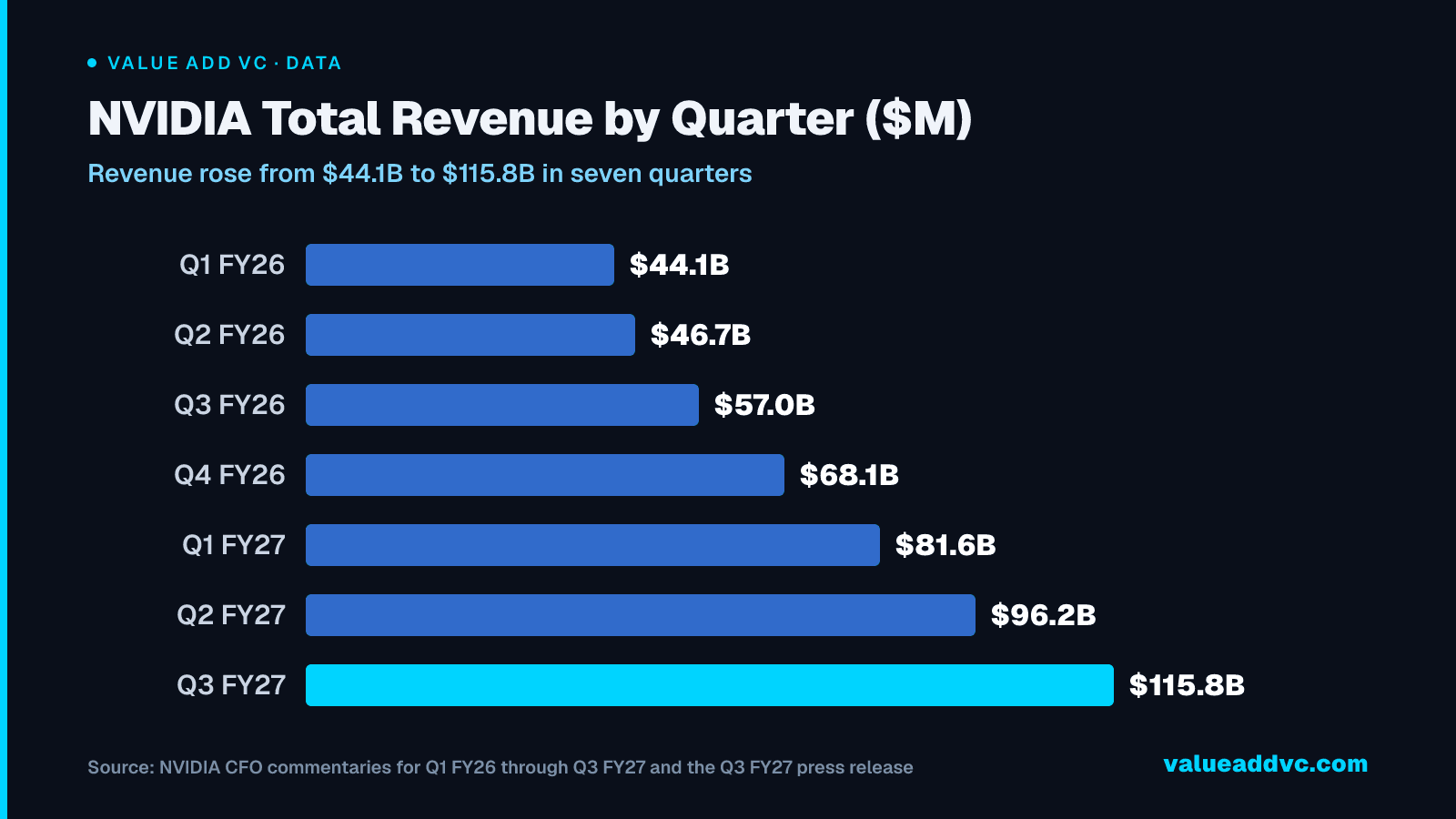
The growth curve over seven quarters is steep. Revenue was $44.1 billion in Q1 of fiscal 2026 and has risen every quarter since, to $115.8 billion. Data Center was 92.9% of revenue this quarter on our arithmetic ($107.6 billion of $115.8 billion).
NVIDIA Total Revenue by Quarter ($M)
Revenue rose from $44.1B to $115.8B in seven quarters
NVIDIA CFO commentaries for Q1 FY26 through Q3 FY27 and the Q3 FY27 press release
Data
| Item | Value |
|---|---|
| Q1 FY26 | $44.1B |
| Q2 FY26 | $46.7B |
| Q3 FY26 | $57.0B |
| Q4 FY26 | $68.1B |
| Q1 FY27 | $81.6B |
| Q2 FY27 | $96.2B |
| Q3 FY27 | $115.8B |
NVIDIA Data Center Revenue by Quarter ($M)
Data Center grew from $39.1B to $107.6B over the same seven quarters
NVIDIA CFO commentaries for Q1 FY26 through Q3 FY27; Q3 FY27 is the rounded $107.6B figure
Data
| Item | Value |
|---|---|
| Q1 FY26 | $39.1B |
| Q2 FY26 | $41.1B |
| Q3 FY26 | $51.2B |
| Q4 FY26 | $62.3B |
| Q1 FY27 | $75.2B |
| Q2 FY27 | $89.0B |
| Q3 FY27 | $107.6B |
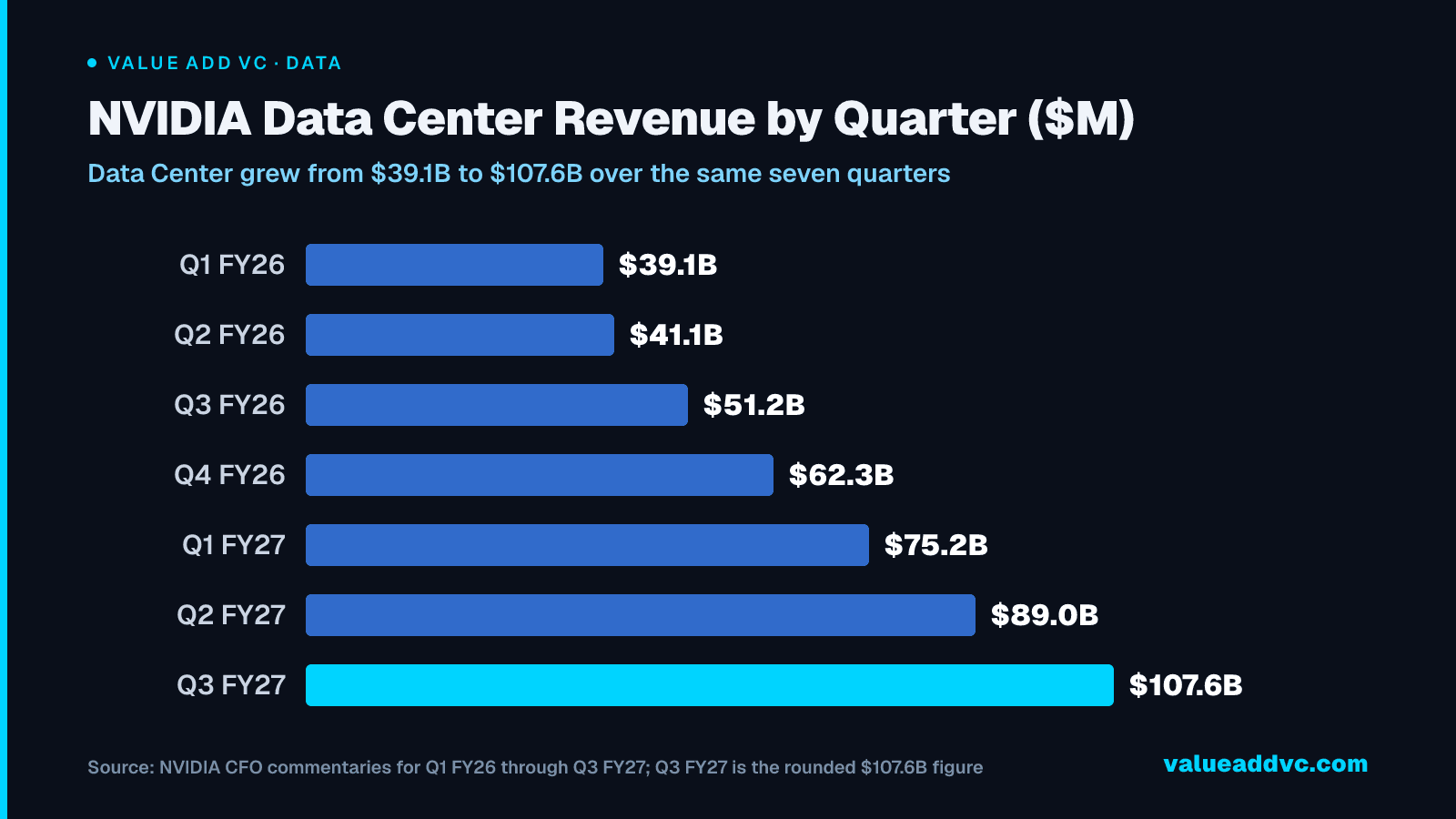
History from the Q1 FY27, Q2 FY27 and Q4 FY26 CFO commentaries. Data Center totals match across the old and new reporting frameworks. NVIDIA gave Q3 FY27 Data Center revenue only as $107.6 billion, so that bar is drawn at the rounded figure.
A New Segment Structure
Readers comparing this report with older NVIDIA coverage should know the categories changed. Starting in Q1 of fiscal 2027, NVIDIA stopped reporting Gaming, Professional Visualization, Automotive and OEM & Other. It now reports two market platforms. Data Center is split into Hyperscale and AI Clouds, Industrial & Enterprise (ACIE), and Edge Computing covers PCs, game consoles, workstations, AI-RAN base stations, robotics and automotive, per the Q1 FY27 CFO commentary. Hyperscale covers the public clouds and the largest consumer internet companies, as NVIDIA defines it. The two reportable segments remain: Compute & Networking was $106.0 billion and Graphics was $9.8 billion this quarter.
| Platform | Q3 FY27 | Q2 FY27 | Q3 FY26 | Q/Q | Y/Y |
|---|---|---|---|---|---|
| Data Center | $107.6B | $89.0B | $51.2B | +21% | +110% |
| Hyperscale | $60.1B | $48.7B | $35.1B | +23% | +71% |
| AI Clouds, Industrial & Enterprise (ACIE) | $47.5B | $40.3B | $16.1B | +18% | +195% |
| Edge Computing | $8.2B | $7.2B | $5.8B | +14% | +42% |
| Total | $115.8B | $96.2B | $57.0B | +20% | +103% |
Source: Q3 FY27 CFO commentary, revenue by market platform. NVIDIA moved one company from ACIE to Hyperscale in Q2 FY27 and recast prior-period revenue, so Q1 FY27 sub-splits as first reported differ from the recast figures.
Data Center: $107.6 Billion
Data Center revenue was a record $107.6 billion, up 110% from a year ago and 21% from the prior quarter, according to the CFO commentary. CNBC reported a StreetAccount estimate of $101.87 billion. NVIDIA said both sub-markets grew substantially, driven by the Rubin introduction, standalone Vera CPUs and continued growth in Blackwell Ultra.
Hyperscale vs AI Clouds and Enterprise
Hyperscale revenue was $60.1 billion, up 23% sequentially and 71% from a year ago. Kress attributed it to the Vera Rubin ramp and sustained strength in Grace Blackwell. ACIE was $47.5 billion, up 18% sequentially and 195% from a year ago. On the call, she said ACIE growth came from "Vera Rubin shipments to top leading NeoCloud customers and the start of our Frontier Labs building their own data centers." ACIE is now the faster-growing half on a year-over-year basis. Kress said she expects the major frontier labs to contribute about 15% of Data Center revenue this year, and that sovereign AI revenue more than tripled from a year ago. She gave no dollar figure for sovereign AI.
Networking over $21 billion
The CFO commentary no longer splits Data Center into compute and networking. Kress gave the networking number on the call: "Our networking franchise continues to scale. With Q3 revenue exceeding $21 billion." She said co-packaged optics scale-out is in volume production. NVIDIA did not give a compute figure, so we do not derive one. Background on the networking business is in our NVIDIA networking explainer.
Vera Rubin: nearly $20 billion in its first quarter
Kress said the Rubin platform generated nearly $20 billion in its first quarter of production shipments, and the press release calls it "the fastest product ramp in the company's history." Per the release, Vera Rubin NVL72 racks are running at partners including CoreWeave, Google Cloud, Microsoft Azure, Oracle Cloud Infrastructure and Nebius. Kress said hyperscale partners brought Vera Rubin into production in about one month, half the time Grace Blackwell needed, and that Vera Rubin Ultra is on track for next year and Feynman for 2028. She also said CoreWeave, Meta, Nscale and OpenAI have adopted the standalone Vera CPU, and that she expects total CPU revenue to more than double in fiscal 2028. The initial Rubin ramp is also the reason NVIDIA gave for slightly lower gross margins this quarter.
Edge Computing: $8.2 Billion
Edge Computing revenue was $8.2 billion, up 42% from a year ago and 14% sequentially, ahead of the $7.47 billion StreetAccount estimate reported by CNBC. The CFO commentary credits strong Blackwell workstation sales and edge compute for physical AI, and says higher memory and system prices continue to weigh on consumer PC demand. Because gaming now sits inside Edge Computing, there is no separate gaming number this quarter. Kress said on the call that physical AI revenue nearly tripled from a year ago and is on track to exceed $25 billion for the full year. She did not say how much of that figure is booked in Edge Computing.
Margins and the New Non-GAAP Basis
GAAP gross margin was 74.8% and non-GAAP gross margin 74.9%, up 1.4 points from a year ago on Blackwell Ultra mix and down 0.2 and 0.1 points sequentially on the initial Rubin ramp, per the CFO commentary. CNBC reported a StreetAccount estimate of 74%. Operating expenses were $9.2 billion GAAP and $8.8 billion non-GAAP, with the increases driven by compute infrastructure and employee compensation costs. Operating income was $77.5 billion GAAP and $77.9 billion non-GAAP. GAAP net income of $65.3 billion works out to a 56.4% net margin on our arithmetic. The GAAP tax rate was 17.4% and the non-GAAP rate 17.0%.
Two details matter for anyone comparing numbers. First, the press release says that beginning in Q1 of fiscal 2027, NVIDIA's non-GAAP measures "no longer exclude stock-based compensation expense," and historical non-GAAP figures were updated to match. Non-GAAP numbers here are not comparable with older press coverage. Second, non-GAAP EPS ($2.68) came in below GAAP EPS ($2.70) because $1.767 billion of net equity-securities gains is excluded from non-GAAP. The CFO commentary breaks that into $2.8 billion of gains on publicly held stakes and a $1.0 billion net loss on non-marketable stakes, including $1.8 billion of impairment.
The Q4 Guide and the Fiscal 2028 Outlook
NVIDIA expects fourth-quarter revenue of $130.0 billion, plus or minus 3%, which is a range of $126.1 billion to $133.9 billion. The quarter "includes an additional week," per the release, so part of the sequential step-up is calendar. NVIDIA is not assuming any Data Center compute revenue from China. At the midpoint, the guide implies 90.8% growth over the $68.1 billion of Q4 fiscal 2026 on our arithmetic, extra week included. CNBC reported the LSEG average estimate at $125.1 billion.
GAAP and non-GAAP gross margins are guided to 71.0% to 72.0%, below this quarter's 74.8% and 74.9%. Kress framed that as a floor: "We expect Q4 to mark the bottom of gross margins before improving to the 72 to 73 range in fiscal year '28." Asked by UBS's Timothy Arcuri about durability, she repeated, "What we provided here in Q4 is our bottom." Operating expenses are guided to about $11.0 billion GAAP and $10.7 billion non-GAAP, which Kress said reflects the extra week and transition-related costs. The full-year tax rate is expected to be 16.0% to 18.0%.
Kress raised the fiscal 2028 outlook: "We expect revenue to grow approximately 75% year over year, up from 70% and off what is now a higher fiscal 2027 base." For context, CNBC reported that LSEG consensus had expected 90% growth in fiscal 2027 and 70% in fiscal 2028. She also said she expects enterprise revenue to more than double in fiscal 2028. Kress mentioned new Commerce Department export controls released this week, adding: "with demand far exceeding supply, we expect our performance to remain strong."
Capital Return: $28.1 Billion in One Quarter
NVIDIA returned $28.1 billion to shareholders in Q3, which the CFO commentary calls a record. The cash flow statement shows $22.1 billion of repurchases and $6.0 billion of dividends, against $243 million of dividends in the same quarter a year earlier. In September 2026 the board added $150 billion to the repurchase authorization, without expiration, leaving about $227.3 billion at quarter end, per the release. The CFO commentary says NVIDIA plans to use it through fiscal 2028. The next quarterly dividend of $0.25 a share is payable December 23, 2026 to holders of record on December 2.
Kress said NVIDIA has returned 65% of free cash flow so far this fiscal year and intends to return "all excess free cash flow net of strategic uses to shareholders" from this quarter on. Asked by Goldman's Jim Schneider about priorities, she called buybacks a "Super top priority" and said there is room to complete the planned repurchases before the end of fiscal 2028. In the Equibles transcript she describes the $150 billion increase as "the largest in history." That is her characterization, which we have not checked.
Cash Flow, Inventory and $390 Billion of Supply Commitments
Operating cash flow was $48.3 billion, up from $23.8 billion a year ago and $24.1 billion a quarter ago. Capex for property, equipment and intangibles was $4.4 billion, and after $54 million of related principal payments, free cash flow was $43.8 billion, a 37.8% free cash flow margin on our arithmetic. Cash, cash equivalents and marketable debt securities fell to $53.5 billion from $56.6 billion a quarter ago. NVIDIA also held $44.2 billion of marketable equity securities and $65.5 billion of non-marketable securities. Long-term debt was $32.4 billion, and NVIDIA repaid $1.0 billion of senior notes in the quarter.
Working capital grew with the Rubin launch. Inventory rose to $39.7 billion from $31.6 billion, and accounts receivable was $81.0 billion, with days sales outstanding up to 64 from 60. The CFO commentary links the higher DSO to shipment linearity from the Rubin launch and to extended payment terms on large multi-quarter agreements with some investment-grade customers. CNBC, citing an NVIDIA supplemental document we did not open, reported that two direct customers accounted for 18% and 17% of receivables.
The biggest change is in commitments. Supply commitments rose to $390 billion from $279 billion last quarter, "primarily related to the multi-year procurement of memory supply," per the CFO commentary. Cloud service agreements and data center lease commitments together rose to $102 billion from $74 billion. Total future commitments in the table come to $518 billion. (One CNBC blog entry printed the supply figure as $390 million. The CFO commentary says billion.)
| Commitment | Amount | Note |
|---|---|---|
| Supply and capacity | $390B | Up from $279B last quarter, mainly multi-year memory procurement |
| Data center leases not yet commenced | $74B | CFO commentary, commitments table |
| Neocloud agreements | $32B | Separate additional-commitments table, not in the $518B total; formerly called AI cloud agreements |
| Cloud service agreements | $28B | CFO commentary, commitments table |
| Equity investments | $20B | CFO commentary, commitments table |
| Capex | $6B | CFO commentary, commitments table |
| Total future commitments | $518B | CFO commentary, commitments table |
Source: Q3 FY27 CFO commentary, future commitments table, as of the end of Q3 FY27.
Guarantees, including the OpenAI Ohio campus
Separately, NVIDIA lists $118.0 billion of maximum gross exposure under guarantees. Most of it, up to $105 billion per the CFO commentary, is credit support for the land, power and shell buildout of about 4.25 gigawatts across nine buildings at SB Energy's PORTS-Pike Technology Campus in Ohio. Per the CFO commentary, the campus will exclusively host NVIDIA infrastructure under 20-year leases to OpenAI, and the first is expected in fiscal 2029. NVIDIA says it has not made any payments on its guarantees to date.
| Guarantee | Maximum gross exposure |
|---|---|
| SB Energy Corp. credit support guarantees | $105.0B |
| Power and systems credit support guarantees | $9.5B |
| Land, power and shell guarantees for neoclouds | $3.5B |
| Total maximum gross exposure | $118.0B |
Kress sounded more cautious about this side of the balance sheet. "As the market matures and additional sources of capital become available, we are rigorously evaluating future investments, commitments, and guarantees," she said. When Bernstein's Stacy Rasgon asked about the new neocloud wording in the commentary, she answered, "Is it new? No. Did we change anything? No." For earlier coverage of the OpenAI exposure, see our note on NVIDIA's OpenAI backstop and the SB Energy IPO deep dive.
China
NVIDIA shipped $2.4 billion of Data Center Hopper products to China in the quarter, per the CFO commentary. Kress said those shipments have ended: "Our guidance does not have any licensed Hopper data center products included, and we are no longer shipping licensed Hopper data center products to China." The Q4 outlook assumes no China Data Center compute revenue at all. H20 charges and releases were insignificant in the first nine months of fiscal 2027, against $4.3 billion a year earlier.
The policy backdrop shifted the day before the report. CNBC reported that the Commerce Department announced a change on Monday that would stop NVIDIA chips from being rented to Chinese companies at all, and ABC News described a new rule to address remote access to advanced AI chips. Also on November 17, NVIDIA's board established a National Security and Export Control Oversight Committee, chaired by director Suzanne Nora Johnson, with directors Stephen C. Neal and John O. Dabiri as members. Our export controls explainer has the longer history.
Leadership: Jones Opens, Kress Answers
Jensen Huang resigned as president, CEO and director on November 11, 2026, when the board accepted his resignation, per NVIDIA's 8-K. NVIDIA announced it on November 12, 2026, and said that Colette Kress would serve as interim CEO while remaining EVP and CFO. The same release announced that the board appointed Harvey C. Jones as its first-ever Chair. The board says it will consider internal and external candidates for a permanent CEO.
With Toshiya Hari of investor relations hosting, Jones gave the opening remarks. He said Huang "voluntarily resigned" after "disclosure of personal behavior inconsistent with the company's code of conduct, standards, and cultural norms." He added that "The NVIDIA Board unanimously accepted his resignation and does not intend to reinstate Jensen as CEO," and that the board has "retained Heidrick & Struggles to lead the search." He said the call would not cover the circumstances of the resignation or the ongoing investigation. Following up on BofA's Vivek Arya's question about the leadership transition, Jones said the board wants a permanent CEO "as quickly as possible, but we won't expedite the CEO before finding exactly the right person."
Kress gave the prepared remarks and answered every analyst question. Ian Buck, VP of Hyperscale and High Performance Computing, was introduced as joining the Q&A, but neither transcript shows him answering. As reported by CNN, Huang said on Tuesday that he would be "honored" to return as CEO if the board decided his return was in the best interest of shareholders and the company. Our NVIDIA company deep dive covers the company and the transition in more detail.
The Best Quotes from the Call
Every quote below comes from the third-party Singju Post transcript, cross-checked against Equibles. Where they overlap, the quotes also match reporting by CNBC, CNN and Fox Business.
“The NVIDIA Board unanimously accepted his resignation and does not intend to reinstate Jensen as CEO.”
Harvey C. Jones, Chair
“In its first quarter of production shipments, the Rubin platform generated nearly $20 billion in revenue. Making it the fastest product ramp in NVIDIA's history.”
Colette Kress, Interim CEO and CFO
“We are raising our fiscal year 2028 outlook. We expect revenue to grow approximately 75% year over year, up from 70% and off what is now a higher fiscal 2027 base.”
Colette Kress
“We expect Q4 to mark the bottom of gross margins before improving to the 72 to 73 range in fiscal year '28.”
Colette Kress
“From a business perspective, it's business as usual. We've engaged with our customers, we've engaged with our suppliers, our partners. They're all 100% behind us.”
Colette Kress, answering Vivek Arya (BofA)
“As the market matures and additional sources of capital become available, we are rigorously evaluating future investments, commitments, and guarantees.”
Colette Kress
“All are getting the same pricing. That is super important for us.”
Colette Kress, answering Joshua Buchalter (TD Cowen)
“Our momentum is real. Our demand is accelerating. Our supply is growing. Our customers and our partners are with us. And employees are committed. We've got this.”
Colette Kress, closing remarks
Analyst Q&A Themes
Eight analysts asked questions, after Jones said the call would not take questions on the circumstances of the resignation. Most asked whether the transition changes demand, margins or how NVIDIA spends its cash. The answers kept returning to three points: customers and suppliers are staying, Q4 is the margin bottom, and buybacks come first.
Joseph Moore, Morgan Stanley: Confidence in the fiscal 2028 growth target
Kress pointed to demand plus added supply and said NVIDIA is still studying the new export controls: "we feel confident in terms of both the demand that we have in front of us as well as the supply and additional supply that we can do the 75%."
Vivek Arya, BofA: Moats, talent retention and the transition
Kress cited employees, leadership and "business as usual," and said of suppliers, "We've secured memory, we've secured advanced packaging." Jones then added remarks on the CEO search.
Timothy Arcuri, UBS: Gross margin durability and pricing against ASICs
Kress: "What we provided here in Q4 is our bottom." On the 72% to 73% fiscal 2028 range: "We see no changes at this time."
C.J. Muse, Cantor: Appetite for financing AI clouds and neoclouds
Kress said land, power and shell come first, and that NVIDIA will be "taking a very strong look in terms of the types of companies that we would want to help in terms of the financing, as a lot of things have changed over this last quarter."
Stacy Rasgon, Bernstein: The new neocloud-commitment wording in the CFO commentary
Kress: "Is it new? No. Did we change anything? No." She said guarantees start only when projects are ready.
Ben Reitzes, Melius: Risk of a 2028 slowdown after the change in government
Kress pointed to agentic demand carrying into fiscal 2028 and to engagement with government and local communities on data centers.
Joshua Buchalter, TD Cowen: Allocation across hyperscalers, labs and neoclouds
Allocation depends on site readiness, capital and offtake, Kress said, and every customer type pays the same price.
Jim Schneider, Goldman Sachs: Capital allocation priorities
Kress called buybacks a "Super top priority," with supplier prepayments next and customer financing selective: "there is definitely the room to continue all of the stock repurchases plans that we want to do and complete those before the end of fiscal year '28."
Stock Reaction
NVIDIA shares fell 0.44% in Tuesday's regular session, as reported by CNN and Fox Business. After-hours moves differed by outlet and time, so we list each one with its source rather than pick a single number.
| Outlet | When | Reported move |
|---|---|---|
| CNN | as of 6:10 p.m. ET, after the call | gaining roughly 5% |
| CNBC | extended trading, no timestamp given | rose more than 3%; a separate live-blog entry said up nearly 4% |
| Fox Business | after the release and the call | rose over 3.4% |
| Decrypt | published before the 5 p.m. ET call | climbed roughly 2% |
CNN reported that the shares had dropped 35% from their October 6 record high going into the report, erasing roughly $2 trillion of market value. In extended trading, CNBC reported that CoreWeave, Nebius and Iren each rose between 8% and 10%. For the longer view, see our NVIDIA valuation analysis.
What to Watch
The CEO search. Heidrick & Struggles is running it, and the board says it will consider internal and external candidates. Any announcement before the Q4 report would change who presents the fiscal 2028 outlook.
Whether Q4 gross margin really is the bottom. The 71.0% to 72.0% guide and the 72% to 73% fiscal 2028 range are the numbers Kress will be measured against.
The commitments and guarantees. Supply commitments of $390 billion and $118.0 billion of guarantee exposure, $105 billion of it tied to the OpenAI Ohio campus, are now large enough to read every quarter.
China after Hopper. NVIDIA is guiding to zero China Data Center compute revenue, and the board's new export-control committee and the Commerce rule on renting chips are new variables.
Frontier-lab demand. Kress said the major labs will be about 15% of Data Center revenue this year, and cited Anthropic's annualized revenue reaching $81 billion at the end of October. That is her figure, not an Anthropic disclosure. Anthropic's own listing is tracked on our Anthropic IPO page.
The Hugging Face deal. NVIDIA announced an agreement to acquire Hugging Face. CNBC reported the price as just under $13 billion, but NVIDIA's Q3 documents do not state one.
The Anthropic IPO tracker covers Anthropic's listing, and our Hugging Face analysis covers the acquisition target.
Honest Caveats
Call quotes come from third-party transcripts (The Singju Post, cross-checked with Equibles). NVIDIA's official transcript and investor site could not be reached when we checked. Apart from the 8-K on the CEO transition, SEC filings were not read directly.
Consensus figures are as reported by CNBC, citing LSEG and StreetAccount. Other outlets cited slightly different estimates.
After-hours moves are as reported by each outlet at the time noted. We do not quote a closing price.
Ratios marked as our arithmetic (Data Center share, net and free cash flow margins, the guide range and the implied Q4 growth rate) are calculated from NVIDIA's reported figures, not stated by NVIDIA.
Trace's Take
My opinion: the numbers did their job. A company days removed from losing its founder CEO beat its own guide by billions, raised the next year's outlook and put a floor under margins. Kress ran the call like a CFO, which is exactly what investors needed this week. What I would watch most closely is the balance sheet, not the income statement. Supply commitments and guarantees are now a bigger story than any single quarter of revenue, and the CEO search will decide who has to manage them.
Figures are from NVIDIA's Q3 FY2027 press release and CFO commentary and the reporting linked above, as of November 17, 2026. This is not investment advice. Track listings on the IPO tracker and private rounds on the funding tracker, or download the free Startup Funding Dataset.
Latest from the Pulse
Get VC data most people never see
— free to subscribe
Trace's notes on venture, AI and startups, a few times a week. Join 5,000+ subscribers. No spam.
No spam, unsubscribe anytime. Sent via Substack · Privacy · or subscribe on Substack ↗