

As of November 12, 2026, Jensen Huang is no longer Nvidia's CEO. The company he co-founded in 1993 and ran for 33 years is now led by its CFO, Colette Kress, on an interim basis, five days before an earnings report that much of the AI market is priced off.
This deep dive covers what happened and who is running Nvidia now, how a graphics-chip startup planned in a Denny's booth became the company at the center of AI spending, its revenue by fiscal year, what the data-center business actually sells and to whom, why Huang is hard to replace, and what to watch next. A note on dates: Nvidia's fiscal year ends in late January, so "fiscal 2026" is roughly calendar 2025 (it ended January 25, 2026). Market-cap figures below are calendar dates.
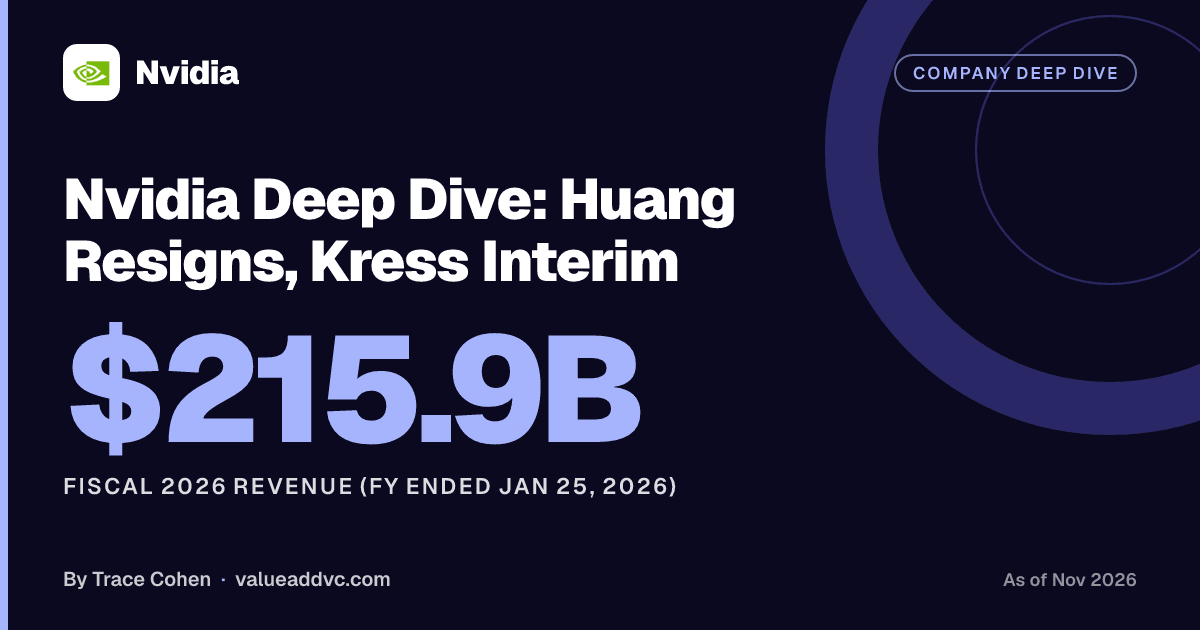
Sources: NVIDIA fiscal 2026 results; share move per CNBC as reported in our Pulse story.
What happened at Nvidia on November 12, 2026?
Nvidia's board announced that Huang has resigned as president, chief executive officer and a member of the board, effective immediately, in a CEO transition release. The company frames it as a resignation. Kress, executive vice president and CFO, becomes interim CEO and keeps her finance duties. The board also appointed Harvey C. Jones, former CEO of Synopsys, as Nvidia's first-ever chair of the board, splitting a role that had not existed as a separate seat before. The board said it will consider internal and external candidates for a permanent CEO and gave no timeline.
The market reaction was immediate. Nvidia shares were down 13% on Thursday morning, taking the company's market value below $4 trillion, CNBC reported, as covered in our Pulse story on the resignation. That is a separate measure from the figure CBS News reported before the announcement: more than $450 billion of market value lost since the scandal began, which our Wednesday-night Pulse lead covered. The two numbers use different starting points and should not be added together.
The background, kept to what is sourced: Huang told staff on November 8 that he had been unfaithful to his wife, and the board opened an investigation. On November 11, The New York Times reported a second relationship, with an Nvidia employee who reports to Huang; that report has not been confirmed by either person. The same night, reports said the board was preparing to remove him. The release itself gives no reason for the resignation, and no one has been charged with anything. The full sourced timeline is in our Pulse coverage.
Jones said the board has "full confidence in Colette and the leadership team" and expects operations, customer commitments and the product roadmap to continue without interruption, per our story, which quotes the release. Bernstein analyst Stacy Rasgon gave CNBC the market's worry in one line: "Jensen is Nvidia, right? He is the visionary."
Who is Colette Kress, Nvidia's interim CEO?
Kress joined Nvidia in September 2013 as executive vice president and CFO, after nearly 25 years in finance roles at large technology companies, according to her Nvidia biography. Before Nvidia she spent three years as senior vice president and CFO of Cisco's Business Technology and Operations Finance organization, responsible for financial strategy, planning, reporting and business development. Before that she spent 13 years at Microsoft, including four years as CFO of the Server and Tools division, and earlier held finance roles at Texas Instruments. She holds a B.S. in finance from the University of Arizona and an MBA from Southern Methodist University.
Nvidia's fiscal 2026 Form 10-K listed her as 58 years old as of February 20, 2026, one of five executive officers alongside Huang, Ajay Puri (worldwide field operations), Debora Shoquist (operations) and Timothy Teter (general counsel). That is a small senior team for a company with about 42,000 employees in 38 countries at the end of fiscal 2026, per the same filing.
What Kress brings is continuity with investors. She has run the finance side through the entire AI build-out, from $10.92 billion of revenue in fiscal 2020 to $215.9 billion in fiscal 2026, and she is the executive Wall Street already hears on every earnings call. What she has not done publicly is run product strategy or engineering, which is where Huang spent his time. An interim CEO who is also the CFO is a holding pattern, not a succession plan.
How did Nvidia start? 1993 to the GPU
Nvidia was founded on April 5, 1993, by Jensen Huang, Chris Malachowsky and Curtis Priem with "a vision to bring 3D graphics to the gaming and multimedia markets," according to the company's corporate timeline. The three planned it at a Denny's on Berryessa Road in San Jose. In September 2023, Denny's marked the booth with a plaque, and Huang, whose first U.S. job was as a busboy and waiter at Denny's, told the crowd: "Honestly, none of us knew how to write a business plan," GamesBeat reported.
Huang arrived with a chip-industry background. Nvidia's 10-K says he worked at LSI Logic from 1985 to 1993, including as director of the Coreware business unit, and holds a B.S.E.E. from Oregon State University and an M.S.E.E. from Stanford.
The early years nearly killed the company. Per the history compiled on Wikipedia, which cites published accounts of the period, Huang cut headcount from about 100 to 40 in 1996 and bet the remaining resources on the RIVA 128 graphics accelerator; by its August 1997 release, Nvidia reportedly had enough cash for about one month's payroll. The unofficial motto that came out of that stretch, "Our company is thirty days from going out of business," became a line Huang opened internal presentations with for years, per the same account.
Nvidia went public on January 22, 1999, at a market value of about $563 million, per StockAnalysis market-cap history. Later that year it released the GeForce 256 and, in its own words, "invents the GPU," per the company timeline. The GPU was built to draw triangles for games; the next two decades were about finding everything else it could compute.
What was Nvidia's CUDA bet, and why did it matter?
In 2006 Nvidia introduced CUDA, a programming architecture that opened "parallel processing capabilities of GPUs to science and research," per its timeline. For years it was a cost line with no obvious market: Nvidia shipped CUDA-capable hardware into gaming cards and courted researchers who had no budget. The history on Wikipedia puts the company's investment in CUDA in the early-to-mid 2000s at more than a billion dollars.
The payoff arrived in 2012, when Nvidia GPUs powered the AlexNet neural network, which the company's timeline credits with launching the modern AI era. Deep learning turned out to be the parallel workload CUDA had been waiting for, and the developers who learned on CUDA kept building on it. That software layer, more than any single chip, is why rivals with competitive silicon still struggle to take share.
Nvidia still describes itself as a software-heavy company: more than half of its engineers work on software, according to its fiscal 2026 10-K, and 31,000 of its roughly 42,000 employees were in research and development at the end of that year.
Nvidia revenue by year: the numbers over time
For most of its history Nvidia was a cyclical graphics company. Revenue was $11.72 billion in fiscal 2019 and fell 7% to $10.92 billion in fiscal 2020, per the fiscal 2020 results. Fiscal 2023 was flat at $26.97 billion against $26.91 billion a year earlier, per the fiscal 2023 release, as a gaming slump offset data-center growth. Then ChatGPT-era demand for H100 systems hit: revenue rose 126% to $60.9 billion in fiscal 2024, then to $130.5 billion in fiscal 2025 and $215.9 billion in fiscal 2026, up 65%.
| Fiscal year (ends late January) | Revenue | GAAP gross margin | Source |
|---|---|---|---|
| FY2019 | $11.72B | 61.2% | FY2020 release |
| FY2020 | $10.92B | 62.0% | FY2020 release |
| FY2021 | $16.68B | 62.3% | FY2021 release |
| FY2022 | $26.91B | 64.9% | FY2022 release |
| FY2023 | $26.97B | 56.9% | FY2023 release |
| FY2024 (ended Jan 28, 2024) | $60.92B | 72.7% | FY2024 release |
| FY2025 (ended Jan 26, 2025) | $130.50B | 75.0% | FY2025 release |
| FY2026 (ended Jan 25, 2026) | $215.9B | 71.1% | FY2026 release |
Nvidia revenue by fiscal year ($B)
Revenue went from $27.0B in fiscal 2023 to $215.9B in fiscal 2026, an eightfold jump in three years
NVIDIA fourth-quarter and fiscal-year results releases, fiscal 2020 through fiscal 2026
Data
| Item | Value |
|---|---|
| FY2019 | $11.7B |
| FY2020 | $10.9B |
| FY2021 | $16.7B |
| FY2022 | $26.9B |
| FY2023 | $27.0B |
| FY2024 | $60.9B |
| FY2025 | $130.5B |
| FY2026 | $215.9B |
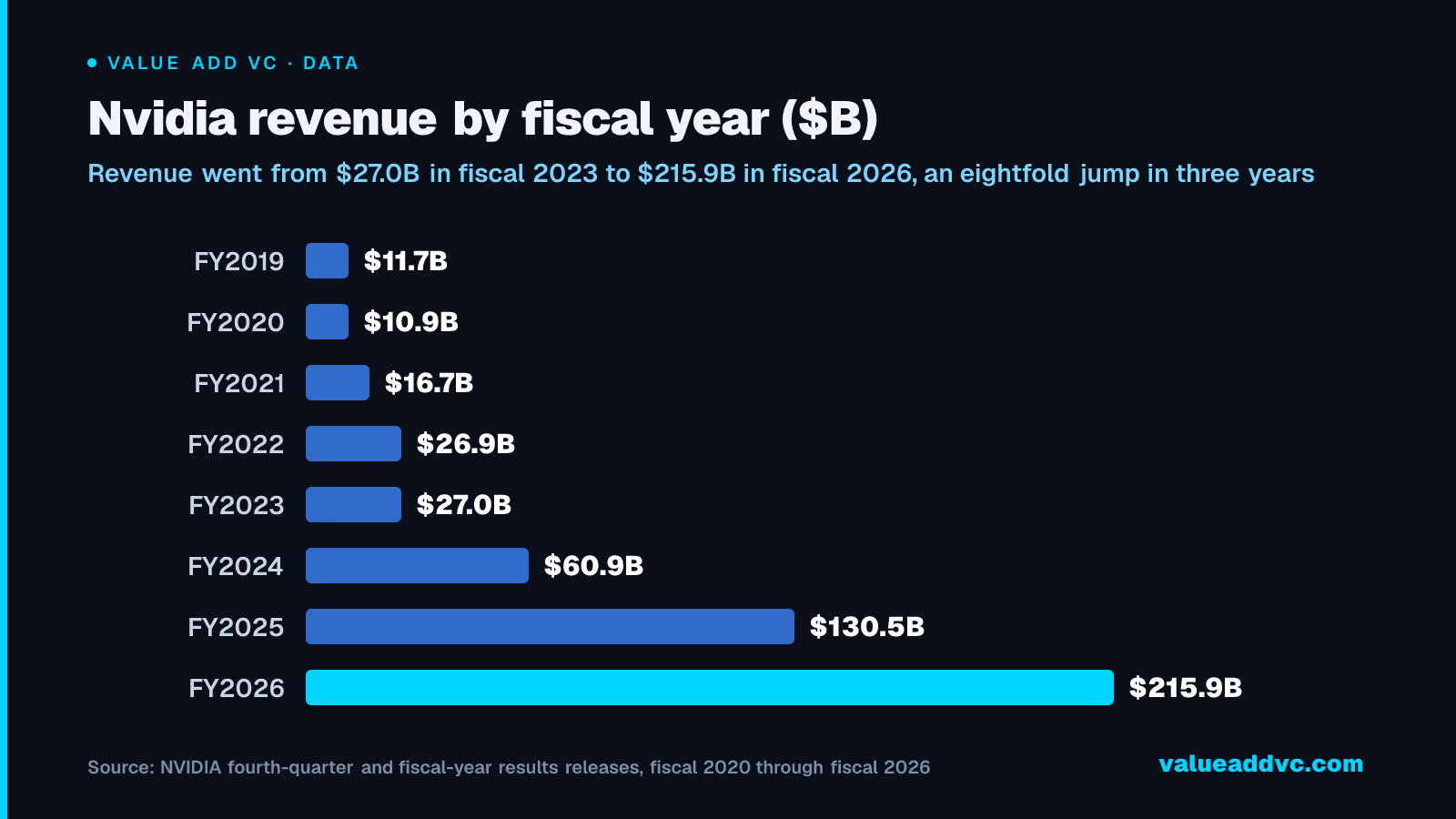
Profit scaled faster than revenue. GAAP net income was $29.76 billion in fiscal 2024 and $72.88 billion in fiscal 2025, per the fiscal 2025 release, and $120.07 billion in fiscal 2026, per the fiscal 2026 release. Gross margin dipped to 71.1% in fiscal 2026 from 75.0%; the 10-K attributes the decline to the shift from Hopper HGX systems to full-scale Blackwell data-center systems and a $4.5 billion charge tied to excess H20 inventory and purchase obligations.
The current fiscal year is running even hotter. For the second quarter of fiscal 2027, which ended July 26, 2026, Nvidia reported revenue of $96.2 billion, up 106% from a year earlier, with a 75.0% gross margin and $59.7 billion of net income, per its Form 10-Q. It guided the third quarter to $108.0 billion, plus or minus 2%, in its second-quarter release. For the quarter-by-quarter breakdown, see our Nvidia revenue by quarter post.
Data center vs. gaming: how Nvidia's business flipped
As late as fiscal 2022, gaming brought in more revenue than data center at Nvidia: $12.46 billion of revenue against $10.61 billion for data center, per the fiscal 2022 results. In fiscal 2021 the split was $7.76 billion gaming to $6.70 billion data center, per the fiscal 2021 release. Fiscal 2023 was the crossover: data center rose 41% to $15.01 billion while gaming fell 27% to $9.07 billion.
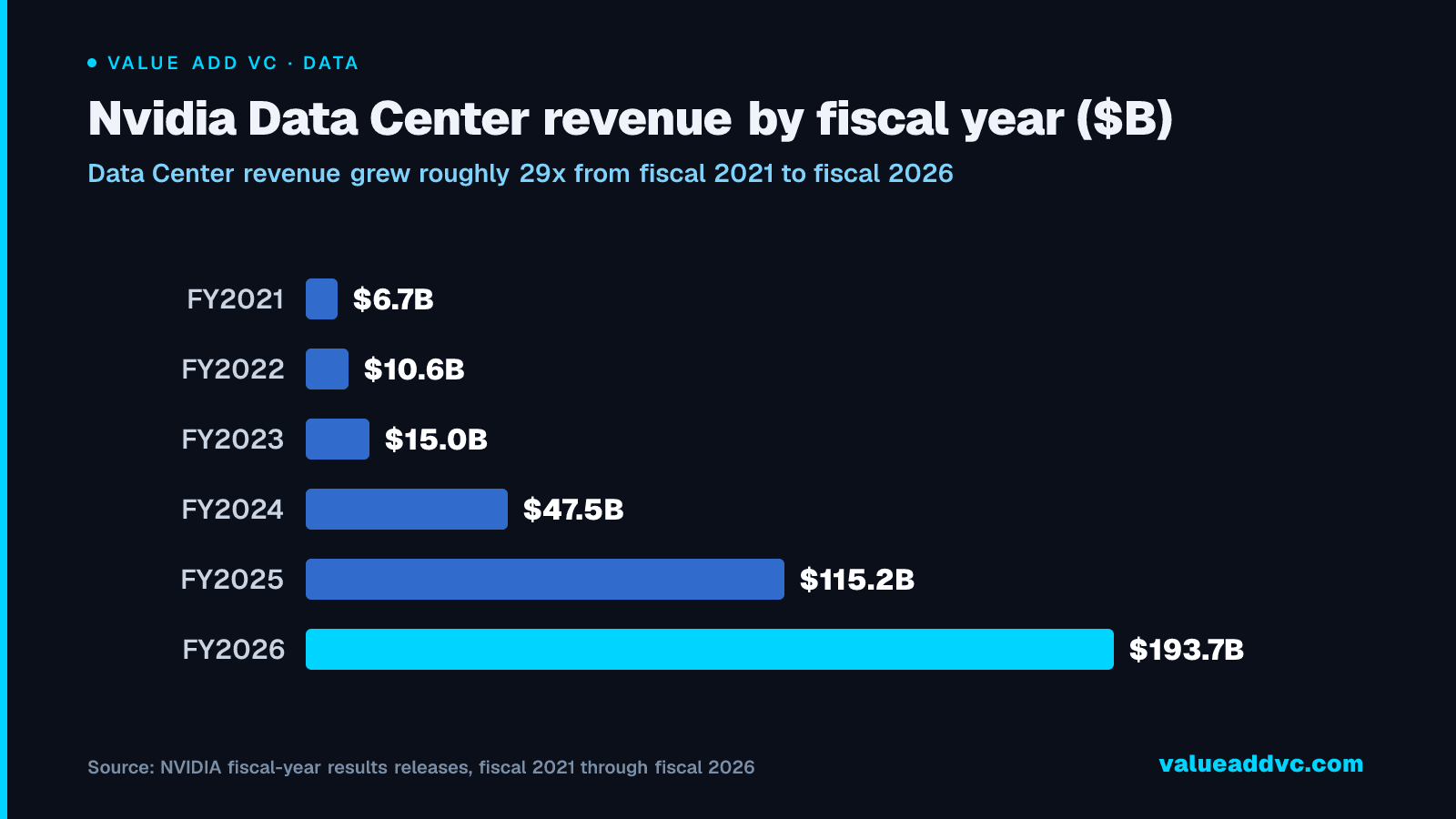
After that, the gap stopped being a contest. Data center was $47.5 billion in fiscal 2024 against $10.4 billion of gaming, per the fiscal 2024 release; $115.2 billion against $11.4 billion in fiscal 2025; and $193.7 billion against $16.0 billion in fiscal 2026. Gaming still grew 41% last fiscal year, but it is now about 7% of revenue, by our arithmetic from those figures.
Nvidia Data Center revenue by fiscal year ($B)
Data Center revenue grew roughly 29x from fiscal 2021 to fiscal 2026
NVIDIA fiscal-year results releases, fiscal 2021 through fiscal 2026
Data
| Item | Value |
|---|---|
| FY2021 | $6.7B |
| FY2022 | $10.6B |
| FY2023 | $15.0B |
| FY2024 | $47.5B |
| FY2025 | $115.2B |
| FY2026 | $193.7B |
Nvidia market cap milestones: $1 trillion and beyond
Nvidia first touched a $1 trillion market value on May 30, 2023, the first chipmaker to do so, before closing that day at about $992 billion, Yahoo Finance reported. On calendar year-end figures from StockAnalysis, it was worth about $1.22 trillion at the end of 2023, $3.29 trillion at the end of 2024 and $4.53 trillion at the end of 2025. On November 12, 2026, the same source showed about $3.97 trillion, after the resignation selloff.
For context on how that value compares with earnings, see our Nvidia valuation analysis and Nvidia stock in 2026.
What does Nvidia actually sell to AI companies?
Less a chip than a data center. The Hopper generation (H100, H200) sold as HGX systems; Blackwell shifted Nvidia toward selling full rack-scale systems with its Grace CPUs, NVLink interconnect and networking, which the 10-K describes as a transition from Hopper HGX systems to "Blackwell full-scale datacenter solutions." In the fiscal 2026 release, Huang called Grace Blackwell with NVLink "the king of inference today" and said the next platform, Vera Rubin, will extend that lead; the same release lists Vera Rubin partnerships with Meta, AWS, Microsoft Azure and Oracle Cloud Infrastructure.
Networking is part of the product, not a side business: Nvidia sells InfiniBand and Ethernet switching alongside the GPUs, covered in our Nvidia networking explainer. Software (CUDA, inference tooling, open models such as Nemotron and Cosmos, per the 10-K) keeps customers on the platform.
Starting in fiscal 2027, Nvidia splits data-center revenue by buyer type. In the quarter that ended July 26, 2026, Data Center revenue was $89.0 billion: $48.7 billion from Hyperscale customers and $40.3 billion from AI Clouds, Industrial & Enterprise, with another $7.2 billion from Edge Computing, per the 10-Q. The filing says hyperscale revenue more than doubled year over year on Blackwell Ultra, while the AI-cloud and enterprise group grew 138%, driven by AI natives, enterprises and sovereign customers.
Who buys Nvidia chips, and how concentrated is the risk?
Very concentrated. Nvidia does not name its largest customers, but its fiscal 2026 10-K says one direct customer accounted for 22% of total revenue and another for 14%, both mainly in the Compute & Networking segment. Direct customers are mostly the OEMs, ODMs and system integrators that assemble servers; behind them sit the indirect customers, cloud providers, AI model makers and enterprises, and Nvidia says it estimates some of those individually account for 10% or more of revenue.
The latest filing shows a slightly wider spread but no less dependence. For the first half of fiscal 2027, three direct customers accounted for 16%, 15% and 13% of revenue, and five direct customers held between 10% and 22% each of accounts receivable at July 26, 2026, per the 10-Q.
Outside estimates put the exposure in starker terms. A Morgan Stanley report dated October 15, 2026 estimated that 91.7% of Nvidia's 2027 revenue is exposed to AI-infrastructure demand, and that SpaceX and Amazon Web Services together would account for about 54% of Nvidia's hyperscaler revenue in 2027, according to Fortune. Those are analyst projections, not company disclosures. Either way, Nvidia's fortunes ride on a handful of buyers' capex budgets; our Nvidia share of AI capex post tracks that link.
Can Nvidia replace Jensen Huang? The key-man question
Huang was Nvidia's only CEO, from its 1993 founding to November 12, 2026, and also president and a director the whole time, per the 10-K. He ran the company with roughly 60 direct reports and no chief operating officer, as Pulse noted in its securities-suit coverage. That structure put product calls, customer relationships and the multi-year platform roadmap (Hopper to Blackwell to Rubin) through one person.
The things that are hardest to hand over are judgment calls made years ahead: the CUDA investment in 2006, the bet on data-center systems over chips, and the decision to sell full racks rather than components. Those required a founder's license to spend on markets that did not yet exist. A new CEO inherits the roadmap; the open question is who sets the next one.
On succession, the facts are thin. Nvidia's own risk factors say it is "highly dependent on the services of our longstanding executive team" and that failure to ensure effective succession planning could hinder its execution. No successor had been named publicly before the resignation, and the board's release says only that the search will consider internal and external candidates.
The counterweight: Nvidia's business does not reset with its CEO. Customer contracts, a booked supply chain and a product roadmap through Vera Rubin are already in place, and the board says operations will continue without interruption. The risk is less next quarter than the next platform decision.
What to watch next for Nvidia
November 17 earnings. Nvidia said it will report third-quarter fiscal 2027 results on Tuesday, November 17, at 1:20 p.m. Pacific, with the call at 2 p.m. Pacific, per the transition release. The guidance to beat is $108.0 billion of revenue, plus or minus 2%, and a 74.0% GAAP gross margin, plus or minus 50 basis points, from the second-quarter release. The bigger tell is the fourth-quarter outlook Kress gives as interim CEO.
The permanent CEO search. The board has not given a timeline. An internal pick signals continuity on the roadmap; an outside hire signals a governance reset. Our Pulse story will be updated as the board reports progress.
The AI-trade exposure. Nvidia is about 6% of the S&P 500's market value, per a Reason Foundation figure Pulse cited on November 11, so its governance discount reaches index funds, AI cloud providers and the private AI market. If the data-center guidance holds on November 17, Thursday's drop reads as a leadership discount; if it softens, late-stage AI valuations priced off Nvidia's multiple will need re-marking.
Value Add VC data: Nvidia and the private AI market
Nvidia is a public company, so it does not appear in our private-round data as a fundraiser. It appears as an investor. In the week of the resignation, Pulse covered Nvidia joining SoftBank's $500 million round in Agile Robots at an $8.5 billion valuation. Anthropic's IPO, the biggest test of AI valuations this quarter, is being marketed against an AI index Nvidia anchors; see our Anthropic S-1 breakdown.
- The free Startup Funding Dataset lists sourced rounds and fund closes, including AI rounds Nvidia joined.
- Our 300+ tech IPOs ranked and 2026 IPO tracker follow the AI listings that trade alongside Nvidia.
- Related: Nvidia's Hugging Face deal and Nvidia's OpenAI backstop.
The Bottom Line
Nvidia spent 33 years as a founder-run company and three years as the main supplier of the AI boom, growing revenue from $27.0 billion in fiscal 2023 to $215.9 billion in fiscal 2026. As of November 12, 2026, it has an interim CEO who is also its CFO, a newly created independent chair, and a search with no end date. The business underneath is intact on its last reported numbers; the open question is who makes the next decade's platform bets. November 17 is the first data point.
Figures come from Nvidia's results releases, its fiscal 2026 Form 10-K and fiscal 2027 second-quarter Form 10-Q, the November 12, 2026 CEO transition release, StockAnalysis market-cap data, Yahoo Finance, GamesBeat and Fortune; resignation-day market moves are from CNBC as reported in our Pulse story. Fiscal years end in late January. Track AI rounds in our Startup Funding Dataset (free CSV of sourced rounds and fund closes). Not investment advice.
Latest from the Pulse
Get VC data most people never see
— free to subscribe
Trace's notes on venture, AI and startups, a few times a week. Join 5,000+ subscribers. No spam.
No spam, unsubscribe anytime. Sent via Substack · Privacy · or subscribe on Substack ↗