

vVARDIS Holding AG is selling 8,333,334 Class A shares at $21 to $24 each, a $187.5 million raise at the $22.50 midpoint (F-1/A filed November 12, 2026), to list its five-minute cavity treatment on the New York Stock Exchange as VVVV.
The November 12 amendment shrank the deal: the November 6 version offered 9,523,810 shares at the same range, with an over-allotment option sold by the founders. That was about $214 million at the midpoint, the figure Renaissance Capital and IPOScoop reported when the roadshow launched. It is analysis of a public filing, not a recommendation to buy or sell the stock.
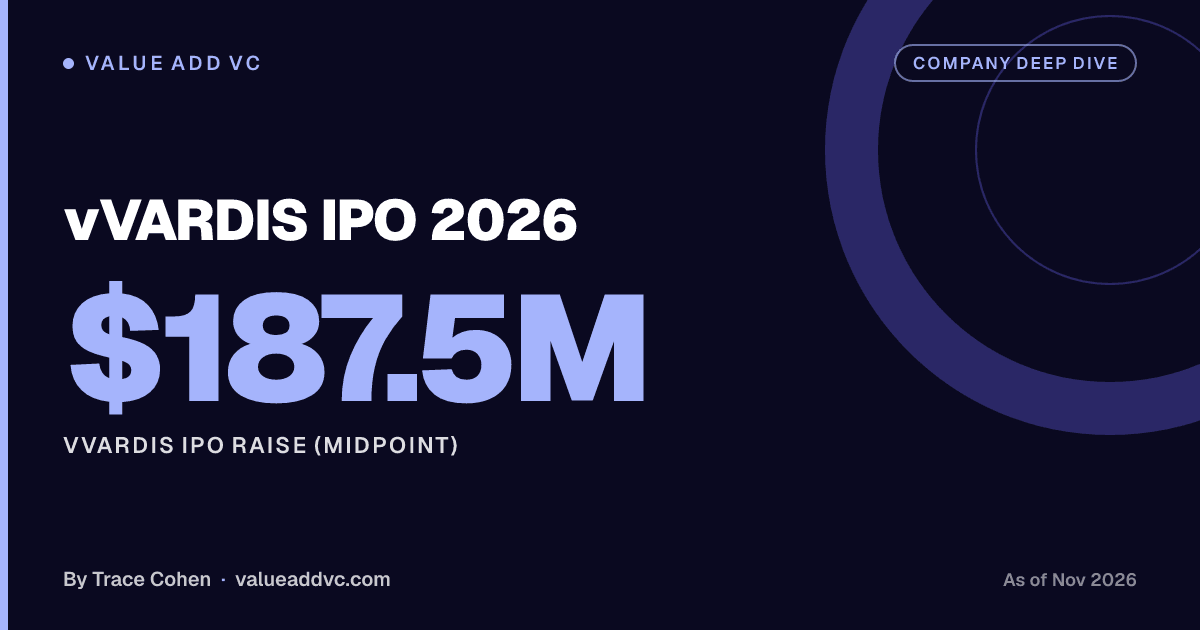
vVARDIS IPO: Company Snapshot
The vVARDIS IPO is a $175.0 million to $200.0 million primary offering (our arithmetic: 8,333,334 shares times $21 and $24) by a Zug, Switzerland company that sells most of its product in the United States. Goldman Sachs and J.P. Morgan are joint bookrunning managers, with William Blair, UBS and Deutsche Bank as bookrunners, per the F-1/A cover.
| Metric | Value | Source |
|---|---|---|
| Shares offered (base) | 8,333,334 Class A | F-1/A cover, Nov 12, 2026 |
| Price range | $21.00 to $24.00 | F-1/A cover |
| Gross raise at midpoint | $187.5M (our math: 8,333,334 x $22.50) | Value Add VC arithmetic on the F-1/A |
| Estimated net proceeds | $166.2M ($192.3M with option) | F-1/A, The Offering |
| FY2025 net revenue | $30.2M (+148.5%) | F-1/A, summary financials |
| H1 2026 net revenue | $28.6M (+214.2%) | F-1/A, summary financials |
| H1 2026 net loss | $27.8M | F-1/A, summary financials |
| Founders' voting power after IPO | 87.6% | F-1/A, Principal Shareholders |
Source: vVARDIS F-1/A, Amendment No. 2, SEC EDGAR, November 12, 2026. Where a figure is our own arithmetic on filed numbers, the row says so.
What vVARDIS Actually Does
vVARDIS makes Curodont, a peptide-containing liquid that a dentist or hygienist applies to an early-stage cavity in five minutes or less, with no drill, needle or anesthesia. The F-1/A says the formula lets calcium, phosphate and fluoride from saliva move into the depth of the lesion and rebuild enamel crystals there, instead of stopping at the tooth surface.
The scale claims are the company's own estimates: over 3.5 million teeth treated by June 30, 2026, and sales to over 20,000 of the roughly 110,000 general dental practices in the United States since the January 2024 US launch. vVARDIS cites more than 250 publications behind the technology. Its US product, Curodont Repair Fluoride Plus, is marketed under an FDA over-the-counter monograph, not a new drug approval, a point Renaissance Capital also flagged.
How Does vVARDIS Make Money?
vVARDIS makes money selling Curodont kits to dental practices, mostly through one distributor. Henry Schein, its exclusive distributor in the United States and the United Kingdom, accounted for 72% of sales in 2025 and 70% in 2024, per the F-1/A risk factors. The United States produced $28.7 million of the $30.2 million in 2025 net revenue, about 95% on our arithmetic, and the same share in the six months to June 30, 2026.
A practice earns a new billable procedure: the company says the treatment costs about the same as a small single-surface filling and takes less chair time. vVARDIS backs the distributor with its own field team of 68 key account managers at September 30, 2026. The filing calls the asset-light model a key factor in gross margin, which reached 86.4% in the six months to June 30, 2026, up from 51.4% a year earlier.
How Much Has vVARDIS Raised Before the IPO?
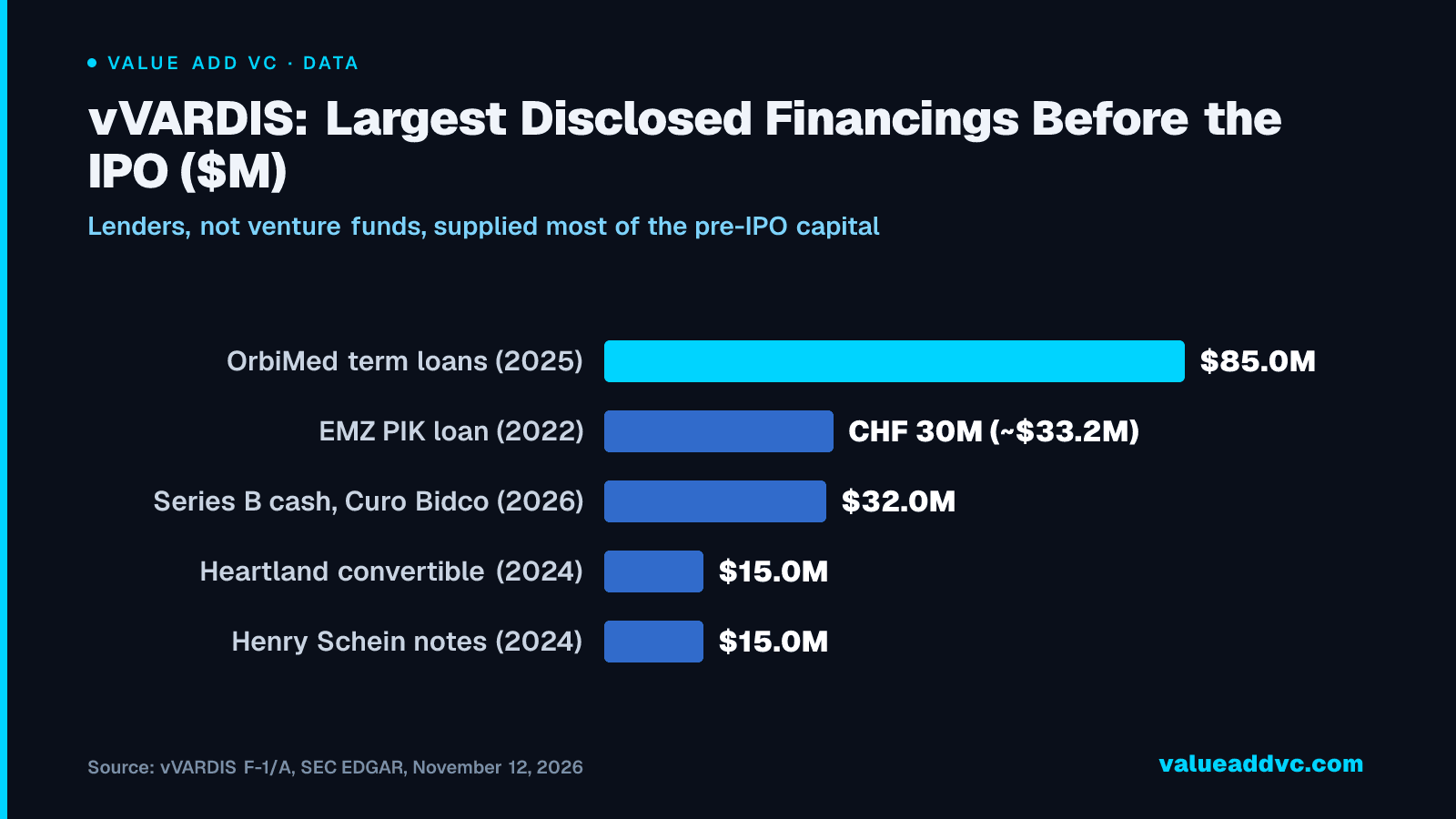
vVARDIS funded itself before the IPO mostly with debt, not venture rounds. Its largest disclosed financing is an $85.0 million OrbiMed term loan facility, and the April 2026 Series B brought $32.0 million in new cash. Its only Form D on EDGAR, from October 2022, reports $1,769,500 sold to 7 investors. The F-1/A also shows 6,856,795 Series A preferred shares carried at $44.5 million, whose preference amount was 2.0x the subscription amount, a right that ends at conversion. For how those terms work, see our explainers on liquidation preferences and when venture debt destroys equity value.
| Date | Event | Terms |
|---|---|---|
| 2020 | vVARDIS founded; acquires Swiss oral-care company Credentis AG | Founding year per management bios; Credentis deal per financial-statement notes |
| Nov 2021 - Oct 2022 | Form D exempt offering | $1,769,500 sold to 7 investors; first sale Nov 30, 2021 |
| Mar 2022 | PIK loan from EMZ VI | CHF 30.0M at 8.000%; repaid in full June 2025 |
| Jun 2024 | Convertible note from Heartland Dental | $15.0M plus warrants on 1,562,081 shares |
| Aug and Dec 2024 | Secured notes from Henry Schein | $10.0M plus $5.0M at 8.000%, now due June 30, 2027 |
| Feb and Jun 2025 | OrbiMed credit facility | $35.0M plus $50.0M, maturing Feb 6, 2030, with penny warrants |
| Apr 2026 | Series B preferred | $32.0M new cash for 1,129,816 shares; Heartland's $16.8M note converted |
| Nov 2026 | NYSE IPO (proposed) | 8,333,334 shares at $21-$24, per the Nov 12 F-1/A |
Source: vVARDIS F-1/A (Nov 12, 2026), Liquidity and Capital Resources and financial-statement notes; Form D filed Oct 25, 2022. Dollar amounts are as filed.
vVARDIS: Largest Disclosed Financings Before the IPO ($M)
Lenders, not venture funds, supplied most of the pre-IPO capital
vVARDIS F-1/A, SEC EDGAR, November 12, 2026
Data
| Item | Value |
|---|---|
| OrbiMed term loans (2025) | $85.0M |
| EMZ PIK loan (2022) | CHF 30M (~$33.2M) |
| Series B cash, Curo Bidco (2026) | $32.0M |
| Heartland convertible (2024) | $15.0M |
| Henry Schein notes (2024) | $15.0M |
The debt is expensive. The effective interest rate on the two OrbiMed tranches at June 30, 2026, an accounting measure that also counts fees and warrant costs, was 24.6% and 31.8%, per the F-1/A; the stated rate is 7.5% plus the greater of one-month SOFR or 3.5%. Interest expense was $9.0 million in the six months to June 30, 2026. OrbiMed also holds warrants on 2,516,883 shares at CHF 0.006 each. Compare our venture debt providers ranking and private credit vs venture debt guide.
Product Portfolio
The vVARDIS product line is narrow. Curodont Repair Fluoride Plus is the US product and the main revenue source; Curodont Repair is the version sold in the company's other markets. Each kit is meant for a single application per lesion, per the F-1/A.
Everything else is pipeline: next-generation peptides, later-stage cavities, hard- and soft-tissue products, and possible uses outside dentistry. R&D spending rose to $7.2 million in the six months to June 30, 2026 from $2.0 million a year earlier, run by a team of about 11 people. As of June 30, 2026 the company held seven issued US patents and five pending US applications.
The Cap Table Behind VVVV: Dual Class, a Ratchet and Pledged Shares
The vVARDIS cap table has three features that matter more than the headline raise. First, dual-class shares: each founder share converts into ten Class B voting rights shares at one-tenth the par value. Each share gets one vote, so the founders' 143,888,790 Class B shares deliver 87.6% of the vote while carrying the economics of 14,388,879 ordinary shares.
vVARDIS After the IPO: Voting Power vs Economic Ownership
vVARDIS F-1/A, Nov 12, 2026 (founders); IPO-buyer figures are Value Add VC arithmetic on the same filing
Data
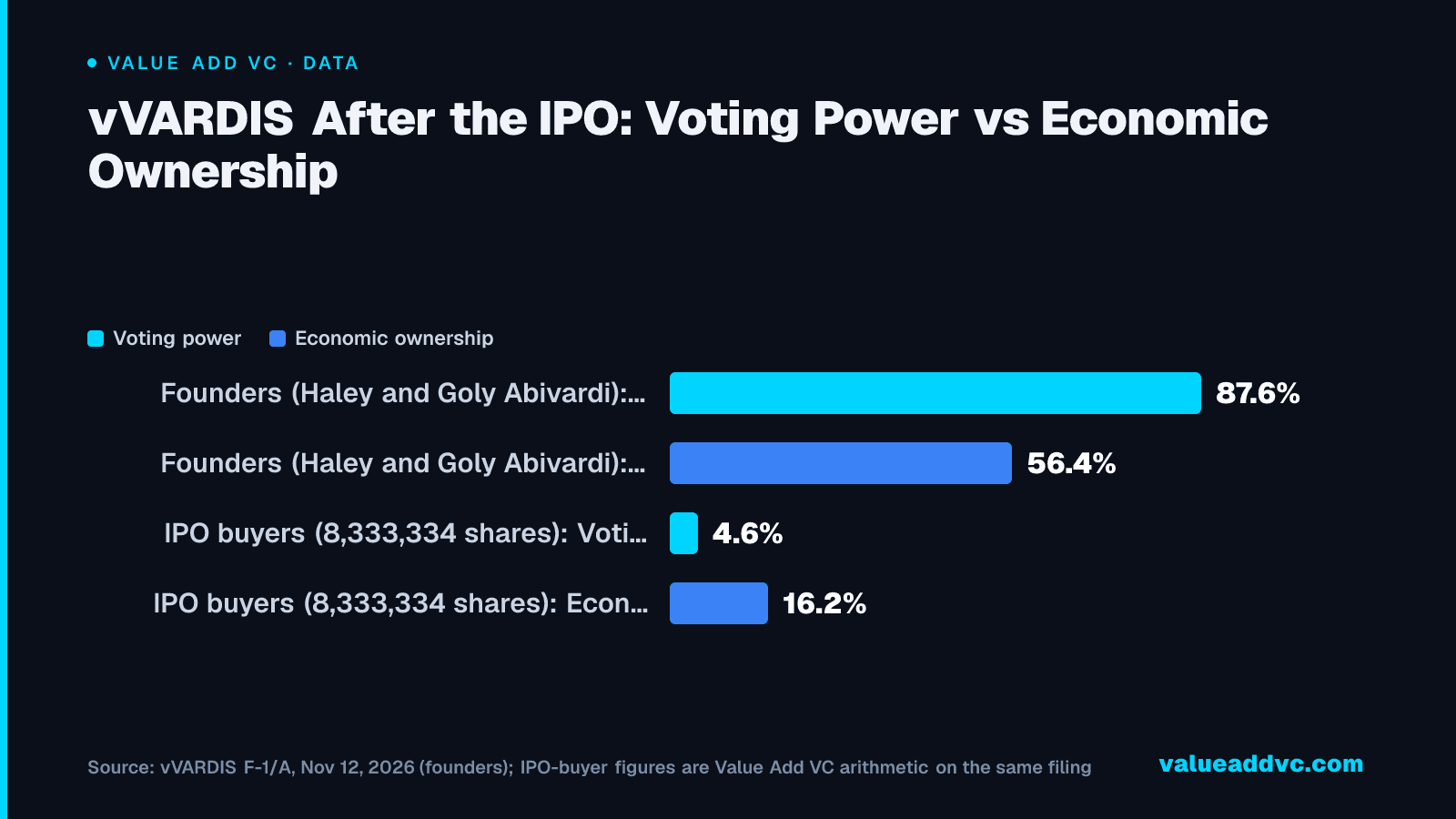
IPO buyers: 8,333,334 / 181,094,530 total shares = 4.6% of votes; 8,333,334 / 51,594,619 economic share-equivalents = 16.2%. Base deal, no option exercise.
Second, a price-based top-up for Series B holders. The new-money investor in the April 2026 Series B paid $32.0 million for 1,129,816 preferred shares, about $28.32 a share on our arithmetic, above the whole $21 to $24 range. Series B holders can subscribe at par for 4,498,951 extra Class A shares at the $22.50 midpoint, 4,943,710 at $21 and 4,109,781 at $24. Curo Bidco, whose shares are held by Apollo Credit Strategies funds per the F-1/A, would get 2,955,131 of them and Heartland Dental 1,543,820. That works like a ratchet; our anti-dilution guide explains the mechanics, and the Apollo page tracks the firm's other deals.
Third, the founders' personal debt. The F-1/A says 10,329,426 of their Class A shares, 20.0% of the economic control after the offering, back personal loans, and CHF 70 million of that debt was in default from December 2024 until October 5, 2026. The lenders extended CHF 60 million to December 31, 2026, and the founders plan to refinance CHF 55 million with new term loans. After that refinancing, 13,203,563 shares would be pledged. A forced sale by a lender could add supply to the stock; vVARDIS is not a party to the loans.
vVARDIS Revenue and Key Metrics
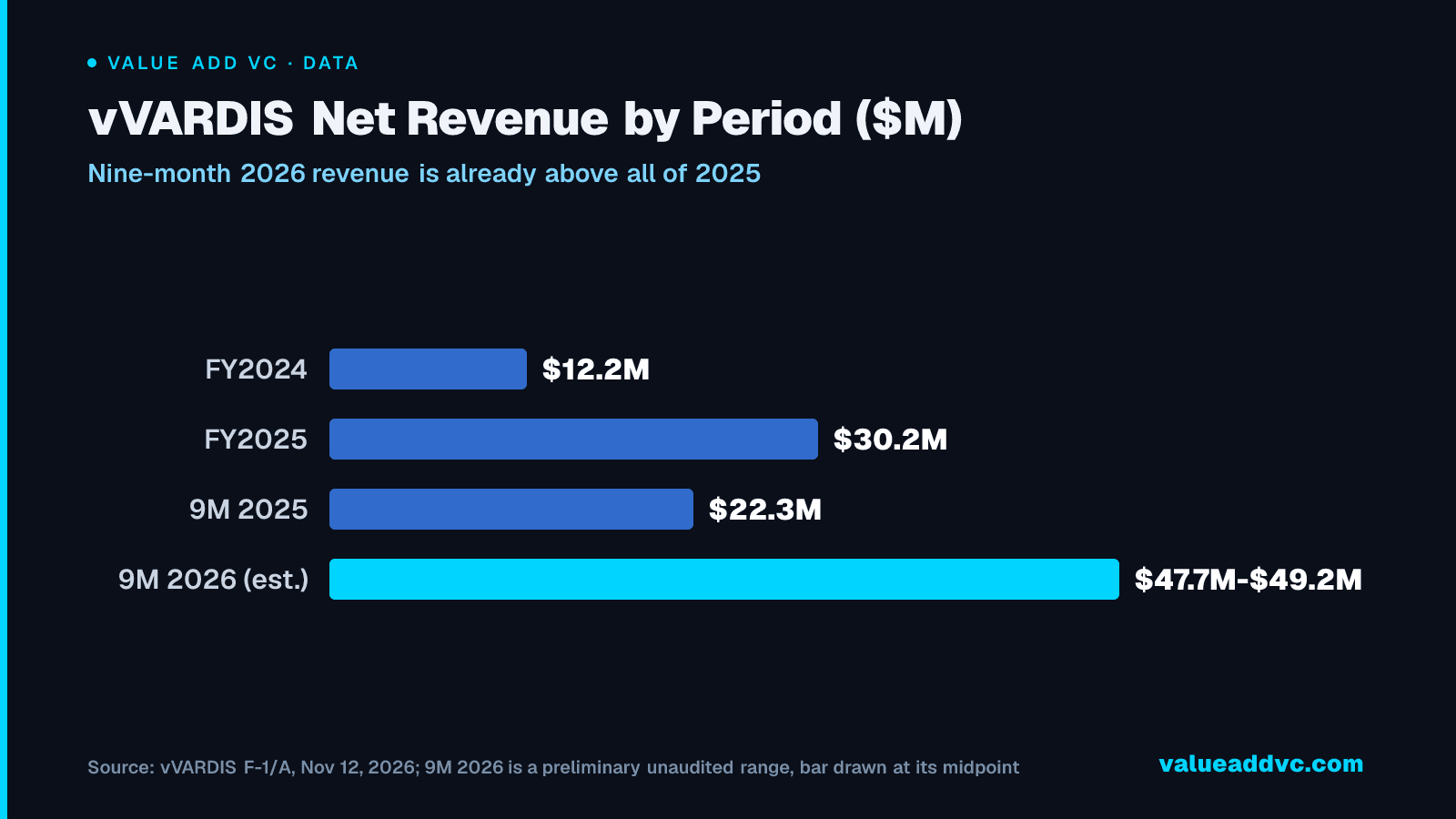
vVARDIS revenue grew from $12.2 million in 2024 to $30.2 million in 2025, and the F-1/A's preliminary, unaudited estimate for the nine months to September 30, 2026 is $47.7 million to $49.2 million, up 114.0% to 120.8%. Subtracting January-June revenue gives an implied third quarter of $19.1 million to $20.6 million (our arithmetic), against $13.2 million a year earlier. US units of Curodont Repair Fluoride Plus rose 112% to about 214,000 over the nine months.
vVARDIS Net Revenue by Period ($M)
Nine-month 2026 revenue is already above all of 2025
vVARDIS F-1/A, Nov 12, 2026; 9M 2026 is a preliminary unaudited range, bar drawn at its midpoint
Data
| Item | Value |
|---|---|
| FY2024 | $12.2M |
| FY2025 | $30.2M |
| 9M 2025 | $22.3M |
| 9M 2026 (est.) | $47.7M-$49.2M |
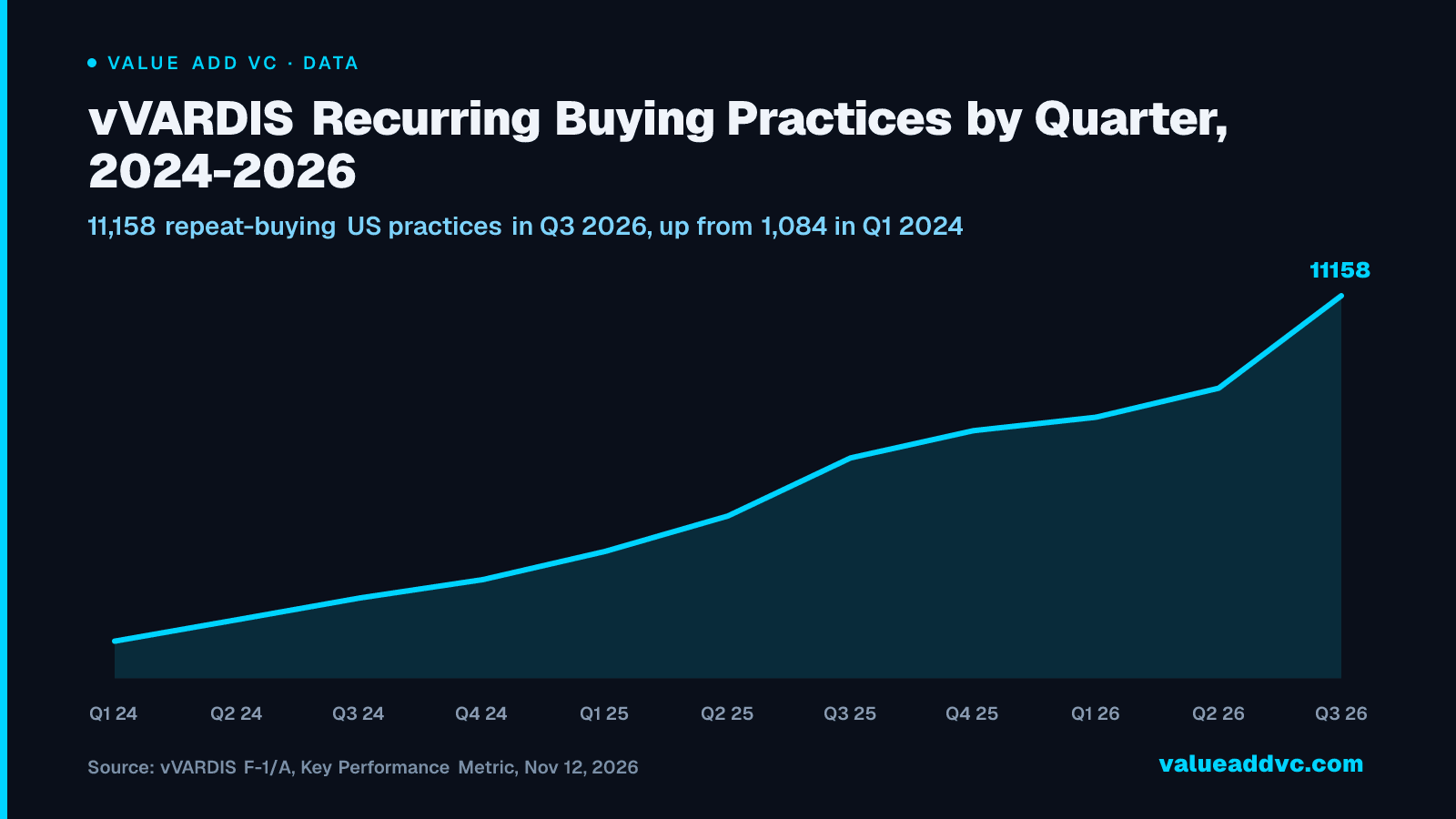
The metric the company leads with is Recurring Buying Practices: US practices that placed more than one order in the last four months. It reached 11,158 in the third quarter of 2026, up 74% year on year, though the growth rate has slowed every quarter since early 2025 (242% in Q1 2025).
vVARDIS Recurring Buying Practices by Quarter, 2024-2026
11,158 repeat-buying US practices in Q3 2026, up from 1,084 in Q1 2024
vVARDIS F-1/A, Key Performance Metric, Nov 12, 2026
Data
| Item | Recurring Buying Practices |
|---|---|
| Q1 24 | 1084 |
| Q2 24 | 1709 |
| Q3 24 | 2343 |
| Q4 24 | 2876 |
| Q1 25 | 3702 |
| Q2 25 | 4734 |
| Q3 25 | 6427 |
| Q4 25 | 7221 |
| Q1 26 | 7615 |
| Q2 26 | 8461 |
| Q3 26 | 11158 |
The costs are still larger than the revenue. Selling, general and administrative expense was $35.1 million in the six months to June 30, 2026, about 1.2 times net revenue on our arithmetic, and the operating loss was $17.6 million. Cash was $29.0 million at June 30, 2026 and an estimated $19.4 million at September 30. The accumulated deficit was $256.3 million. Pro forma for the offering at the midpoint, cash would be $195.2 million.
Who Does vVARDIS Compete With?
vVARDIS says no commercially available product directly competes with Curodont as a non-invasive treatment that restores early-stage cavities, so its real rivals are the habits it is trying to replace. That claim is the company's own characterization. The F-1/A warns that better-funded companies may enter as awareness grows.
| Option | Used for | Invasiveness | Main limitation (per F-1/A) |
|---|---|---|---|
| Curodont (vVARDIS) | Early-stage lesions | No drill, no needle | Awareness is still limited, per the company |
| Fluoride varnish | Prevention | Non-invasive | Works at the enamel surface; not a treatment for an existing lesion |
| Silver diamine fluoride | Active cavities | Non-invasive | Permanently stains treated decay black |
| Dental sealants | Prevention on chewing surfaces | Non-invasive | Cannot treat cavities between teeth |
| Fillings | Late-stage cavities | Drill removes tooth structure | Irreversible; can start a cycle of re-treatment |
| Watch-and-wait | Early-stage lesions | None | Lesion is left untreated |
Source: vVARDIS F-1/A, Business section, Nov 12, 2026. These are the issuer's descriptions of alternative treatments, not independent clinical comparisons.
Two adjacent companies matter. The filing cites data from Overjet and VideaHealth, AI cavity-detection tools, which it says find 30% to 40% more early-stage cavities than unaided exams; vVARDIS argues that AI detection could widen its market by more than 30%. And Henry Schein is distributor, lender and, per the F-1/A, largest customer at once.
Leadership Team
vVARDIS is run by sisters Dr. Haley Abivardi and Dr. Goly Abivardi, co-CEOs and co-chairs since the 2020 founding. Both trained as dentists at the University of Zurich and co-founded the Swiss dental group Swiss Smile. CFO Thomas Rondot joined in 2021 from Coty, after 13 years at Danone. The company had about 153 full-time employees at June 30, 2026, 99 of them in the United States.
Bull Case and Bear Case
What's working
Repeat buying is real and gross margin is high. Unit cost of Curodont Repair Fluoride Plus fell 60% after a third-generation manufacturing process, per the F-1/A, and nine-month adjusted EBITDA loss narrowed to an estimated $9.2 million to $9.4 million from $17.1 million. The product is in the curricula of over 50 US and European dental programs.
What's hard
Net loss is not shrinking: the nine-month estimate of $39.7 million to $41.3 million is roughly flat against $40.7 million a year earlier, because higher operating expenses and interest expense, which roughly doubled to an estimated $13.8 million to $14.1 million, offset the gain in gross profit. One distributor, one country and one product carry the revenue. The over-the-counter monograph route could be revisited by the FDA, which the F-1/A lists as a risk. In January and April 2026 vVARDIS needed OrbiMed waivers on revenue and financing covenants, and in September 2026 another for covenants tied to liquidating two subsidiaries.
What the headline misses
The "$4.4 billion valuation" in early coverage, relayed by Oral Health Group from Reuters, matches counting every Class B share as a full share: our arithmetic on the November 6 terms, (38,396,216 + 143,888,790) x $24, gives $4.37 billion. On the new terms, 37,205,740 Class A shares plus 143,888,790 Class B shares at one-tenth weight equal 51,594,619 economic share-equivalents, or $1.08 billion to $1.24 billion across the range ($1.16 billion at the midpoint). Adding the 4,498,951 Series B top-up shares and OrbiMed's penny warrants gives about $1.32 billion at the midpoint, close to the $1,345 million market cap Renaissance listed for the earlier, larger terms.
What vVARDIS Tells Founders and Investors
For founders, vVARDIS shows a company can reach a NYSE listing on lender money, a strategic distributor and a dental-group investor (Heartland Dental), with very little classic venture capital. The cost shows up later, in loan rates, warrants, waivers and the Series B top-up. Our guide to down rounds covers the same trade-off in private markets.
For investors, the lesson is to read the share count, not the headline value. The IPO process explainer walks through where these terms sit in a filing, and the VC glossary defines them.
When Does vVARDIS Start Trading?
Update, November 12, 2026: the F-1/A filed today cuts the base deal to 8,333,334 shares from 9,523,810, keeps the $21 to $24 range, removes the founders as selling shareholders, and gives the 1,250,000-share option to the company instead. Estimated net proceeds fall to $166.2 million from $191.1 million. Renaissance Capital's VVVV profile now shows 8.3 million shares and a $188 million deal.
vVARDIS is expected to price after the market close on November 12, 2026 and begin NYSE trading on November 13, according to the IPO calendar IPOX; Oral Health Group described both dates as provisional. The F-1/A leaves the date blank. Lockups run 180 days for most holders and 270 days for the co-founders.
The deal lands in a busy month: Renaissance's week-ahead note put vVARDIS on the calendar as Anthropic's listing approached. For the wider field, see the IPO hub, our IPO tracker, the 2026 IPO wave page, the 2026 IPO window, the biggest IPOs of 2026, and November's other deep dives on Blue Lagoon and Gravitics. History on first-day pops and IPO flops shows how wide day-one outcomes run; it predicts nothing about VVVV.
Honest Caveats
The nine-month 2026 figures are preliminary management estimates; Deloitte AG has not audited or reviewed them, and full results will not be filed until after the offering.
The $1.16 billion and $1.32 billion values are Value Add VC arithmetic on filed share counts, not a figure the company states; the final number depends on the price and the top-up share count.
Clinical, market-size and teeth-treated claims (a $29 billion US addressable market, 3.5 million teeth) are the issuer's estimates and have not been independently verified here.
The Bottom Line
vVARDIS brings a fast-growing, high-margin product and a simple story to the NYSE: a five-minute treatment that keeps dentists from drilling early cavities. The filing behind it is less simple. It shows expensive debt, one dominant distributor, founder control backed by pledged shares, and a Series B that gets more shares the lower the IPO prices. The November 12 cut to 8.33 million shares, with the founders no longer selling, is the latest data point; the price is the next one.
Figures are from vVARDIS's SEC filings and the reporting linked above, as of November 12, 2026. Follow new listings on the IPO tracker and private rounds on the funding tracker, or download the free Startup Funding Dataset (CSV of sourced rounds and fund closes).
Latest from the Pulse
Get VC data most people never see
— free to subscribe
Trace's notes on venture, AI and startups, a few times a week. Join 5,000+ subscribers. No spam.
No spam, unsubscribe anytime. Sent via Substack · Privacy · or subscribe on Substack ↗