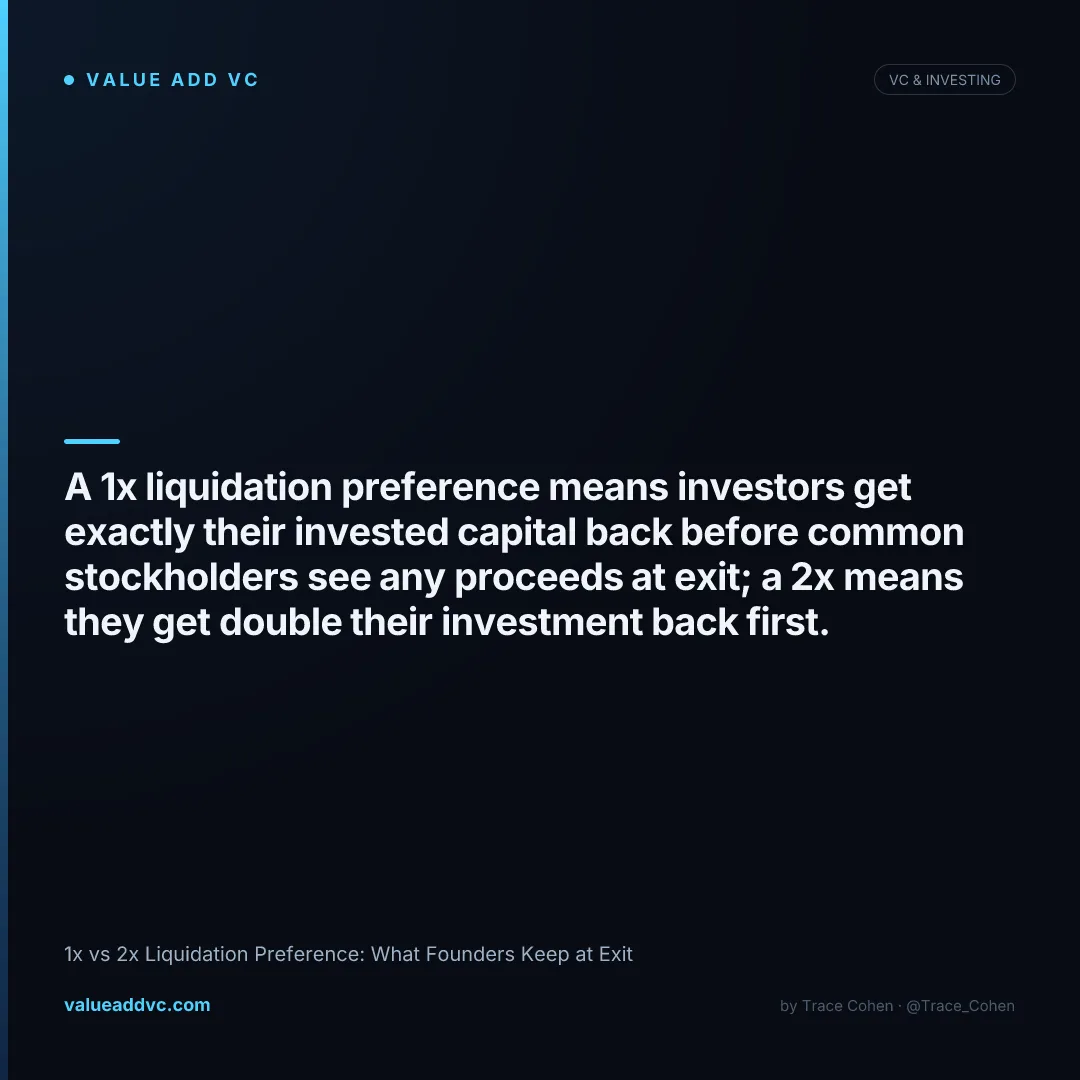
Whether your term sheet says 1x or 2x, participating or non-participating, liquidation preference is the clause that decides what founders actually keep at exit — and most sign without modeling it.
Every preferred stock deal has one. Most founders nod along without modeling the actual exit scenarios. I've reviewed cap tables where $80M acquisitions left common stockholders — founders, early employees, everyone below preferred — with less than $2M combined, because of stacked participating preferences. That's not edge case. That's math.
Here is exactly how liquidation preference works, what the different structures cost you, and how to negotiate it.
How Liquidation Preference Works
When a venture investor buys preferred stock, they negotiate a liquidation preference: a right to receive a minimum payout from any liquidity event — acquisition, IPO, or asset sale — before common stockholders see anything. The amount is expressed as a multiple of their investment.
A 1x non-participating preference on a $10M investment means the investor gets $10M back first. If the company sells for $15M, investors take $10M and common holders split $5M. If the company sells for $100M, the investor faces a choice: take the $10M preference, or convert to common shares and receive their ownership percentage of $100M — whichever is greater.
That conversion choice is what "non-participating" means: investors either take the preference or convert to common. They cannot do both. Participating preferred removes that constraint entirely.
Participating vs Non-Participating: Exit Math That Matters
The table below models a company that raised $10M from a VC who owns 33% post-financing. Three exit sizes, three preference structures. The differences are substantial.
| Exit Size | 1x Non-Participating | 1x Participating | 2x Non-Participating |
|---|---|---|---|
| $15M | $5M to founders | $3.3M to founders | $0 to founders |
| $30M | $20M to founders | $13.4M to founders | $10M to founders |
| $60M | $40M to founders | $33.3M to founders | $40M to founders |
| $100M | $67M to founders | $60.3M to founders | $67M to founders |
Assumes $10M raised, 33% investor ownership. Founders hold 67% of common. Does not account for option pool dilution or multiple investor tranches.
The Participating Preferred Trap in Practice
Here is a scenario that breaks founders' hearts: your company raises $30M across three rounds, some of which included participating preferred from investors who got aggressive terms in a tough market. You sell for $90M — a 3x return on invested capital, which sounds like a win.
Investors take $30M off the top in preferences. Then, holding 55% of the equity on a fully diluted basis, they participate pro-rata in the remaining $60M — taking another $33M. Total investor proceeds: $63M out of $90M. Founders and employees split $27M. The team that built a $90M company walks away with less than a third of the proceeds.
I've seen versions of this story multiple times. It is entirely legal. It is in the term sheet. Most founders either missed it at signing or assumed the exit would be large enough that it would not matter. Exit sizes are rarely in your control.
What's Market in 2025–2026: Liquidation Preference Benchmarks
Per NVCA model documents and Cooley deal data, non-participating 1x liquidation preference is the clear standard for institutional venture deals. Here is where different structures appear by stage and deal type:
- •Series Seed and A: Non-participating 1x in 85%+ of institutional deals; participation is rare and usually negotiated away
- •Series B and C: Non-participating 1x dominant; some strategic investors push for capped participating preferred (e.g., 3x cap before auto-conversion)
- •Corporate VC and strategic rounds: More likely to include participating preferred, often 1x participating with a 3x proceeds cap
- •Down rounds and bridge structures: 2x preferences and participating preferred re-emerge as investor protection mechanisms
- •Late-stage 2021-era crossover rounds: Many carried 2x–3x participating preferences that still sit on cap tables today — check before your next raise
The VC Performance dashboard tracks fund return data by vintage year — the 2021 class with elevated preferences is particularly illuminating in terms of how those deals have played out for founders vs. investors in the subsequent exit environment.
How to Negotiate Liquidation Preference
Liquidation preference is negotiable. Most founders who push back on participating preferred get non-participating instead — especially if they have competitive term sheets. Here is the framework:
- •Start from non-participating 1x as your baseline. Any deviation requires explicit justification from the investor.
- •If you must accept participating preferred, negotiate a cap — typically 3x total payout before automatic conversion to common.
- •Model the exit math. Build a waterfall at $30M, $60M, and $120M exit scenarios. Show investors you understand the math — it signals sophistication and changes the negotiation dynamic.
- •Watch for stacking: multiple rounds of participating preferred compound against founders. Each new preferred layer joins the liquidation waterfall in seniority order.
- •Redemption provisions combined with participating preferred are especially dangerous — investors can force a buyback AND participate in proceeds. Avoid this combination entirely.
- •Ask competing investors for their standard terms upfront. A term sheet from a clean 1x non-participating investor is your best leverage against a messier offer.
Non-participating 1x is market standard. If an investor asks for more, make them earn it — or find a better investor.
Track VC fund performance and deal term benchmarks at Value Add VC. Originally published in the Trace Cohen newsletter.
Latest from the Pulse
Get VC data most people never see
— free to subscribe
Trace's notes on venture, AI and startups, a few times a week. Join 5,000+ subscribers. No spam.