The board composition clause in a term sheet is the most underread paragraph with the most lasting consequences. Founders spend hours negotiating the valuation and five minutes on board structure — then spend the next decade living with what they agreed to.
Based on NVCA data and deal-level analysis, founders lose effective board majority at Series A in approximately 60% of venture-backed deals — not always because they gave up the votes explicitly, but because the independent seat ends up investor-aligned in practice. Understanding what the clause actually says, how it evolves across rounds, and where you have real negotiating leverage is non-negotiable before you sign.
The Standard Board Composition Term Sheet Language
The NVCA model term sheet — the industry baseline used in the vast majority of US venture deals — specifies board composition as follows for a Series A:
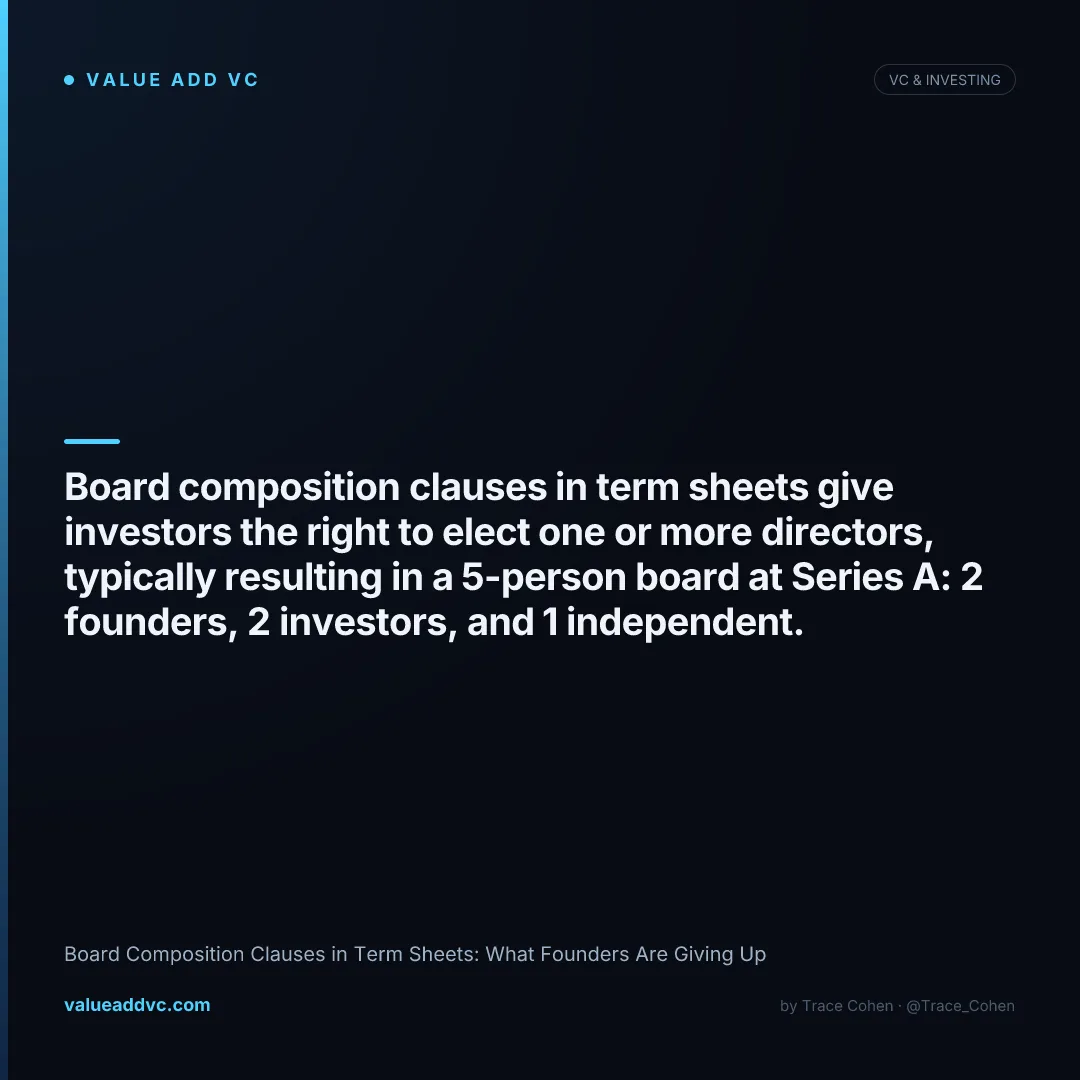
This 5-person structure is the de facto standard. On paper, the board is deadlocked between 2 founders and 2 investors, with the independent director holding the deciding vote. In practice, the independent is often a former operator or executive surfaced by the VC firm — selected via "mutual agreement" that in most cases means the investor proposes and the founder ratifies.
How Board Composition Shifts Across Rounds
The board structure you agree to at Series A sets the precedent for every subsequent round. Here is how it typically evolves:
Investors take observer rights — attend meetings, no vote
The pivot point — this is where control typically shifts
New lead investor claims a seat, often displacing a founder
CEO may retain operational authority but strategic control is shared
The Independent Director: Whose Side Are They On?
The independent director is the linchpin of the board composition clause in term sheets — and the most misunderstood seat. Founders often assume "mutually agreed" means a genuinely neutral party. It rarely does.
Signs the Independent Is Truly Independent
- ✓ Founder sourced the candidate, VC approved
- ✓ No prior relationship with the VC firm
- ✓ Deep operational experience in your sector
- ✓ Has disagreed with investors publicly before
- ✓ Compensation structured by the full board, not the VC
Red Flags the Independent Is Investor-Aligned
- ✕ VC firm surfaced the candidate directly
- ✕ Prior portfolio company executive of the same fund
- ✕ Compensation or equity was negotiated without founder input
- ✕ The VC has a right to replace the independent unilaterally
- ✕ No formal founder consent required for removal
What Founders Can Actually Negotiate on Board Composition
Contrary to what first-time founders assume, board composition is one of the more negotiable provisions — especially at Series A when you have a competitive process. Here is what has been moved in real deals:
1 founder, 1 investor, 1 independent. Simpler governance, fewer veto points. Works when founder has strong alternatives and the deal is competitive.
2 founders, 1 investor, 2 independents. Investors will resist this unless you are a repeat founder with a strong track record or a hot deal with multiple term sheets.
Investors attend all meetings and receive materials but have no vote. Standard at pre-seed; increasingly rare at Series A for lead investors.
Add language requiring affirmative written consent from both founder directors — not just 'mutual agreement' — before the independent is seated. This is a reasonable ask that most VCs will accept.
Investor board seat converts to observer if fund has not deployed capital in 5+ years. Almost never accepted but worth flagging in a competitive process.
Protective Provisions That Travel With Board Seats
Board composition does not exist in isolation. Investor board seats almost always come bundled with protective provisions that give investors veto rights over specific actions — even when the board vote goes against them. Per NVCA model terms, standard protective provisions include:
These protections are held at the preferred stock class level — meaning a majority of Series A holders can block these actions regardless of the board vote. Board seats plus protective provisions is the full picture of governance transfer. Track how this compounds round-over-round using the Benchmarking Dashboard.
The cap and the valuation are what founders remember. The board clause is what they live with.
Every VC board seat is a vote on your future — who runs the company, when you sell, and whether you stay CEO. Negotiate it that way.
Track VC fund governance structures and term sheet benchmarks on the VC Performance Dashboard at Value Add VC. Originally published in the Trace Cohen newsletter.
Latest from the Pulse
Get VC data most people never see
— free to subscribe
Trace's notes on venture, AI and startups, a few times a week. Join 5,000+ subscribers. No spam.