
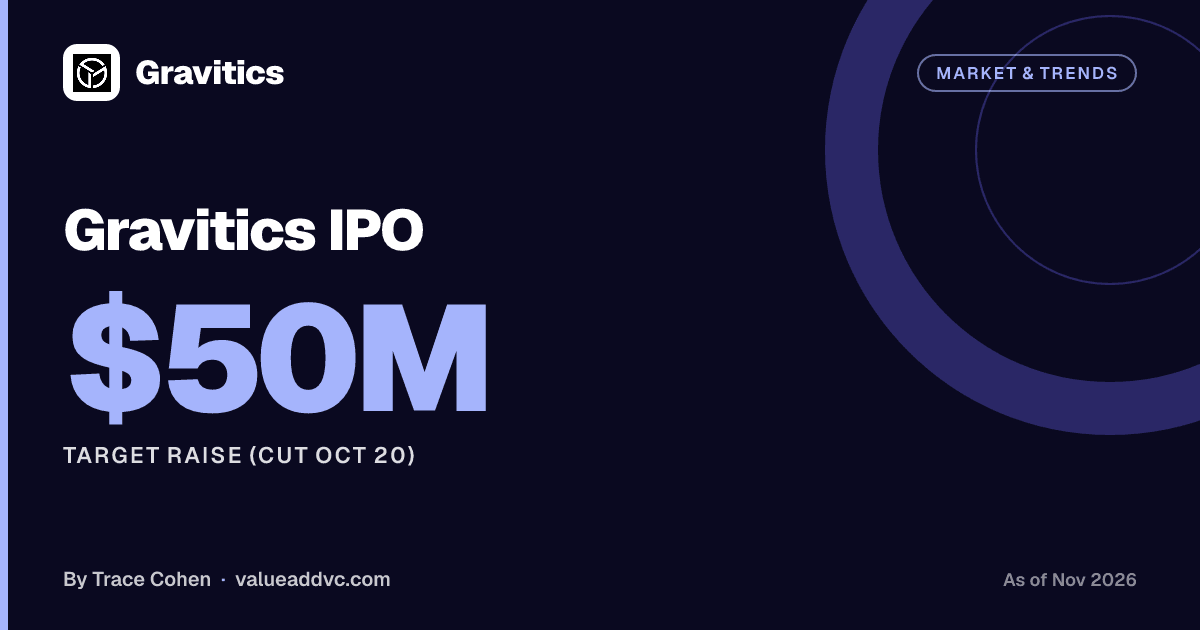
Gravitics still has not priced its $50M Nasdaq offering as of Nov 1, 2026, after its October 30, 2026 outside closing date passed with no closing filed. The October 30 date is the outside closing date in its merger agreement with Non-Invasive Monitoring Systems, and as of November 1, 2026 NIMU had filed no 8-K reporting a closing, a fifth amendment or a termination, per SEC EDGAR. Gravitics cut its planned Nasdaq IPO to $50 million on October 20, 2026 — 3.2 million shares at $14 to $17, down 60% from the $125 million it set terms for on August 20 — and the deal still had not priced, according to Renaissance Capital, whose IPO profile still shows no offer price.
Gravitics IPO Key Numbers (as of November 1, 2026)
| Date | Event | Valuation / Amount | Source |
|---|---|---|---|
| Aug 20, 2026 | Terms set: 8.1M shares at $14-$17 | $125M | Renaissance Capital |
| Oct 13, 2026 | Still unpriced (Filed Terms status) | — | Renaissance Capital |
| Oct 20, 2026 | Offering cut 60%: 3.2M shares at $14-$17 | $50M; $621M market value at midpoint | Renaissance Capital |
| Sep 30, 2026 | Amendment No. 3: outside closing date moved to Oct 30; offering target raised from $40M to $125M | $125M target | SEC Form 8-K (filed Oct 5, 2026) |
| Oct 19, 2026 | Amendment No. 4: Public Offering redefined, all other terms unchanged | $50M expected, not less than $40M | SEC Form 8-K (filed Oct 19, 2026) |
| Oct 30, 2026 | Merger agreement outside closing date passes | — | SEC Form 8-K |
| Nov 1, 2026 | Our own check: no NIMU filing of any kind after Oct 20 (no closing, extension or termination 8-K); Renaissance profile showed status filed, no offer price, on Oct 31 | Not priced | SEC EDGAR; Renaissance Capital |
Market value is Renaissance Capital's fully diluted figure at the $15.50 midpoint of the range. It is a target, not a priced valuation or market cap.
Updated Nov 1, 2026
Rechecked Nov 1, 2026: Non-Invasive Monitoring Systems' EDGAR filing list (latest filings are still the October 20 S-1/A and S-4/A; no 8-K after October 20), the October 19 8-K for Amendment No. 4, the October 5 8-K for Amendment No. 3, and Renaissance Capital's October 20 terms report. Renaissance Capital's GVTX profile showed no offer price on Oct 31, 2026. Correction: the Amendment No. 3 8-K was filed October 5, 2026, not October 2 as this page said earlier; the October 2 8-K covered extensions of NIMU's insider promissory notes.
What Happened at the October 30 Deadline
Nothing was filed. Amendment No. 3, signed September 30, 2026, “extends the outside closing date and outside termination date from September 30, 2026 to October 30, 2026,” per NIMU's October 5 8-K. As of November 1, 2026, NIMU's EDGAR filing list showed no 8-K after October 20: no closing, no fifth amendment and no termination notice. That is a negative result from a filing search, not a finding that the deal is dead. The same amendment says the public offering and the Nasdaq uplisting are to be completed “as soon as practicable after closing of the Merger,” and the parties have already amended the agreement four times, so another extension or a late closing is possible. Watch NIMU's 8-K filings and Renaissance Capital's GVTX profile, which still showed no offer price on October 31.
The last change before the deadline came on October 19. NIMU's 8-K for Amendment No. 4 says the parties “entered into a fourth amendment to the Merger Agreement,” which modified the definition of “Public Offering” “so that it means an underwritten public offering with gross proceeds currently expected to be $50 million, but in no event less than $40 million (excluding the underwriter’s over-allotment option).” All other terms stayed the same. A day later, on October 20, Renaissance Capital reported that Gravitics cut its offering to 3.2 million shares at $14 to $17, from 8.1 million shares, with Lucid Capital Markets as sole bookrunner and a $621 million fully diluted market value at the midpoint.
The amendments tell their own story. The offering target was $40 million before Amendment No. 3 raised it to $125 million on September 30, per the October 5 filing. Three weeks later Amendment No. 4 brought it back to $50 million, with $40 million as the floor. The deal has been resized twice in three weeks and is now back near where it started.
GVTX Deal Terms: Original vs. Cut vs. Amendment No. 4
| Version | Shares | Range | Size | Source |
|---|---|---|---|---|
| Original terms (Aug 20, 2026) | 8.1M | $14-$17 | ~$125M | Renaissance Capital |
| Merger agreement after Amendment No. 3 (Sep 30, 2026) | — | — | $125M target (up from $40M) | SEC 8-K |
| Merger agreement after Amendment No. 4 (Oct 19, 2026) | — | — | $50M expected; floor $40M | SEC 8-K |
| Cut terms (Oct 20, 2026) | 3.2M | $14-$17 | $50M; $621M value at $15.50 midpoint | Renaissance Capital |
Source: Renaissance Capital and Gravitics' SEC S-1/A filing, checked October 13, 2026; deal size updated October 21, 2026; pricing status rechecked November 1, 2026.
How the GVTX Deal Is Structured
Gravitics isn't filing a traditional S-1 IPO — it's merging into Non-Invasive Monitoring Systems (NIMU), an existing public shell company, in a deal first agreed on March 6, 2026, amended June 30 and August 5, 2026, and amended a third time on September 30, 2026 to extend the outside closing date to October 30, 2026 (disclosed in a Form 8-K filed October 5, 2026), according to a reproduction of the company's SEC S-1/A filing published by StockTitan. Once the merger closes, NIMU will be renamed Gravitics Holdings and trade on the Nasdaq Capital Market under ticker GVTX, with Gravitics stockholders holding at least 95.5% of the combined company and NIMU's existing shareholders holding no more than 4.5%. A 1-for-150 reverse stock split is planned as part of the transaction.
Lucid Capital Markets is the sole bookrunner on the primary offering — originally $125 million (8.1 million shares at $14.00 to $17.00), cut on October 20, 2026 to $50 million (3.2 million shares at the same range), per Renaissance Capital — and would earn a 6.5% underwriting fee on gross proceeds. The merger agreement's outside closing date was extended to October 30, 2026 via Amendment No. 3, dated September 30, 2026 (disclosed in an 8-K filed October 5, 2026), and a fourth amendment on October 19, 2026 set the offering at an expected $50 million with a $40 million floor. The offering still had not priced as of October 31, 2026, per Renaissance Capital. See Value Add VC's Gravitics hub for continuing coverage of the deal.
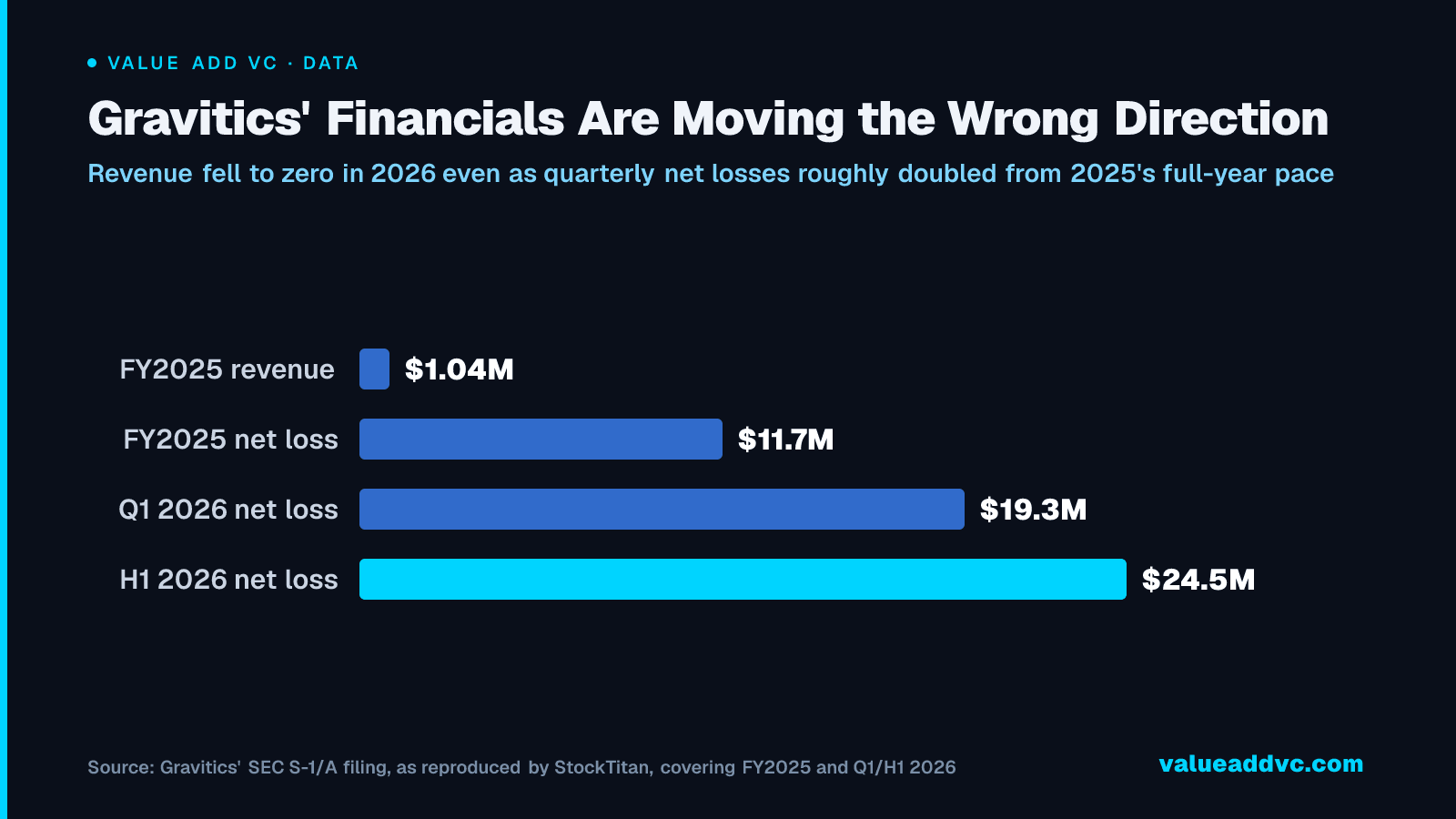
Gravitics' Financials Are Moving the Wrong Direction
Revenue fell to zero in 2026 even as quarterly net losses roughly doubled from 2025's full-year pace
Gravitics' SEC S-1/A filing, as reproduced by StockTitan, covering FY2025 and Q1/H1 2026
Data
| Item | Value |
|---|---|
| FY2025 revenue | $1.04M |
| FY2025 net loss | $11.7M |
| Q1 2026 net loss | $19.3M |
| H1 2026 net loss | $24.5M |
The Axiom Space Contract Isn't the Cushion It Looks Like
Gravitics' headline commercial validation is a $125 million fixed-price contract with Axiom Space, signed in May 2024 and announced by Gravitics on July 9, 2024 as a contract “to provide a pressurized spacecraft that will support Axiom Station operations,” to build a cargo-logistics module for Axiom's planned commercial space station — coincidentally the same dollar figure as the IPO itself. But the contract is mostly theoretical revenue so far: of a $6 million milestone tied to Gravitics' Preliminary Design Review, only $0.5 million had actually been billed and collected as of June 30, 2026, because the remaining $5.5 million was contingent on Axiom securing its own additional equity funding — financing that hadn't materialized as of the filing, per Gravitics' SEC disclosures reproduced by StockTitan. The contract runs through December 31, 2029, with the bulk of its value tied to Gravitics passing an independently verified Critical Design Review.
That distinction matters for anyone reading the $125 million Axiom figure as committed revenue: it's a contract ceiling, not cash Gravitics has collected or is guaranteed to collect on any fixed schedule.
Gravitics' Funding Before the IPO Attempt
Gravitics was incorporated in Delaware on May 7, 2021 and is headquartered in Marysville, Washington, where it operates a 42,000-square-foot facility, according to the SEC filing and Payload's coverage of the company's 2022 launch. The company emerged from stealth in November 2022 with a $20 million round led by Type One Ventures, with participation from Tim Draper's Draper Associates and FJ Labs, to build its first product, the StarMax module — designed for roughly 400 cubic meters of usable volume and compatibility with SpaceX's Starship, Blue Origin's New Glenn, and ULA's Vulcan.
Gravitics added a $13.2 million institutional private placement in February 2026, placed by Joseph Gunnar & Co., and has also been selected for a Strategic Funding Increase (STRATFI) award from the U.S. Space Force's SpaceWERX program, with potential combined government, SBIR, and private funding of up to $60 million. Co-founders Colin Doughan (CEO) and Mike DeRosa lead the company. In August 2026 NASA selected Gravitics for a 2026 SBIR Phase I award to develop the Multiple-Downmass Hangar, “a system for affordable and frequent commercial sample return from low Earth orbit,” per the company's August 10 release; NASA announced its Phase I selections on August 6, and the release does not state a dollar amount.
Where Gravitics Sits in the Space-Infrastructure Funding Wave
Gravitics' attempted public raise, now cut to $50 million from $125 million, is small next to the private rounds flowing into adjacent space and defense-hardware categories this year — most of which have real revenue or flight history behind them, unlike Gravitics' pre-revenue, reverse-merger path.
| Company | Segment | Latest round / status | Amount | Valuation | Date |
|---|---|---|---|---|---|
| Gravitics | Space station modules | IPO terms (reverse merger) | $50M target (cut from $125M on Oct 20) | N/A — pre-revenue | Aug 2026 |
| Firefly Aerospace | Launch + lunar landers | Priced follow-on offering (FLY) | $576M (4M primary + 8M secondary at $48) | ~$7.9B | May 28, 2026 |
| K2 Space | Satellites / defense | Series D | $500M | $6.8B | Jul 2026 |
| Muon Space | Satellites | Series C | $250M | $1.5B | Aug 2026 |
| Castelion | Hypersonic missiles | Series C | $1B | $13B | Aug 2026 |
| Saronic | Autonomous Navy ships | Series D | $1.75B | $9.25B | Mar 2026 |
How we counted: Gravitics plus 5 space and defense-hardware companies financed or priced in 2026 with disclosed rounds or pricings; as of October 13, 2026. Sources: Renaissance Capital and our own reporting on Firefly Aerospace, K2 Space, Muon Space, Castelion, and Saronic.
What the headline misses
A reverse merger into an existing shell company is a faster path to a Nasdaq ticker than a traditional S-1, but it typically comes with less underwriter-driven price discovery and a thinner bookbuilding process — which may be part of why this deal has stalled rather than priced on a normal timeline. Agility Robotics is taking a related but distinct path to Nasdaq, a SPAC merger rather than a reverse merger into a shell, which still has to clear a shareholder vote before it closes. More than two months between setting terms and still showing no offer price is unusually long for a deal this size; both City Therapeutics and Iambic Therapeutics, by contrast, each set terms and were expected to price within about a week in October 2026.
The financial picture is a genuine warning sign, not just a pre-revenue technicality: Gravitics had $1.04 million in revenue for all of 2025, and that fell to zero in the first half of 2026 even as quarterly losses roughly doubled, with an accumulated deficit of $61.8 million. The Axiom Space contract's headline $125 million value is real on paper, but the company itself disclosed that most of it remains unbilled and contingent on a third party's own financing — a risk Gravitics doesn't control.
None of this means the deal won't eventually price — reverse mergers can take longer to close for reasons unrelated to investor demand, including routine SEC comment periods. But as of this writing, every number in this piece describes a proposed transaction, not a completed one.
GVTX Bull Case vs. Bear Case
Bull. Gravitics has a $125 million Axiom Space contract ceiling, a Space Force STRATFI selection, a NASA SBIR Phase I award, and a path to a Nasdaq ticker that would give a pre-revenue hardware company public capital to build with. The merger is still described in forward-looking terms rather than abandoned: Renaissance Capital's profile says that at closing “the Company intends to change its name to Gravitics Holdings.”
Bear. Revenue was zero for the six months ended June 30, 2026, with a $24.5 million net loss for that period and a $61.8 million accumulated deficit. The Axiom contract is mostly unbilled and depends on Axiom's own financing. The structure is a reverse merger into a shell with thinner price discovery than a traditional IPO, the offering size has moved from $40 million to $125 million to $50 million across two amendments, and the October 30 outside date passed with nothing filed. None of that makes Gravitics a bad company. It does mean public investors would be funding manufacturing before a first flight, through a deal that has needed four amendments.
The bottom line:
Gravitics set terms for a $125M Nasdaq reverse merger in August 2026, cut it to $50M on October 20 with a $40M floor, and reached its October 30, 2026 outside closing date with no pricing, closing, extension or termination filed as of October 31 — while revenue fell to zero and the headline Axiom Space contract remains mostly unbilled.
Track the original terms-setting in our Pulse coverage of Gravitics' August filing, see how K2 Space's $6.8B Series D compares, and read more analysis at Value Add VC.
Latest from the Pulse
Get VC data most people never see
— free to subscribe
Trace's notes on venture, AI and startups, a few times a week. Join 5,000+ subscribers. No spam.
No spam, unsubscribe anytime. Sent via Substack · Privacy · or subscribe on Substack ↗