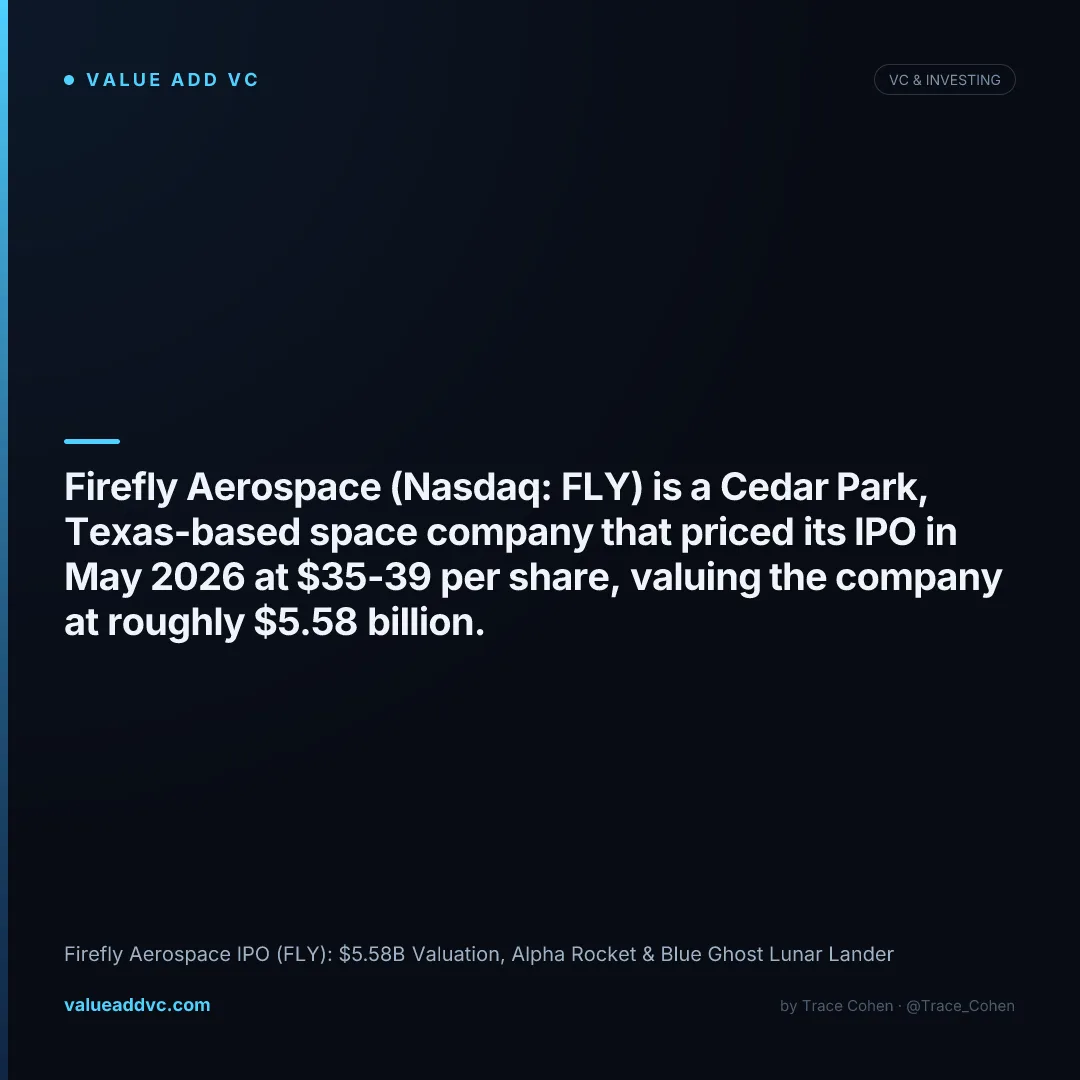
Firefly Aerospace is now public. In May 2026, the Cedar Park, Texas rocket builder priced its Nasdaq IPO at $35-39 per share, landing a valuation of roughly $5.58 billion, on the back of revenue that grew 572% year over year. That is one of the more dramatic growth numbers to hit the public markets this cycle, and it comes from a company that builds two genuinely different products: a small launch rocket and a lunar lander that has already flown for NASA.
But there is a second story running underneath the fundamentals: FLY shares have moved on SpaceX IPO speculation as much as on Firefly's own numbers. Whenever chatter about Elon Musk's company going public resurfaces, space-sector comps — Firefly included — catch a bid. That makes FLY a stock where you need to separate the company from the sector-wide sentiment trade. Here is the full breakdown.
What Firefly Aerospace Actually Builds
Firefly operates across two very different product lines, which is the core of its investment pitch. The first is Alpha, a small-to-medium launch vehicle designed to deliver roughly 1,170 kg to low Earth orbit (LEO). Alpha targets the dedicated small-satellite launch market — customers who do not want to wait in line for a shared ride on a larger rocket and are willing to pay a premium for a dedicated slot and schedule control.
The second is Blue Ghost, Firefly's lunar lander built for NASA's Commercial Lunar Payload Services (CLPS) program — the initiative that pays private companies to deliver science and technology payloads to the Moon ahead of the Artemis crewed missions. Blue Ghost has already flown a mission and delivered payloads to the lunar surface, which gives Firefly something almost no other small-launch company has: a second, NASA-anchored revenue line that does not depend on the commercial satellite launch market at all.
~$5.58B
Valuation
IPO priced $35-39/share, May 2026
+572%
Revenue Growth
Year over year
1,170 kg
Alpha Payload
To low Earth orbit
The IPO: Pricing, Valuation, and the SpaceX Halo Effect
Firefly priced its IPO in May 2026 within a $35-39 per share range, landing on Nasdaq under the ticker FLY at an implied valuation around $5.58 billion. That is a substantial multiple for a company whose launch cadence is still a fraction of Rocket Lab's or SpaceX's, and it reflects investor appetite for space-sector exposure broadly, not just for Firefly specifically.
The stock has reportedly caught additional lift on speculation about a SpaceX IPO. Whenever reports surface that Elon Musk might eventually take SpaceX public — even without a confirmed timeline — the entire space-sector comp set, including Firefly and Rocket Lab, tends to re-rate higher on the theory that a SpaceX listing would validate space-industry valuations across the board and pull in a wave of new retail and institutional capital looking for the "next SpaceX" while the real one is still private, the same dynamic that's now playing out against legacy primes in the aerospace scoreboard against Boeing and Lockheed. That is a sentiment tailwind, not a fundamental one, and it is worth discounting when you assess FLY on its own merits.
The 572% year-over-year revenue growth is real and worth taking seriously — but it is also growth off a small base, which is typical for a company ramping launch cadence and delivering its first lunar missions. The percentage looks extraordinary; the absolute revenue dollars still look like an early-stage aerospace company, not an established launch provider.
Ownership: AE Industrial Partners and the Founder
AE Industrial Partners, a private equity firm focused on aerospace, defense, and space, is Firefly's majority owner. AE Industrial took control of Firefly in 2022 after the company's prior ownership structure — which included a Ukrainian businessman — was forced out over U.S. national security concerns tied to Firefly's work with the Department of Defense and NASA. That restructuring is part of why Firefly's ownership today looks nothing like its early cap table, and it is a useful reminder that companies operating in the defense and space supply chain face a different level of government scrutiny over foreign ownership than a typical consumer or SaaS startup.
Novaport Ventures is another notable investor in the cap table. Founder Tom Markusic brings a résumé that reads like a tour of the modern space industry: stints at NASA, SpaceX, Blue Origin, and Virgin Galactic before starting Firefly. That pedigree matters to investors evaluating execution risk — Markusic has seen how the best (and worst) space companies operate from the inside, which is a meaningful signal in a sector where engineering execution, not vision, is usually the thing that kills companies.
The Competitive Landscape: Rocket Lab, and a Graveyard of Failed Peers
Firefly's most relevant public comp is Rocket Lab (RKLB), which has been public since 2021 and has built a longer flight-heritage record with its Electron rocket, along with its own diversification into satellite components and its Neutron medium-lift vehicle. Rocket Lab is the bar Firefly needs to clear to prove that a small-launch company can scale into a durable, diversified space business rather than staying a single-product rocket shop.
The rest of the small-launch field has not been kind to founders or investors. Virgin Orbit filed for bankruptcy in 2023 after its air-launched rocket system failed to reach commercial viability. Astra struggled with repeated launch failures and was eventually taken private again after its stock collapsed from its 2021 SPAC debut. Both are useful cautionary tales: small launch is a business where a handful of failed missions can wipe out a company's credibility and cash position simultaneously, no matter how strong the initial hype cycle was.
| Company | Status | Outcome |
|---|---|---|
| Firefly Aerospace (FLY) | Public, Nasdaq (May 2026) | $5.58B valuation, 572% YoY revenue growth |
| Rocket Lab (RKLB) | Public, Nasdaq (since 2021) | Established flight heritage, diversifying into spacecraft |
| Virgin Orbit | Bankrupt (2023) | Air-launch system failed commercially |
| Astra | Taken private again | Repeated launch failures, stock collapse from SPAC |
Sources: Company disclosures, Nasdaq, industry press. Track this and other space-sector listings on the IPO Tracker.
Bull Case vs. Bear Case
Bull Case
- + 572% YoY revenue growth is a genuine, rare growth rate
- + Blue Ghost lunar lander gives Firefly a NASA-anchored revenue stream competitors lack
- + Alpha's 1,170 kg payload capacity is competitive in the small-launch niche
- + Founder Tom Markusic has deep operating experience across NASA, SpaceX, Blue Origin, and Virgin Galactic
- + AE Industrial Partners brings institutional discipline as majority owner
- + Eclipse/MLV medium-lift partnership with Northrop Grumman opens a bigger addressable market
- + Small-satellite launch demand keeps growing as constellations proliferate
Bear Case
- - 572% growth is off a small revenue base — the percentage overstates the scale
- - Small launch has a brutal failure history: Virgin Orbit and Astra both collapsed
- - Part of FLY's current price appears tied to SpaceX IPO speculation, not Firefly fundamentals
- - Rocket Lab has a longer flight-heritage track record and more launch cadence
- - Launch businesses are extremely capital-intensive with thin near-term margins
- - A single high-profile launch failure could hit the stock disproportionately hard
- - $5.58B valuation already prices in a lot of future execution that has not happened yet
Firefly is not trying to be SpaceX.
It is trying to prove that a small rocket and a Moon lander can be the same public company — and Wall Street just paid $5.58 billion to find out if that thesis holds.
The Take
The Blue Ghost side of this business looks more compelling than the Alpha side, and that appears to be an underrated point in most of the coverage of this IPO. Small launch is a commodity business waiting to happen — there is only so much pricing power in flying a rocket that carries just over a metric ton to LEO, especially with Rocket Lab already entrenched and SpaceX's rideshare program eating into the demand for dedicated small launches at the margin. What actually differentiates Firefly is that it has a second business — the lunar lander program — that puts it in a small club of companies NASA trusts to deliver payloads to the Moon under CLPS. That is a much harder moat to replicate than a rocket factory, because it is built on government trust and mission heritage, not just engineering.
The part of this story most worth pushing back on is the SpaceX halo effect. It is real — space-sector stocks have clearly caught a bid on SpaceX IPO chatter — but it is also exactly the kind of sentiment-driven repricing that can unwind just as fast as it built up. If SpaceX goes another two years without filing, or if reports of an IPO turn out to be overstated (which has happened before with SpaceX rumors), some of the air comes out of every space-sector comp, Firefly included. Any part of FLY's valuation attributable to that speculation should be treated as borrowed, not earned.
The honest read: Firefly is a legitimate operating company with two real product lines and a growth rate that gets attention for good reason, but a $5.58 billion valuation on 572% growth off a small base, in a sector with a documented history of spectacular blowups (Virgin Orbit, Astra), means the next several launch cycles matter more than the S-1 numbers. Alpha's launch cadence and Blue Ghost's next mission are worth watching closely before treating FLY as anything more than a speculative, sector-driven position.
The Bottom Line
Firefly Aerospace's May 2026 IPO gave the market its first true small-launch-plus-lunar-lander public company, priced at $35-39 per share for a ~$5.58 billion valuation on the strength of 572% year-over-year revenue growth. The Alpha rocket and Blue Ghost lunar lander are genuinely different businesses bundled into one ticker, backed by AE Industrial Partners and led by a founder, Tom Markusic, with a résumé spanning nearly every major space company of the last two decades.
The risk is that small launch has already claimed two prominent public-market casualties in Virgin Orbit and Astra, and that some of FLY's current valuation is riding sentiment around a SpaceX IPO that has not happened and may not happen soon. Rocket Lab remains the closest apples-to-apples comp, and it took years of consistent launch cadence to earn the valuation multiple it commands today — Firefly will need to do the same.
Track FLY and the rest of this year's space and tech listings on our IPO Tracker, browse comparable late-stage private companies on the Unicorn Tracker, and see how venture-backed space companies have performed on the VC Performance Dashboard.
Follow the Firefly Aerospace IPO and other upcoming space and tech offerings on the IPO Tracker at Value Add VC. Reach out at t@nyvp.com or @Trace_Cohen.
Latest from the Pulse
Get VC data most people never see
— free to subscribe
Trace's notes on venture, AI and startups, a few times a week. Join 5,000+ subscribers. No spam.
No spam, unsubscribe anytime. Sent via Substack · Privacy · or subscribe on Substack ↗