
$251 billion has already been raised across 86 US IPOs in 2026 through late July — more than five times all of 2025's $47.4 billion full-year total — and the year isn't close to over.
I've been telling LPs since early this year that 2026 would be the reopening, not just a recovery — and the data has come in even stronger than that. But "the IPO market is back" is doing a lot of work in that sentence. A handful of enormous deals, led by SpaceX's $85.7 billion offering, are carrying most of the headline number, while some of the biggest private companies in the world — Databricks chief among them — are explicitly choosing to sit 2026 out. The window is wide open for the right company at the right size. It is not open for everyone.
IPO Market 2026: The Numbers Behind the Reopening
The IPO market in 2026 has gone from cautiously reopening to genuinely overheated in the span of about six months. Renaissance Capital counted 86 priced US IPOs through late July, already on pace to blow past 2025's count of 216 deals under narrower methodologies (or 347 under broader ones that include smaller listings). Total proceeds of $251 billion dwarf the $47.4 billion raised in all of 2025 and the $33 billion raised in 2024 — a market that spent 2022-2024 rebuilding from an $8.6 billion trough is now raising more in seven months than it raised in the prior three years combined.
Who's Actually Gone Public vs. Who's Still in the Pipeline
SpaceX is the story of the 2026 IPO market almost by itself. The company priced its offering at a $1.75 trillion valuation and, after underwriters exercised their overallotment option, raised $85.7 billion total — a single deal that represents roughly a third of every dollar raised in US IPOs this year. Anthropic filed for its IPO on June 1 following a $65 billion funding round in late May, and OpenAI filed confidentially on June 8 at an $852 billion private valuation. Strava confidentially filed at a $2.2 billion valuation and is reportedly working with Goldman Sachs toward a spring-timed listing. Consumer hardware got its own entrant in September, when Oura filed its S-1 targeting a $16 billion Nasdaq listing.
Not every marquee name is racing to the window, though. Databricks CEO Ali Ghodsi told Bloomberg Television in June that 2026 is "a terrible year to go public," ruling out a listing this year in favor of 2027 — even as the company closed a $5 billion strategic round in August at a $190 billion valuation, up 42% from its $134 billion mark just eight months prior. Canva and Cohere remain rumored for 2027 rather than committed to a 2026 date. For what actually happens between a company deciding to go public and its first day of trading, see our breakdown of the IPO process, and for our full list of what's confirmed, delayed, or still speculative, see our complete 2026 tech IPO calendar, and track live valuations on our tech IPO dashboard.
| Company | 2026 status | Valuation | Key detail |
|---|---|---|---|
| SpaceX | Listed | $1.75T | $85.7B raised post-overallotment, largest 2026 deal |
| Anthropic | Filed (June 1) | $65B (last round) | Filed weeks after closing its May 2026 raise |
| OpenAI | Confidentially filed (June 8) | $852B (private) | Largest private valuation ever to pursue an IPO |
| Strava | Confidentially filed | $2.2B | Working with Goldman Sachs, targeting spring window |
| Databricks | Delayed to 2027 | $134B → $165-175B (talks) | CEO calls 2026 "a terrible year to go public" |
| Canva | Rumored, no date | Not disclosed | Speculation points to 2027 |
| Cohere | Rumored, no date | Not disclosed | No confirmed timing as of late July 2026 |
Figures blended from Renaissance Capital, Bloomberg, company S-1 and confidential filing reports, and Built In / Forge Global 2026 IPO tracking, as of late July 2026.
Why the IPO Market in 2026 Is So Concentrated at the Top
The headline growth numbers hide a concentration problem that's been building since 2024. Even before 2026's mega-deals, 11 IPOs raised more than $1 billion in 2025 — up from just 7 in 2024 — and those 11 deals alone accounted for over 40% of the year's total proceeds. The TMT sector led both deal count and proceeds, taking seven of the top 10 spots by size. 2026 has taken that pattern to an extreme: a single SpaceX deal represents roughly a third of all US IPO proceeds raised this year, meaning the "record year" narrative rests disproportionately on one company's decision to finally list after 24 years private.
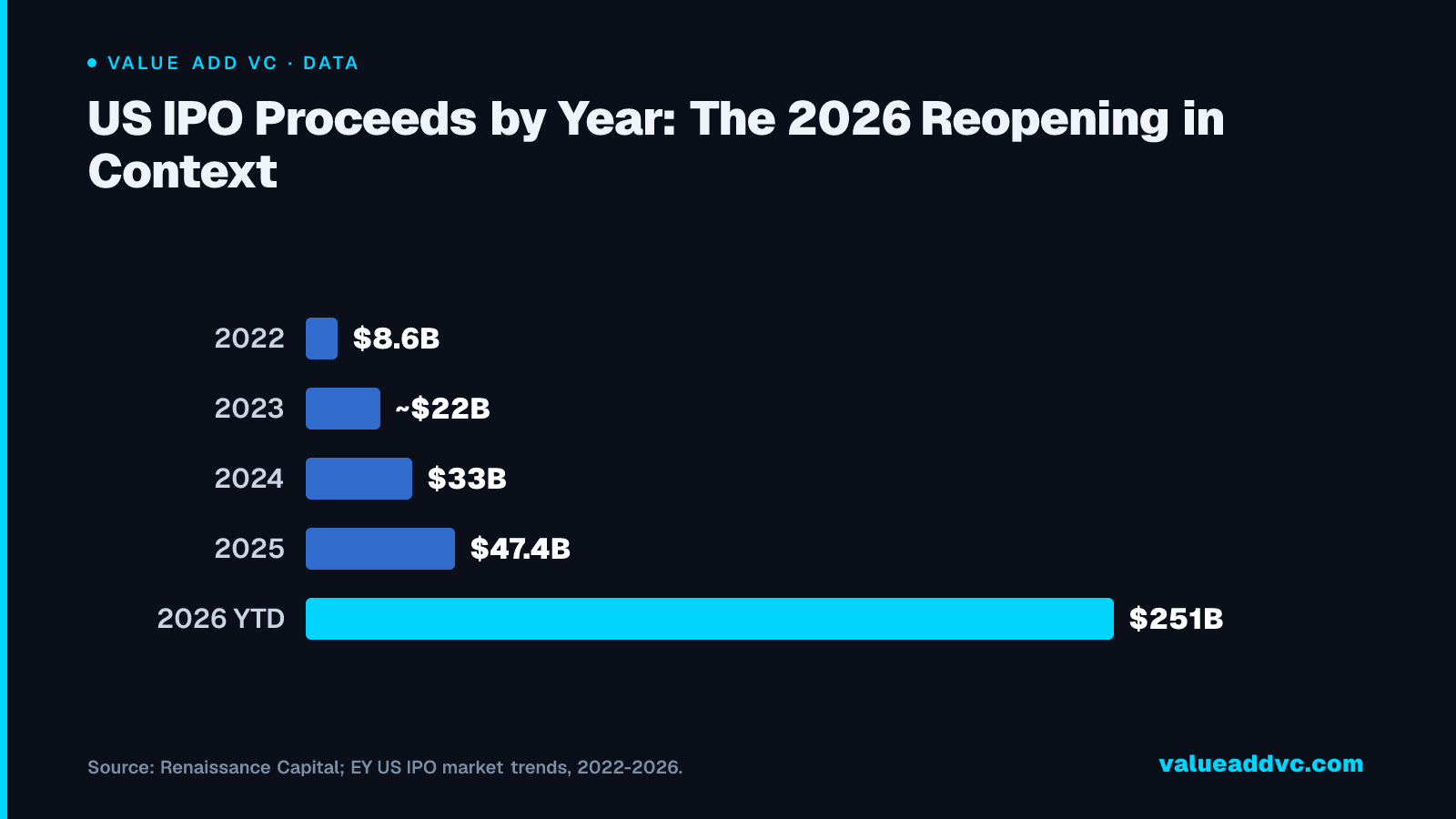
US IPO Proceeds by Year: The 2026 Reopening in Context
2026's $251B (YTD, through late July) already exceeds the prior four full years combined — but a single deal, SpaceX, accounts for roughly a third of it.
Renaissance Capital; EY US IPO market trends, 2022-2026.
Data
| Item | Value |
|---|---|
| 2022 | $8.6B |
| 2023 | ~$22B |
| 2024 | $33B |
| 2025 | $47.4B |
| 2026 YTD | $251B |
For LPs, that concentration matters more than the aggregate. A fund whose returns depend on the broad IPO window reopening for mid-cap SaaS and biotech names is looking at a very different 2026 than a fund with a direct stake in SpaceX, Anthropic, or OpenAI. Our VC fund performance dashboard tracks how exit concentration is showing up in vintage-year TVPI and DPI data across the industry.
What the IPO Window Looks Like for the Rest of 2026
Global H1 2026 IPO proceeds hit $178 billion, up 205% from H1 2025's $58.2 billion, on 524 deals versus 490 a year earlier — growth that's broader than just the US mega-deals, even if the US totals get the headlines. Bankers I've spoken with point to three drivers behind the reopening: interest rates stabilizing after two years of uncertainty, investor risk appetite returning after a long dry spell, and a backlog of late-stage private companies that simply ran out of room to keep raising private capital at ever-higher marks without an exit event.
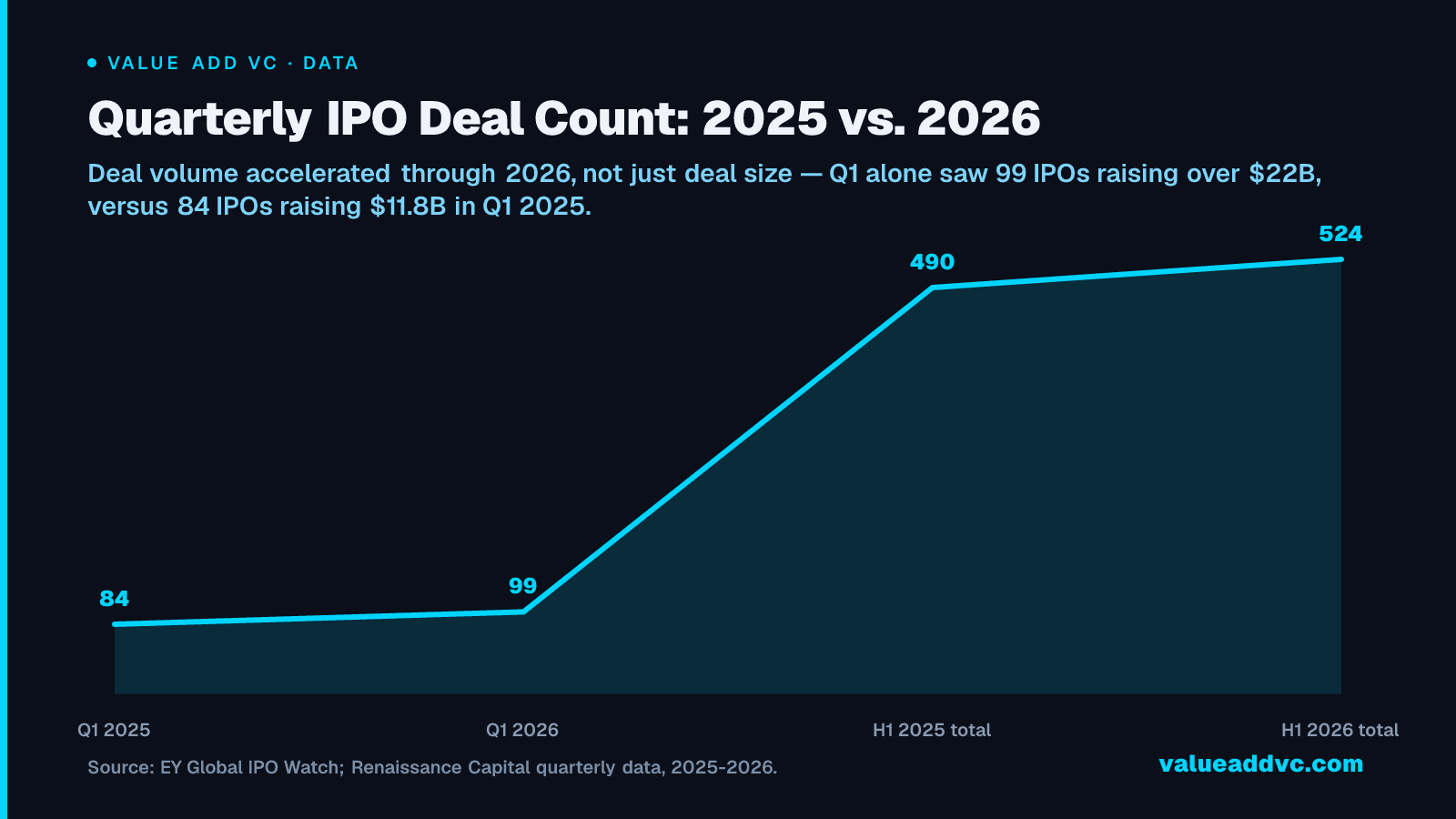
Quarterly IPO Deal Count: 2025 vs. 2026
Deal volume accelerated through 2026, not just deal size — Q1 alone saw 99 IPOs raising over $22B, versus 84 IPOs raising $11.8B in Q1 2025.
EY Global IPO Watch; Renaissance Capital quarterly data, 2025-2026.
Data
| Item | IPO deals |
|---|---|
| Q1 2025 | 84 |
| Q1 2026 | 99 |
| H1 2025 total | 490 |
| H1 2026 total | 524 |
What that means practically for the rest of 2026: expect more names like Strava — sub-$5 billion, founder-led, profitable or close to it — to use this window while it's open, and expect more names like Databricks to keep waiting as long as private capital stays this cheap. A $165-175 billion private valuation with no public-market volatility is a rational trade for a company that doesn't need the liquidity yet. The companies that can't make that trade — because employees need liquidity, because a fund needs a marked exit, because competitive pressure demands a war chest — are the ones actually filing.
What This Means for Founders Weighing an IPO Timeline
If you're a founder or a board member trying to decide whether 2026 is your year, the data argues for splitting the decision into two separate questions rather than one. The first is whether the public market wants your kind of company at all right now — and the answer for AI infrastructure, defense tech, and space is an emphatic yes, given that SpaceX, Anthropic, and OpenAI have absorbed the overwhelming majority of both investor attention and actual dollars. The second, separate question is whether your company specifically needs the liquidity event this year, which is the question Databricks answered with a firm no. A $165-175 billion private mark with continued growth and no quarterly earnings scrutiny is a genuinely better outcome than a rushed public debut into a market that could turn in twelve months.
The practical playbook I've been giving portfolio companies this year: if you're inside the top handful of category leaders with real revenue and a growth story the market already believes (the SpaceX/Anthropic/OpenAI tier), the window is unusually favorable and there's real cost to waiting, since being first to market in a hot category has historically captured a valuation premium the fast-followers don't get. If you're outside that tier — a $2-5 billion company like Strava rather than a $500 billion-plus one — the calculus is closer, and the deciding factor is usually investor liquidity pressure rather than market conditions. Funds nearing the end of their fund life, or facing LP pressure for distributions, are pushing portfolio companies toward 2026 windows even at valuations that a patient board might otherwise wait out.
One thing every banker and GP I've talked to agrees on: the concentration in 2026's numbers means the market is still fragile in a way the aggregate $251 billion figure disguises. A single disappointing debut from Anthropic or OpenAI later this year — even a modest first-day pop instead of a blowout like history's biggest first-day IPO pops — could shift sentiment fast enough to push the next tier of filers back onto the sidelines, the same way 2021's late-year IPO wobbles bled into a two-year freeze. Founders building toward a 2026 or 2027 listing should be tracking these first movers' actual trading performance, not just their filing headlines, before locking in their own timeline. Our unicorn tracker follows valuation marks across the private companies most likely to be 2027's IPO class.
The Bottom Line
The 2026 IPO market has already raised $251 billion across 86 deals — more than five times 2025's full-year total — but that headline is carried by a handful of enormous, AI- and space-adjacent names, not a broad reopening for every late-stage company. SpaceX alone accounts for roughly a third of the year's proceeds, Anthropic and OpenAI have filed and are the deals to watch through year-end, and Databricks' explicit choice to wait for 2027 shows the window still isn't universally open. For funds and LPs, the read isn't "IPOs are back" — it's that the market has become more selective about who gets to go first, and the rest of the pipeline is watching to see how these first movers trade before committing to their own timeline.
Latest from the Pulse
Get VC data most people never see
— free to subscribe
Trace's notes on venture, AI and startups, a few times a week. Join 5,000+ subscribers. No spam.
No spam, unsubscribe anytime. Sent via Substack · Privacy · or subscribe on Substack ↗