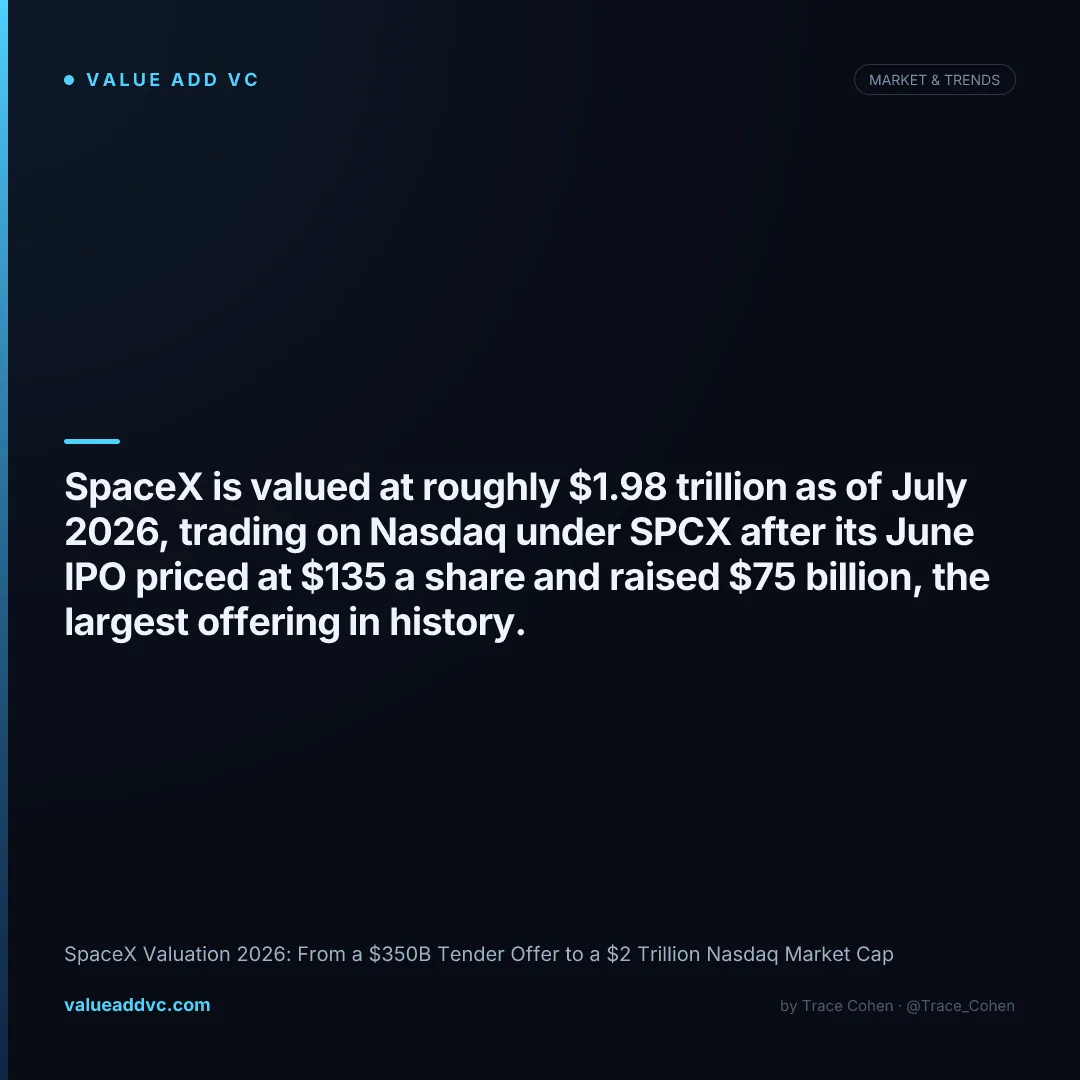
SpaceX is worth roughly $1.5 trillion right now, on Nasdaq, up more than 4x from the $350 billion private valuation its board set just 18 months ago.
SpaceX got priced through opaque insider tender offers four times in 18 months, then let the public decide — and the public's number landed within spitting distance of where the private market had already pushed it. That's rare, and it's worth understanding exactly how it happened.
Here's the full pricing history, from the December 2024 tender offer through the June 2026 IPO to where the stock sits today, and what actually changed once SpaceX had to defend its price in public every single day. It also doubles as a preview of how every other trillion-dollar-plus private company still on the sidelines (from OpenAI to Anthropic) is likely to get priced once it eventually lists.
Sources: Bloomberg, CNBC, TechCrunch, CNN Markets, checked July 2026.
What Is SpaceX's Valuation in 2026?
SpaceX's market capitalization is approximately $1.52 trillion as of late July 2026, with shares trading around $123-$125 on Nasdaq under the ticker SPCX. The company priced its IPO at $135 a share on June 11, 2026, closed its first trading day near $161 (a $2.1 trillion market cap), and has since slipped below its offering price as early volatility worked through the stock.
| Date | Event | Share Price | Implied Valuation |
|---|---|---|---|
| Dec 2024 | Insider tender offer | n/d | $350B |
| Jul 2025 | Insider tender offer | $212 | $400B |
| Dec 2025 | Insider tender offer | $421 | $800B |
| Jun 11, 2026 | IPO pricing (555.6M shares, $75B raised) | $135 | $1.77T |
| Jun 12, 2026 | First-day close, +19% | $161 | ~$2.1T |
| Jul 22, 2026 | Current trading | $123-$125 | ~$1.52T |
Figures blended from Bloomberg, CNBC, TechCrunch, and CNN Markets reporting, December 2024-July 2026. Tender offer share prices before July 2025 were not publicly disclosed with precision.
How SpaceX Was Priced Before the IPO
Before it went public, SpaceX's valuation was set entirely by periodic insider tender offers — twice-yearly windows where the company's board and CFO, Bret Johnsen, set a price at which employees and early shareholders could sell shares back to the company or to approved buyers. There was no public order book and no market-clearing mechanism; the price was effectively a negotiated number reflecting demand from existing holders, recent SpaceX milestones (Starship progress, Starlink subscriber growth), and comparable private mega-rounds elsewhere in the market.
That process pushed SpaceX from a $350 billion valuation in December 2024 to $400 billion by July 2025 (at $212 a share) and then to $800 billion by December 2025 (at $421 a share) — a doubling of the share price in five months. The tech IPO pipeline had been watching SpaceX as the marquee name that would test whether private mega-valuations could survive contact with public markets, and in February 2026 the company merged with xAI in a deal that valued the combined entity at $1.25 trillion, adding an AI-compute narrative on top of the rockets-and-satellites story just months before the S-1 filing.
What the Public Listing Actually Changed
Going public changed three things that private tender offers never had to reckon with: continuous price discovery, a revenue multiple investors could underwrite in real time, and daily scrutiny from short sellers and analysts. SpaceX raised $75 billion by selling 555.6 million shares at $135 apiece, pricing the company at $1.77 trillion the second trading opened on June 12, 2026 — more than triple the size of the largest prior U.S. IPO and more than double Saudi Aramco's $25.6 billion raised in its 2019 record-setting listing. The stock popped 19% on day one to close near $161, implying a roughly $2.1 trillion market cap, before drifting back down toward the IPO price by early July as a lawsuit tied to a data-center dispute and a $45 billion Anthropic compute contract rattled sentiment.
| IPO | Year | Amount Raised | IPO Valuation |
|---|---|---|---|
| SpaceX | 2026 | $75B | $1.77T |
| Saudi Aramco | 2019 | $25.6B | $1.7T |
| Alibaba | 2014 | $25B | $168B |
| Meta (Facebook) | 2012 | $16B | $104B |
| Visa | 2008 | $17.9B | $45B |
| ARM Holdings | 2023 | $4.9B | $54.5B |
Figures blended from company filings, Bloomberg, and Reuters reporting on each IPO's pricing date. SpaceX raised more capital than the next two largest IPOs on this list combined.
Why SpaceX's Valuation Multiple Is So High
SpaceX's $1.77 trillion IPO valuation implied roughly a 94x multiple on its $18.7 billion in 2025 revenue, which grew 43% from $13.1 billion in 2024. That is an extraordinarily rich price-to-sales ratio for a company that builds rockets — closer to what investors pay for hyper-growth AI software than for aerospace manufacturing. The multiple is doing a lot of work: it's pricing in Starlink's continued expansion (10 million-plus active customers across 160 countries as of February 2026, with Quilty Space projecting 16.8 million subscribers by year-end), Starship's eventual commercial cadence, in-space AI compute, and the xAI merger's data-center ambitions, not just the launch business SpaceX is best known for. For the line-by-line segment breakdown behind those numbers, see our SpaceX S-1 and Q2 2026 revenue breakdown.
Strip out the narrative and the actual profit engine is narrower: Starlink generated $11.4 billion of SpaceX's $18.7 billion in 2025 revenue (61%) and $4.4 billion of operating profit at a 63% EBITDA margin, making it the company's only clearly profitable segment. Launch services, Starship development, and the newly folded-in xAI compute business are still burning cash. That concentration is exactly why 25 of 26 covering analysts rate the stock a buy with an average $205 price target, while the stock itself has already round-tripped from $161 back toward its $135 IPO price — the market is still deciding how much of that Starlink cash flow should carry a trillion-dollar rocket company's price tag. You can track how SpaceX and other recent mega-cap listings are trading relative to their IPO price on our tech IPO dashboard.
SpaceX Valuation 2026: Is the Stock Overpriced?
The honest answer is that nobody knows yet, and that's the entire point of going public — SpaceX can no longer set its own price through a tender offer its own CFO administers. At a 94x revenue multiple, the stock has almost no margin for error: any slip in Starlink subscriber growth, a Starship setback, or trouble monetizing the xAI compute tie-up could compress the multiple fast, which is exactly what the early July pullback toward the IPO price hints at. A smaller, cheaper piece of the Starlink cash-flow story through a vehicle like RVI's known SpaceX exposure may be the more attractive way to get exposure than chasing the stock at a fresh trillion-dollar mark. Still, for investors who believe Starship and in-space AI compute are underpriced optionality, the current pullback from $161 toward $135 is the first real entry point the public market has offered.
The Next Test for SpaceX's Valuation: Lockup Expirations
SpaceX structured its post-IPO lockups in staggered tranches specifically to avoid the single-day supply shock that has hammered other mega-cap debuts. Roughly 20% of locked shares free up after the company reports Q2 2026 earnings in late July, with additional 7% tranches releasing through August, September, and October, and a larger batch tied to Q3 earnings ahead of the full 180-day lockup clearing in December 2026. One 10% tranche only unlocks early if the stock trades at least 30% above the $135 IPO price — $175.50 — meaning that piece of insider selling pressure is explicitly tied to strength, not weakness, in the stock.
Elon Musk's roughly 42% stake, about 6.4 billion shares, is under a separate, extended lockup that doesn't expire until June 2027 with no early-release provision — a full year past the standard window. That structure matters for the valuation conversation because it removes the single largest potential seller from the market for the next 11 months, concentrating near-term supply risk in the smaller employee and early-investor tranches instead. With the stock already trading closer to its $135 IPO price than its $161 first-day close, how the market absorbs those July-through-December unlocks will likely do more to determine whether SpaceX holds a $2 trillion valuation than any single Starship launch or Starlink subscriber update.
Bottom line: SpaceX went from a $350 billion private valuation to a ~$1.5 trillion public market cap in 18 months, and the number that matters most isn't the peak — it's that the stock has already given back roughly $600 billion in market value since its first-day close as the public market starts pricing Starlink's cash flow against everything else the company is promising. That volatility is the real difference between a tender offer and a ticker. Track SpaceX and other recent mega-cap debuts on our tech IPO tracker at Value Add VC.
Latest from the Pulse
Get VC data most people never see
— free to subscribe
Trace's notes on venture, AI and startups, a few times a week. Join 5,000+ subscribers. No spam.