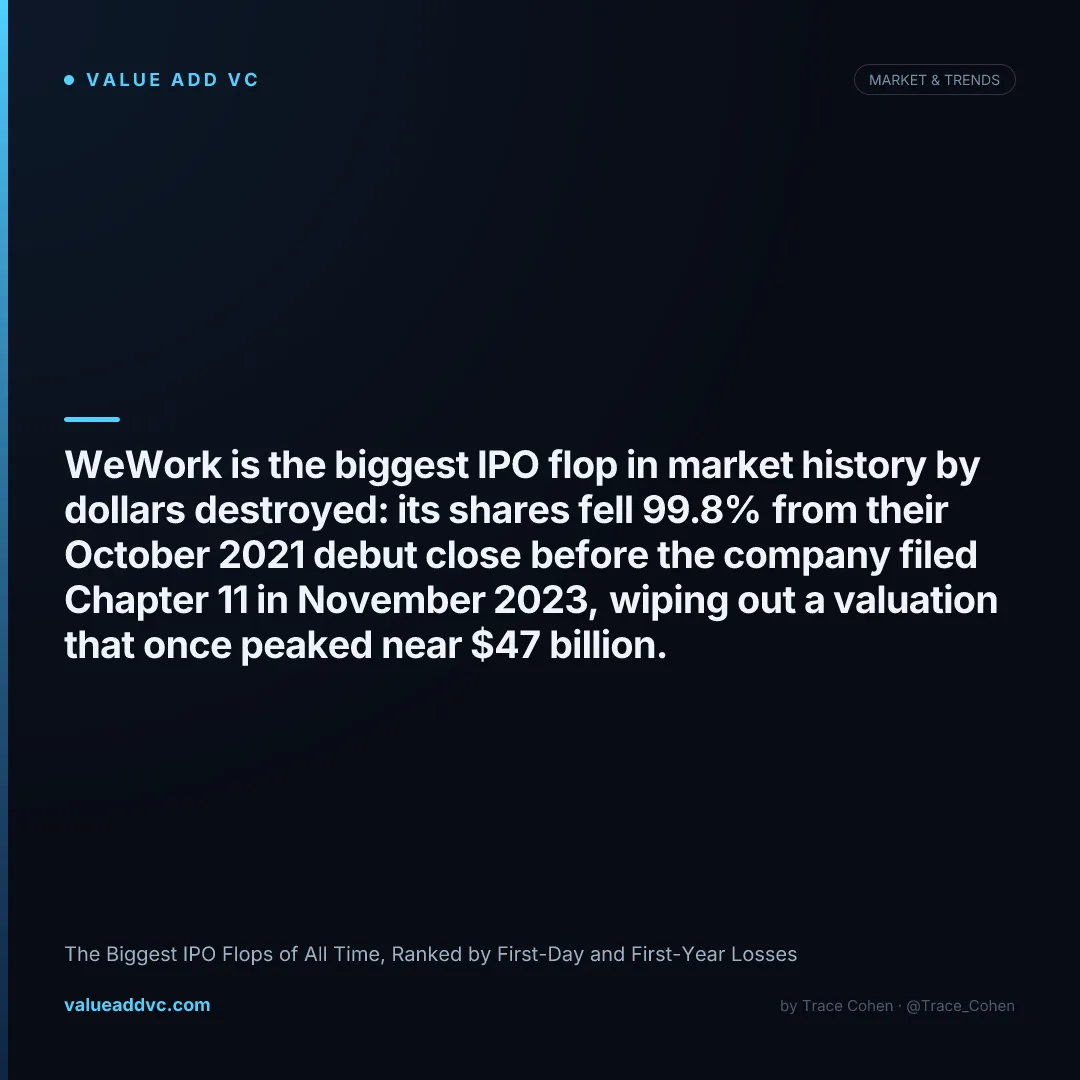
WeWork's shares fell 99.8% from their October 2021 debut before the company filed Chapter 11 bankruptcy just over two years later, and Webvan burned through more than $1.5 billion and collapsed in 18 months after its 1999 IPO. That's the short answer. The longer answer is more interesting.
Every IPO flop below raised real capital from public investors on a story that didn't hold. I've sat on the other side of the table for 65+ investments, and the pattern across these eight is consistent: the flop rarely shows up in the S-1 numbers themselves — it shows up in the gap between the growth story management sells on the roadshow and the unit economics nobody wants to underwrite in public.
What are the biggest IPO flops of all time?
WeWork is the biggest IPO flop of all time by dollars destroyed, falling from a peak private valuation near $47 billion to Chapter 11 bankruptcy within roughly four years of its delayed 2021 public debut. Webvan and Pets.com destroyed value faster — both went from IPO to bankruptcy filing in under 18 months during the 1999–2001 dot-com collapse — while Blue Apron, Peloton, Groupon, Snap, and Funko round out the list with losses ranging from 41% on day one to more than 99% over several years.
Below is the full ranked list, with what each company raised, what it was worth at its peak, and exactly how the collapse played out.
The 8 biggest IPO flops, ranked
How far each stock fell from its IPO or peak price
Percentage decline flattens out timing differences — a two-year collapse and an 18-month collapse both register as "the stock is basically gone" — but it's still the cleanest way to compare flops that happened decades apart under completely different market conditions.
Funko's 41% figure is a single-day loss, not a peak-to-trough decline — the stock partially recovered in subsequent years, unlike the others on this list.
IPO flops compared: valuation at peak, what triggered the collapse, and where they ended up
| Company | Peak valuation | IPO year | Decline | Outcome |
|---|---|---|---|---|
| WeWork | $47B (2019 private) | 2021 (SPAC) | -99.8% | Chapter 11 bankruptcy, Nov 2023 |
| Webvan | $6B | 1999 | -100% | Bankruptcy, July 2001 |
| Pets.com | ~$300M | 2000 | -98% | Liquidated, Nov 2000 |
| Blue Apron | ~$2B | 2017 | -99% | Sold to Wonder Group, 2023 |
| Peloton | ~$50B | 2019 | -96% from peak | Still public, restructured |
| Groupon | $13B | 2011 | -80%+ in year one | Still public, reverse-split |
| Snap | ~$33B at IPO | 2017 | -68% from IPO price | Still public, 2026 earnings beat |
| Funko | ~$680M at IPO | 2017 | -41% day one | Still public, partially recovered |
Figures are 2026 estimates blended from company IPO and bankruptcy filings, HowStuffWorks, NBC News' WeWork bankruptcy coverage, and contemporaneous market reporting. Peak valuations reflect the highest publicly reported figure at or near each company's IPO or all-time-high stock price.
How We Ranked These
Ranking weighs two factors: total percentage decline from IPO or peak price, and speed of collapse to bankruptcy or effective wind-down where applicable. WeWork ranks first because it combines both a near-total percentage loss (-99.8%) and a clear bankruptcy filing on a company that had once been the most richly valued startup in the US. Webvan and Pets.com rank close behind on sheer speed — both went from ringing the opening bell to filing for bankruptcy in under 18 months, a collapse pace nothing else on this list matches. Companies that are still trading publicly today, like Snap and Peloton, rank lower than companies that went bankrupt, since a stock that still exists at least retains some residual value and a path to recovery. Figures are sourced from company filings and contemporaneous reporting from HowStuffWorks, Forbes, and financial news archives — see our editorial standards.
What the "biggest flop" headline misses
A first-day or first-year collapse isn't always the end of the story. Facebook's 2012 IPO is the most famous counterexample — a Nasdaq technical glitch and a rocky first six months dropped the stock roughly 50% from its $38 IPO price, and financial media called it a flop for most of that first year. It's now one of the most valuable companies in the world. Snap, sitting at number 7 on this list, is showing early signs of the same pattern nine years out: a real earnings beat and a monthly active user base nearing 1 billion don't erase 68% of lost value, but they complicate the "permanent flop" framing.
The other thing this kind of list obscures: announced valuation and delivered value are different numbers. WeWork's "$47 billion" figure was a private mark-to-model number from a single funding round, not a price anyone paid for the whole company on an open market — which is exactly why the eventual IPO attempt, where public investors actually had to underwrite that number, is what exposed the gap.
Why do so many high-profile IPOs flop?
The common thread across all eight is a growth story that outran unit economics well before the IPO — not a market crash that caught a healthy business off guard. Webvan and Pets.com lost money on every single transaction. WeWork's core lease-arbitrage model required constant new capital to paper over negative cash flow. Blue Apron's customer acquisition cost consistently exceeded lifetime value once early-adopter enthusiasm faded. Peloton and Groupon both mistook a demand spike — pandemic lockdowns, early daily-deals novelty — for a durable growth rate and scaled cost structure to match the spike rather than the trend line.
For founders and investors, the read-through is the same one we cover in how to read an S-1: the cumulative losses section and the customer cohort economics matter more than the headline growth rate on the cover page. Track how current-year listings are pricing against this history on the Tech IPO Tracker, and see the opposite end of the spectrum — debuts that popped instead of flopping — in our ranking of the biggest IPO first-day pops of all time.
The Bottom Line
Every flop on this list had a growth story that outran its unit economics before it ever rang the opening bell.
WeWork and Webvan prove the two ways to lose it all: slowly over years, or in under 18 months flat.
Track how current-year IPOs are pricing against this history on the Tech IPO Tracker at Value Add VC.
Latest from the Pulse
Get VC data most people never see
— 100% free
Weekly benchmarks, valuations, and fund data. Join 5,000+ investors. No spam.