
Founders with genuinely great visions are common. Few have the execution to match them.
The founders who tell the most cinematic story about where the world is going are often the slowest to build toward it. And the founders who barely articulate a 5-year plan — but ship something new every two weeks — are the ones who end up in the headlines.
Vision is table stakes for fundraising. It is not what gets you to product-market fit. At pre-seed and seed, execution is the only currency that actually compounds.
What the Data Actually Shows
CB Insights analyzed over 1,100 startup post-mortems through 2024 and found that the top three causes of failure — no market need (35%), ran out of cash (29%), and wrong team (23%) — are all execution failures in disguise. Nobody runs out of cash because their vision was wrong. They run out because they did not hit the milestones needed to justify the next raise.
35%
of startups fail due to no market need
Almost always a signal of insufficient early customer discovery and iteration
29%
fail by running out of cash
A pace problem, not an idea problem — execution sets the burn-to-milestone ratio
14 months
median time from seed to Series A
Founders who ship bi-weekly compress this. Those who strategize bi-weekly miss the window
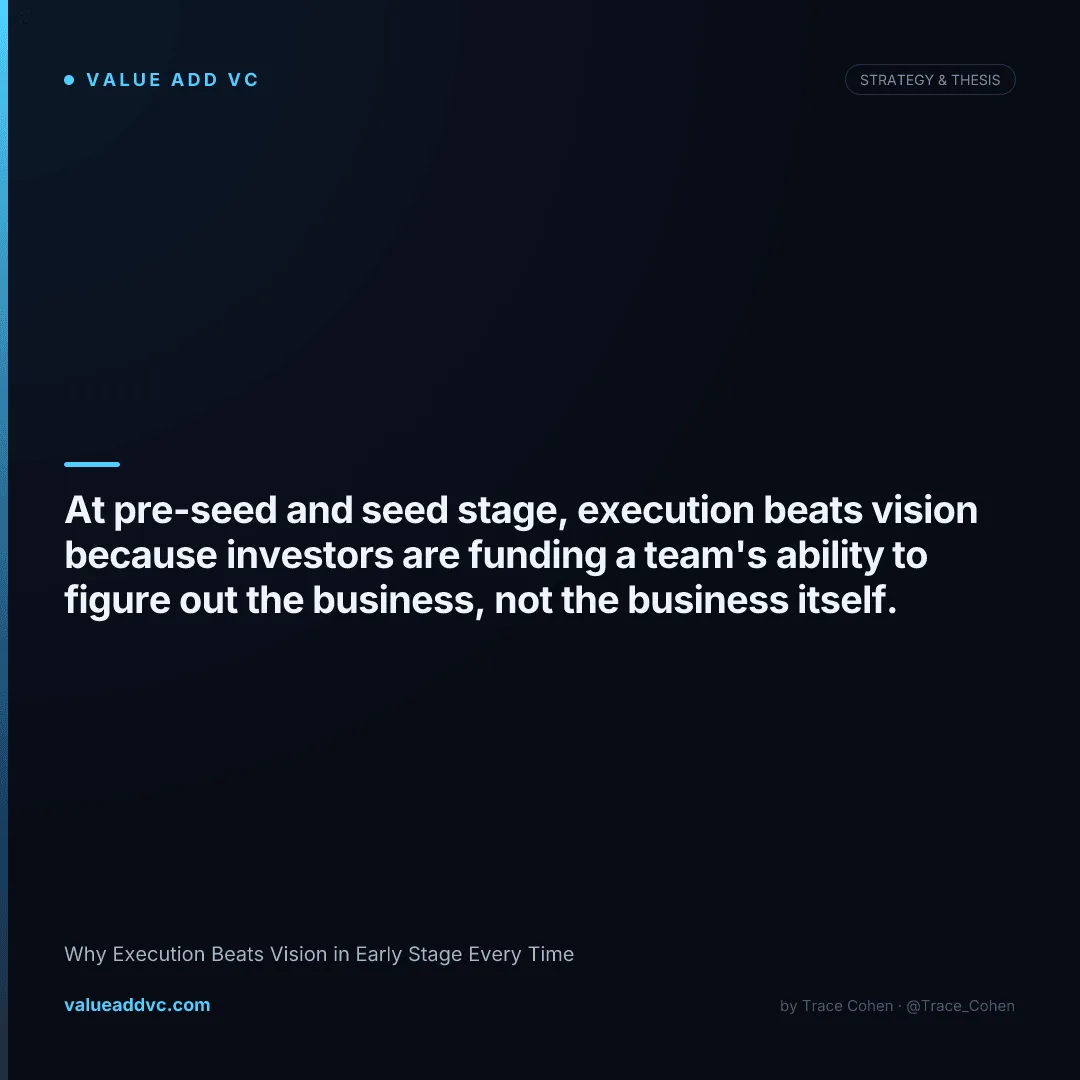
At the seed stage, investors are not funding a business. They are funding a team's ability to figure out the business. And the only evidence of that ability is what the team has already done — not what they have planned.
Vision Has a Role — Just Not the One Founders Think
Vision does matter — it matters enormously, but for a different reason than most founders assume. Vision is what attracts great co-founders, early employees, and the first believers among investors. It sets a direction and prevents local-maximum thinking. A founder without vision eventually optimizes themselves into a dead end.
But vision without traction is just storytelling. And at early stage, storytelling without proof is a liability. The best investors — the ones who have consistently found companies at the pre-seed that turned into breakouts — are not buying the story. They are buying the evidence of motion behind the story.
Sequoia's famous memo on Zoom from 2018 did not fund the vision of video-first work. They funded Eric Yuan's track record at Cisco, the product NPS scores, and the revenue growth rate — all execution signals. The vision came after the evidence, not before it.
The Six Signs a Founder Executes (vs. Talks)
Specific recent output
They can name something they shipped, closed, or learned in the last two weeks. Not a roadmap item — an artifact.
Honest milestone accounting
They know their metrics cold and can tell you where they missed, not just where they won. Miss-and-learn velocity is a quality signal.
Short iteration loops
Design → build → test cycles measured in days, not quarters.
Customer pull evidence
Not 'we have 5 pilots in conversation' but 'we have 3 paying, 2 just renewed, and one asked us to build X.' Pull vs. push is everything.
Low meeting overhead
They are building, selling, and talking to users — not coordinating.
Uncomfortable specificity
When asked about a problem, they have a specific answer with a number attached. Visionaries give frameworks. Executors give data.
Why AI Makes This Even More True in 2026
The marginal cost of building has collapsed. In 2019, a two-person team needed 9–12 months to ship an enterprise-grade MVP. In 2026, that same MVP ships in 6–8 weeks with AI-assisted coding, off-the-shelf infrastructure, and vertical LLMs. The tooling gap that once protected slow executors is gone.
That means the market moves faster. Competitors emerge in weeks. The window from "good idea" to "ten clones exist" has shrunk from 18 months to under 6 in most software categories. In that environment, the vision advantage compounds more slowly and the execution advantage compounds faster.
Among companies today, the ones winning in 2025–2026 are not necessarily the most differentiated in their positioning — they are the most relentless in their shipping cadence. They close customer feedback loops in real time and their product is measurably better every 30 days. Vision sets the target. Execution closes the distance.
What Investors Are Actually Grading at Seed
What Moves the Needle
- ✓ First $10K–$50K in revenue (even if messy)
- ✓ 3+ customers who use the product weekly without being asked
- ✓ Measurable improvement in core metric over 90 days
- ✓ Evidence team can hire and onboard fast
- ✓ Founder who has already done something hard before
What Barely Matters at This Stage
- ✕ 10-year TAM projections without bottom-up grounding
- ✕ "If we get 1% of the market" math
- ✕ A slide deck that took longer than a prototype
- ✕ Partnerships "in discussion" with no signed paper
- ✕ A strategy for year 5 when year 1 is still a question mark
The honest advice I give every early-stage founder I meet:
Your vision should fit on a Post-it. Your execution should fill a changelog. Investors fund evidence — not ideas — and the only evidence that matters at pre-seed is what you have already shipped, sold, and learned this month.
Trace Cohen is a 3x founder and has made 65+ investments across pre-seed and seed stage companies. Follow more at his newsletter and Value Add VC.
Latest from the Pulse
Get VC data most people never see
— free to subscribe
Trace's notes on venture, AI and startups, a few times a week. Join 5,000+ subscribers. No spam.
No spam, unsubscribe anytime. Sent via Substack · Privacy · or subscribe on Substack ↗