
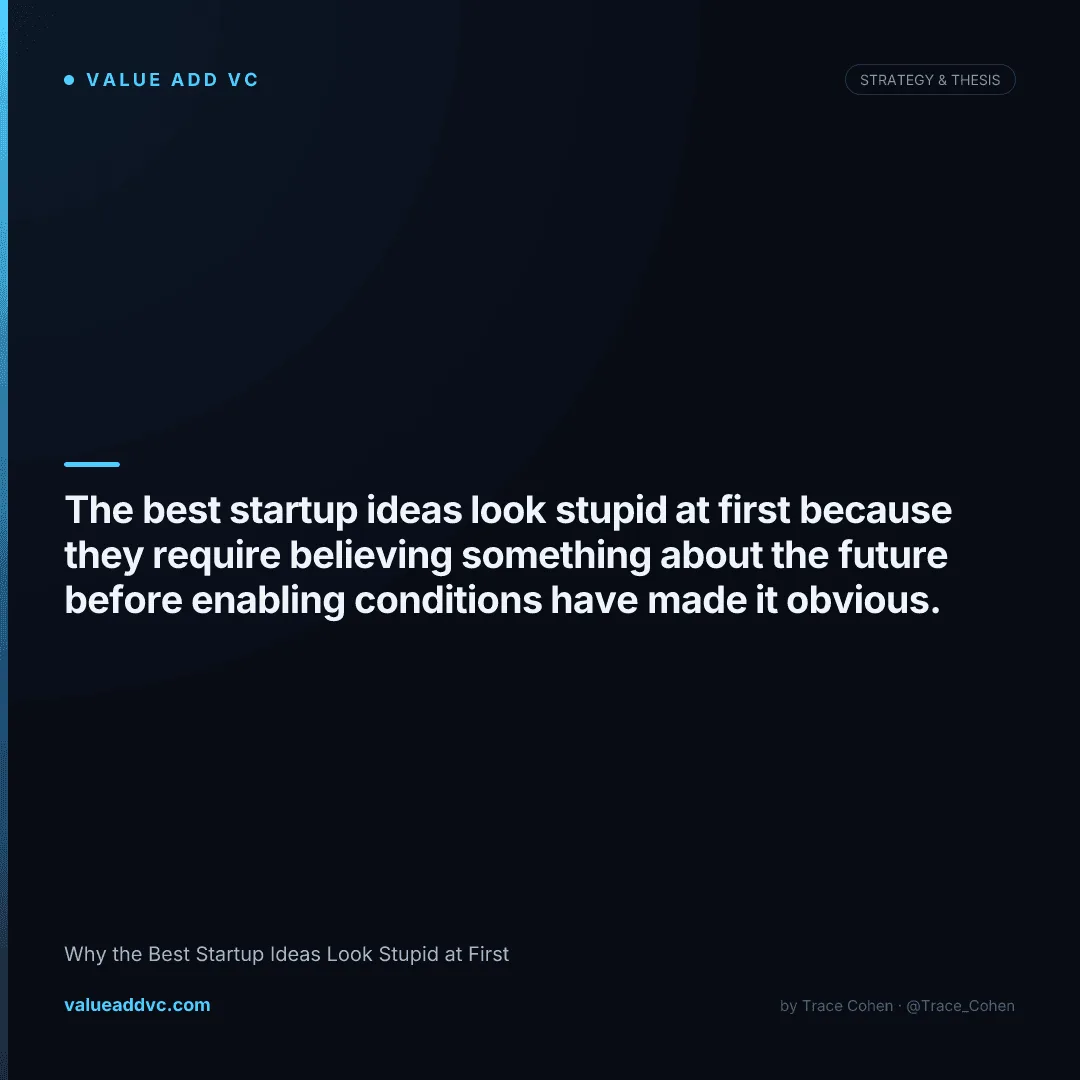
In 2008, Airbnb pitched the idea of letting strangers sleep in your home to every major VC in Silicon Valley. Seven of them passed. One prominent investor reportedly said it was "a cute idea" but not a business. That company is now worth over $75B. Uber launched as a black car service for San Francisco tech workers who thought hailing a cab was beneath them. Twitter was described by early employees as "a status update tool for narcissists." Every generational company looked stupid first.
This is not survivorship bias dressed up as wisdom. It is a structural feature of how markets work — and understanding it is the difference between investing in and building companies that matter versus crowding into the obvious lanes everyone else is already sprinting down.
The Mechanics of Looking Stupid
Truly contrarian ideas look stupid for one of four specific reasons — and only one of them is actually bad. Understanding the difference is the core competency most VCs and founders lack.
- •The market doesn't exist yet: The idea is right but the enabling conditions — infrastructure, consumer behavior, regulation — haven't arrived. Uber without smartphones is a logistics nightmare. This is the timing problem, not an idea problem.
- •The incumbent assumption is wrong: Conventional wisdom says X is the winner. The contrarian bet is that X's advantages are more fragile than they appear. Zoom looked stupid when WebEx, Skype, and Google Hangouts already existed. It won because those incumbents optimized for the enterprise IT buyer, not the end user.
- •The TAM looks tiny until it doesn't: The initial market is genuinely small. Nobody in 2004 saw Facebook as a global communications platform — it was a college directory. The compounding surface area of the idea is invisible until adoption creates it.
- •Actually just a bad idea: The idea is wrong. The problem doesn't exist at scale, the unit economics are broken at the foundation, or the timing window has already closed. This is the only case where "looks stupid" actually means stupid.
The first three produce most of the venture returns in history. The fourth is what most people think they're protecting against when they kill contrarian ideas in pitch meetings.
Why Smart People Pass on Great Ideas
The same pattern repeats across every technology cycle with remarkable consistency. The smartest, most credentialed investors in the world pass on the biggest companies — not because they're stupid, but because their pattern-matching is optimized for the last cycle.
The partnership dynamics at established VC firms compound this problem. To get an investment approved, a deal typically needs to clear multiple partners, each with veto power and their own mental model of what a good company looks like. The more consensus required, the more the outliers get filtered out. The biggest misses in venture history — Amazon at $50M pre-IPO, Google before the first close, Airbnb — all failed the consensus test. One or two believers wasn't enough to overcome the room.
There's also a social cost to championing ideas that look stupid. Being wrong about an obvious-sounding bet is forgivable. Being wrong about a bet that made you look naive in the partner meeting is career-defining in a different way. That asymmetry silences internal advocates for contrarian ideas at exactly the firms with the most capital to deploy into them.
In venture, the deals most regretted are rarely the ones that were tried and didn't work. They are the ones that seemed weird enough in the moment that social proof at the table killed conviction before the idea got a real shot. The misses were never about analysis. They were about nerve.
The Contrarian Conviction Framework
There is a real difference between "this looks stupid because we're early" and "this is actually bad." A framework for telling the difference:
The Laugh Test
Do smart, informed people laugh when they first hear it?
Often a positive signal that you're in genuinely contrarian territory
The Conviction Test
Can you articulate exactly why the conventional view is wrong?
If you can't state the wrong assumption precisely, you don't have an edge
The Timing Test
What changed in the last 12–24 months that makes this possible now?
A specific enabling change — technical, regulatory, behavioral — must exist
The First 1,000 Test
Is there a real group of people who will pay for this immediately?
Not the eventual TAM — the specific humans who want this today
What This Means in Practice in 2026
Right now there are ideas circulating that most of the market is dismissing as obviously wrong. Some of them are obviously wrong. But a subset of them look exactly like Airbnb in 2008 or Zoom in 2017 — structurally correct, enabled by recent infrastructure changes, and rejected because the conventional wisdom hasn't caught up yet.
The ideas worth watching in 2026 that have the highest "sounds ridiculous" to "might be right" ratio: AI agents replacing entire mid-market SaaS categories at one-tenth the cost, physical-world robotics in verticals everyone assumed were 15 years away, and financial infrastructure being rebuilt entirely in real-time settlement systems that make the existing correspondent banking system look like a fax machine. None of these are guaranteed. All of them would have sounded like science fiction at a 2022 pitch meeting.
The founders worth backing most quickly are the ones who have a genuinely contrarian view — not a slightly different implementation of something proven, not a feature wrapped in a company — and can defend it with the precision of someone who has lived in the problem long enough to know exactly where the conventional wisdom broke down. That combination is rare. When you find it, the fact that it sounds weird is a feature, not a bug.
If your idea can survive a roomful of smart people laughing at it, and you can still explain precisely why they're wrong — you're probably onto something real.
Stay current with VC and startup trends at Value Add VC. Originally published in the Trace Cohen newsletter.
Latest from the Pulse
Get VC data most people never see
— free to subscribe
Trace's notes on venture, AI and startups, a few times a week. Join 5,000+ subscribers. No spam.
No spam, unsubscribe anytime. Sent via Substack · Privacy · or subscribe on Substack ↗