
"Network effects" is the most abused phrase in startup pitches after "AI-powered." Founders often claim a network effect moat when what they actually have is a referral program, a mailing list, or a slightly viral onboarding flow.
Real network effects are rare. And they span a spectrum from near-impenetrable to essentially irrelevant. The type of network effect matters more than whether you claim to have one at all.
The Six Network Effect Types That Actually Matter
NFX has catalogued 13 varieties. In practice, only six show up consistently in durable unicorn outcomes:
Direct (same-side)
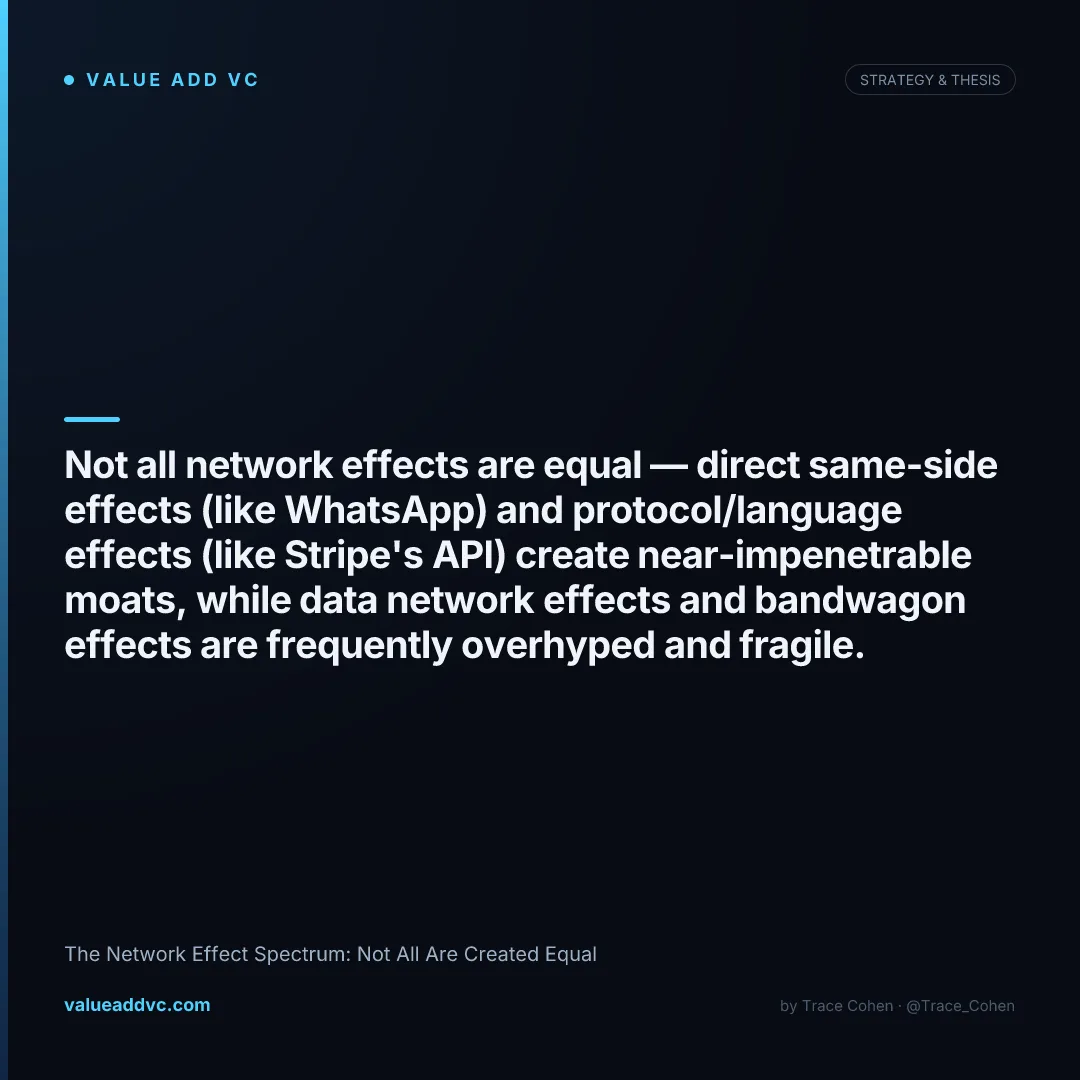
Very StrongValue increases as more people on the same side join. WhatsApp hit 2 billion users with a team of 55 before Facebook acquired it for $19B. Every user made the product more valuable for every other user — no marketplace mechanics required.
Indirect (two-sided marketplace)
Strong (hard to build)More supply attracts more demand, and vice versa. Airbnb, Uber, Stripe. The 2022–2023 marketplace correction proved these are fragile when growth outpaces matching quality. Both sides must be cultivated simultaneously or the whole system degrades.
Data network effects
OverhypedMore usage generates better training data, which improves the product, which attracts more users. Every AI company claims this. Almost none have it — because the feedback loop between usage, data capture, and measurable product improvement has to be tight and non-replicable.
Protocol / language effects
Strongest (rarest)You win because you define the standard. QWERTY. HTML. Stripe's API conventions. Figma's file format. These are the strongest long-term moats and the rarest. They are almost impossible to build intentionally — they emerge from early adoption at critical mass.
Bandwagon / social proof
Moderate (fragile)Adoption driven by social pressure and FOMO. Slack spread through companies because entire teams were already on it. But bandwagon effects can collapse as fast as they build — once sentiment shifts, the same dynamic that created the moat accelerates the exodus.
Local / geographic
Moderate (territorial)Network effects bounded by geography. DoorDash dominated specific cities before scaling nationally. Easier to build than global effects — but a well-funded competitor can pick off markets one by one. The local moat requires constant reinforcement.
Why Weak Network Effects Are Worse Than None
Here is something nobody tells founders: a weak network effect can actively hurt you. When you believe you have a moat you don't actually have, you under-invest in other forms of defensibility. You hire for scale before proving the effect compounds. You price aggressively assuming switching costs will protect you. Then a competitor with 3x your funding arrives, replicates the core features, and your claimed network effects evaporate — because your users just hadn't found an alternative yet.
B2B SaaS products claiming a "data advantage" that was really a one-time integration — not a compounding feedback loop. Marketplaces with no repeat purchase behavior, so there was no network benefit to being on the platform — just distribution. Consumer apps with referral mechanics that drove acquisition but zero retention uplift once the referral bonus expired.
There is one test that applies to every company that claims a network effect:
The Subtraction Test
If you removed your top 10% of users tomorrow, would the product become measurably worse for the remaining 90%? If the answer is no — or even maybe — you do not have a meaningful network effect. You have retention. Those are not the same thing.
What the Unicorn Outcome Data Says
Looking at the highest-multiple exits from 2015–2025, the companies achieving 10x+ premiums over category peers almost universally had one of three network effect types: direct same-side, two-sided marketplace with a proprietary data layer, or protocol/language effects. The correlation is not subtle.
- •WhatsApp ($19B acquisition): 55-person team, 2B users — pure direct network effect with zero paid acquisition at scale
- •Stripe ($95B valuation): Protocol effects plus developer switching costs — the API became the standard before any competitor could contest it
- •Airbnb ($75B market cap): Two-sided marketplace with a cold-start problem so brutal that no competitor has cracked it in 16 years despite unlimited capital attempts
- •Figma ($20B acquisition bid): Collaborative network effects plus community-generated content — designers couldn't leave because their entire workflow was tied to shared files and community templates
- •Reddit ($10.5B IPO valuation): 20 years of cultural capital that no competitor can buy or rebuild — the ultimate bandwagon effect that converted into a genuine community moat
Data network effects — despite the hype — have consistently underdelivered. Google still dominates search not because of data volume, but because the feedback loop between search quality, user engagement, and data capture is so tight that even perfect replication of the data wouldn't replicate the loop. Most "data moat" companies have the data, not the loop.
What Founders Should Do With This
If you're building a company and want an honest assessment of your network effects, run through this framework:
Who creates value for whom?
Map which users make the product better for other users — and how directly. If you can't name the mechanism, you may not have it.
Is the effect local or global?
Local network effects are easier to establish but require continuous territorial defense. Global ones are rare and nearly impossible to displace once they tip.
Does your data actually compound?
More data improving your model is only a moat if the improvement rate exceeds what a competitor with a fraction of your data could replicate in 18 months.
What is the cold-start cost for a competitor?
The strength of your network effect is roughly equal to the cost a well-funded competitor must pay to replicate it. If that cost is $50M, it's not a moat.
The question isn't whether you have network effects.
It's whether your network effect is still working in year three when a competitor with 3x your funding tries to buy their way into your market.
Explore more startup strategy frameworks at Value Add VC. Originally published in the Trace Cohen newsletter.
Latest from the Pulse
Get VC data most people never see
— free to subscribe
Trace's notes on venture, AI and startups, a few times a week. Join 5,000+ subscribers. No spam.
No spam, unsubscribe anytime. Sent via Substack · Privacy · or subscribe on Substack ↗