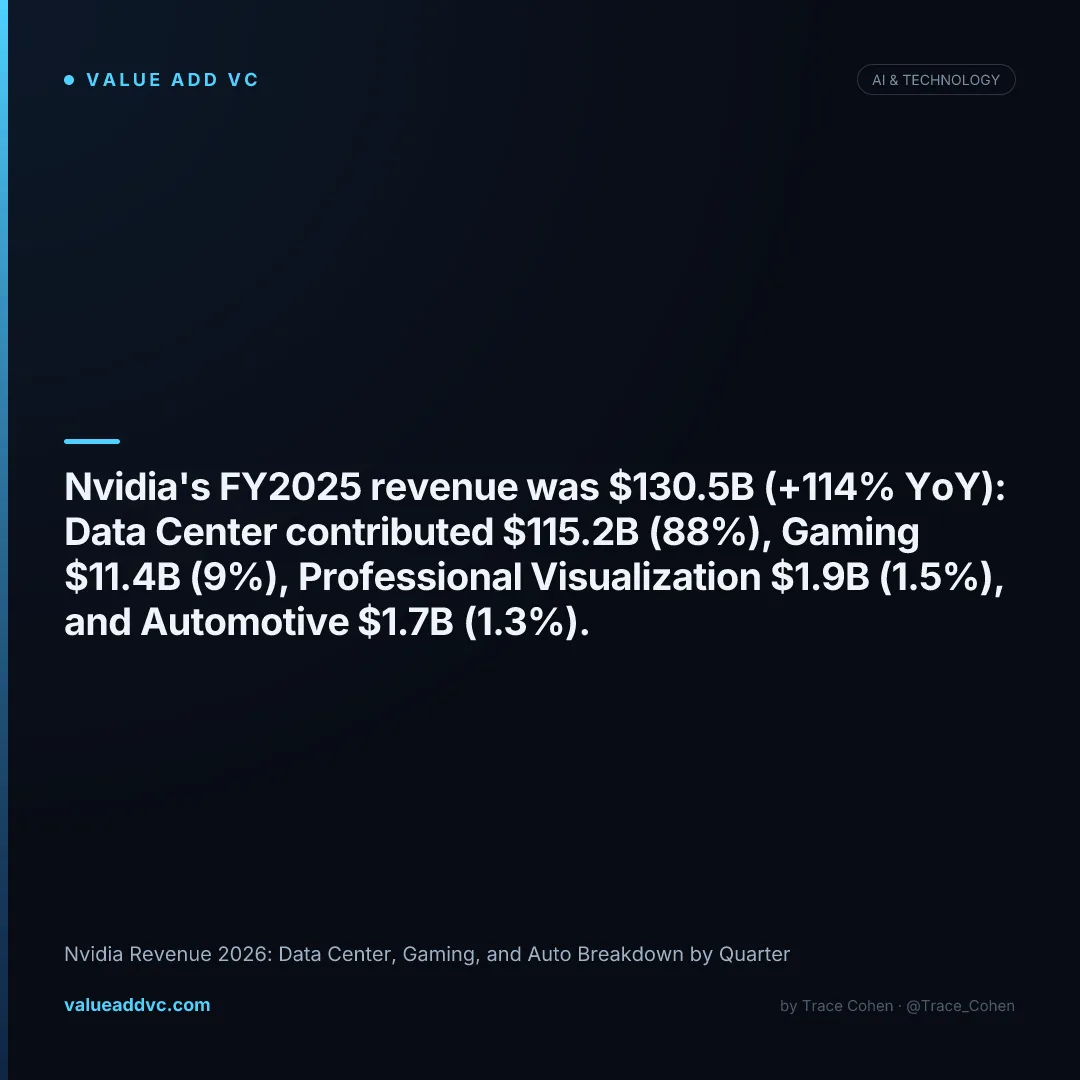
Nvidia generated $130.5 billion in revenue in FY2025 — more than Apple made in any single quarter, and more than the entire global semiconductor industry produced in total revenue just six years ago.
The breakdown matters because it tells a very specific story: this is no longer a GPU company that sells to gamers and data centers. It is a data center infrastructure monopoly that still sells consumer graphics cards as a legacy line of business. Understanding the segment mix is the key to understanding what Nvidia actually is — and whether the valuation makes any sense. It is the same exercise investors ran on what SpaceX's S-1 filing revealed about its revenue mix, where one segment (Starlink) came to define the entire business.
Nvidia Revenue by Segment: FY2023–FY2026
The numbers below use Nvidia's fiscal year, which ends in late January. FY2025 ended January 26, 2025. Q1 FY2026 ended April 27, 2025 and represents the most recent full quarter reported. Nvidia's own fourth-quarter and fiscal 2025 earnings release puts full-year revenue at $130.5 billion, up 114% year-over-year.
| Segment | FY2023 | FY2024 | FY2025 | Q1 FY2026 |
|---|---|---|---|---|
| Data Center | $15.0B | $47.5B | $115.2B | $39.1B |
| Gaming | $9.1B | $10.4B | $11.4B | $3.8B |
| Professional Viz | $1.5B | $1.6B | $1.9B | $0.5B |
| Automotive | $0.9B | $1.1B | $1.7B | $0.6B |
| OEM & Other | $0.7B | $0.3B | $0.3B | $0.1B |
| Total Revenue | $26.9B | $60.9B | $130.5B | $44.1B |
Data Center: The Engine That Ate the Company
Nvidia's Data Center segment went from $15B in FY2023 to $47.5B in FY2024 to $115.2B in FY2025. That is a 7.5x increase in two fiscal years. No company at this revenue scale has grown a major segment this fast in modern history.
The driver is simple: every hyperscaler — Microsoft, Google, Amazon, Meta — is spending $60–85B per year on AI infrastructure, and the majority of that spending flows to Nvidia. H100 clusters at $30,000+ per GPU, NVLink networking at significant additional cost, and now the Blackwell B200 generation at higher ASPs again. The big tech earnings data shows Microsoft Azure AI revenue growing 35% in Q1 2026, Google TPU deployments notwithstanding — and Nvidia is the primary beneficiary of that capex.
The Data Center segment includes Compute (GPU clusters, HGX servers) and Networking (InfiniBand and Ethernet from the Mellanox acquisition). Networking has become a meaningful contributor as AI workloads require extreme bandwidth between GPUs — a GPU cluster without Nvidia's networking is materially slower, creating a platform lock-in that goes well beyond the GPU itself.
Nvidia Revenue Breakdown 2026: Segment Share Evolution
The mix shift is the most important story. In FY2020, Gaming was 47% of Nvidia's revenue. In FY2025, it is 9%. Not because Gaming collapsed — it is generating more absolute revenue than ever — but because Data Center exploded. The company has transformed while maintaining its historical businesses.
Gaming: Stable in Dollars, Irrelevant in Mix
Gaming generated $11.4B in FY2025, up from $10.4B in FY2024. The RTX 40-series refresh drove modest unit growth, and GeForce Now cloud gaming added recurring revenue. But in the context of the overall company, Gaming is a stable cash flow business that no longer drives the investment thesis.
The cyclicality of Gaming is worth noting. FY2023 showed $9.1B — down from $12.5B in FY2022 — due to a post-COVID inventory correction and crypto mining collapse. That volatility is still present in the segment. Q1 FY2026 Gaming revenue of $3.8B annualizes to roughly $15B, suggesting an RTX 50-series launch cycle is generating better-than-expected sell-through.
The GPU pricing architecture for Gaming has also changed. With the RTX 5090 launching above $2,000 MSRP, Nvidia is explicitly moving Gaming up-market, prioritizing ASP expansion over unit volume. This is the right strategy for a company that generates $39B per quarter from data centers and no longer needs Gaming to carry the P&L.
Automotive: The Sleeper Segment Worth Watching
Automotive was $1.7B in FY2025, up 55% year-over-year. That sounds small against $115B in Data Center, but the trajectory is different from anything else in the portfolio. Design wins with Mercedes-Benz, BYD, Li Auto, and Volvo are multi-year contracts that generate recurring software revenue on top of hardware sales.
Automotive Revenue Pipeline
- • FY2024: $1.1B (+21% YoY)
- • FY2025: $1.7B (+55% YoY)
- • Q1 FY2026: $0.6B (run-rate ~$2.5B)
- • Management guidance: multi-billion dollar revenue by FY2027 as DRIVE Orin/Atlan platform ramps
- • Autonomous trucking: Aurora, Kodiak, and others running Nvidia hardware at scale
The NVIDIA DRIVE platform is the key product here. Unlike competitors selling chips for infotainment systems, Nvidia is selling an end-to-end autonomous driving compute stack — from sensor fusion to perception to planning. The software revenue attached to these wins has gross margins above the company average, making Auto a quality-of-earnings story as much as a growth story.
Quarterly Revenue Trend: Q1 FY2024 Through Q1 FY2026
The quarterly progression shows no sign of deceleration in Data Center. The concern most analysts raised — that hyperscaler spending would slow after initial AI buildouts — has not materialized, partly because AI inference workloads are proving more compute-intensive than training alone, and partly because the Blackwell architecture is a genuine generational leap.
What the Revenue Breakdown Means for the Investment Thesis
The question every investor has to answer is whether $115B in Data Center revenue is a cyclical peak or a new baseline. The debate appears to misunderstand the structure of the demand.
The AI spending data shows Microsoft, Google, Meta, and Amazon collectively committed to spending $300B+ on AI infrastructure in 2026 — more than all four spent combined in 2024. Nvidia takes approximately 70–80 cents of every AI infrastructure dollar above the rack level. Even if that share compresses due to AMD, custom silicon, and new entrants, the absolute dollar addressable market is growing faster than the share compression.
Bull Case Drivers
- ✓ AI inference workloads scale with deployment — not just training
- ✓ Blackwell GB200 NVL72 racks have higher ASP than H100 clusters
- ✓ Sovereign AI programs (UAE, Saudi, India) are new demand vectors
- ✓ Automotive and robotics are decade-long tailwinds
- ✓ CUDA moat makes switching costs prohibitive for most workloads
Bear Case Risks
- ✕ Custom silicon (Google TPU v5, AWS Trainium 2) taking share at hyperscalers
- ✕ AMD AMD Instinct closing the performance gap in inference
- ✕ Export controls limiting China sales (historically 20%+ of revenue)
- ✕ Hyperscaler CapEx could plateau if AI ROI disappoints at scale
- ✕ Gaming segment re-entering inventory correction cycle
Professional Visualization: The Forgotten Segment
Professional Visualization — RTX Ada workstation GPUs for content creators, architects, scientists, and engineers — generated $1.9B in FY2025, up 22% YoY. It is the smallest mature segment and rarely gets airtime, but it carries gross margins above the company average and is benefiting from AI-driven workflows in 3D design, medical imaging, and industrial simulation.
The segment also serves as a proving ground for architectures that later move to Data Center. The RTX series in ProViz gets deployed with CUDA and Tensor Core configurations that preview what the H-series and B-series will offer. It is strategically relevant even if financially modest.
Nvidia is not a diversified semiconductor company.
It is an AI infrastructure monopoly generating $44B per quarter — with a Gaming division attached that once defined the company and now barely registers in the mix.
Track Nvidia earnings alongside Microsoft, Google, Meta, and Amazon on the Big Tech Earnings Dashboard. For the broader AI capex picture, see the AI Spending Tracker at Value Add VC.
Latest from the Pulse
Get VC data most people never see
— free to subscribe
Trace's notes on venture, AI and startups, a few times a week. Join 5,000+ subscribers. No spam.
No spam, unsubscribe anytime. Sent via Substack · Privacy · or subscribe on Substack ↗