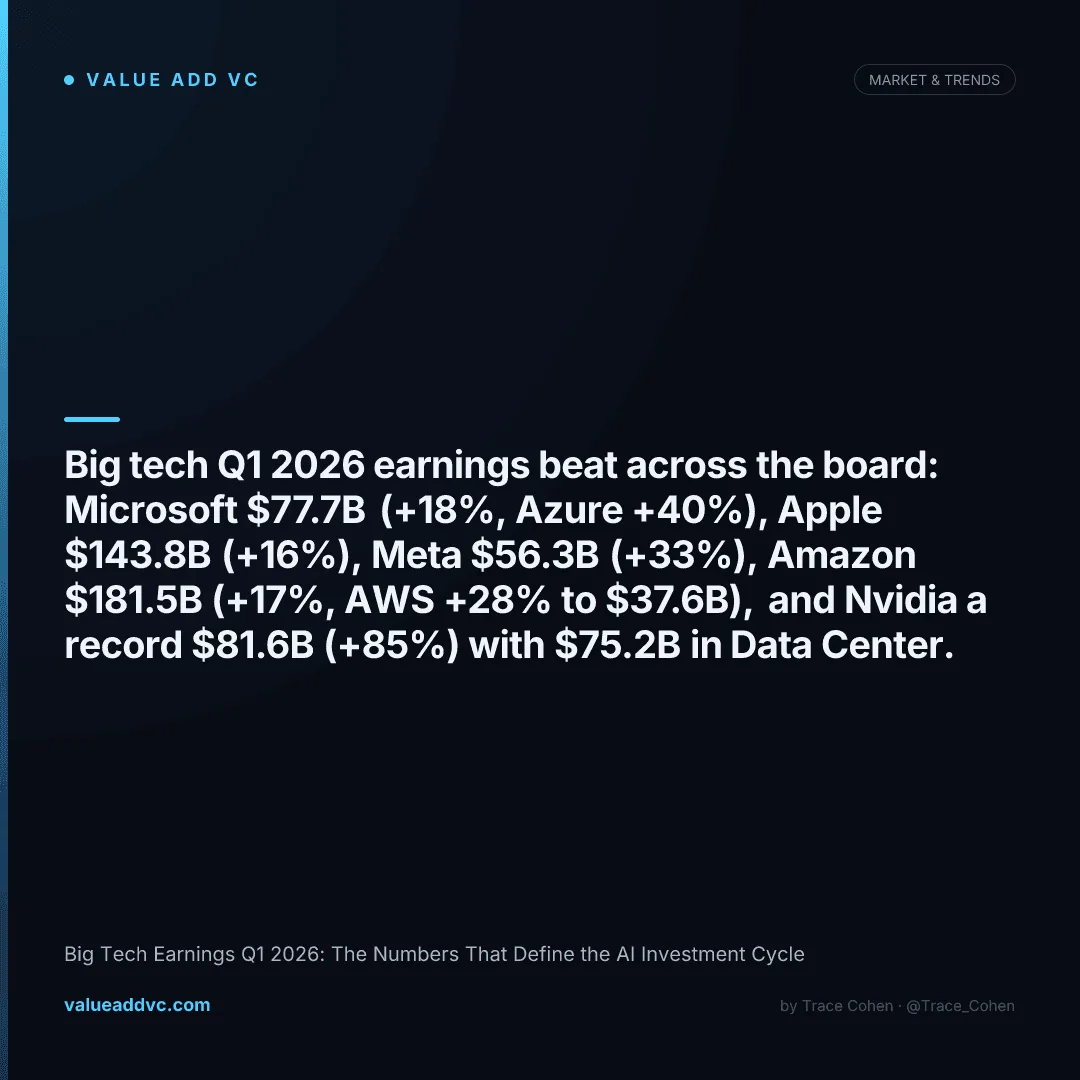
The Q1 2026 big tech earnings season answered the ~$725B question: is the AI capex bet converting to revenue?
The answer is yes — and faster than most analysts modeled. Azure grew 40% year-over-year. AWS reaccelerated to 28%, its fastest in 15 quarters. Meta's AI-driven ad optimization pushed revenue to $56.3B, up 33% — its fastest growth in years. Apple posted $143.8B, up 16%, and Nvidia set a record at $81.6B.
Every major player beat consensus. Every major player raised AI capex guidance. And the market's reaction — mostly positive — reflects a growing conviction that this infrastructure cycle is structurally different from the dot-com or crypto buildouts that preceded it. The compute is being used. The revenue is arriving. The cycle is self-reinforcing.
Big Tech Q1 2026 Earnings: The Key Numbers
| Company | Revenue | YoY Growth | EPS | AI / Cloud Highlight |
|---|---|---|---|---|
| Microsoft | $77.7B | +18% | $3.72 | Azure +40% YoY |
| Alphabet | $96.4B | +14% | $2.81 | Search +19%, Cloud strong |
| Meta | $56.3B | +33% | $8.41 | Fastest ad growth in years |
| Amazon | $181.5B | +17% | $2.87 | AWS +28%, $37.6B |
| Apple | $143.8B | +16% | $2.84 | Record fiscal Q2 |
| Nvidia* | $81.6B | +85% | $2.31 | Data Center $75.2B |
*Nvidia Q1 FY2027 (quarter ended Apr 26, 2026). Others reflect calendar Q1 2026 results (Jan–Mar, reported late April–May 2026); Apple and Microsoft figures are their fiscal quarters covering the same period. Revenue and EPS figures are approximate as reported; track exact figures on the dashboard below.
The AI Capex Cycle Is Now Self-Validating
The most important narrative in Q1 2026 isn't any single earnings beat — it's the feedback loop becoming visible. Companies spent aggressively on AI infrastructure in 2024 and 2025. That spending is now showing up as cloud revenue growth, which justifies spending more. The cycle is entering its compounding phase.
Amazon 2026 capex guidance
~$200B
AWS AI, custom Trainium chips
Microsoft 2026 capex guidance
~$190B
Azure, OpenAI infrastructure
Alphabet 2026 capex guidance
$175–185B
TPUs, data centers, Gemini
Meta 2026 capex guidance
$115–135B
Llama training, AI infra
Combined, that's roughly $725B in AI-directed capex from four companies in a single year — up 77% from ~$410B in 2025, with analysts projecting $1 trillion+ in 2027. Track these numbers in real time on the Big Tech Earnings Dashboard.
Cloud Is Where the AI Revenue Actually Lives
The clearest signal from Q1 2026 is that AI revenue is not primarily a consumer story yet — it's an enterprise cloud story. Azure's 40% growth, after years in the 26–35% range, is heavily driven by AI workloads. Microsoft's AI run-rate topped $37B, and the company disclosed an ~$80B backlog of Azure orders it cannot yet fulfill because of power constraints — demand is outrunning supply.
AWS reaccelerated to 28% growth — Amazon's fastest in 15 quarters — to $37.6B, driven by Bedrock AI model hosting and the Trainium/Inferentia custom chip ecosystem reaching production scale. Google Cloud also posted strong growth, with its contract backlog roughly doubling to ~$460B as AI workloads (Vertex AI, Gemini API) absorb capacity.
All three hyperscalers are growing cloud at or near multi-quarter highs, with demand outrunning available compute and power.
Meta's Q1 2026 Result Is the Ad Market Endorsing AI
Meta's $56.3B in Q1 2026 revenue — growing 33%, its fastest ad growth in years on a base that already included strong 2025 comparables — is the standout result of the quarter. The advertising market is not growing 33% globally. Meta is taking share by making ads work better through AI. Advantage+ campaign tools, AI-generated creative, and dynamic audience optimization have compressed advertiser CAC enough that budgets keep flowing in.
Reality Labs lost $4.8B in Q1 2026, which sounds bad until you contextualize it: Meta generates $52B+ in quarterly operating cash flow from its ads business. The AI bet is funded. The hardware bet is a rounding error on a cash machine.
Meta's 2026 capex guidance of $115–135B is not R&D speculation — it's building the infrastructure needed to serve the AI models that already drive its core business. That distinction matters when evaluating return on invested capital.
Apple's Services and the Slower AI Story
Apple posted $143.8B in revenue, up 16% — a record for the period — with diluted EPS of $2.84, up 19%. iPhone held up well despite a difficult upgrade cycle and tariff-driven margin pressure, but the durable story remains Services, a business with 75%+ gross margins that keeps compounding double digits.
Apple Intelligence, the AI layer baked into iOS 18 and 19, has not yet produced a measurable hardware upgrade super-cycle. The thesis remains intact — that on-device AI will eventually drive the largest iPhone replacement cycle in history — but it has not arrived in the numbers yet. Apple's AI story is slower, and more defensible, than anyone else in this cohort.
Nvidia: Still the Backbone of the Whole Cycle
Nvidia's record Q1 FY2027 (quarter ended April 26, 2026) result of $81.6B — up 85% YoY, with $75.2B from Data Center (+92%) — confirms what every investor already suspected: the hyperscalers are spending their ~$725B capex budgets largely at one address. Blackwell GPU clusters are the infrastructure on which all the Azure AI growth, AWS Bedrock growth, and Google Cloud growth is running. GAAP net income hit $58.3B, and Nvidia announced an $80B buyback plus a dividend hike to $0.25.
The risk Nvidia faces is not demand — it's concentration. Four customers (Microsoft, Google, Meta, Amazon) account for an estimated 40–50% of Nvidia data center revenue. When they build their own custom silicon at scale (Google TPUs, Amazon Trainium, Meta MTIA, Microsoft Maia), the question is not if Nvidia loses share but how much and how fast. For now, Blackwell's performance advantage on transformer workloads is decisive, and the backlog extends well into 2027.
What This Means for Startup Founders and Investors
The Q1 2026 earnings season has three direct implications for the startup and VC ecosystem:
- ①Hyperscaler platform bets are safer than they looked 18 months ago. When Azure and AWS are growing 40% and 28%, building on top of them is not a commodity play — it's a distribution play. Startups that embed deeply in hyperscaler ecosystems have structural tailwinds.
- ②AI infrastructure companies have a long runway. The ~$725B in 2026 capex is not the peak — analysts already see combined big tech capex topping $1 trillion in 2027. Networking, cooling, power, and custom silicon companies have years of demand visibility.
- ③The monetization gap is closing. The bear case in 2025 was that AI spending wouldn't convert to revenue fast enough to justify valuations. Q1 2026 data contradicts that. The conversion is happening at the cloud layer, and application-layer revenue will follow with a 12–18 month lag.
The Q1 2026 earnings season settled a debate:
The AI capex cycle is not speculation. The revenue is arriving. The companies that built the infrastructure are now capturing the returns — and they're spending even more.
Explore Related Dashboards
Interactive tools with live data on this topic
Track big tech earnings trends and AI spending data on the Big Tech Earnings Dashboard and the AI Spending Tracker at Value Add VC. Originally published in the Trace Cohen newsletter.
Latest from the Pulse
Get VC data most people never see
— free to subscribe
Trace's notes on venture, AI and startups, a few times a week. Join 5,000+ subscribers. No spam.
No spam, unsubscribe anytime. Sent via Substack · Privacy · or subscribe on Substack ↗