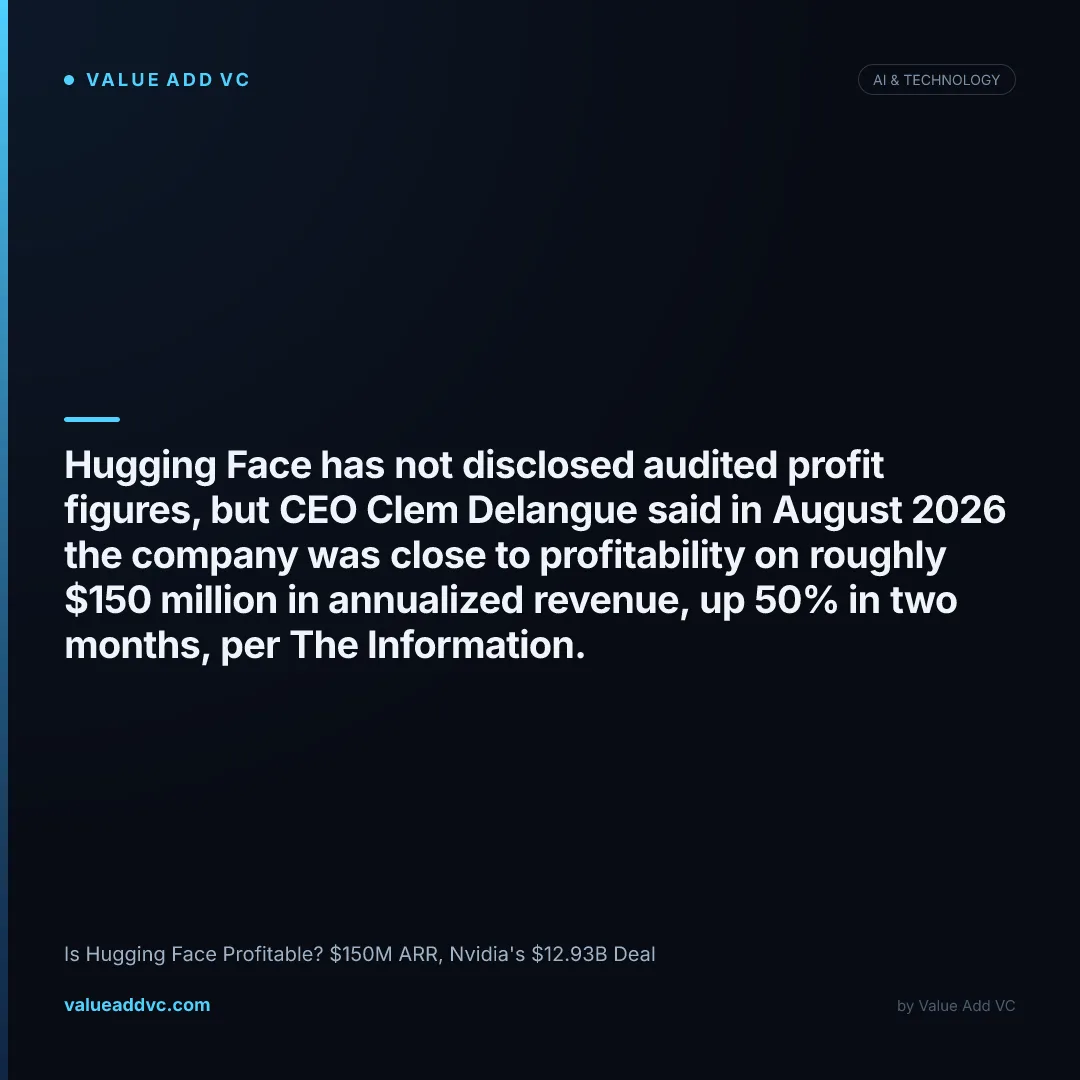
Hugging Face has never disclosed audited profit figures, but CEO Clem Delangue said in August 2026 the company was close to profitability on roughly $150 million in annualized revenue — weeks before Nvidia confirmed a $12.93 billion deal to acquire it outright.
Pulse has tracked Hugging Face's acquisition saga closely since August. This is the narrower question underneath the deal headlines: independent of who ends up owning it, does Hugging Face's own business actually make money?
Sources: The Verge (via SDXCentral), TechCrunch, as of October 17, 2026.
Hugging Face's Profitability Timeline
Delangue has now said Hugging Face is close to profitable twice, more than two years apart, without the company ever confirming it crossed into the black. Between those two statements, its valuation story moved from a $4.5 billion private round to a rejected $500 million investment at $7 billion, to a confirmed $12.93 billion outright sale.
| Date | Event | Figure |
|---|---|---|
| May 2023 | Series D closes | $235M raised, $4.5B valuation |
| May 16, 2024 | Delangue: “profitable, or close to profitable” | $10M ZeroGPU compute pledge |
| Early 2026 | Turns down Nvidia investment | $500M at $7B valuation |
| Aug 24, 2026 | Delangue: “close to profitability” again | Sale talks at $13B+ |
| Aug 26, 2026 | Annualized revenue reported | ~$150M, +50% in 2 months |
| Sep 3, 2026 | Nvidia confirms acquisition | $12.93B |
Sources, in order: SDXCentral (citing The Verge), TechCrunch (x4). How we counted: every dated statement Hugging Face's CEO has made about profitability, plus the valuation and revenue events around them; 6 events; as of October 17, 2026.
What "Close to Profitable" Has Actually Meant
Delangue made this claim once before, in May 2024, when it came paired with an announcement that Hugging Face would give away about $10 million worth of GPU compute through a program called ZeroGPU — he told The Verge, as reported by SDXCentral, that the company could afford it because it was "profitable, or close to profitable," fresh off the $235 million Series D that valued it at $4.5 billion. By August 2026, the framing had shifted: he told TechCrunch the company was focused on "long-term sustainability... rather than short-term profits or fundraising maximization," and that it had only then begun spending the capital it raised three years earlier.
Neither statement is an audited number, and Hugging Face has never published one. What's changed between the two is the revenue base behind the claim: by August 2026, The Information reported annualized revenue near $150 million, up 50% in just two months, which would make "close to profitable" a materially bigger business than it was in 2024, even without a disclosed margin. For the revenue mix behind that number — hosted inference, Pro subscriptions and enterprise licenses — see our deep dive on how Hugging Face makes money.
The Nvidia Deal Changes the Question
Hugging Face turned down a $500 million Nvidia investment at a $7 billion valuation earlier in 2026, according to TechCrunch. Less than a year later, Nvidia confirmed an outright acquisition at $12.93 billion — nearly double what Hugging Face itself was reportedly fielding bids for just weeks earlier. That gap is the clearest evidence that Nvidia's price reflects strategic value (distribution across roughly 3 million models, 500,000 datasets and 18 million-plus developers) rather than a multiple on disclosed profit or even disclosed revenue.
Once the deal closes — expected in the first half of 2027, pending regulatory review — Hugging Face's standalone profitability becomes a moot question in the way it matters for most acquisitions: the business gets folded into Nvidia's own financials rather than reporting on its own, per Nvidia's own announcement. For the deal's structure, retention terms and regulatory risk, see our full breakdown of the Nvidia-Hugging Face acquisition.
What the headline misses
A company getting bought for 86 times one estimate of its annualized revenue is not obviously evidence that its standalone unit economics are healthy — it's evidence that Nvidia values what Hugging Face controls (developer mindshare and model distribution) more than what it currently earns. One read on this: "close to profitable" said twice over two years, by the same founder, without ever crossing into a confirmed number, reads less like imminent breakeven and more like a durable talking point for a company whose free, subsidized tools (ZeroGPU among them) are central to the developer reach that made it acquisition-worthy in the first place. The counterweight is that Hugging Face has never raised anywhere near what rival AI labs have — $235 million total in its last round versus the tens of billions some foundation-model labs have taken in — so "close to profitable" on a comparatively thin capital base is a different claim than it would be from a company that's burned billions to get there.
The Bottom Line
Hugging Face has never confirmed a profit, but it has twice told reporters it was close — once in 2024 alongside a $10 million compute giveaway, and again in August 2026 on roughly $150 million in annualized revenue, shortly before Nvidia agreed to buy the company for $12.93 billion. Whether that acquisition price reflects strong underlying economics or simply strategic necessity for Nvidia is the question the deal itself doesn't answer.
See the full deal mechanics in our Nvidia-Hugging Face acquisition breakdown, the revenue model in how Hugging Face makes money, and track every AI acquisition on the AI Valuations dashboard.
Latest from the Pulse
Get VC data most people never see
— free to subscribe
Trace's notes on venture, AI and startups, a few times a week. Join 5,000+ subscribers. No spam.
No spam, unsubscribe anytime. Sent via Substack · Privacy · or subscribe on Substack ↗