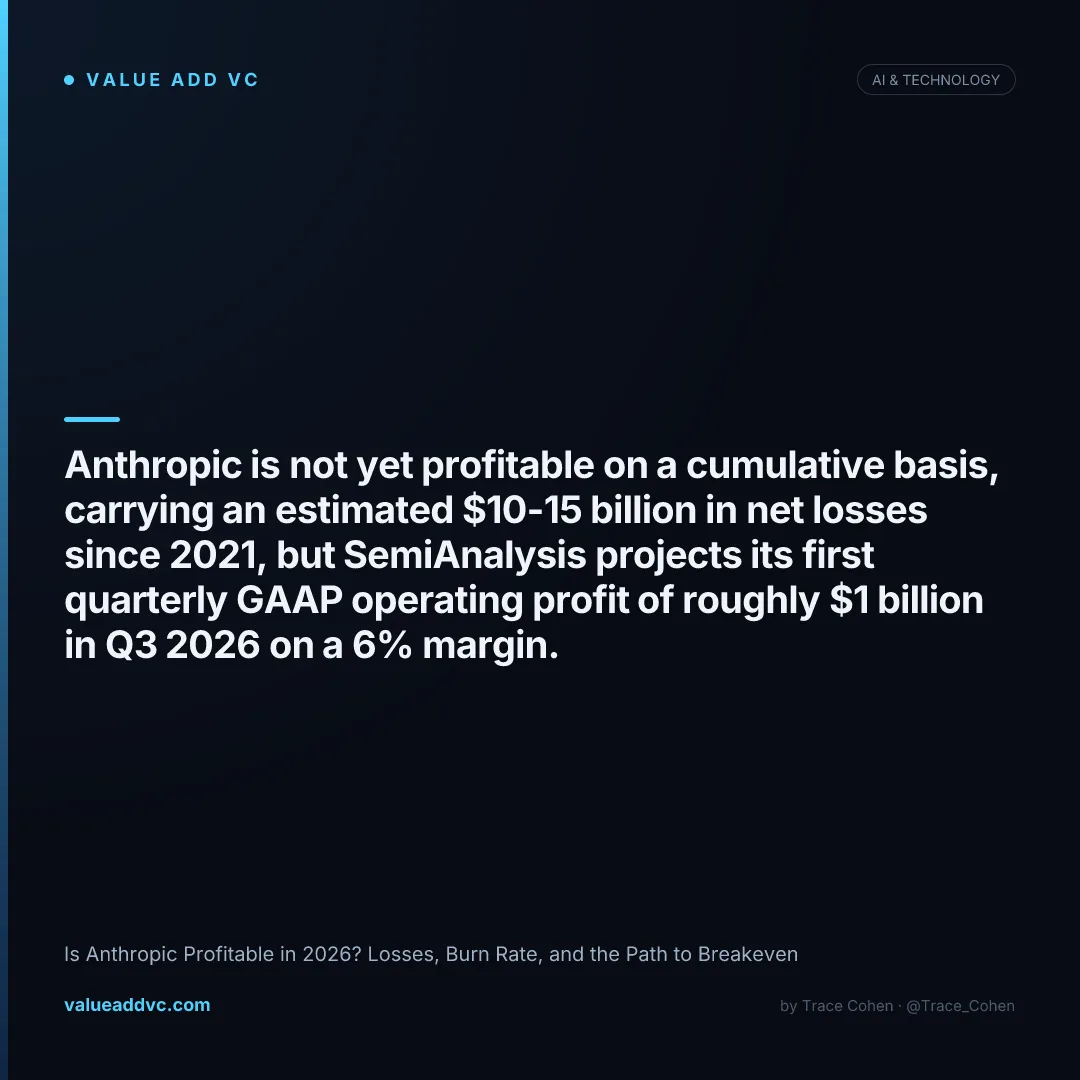
Anthropic is not profitable on a cumulative basis, carrying an estimated $10-15 billion in net losses since 2021, but it is projected to post its first quarterly GAAP operating profit, roughly $1 billion, in the third quarter of 2026. How a company burning billions gets to a profitable quarter is the mechanics worth tracing.
"Is Anthropic profitable" is actually two different questions wearing one headline, and most coverage conflates them. There's the cumulative question, has the company ever closed a year in the black, and the answer there is no. Then there's the run-rate question, is the business generating more cash than it burns right now, and on that measure Anthropic's trajectory looks genuinely unusual for a frontier AI lab. Having tracked both Anthropic's and OpenAI's disclosures closely from the venture side, the gap between those two answers is the actual story.
Figures blended from SemiAnalysis's Anthropic Q3 2026 estimate, the company's Series H disclosures, and Anthropic's own 2026-2027 burn-rate guidance reported by Forbes and Yahoo Finance.
Is Anthropic Profitable in 2026?
Not yet, cumulatively, but the quarter-by-quarter picture is turning fast. Anthropic reported roughly $4.8 billion in Q1 2026 revenue and a projected $10.9 billion in Q2, alongside its first-ever projected quarterly operating profit of $559 million for that same quarter. By Q3, SemiAnalysis estimates GAAP EBIT will exceed $1 billion at a 6% margin, which would mark the first time the company has generated more operating income than expense in a single quarter since it was founded in 2021. As of late July 2026, Anthropic's annualized run rate had reached $65 billion, up from the roughly $60 billion pace reported earlier in the summer.
How Much Money Has Anthropic Actually Lost?
Roughly $10-15 billion is the working estimate for Anthropic's cumulative net operating losses from 2021 through the end of 2025, based on the pace of its funding rounds against disclosed revenue. Looser estimates that fold in the capital committed to compute contracts rather than booked expense push the figure toward $24.8 billion. Either way, the company has never closed a fiscal year with positive net income, which is why the "is Anthropic profitable" question can't be answered with a flat yes even as quarterly operating numbers turn positive in 2026.
Anthropic vs OpenAI: Burn, Margin, and Breakeven, Side by Side
| Metric | Anthropic | OpenAI |
|---|---|---|
| Annualized revenue (as of Aug 2026) | $65B (July 2026) | $40B, after a July breakout |
| Projected 2026 annual loss/profit | First quarterly profit in Q3 | ~$14B loss (some est. $27B burn) |
| 2026 burn rate (% of revenue) | ~33%, falling to 9% in 2027 | ~57% through 2027 |
| Gross margin trajectory | -94% (2024) to ~44-60% (2026) | Compressed 20-30pts by free users |
| Peak training cost | ~$30B | ~4x Anthropic's figure |
| Cloud infrastructure commitment | $80B through 2029 (AWS, Google) | $250B+ committed to Azure/OpenAI deal |
| Free cash flow breakeven target | 2027-2028 | 2029-2030 |
| Revenue mix | ~80-85% enterprise/API | ~85% consumer (ChatGPT) |
Figures are 2026 estimates blended from SemiAnalysis's Anthropic Q3 2026 report, Forbes' May 2026 profitability comparison, Yahoo Finance's gross-margin analysis, and Value Add VC's OpenAI revenue tracking. Neither company publishes audited financials; figures are analyst and press estimates.
When Will Anthropic Actually Turn a Profit?
2027-2028 is the window Anthropic is guiding to for sustained free cash flow, built on projected revenue near $70 billion and gross margins climbing toward 77%. The mechanism is straightforward: burn rate, measured as a share of revenue, is expected to fall from roughly a third of revenue in 2026 to just 9% in 2027, meaning the company needs revenue to keep compounding rather than cutting costs outright to reach that target.
How Does Anthropic's Burn Rate Compare to OpenAI's?
Roughly 33% is Anthropic's 2026 burn rate as a share of revenue, compared to an estimated 57% for OpenAI over the same period, and that gap is the clearest single number explaining why one company reaches breakeven years before the other. OpenAI's consumer-heavy revenue mix, with the vast majority of ChatGPT's roughly 1 billion weekly active users (as of June 2026) paying nothing, means a much larger share of its infrastructure cost never converts to revenue at all — though OpenAI's July enterprise breakout, which pushed its own annualized run rate to $40 billion, is starting to shift that mix.
Anthropic vs OpenAI: 2026 Burn Rate and Projected Annual Loss
Forbes, May 21, 2026; Fortune's OpenAI cash-burn reporting, Nov 2025; company disclosures.
Anthropic's smaller, more efficient training runs and enterprise-first go-to-market are the two structural reasons its loss curve bends toward breakeven faster despite a smaller headline valuation than OpenAI.
What Is Anthropic's Gross Margin, and Why Does It Matter?
Anthropic's gross margin has moved from roughly -94% in 2024 to an estimated 44-60% in 2026, with the range depending on whether a given estimate nets out amortized training cost against a single quarter's compute spend. The more granular number is compute cost per revenue dollar, which Yahoo Finance reported fell from $0.71 in Q1 2026 to a projected $0.56 in Q2 2026. That single ratio, how much it costs Anthropic to serve a dollar of Claude usage, is doing more to determine the company's IPO valuation than any headline revenue number.
What the Headline Misses About Anthropic's Q3 Profit
The "Anthropic turns profitable" headlines circulating since the SemiAnalysis report overstate the picture in one specific way: a single quarter's GAAP operating profit is not the same as being a profitable company. Anthropic's $1 billion projected Q3 2026 EBIT sits against roughly $10-15 billion in cumulative losses built up since 2021, and the company still owes an estimated $80 billion in committed cloud infrastructure spend through 2029 to Amazon and Google. A profitable quarter with a multi-year infrastructure obligation still outstanding is a real milestone, but it is not the same claim as "Anthropic no longer needs outside capital," which is how some coverage has framed it.
Is Anthropic More Profitable Than OpenAI?
Yes, on every forward-looking measure available. Anthropic's projected 2026 annual loss of roughly $2 billion is a small fraction of OpenAI's projected $14 billion loss for the same year, and some outside analysts model OpenAI's actual cash burn as high as $27 billion once compute commitments are included. The comparison isn't close on training efficiency either: Anthropic's peak training cost of roughly $30 billion runs about 4x lower than OpenAI's, according to SaaStr's analysis of both companies' disclosed spending. You can track how that valuation gap has evolved on the AI Valuations Dashboard.
What Does Anthropic's IPO Filing Mean for the Profitability Question?
June 1, 2026 is when Anthropic confidentially filed for an IPO, and the profitability estimates now circulating, including the SemiAnalysis Q3 figure, are widely read as pre-IPO financial framing rather than confirmed, audited results. Public-market investors will demand more precision than "roughly $1 billion" once an S-1 is unsealed, and the gap between analyst estimates and actual disclosed GAAP numbers is a real risk to the valuation Anthropic is targeting. That target has moved fast: as of late August 2026, six Anthropic investors told the Financial Times to expect a valuation of $2 trillion or more at listing, reportedly as soon as October 2026, more than double the $965 billion Series H mark from just months earlier, and CNBC reported the forthcoming public S-1 will list AI backlash as an explicit risk factor. See our full breakdown of the $2 trillion IPO chatter. That filing timeline mirrors, and slightly leads, OpenAI's own confidential S-1 process, making 2026-2027 the window where both companies' actual, audited numbers finally become public.
Anthropic isn't profitable yet on a cumulative basis.
But its Q3 2026 quarterly operating profit is projected to arrive two to three years ahead of OpenAI's.
The Bottom Line
Anthropic is not a profitable company today, and won't be on a cumulative, all-time basis for at least another year or two. But the run-rate trend is real and increasingly well-documented: a projected first quarterly operating profit in 2026, a burn rate compressing from roughly a third of revenue down to single digits by 2027, and a gross margin recovering from deeply negative territory in 2024 to positive and rising now. The enterprise-first, API-heavy revenue mix is doing most of the structural work, converting more reliably into margin than OpenAI's consumer-subscription base does — the same mix behind Anthropic's 40% share of enterprise LLM spend. Whether that trajectory survives contact with audited, public numbers once the IPO filing unseals is the next real test.
More Anthropic Coverage
- Anthropic's Business Model — how the "safety company" actually makes money (80% API/enterprise).
- Anthropic Revenue: $47B Run Rate — how it passed OpenAI quarter by quarter.
Track frontier AI valuations and funding rounds on the AI Valuations Dashboard at Value Add VC. Reach out at t@nyvp.com or @Trace_Cohen.
Latest from the Pulse
Get VC data most people never see
— 100% free
Weekly benchmarks, valuations, and fund data. Join 5,000+ investors. No spam.