
Anthropic makes money by selling Claude by the token — about 80% of a business that booked $16.8 billion of revenue in Q3 2026 alone comes from the API and enterprise contracts, not consumer subscriptions. That mix — the exact inverse of OpenAI's — is the thing to understand about this business, and it's now producing quarterly operating profits: an adjusted operating profit in Q2 2026 and again in Q3.
Most people know Anthropic as "the AI safety company" or "the maker of Claude." Far fewer can tell you how it actually generates revenue. The structure matters because it's the inverse of OpenAI — and it explains why Anthropic keeps winning the developer and enterprise market even when it's second in consumer mindshare.
Anthropic's S-1 is now public on SEC EDGAR, filed October 26, 2026, confirming figures that had previously only circulated from draft prospectus leaks. Full coverage of the filing is in our Anthropic S-1 breakdown.
Anthropic Revenue and Net Loss: Key Numbers
| Period | Revenue | Net income/loss | Source |
|---|---|---|---|
| H1 2025 (six months ended June 30, 2025) | $1.1B | Net loss of $13B | Draft prospectus, as reported by the WSJ (via The Hindu BusinessLine, Oct. 21, 2026) and Reuters (Oct. 20, 2026) |
| FY2025 (context) | Nearly $4.6B | Net loss of $42B; operating loss of about $8.1B excluding the accounting charge | Reuters (Oct. 20, 2026) |
| H1 2026 (six months ended June 30, 2026) | $16.286B | Net loss of $80.7B, incl. a $72.4B non-cash fair-value charge; operating loss $693M | SEC EDGAR, Anthropic S-1 (filed Oct. 26, 2026) |
| Q3 2026 (three months ended Sept. 30, 2026) | $16.8B | Adjusted profit; 11% adjusted operating margin. GAAP net income/loss not disclosed | Anthropic investor meeting, Oct. 14, 2026, reported by Reuters (Oct. 15) and the Financial Times (Oct. 14); margin via FT summaries (TipRanks, Oct. 15) |
All figures are reported, not audited. H1 figures come from a draft prospectus, not a public filing; Q3 figures come from a closed investor meeting. Sources: Reuters, Oct. 20 (via BusinessWorld), The Hindu BusinessLine on the WSJ's reporting, Reuters, Oct. 15, TipRanks' summary of the FT.
Figures from Anthropic's Series H disclosures, Fortune's Aug. 15, 2026 report on preliminary Q2 2026 results, the Wall Street Journal's May 2026 Q2 projections, Axios' Sept. 18, 2026 summary of the New York Times' revenue-pace report, Q3 2026 results per the Financial Times (Oct. 15, 2026) and PYMNTS, and public reporting on IPO plans, June-October 2026.
Anthropic's Business Model and How It Makes Money
Anthropic's business model is selling metered access to its Claude large language models. Companies and developers pay per million tokens of input and output, and the company monetizes through four channels: the Claude API, direct enterprise contracts, the Claude Code developer product, and consumer subscriptions. Roughly 80% of revenue is API and enterprise; the rest is subscriptions. Anthropic booked $16.8B of revenue in Q3 2026, per the Financial Times (Oct. 15, 2026), with SemiAnalysis estimating a Q3 run rate of about $74B, up from the $65B reported in July and the $47B reported in Anthropic's Series H announcement in late May.
The single most important fact about this model is its mix. OpenAI is a consumer company that also sells an API — roughly 60% of its annualized revenue came from consumers as 2026 began, though CFO Sarah Friar said in August 2026 that enterprise revenue has since overtaken consumer. Anthropic is an infrastructure company that also has a chatbot. The bulk of its revenue comes from other companies embedding Claude inside their own products, where Anthropic never touches the end user at all — and that mix is why Anthropic's run rate first passed OpenAI's in April 2026 and has kept extending the lead since.
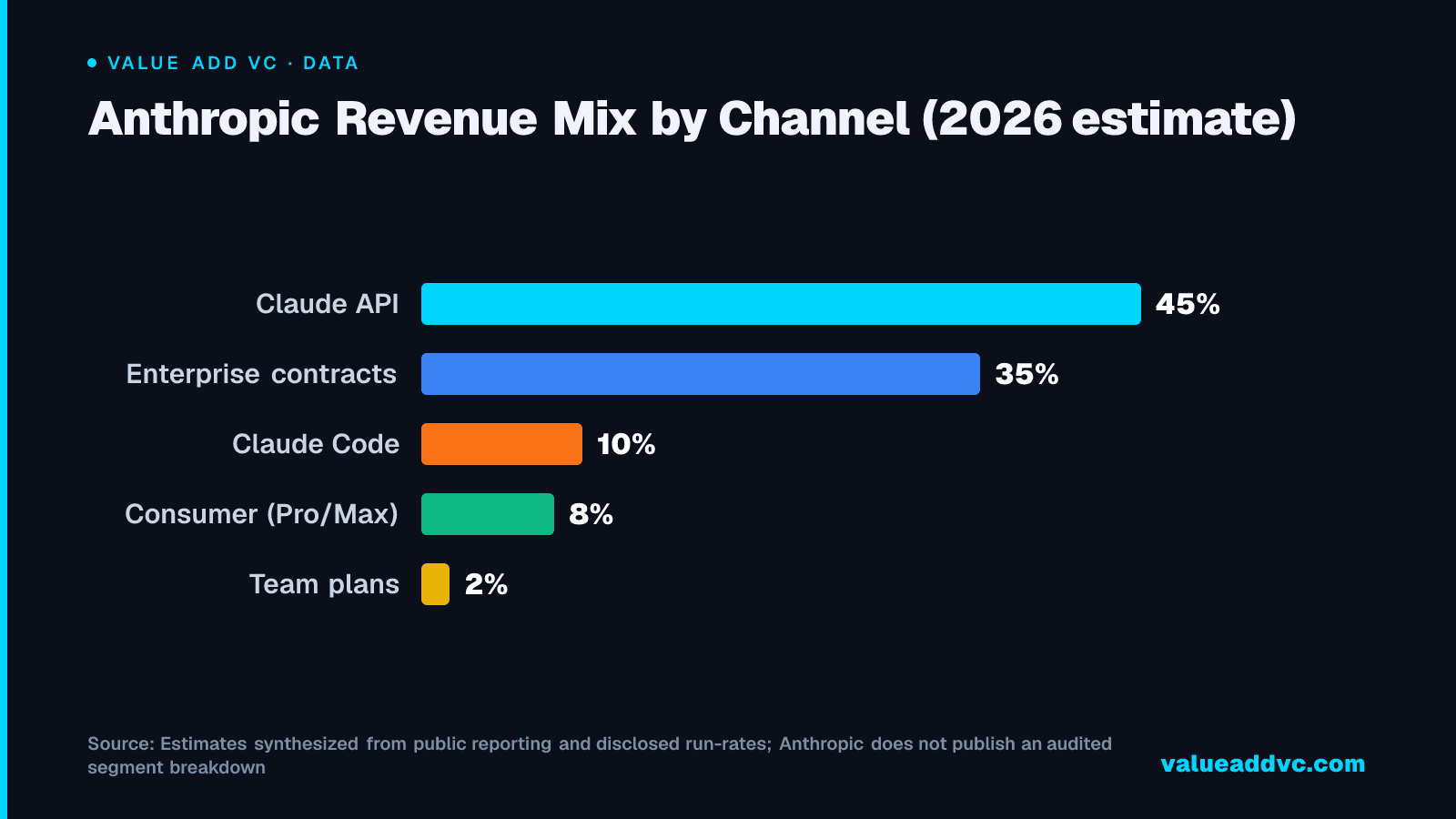
Anthropic Revenue Mix by Channel (2026 estimate)
API and enterprise contracts together account for roughly 80% of revenue — Claude Code alone is now bigger than the entire consumer subscription business.
Estimates synthesized from public reporting and disclosed run-rates; Anthropic does not publish an audited segment breakdown
Data
| Item | Value |
|---|---|
| Claude API | 45% |
| Enterprise contracts | 35% |
| Claude Code | 10% |
| Consumer (Pro/Max) | 8% |
| Team plans | 2% |
The Four Revenue Lines
Each channel monetizes the same underlying asset — Claude inference — but the buyer, contract shape, and margin profile differ sharply.
| Revenue Line | Who Pays | Pricing Model | Est. Share |
|---|---|---|---|
| Claude API | Developers & startups | Per million tokens (in/out) | ~45% |
| Enterprise contracts | Large companies | Committed-spend + volume discounts | ~35% |
| Claude Code | Engineering teams | Seat + usage hybrid | ~10% |
| Consumer (Pro/Max) | Individuals | $20–$200/mo subscription | ~8% |
| Team plans | SMB teams | $20–$25/seat/mo (Standard) | ~2% |
| Cloud partners (Bedrock/Vertex) | AWS & Google customers | Revenue share on resold tokens | Included in API |
Shares are estimates synthesized from public reporting and disclosed run-rates; Anthropic does not publish an audited segment breakdown.
The API: The Engine of Anthropic's Revenue
The Claude API is the foundation. Developers call models like Claude Opus, Sonnet, and Haiku (see how they stack up in our ranking of the best AI models in 2026) and pay per token. As of late September 2026, Anthropic's list pricing runs from $10 per million input tokens and $50 per million output tokens for the top-end Claude Fable 5.1, to $4/$20 for Claude Opus 5.5 (launched September 22 at a lower price than Opus 5's $5/$25, with an $8/$40 Fast Mode), $2/$10 for Sonnet 5, and $1/$5 for Haiku 4.5. The 5x output-vs-input premium matters: generation is the expensive part, and coding workloads generate enormous output volume. Batch processing cuts costs roughly 50% and prompt caching cuts cached-input costs by about 90% — levers large customers use heavily, which compresses realized revenue per token even as volume climbs.
This tiered structure is itself a monetization strategy. A customer might use Haiku for cheap classification, Sonnet for the bulk of an agentic workflow, and Opus or Fable only for the hardest reasoning steps. Anthropic captures value across the entire price-performance curve instead of forcing one model on every job. Prompt caching and batch processing add further discounts that lock in high-volume customers.
Crucially, a large slice of API revenue flows through cloud partners. Amazon (a $8B+ investor) resells Claude through AWS Bedrock, Google through Vertex AI, and Microsoft through Azure, where Anthropic's newest models launch alongside AWS and Google Cloud. These channels let Anthropic reach enterprise buyers who already have cloud commitments — and they're a big reason API consumption scaled so fast without Anthropic building a massive direct sales motion from scratch.
Enterprise and Claude Code: Where the Margin Lives
Enterprise contracts are the second pillar and the highest-quality revenue. Instead of metered pay-as-you-go, large customers sign committed-spend agreements — a company might commit to $5M, $20M, or far more per year in exchange for volume pricing, dedicated capacity, and security guarantees. This converts lumpy API usage into predictable, contracted revenue that investors value far more highly.
Claude Code deserves its own line because it became one of the fastest-growing products in the company's history. Launched as a terminal-native coding agent in May 2025, it hit $1B in annualized revenue by November 2025, $2.5B by February 2026, $8B by May 2026, roughly $15B as of mid-August 2026 according to alt-data firm TickerTrends' proprietary tracked-ARR estimate, a figure Anthropic has not confirmed. If that estimate is close, a product that didn't exist fifteen months earlier would be running at roughly 1.7 times the $9B run rate all of Anthropic generated at the end of 2025. Coding is the killer use case for Claude — the models consistently top developer preference in agentic coding — and Claude Code monetizes that strength directly through consumption-based pricing, which means its revenue compounds daily with adoption rather than growing in discrete seat-license jumps.
The strategic logic: coding workloads are sticky, high-volume, and output-heavy, which means they generate the most token revenue per user. A single engineer running agentic coding sessions can consume more tokens in a day than a casual chatbot user does in a month. That's why coding-heavy customers are disproportionately valuable to Anthropic's economics.
Anthropic Revenue Growth: The Run-Rate Curve
Anthropic's revenue trajectory is one of the steepest in software history. The company went from a roughly $100M run-rate in early 2024 to a $1B run-rate by the end of that year, $9B by the end of 2025, and $65B by July 2026 — driven overwhelmingly by API and enterprise demand rather than consumer subscriptions. In September, the New York Times reported a pace projected to top $100B by year-end, and early backers projected more than $110B, per the WSJ. Updated October 2026: Q3 revenue came in at $16.8B, up about 45% from Q2 after more than doubling the quarter before, per the Financial Times (Oct. 15, 2026), and investors have since trimmed year-end run-rate forecasts to about $74B, per PYMNTS.
| Period | Annualized Run-Rate | Primary Driver |
|---|---|---|
| Early 2024 | ~$100M | Early API adoption |
| End 2024 | ~$1B | API + first enterprise deals |
| End 2025 | $9B | Claude Code + coding workloads |
| Feb 2026 | $14B | Enterprise committed-spend |
| Apr 2026 | $30B | Passed OpenAI's ~$25B run rate |
| May 2026 | $47B | Series H announcement (May 28) |
| Jul 2026 | $65B | Enterprise demand |
| Q3 2026 | ~$74B (SemiAnalysis est.) | Claude Code + Cowork enterprise adoption; $16.8B booked in Q3 |
Figures are annualized run-rates (the latest month or quarter × 12), not full-year recognized revenue, and are drawn from public reporting.
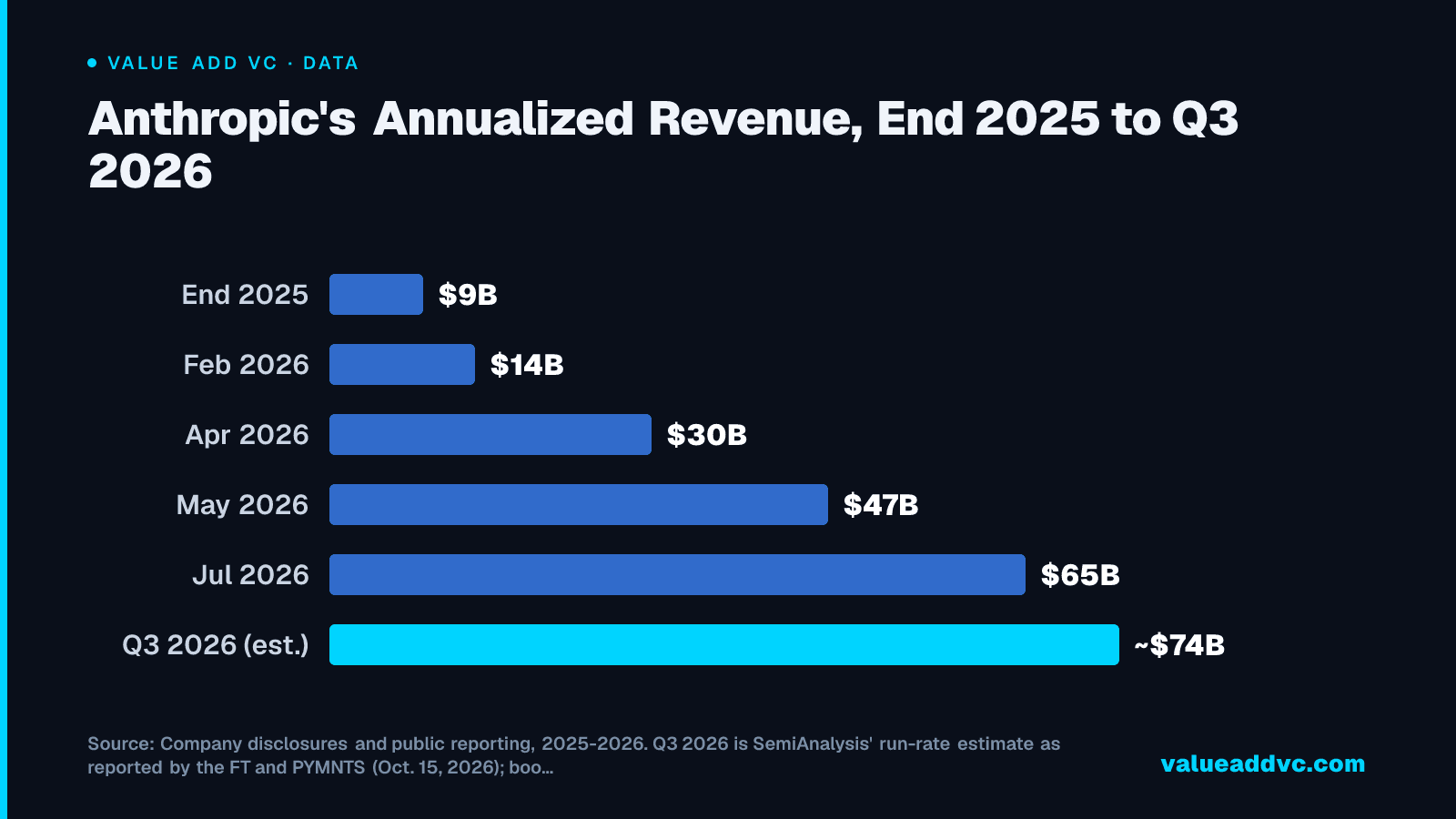
Anthropic's Annualized Revenue, End 2025 to Q3 2026
Anthropic's revenue pace grew roughly 8x in nine months, from $9B to an estimated ~$74B, almost entirely on the back of API and enterprise demand, though growth slowed in Q3.
Company disclosures and public reporting, 2025-2026. Q3 2026 is SemiAnalysis' run-rate estimate as reported by the FT and PYMNTS (Oct. 15, 2026); booked Q3 revenue was $16.8B.
Data
| Item | Value |
|---|---|
| End 2025 | $9B |
| Feb 2026 | $14B |
| Apr 2026 | $30B |
| May 2026 | $47B |
| Jul 2026 | $65B |
| Q3 2026 (est.) | ~$74B |
Is the AI Safety Company Actually Making Money?
Anthropic reported its first-ever quarter of positive adjusted operating income in Q2 2026, on preliminary revenue of more than $11.5B — more than double Q1's $4.73B, per Fortune. The profit amount was not disclosed; the Wall Street Journal had reported in May a projected $559M. In September, Anthropic told a small group of shareholders it would report an adjusted operating profit in Q3 as well, the Financial Times reported, and on October 14 it confirmed a second consecutive adjusted operating profit, at an 11% adjusted operating margin on $16.8B of Q3 revenue, per PYMNTS. See our full breakdown of Anthropic's burn rate and path to breakeven for the cumulative picture. The GAAP half-year picture is different: the updated draft prospectus shows first-half 2026 revenue of $16.3B, versus $1.1B a year earlier, and a net loss of $80.7B that includes a $72B non-cash charge on convertible notes, Reuters and the WSJ reported on Oct. 20, 2026, with nearly $9B spent on computing in the half. Those quarterly profits don't erase years of losses — the prospectus figures Reuters reported show a 2025 operating loss of more than $8B alone, driven by the upfront cost of training frontier models (a single flagship training run can cost hundreds of millions of dollars) and multi-year compute deals and forecast cloud spending that, per reported figures, now add up to well over $100 billion.
The quarter also came as Anthropic's compute bill was stepping up: it agreed in May to pay SpaceX's xAI $1.25 billion a month for data-center capacity through May 2029, per TechCrunch, and more deals have followed, including a roughly $45 billion, six-year compute agreement with Nscale reported by TechCrunch in August. The WSJ reported in May that the company may not remain profitable for the full year due to planned spending increases for computing and model training. The FT reported in September that gross margins exceed 80% before revenue-sharing payments to partners such as Amazon and before training costs; outside estimates that net those out put inference margins nearer 50–60%, but each new model generation requires a fresh, larger training run before it earns a dollar, so the company is structurally spending ahead of revenue between profitable quarters.
To fund the gap between training and revenue, Anthropic has raised tens of billions in equity — the latest a $65B Series H announced May 28, 2026 at a $965B post-money valuation, per the company's announcement. Anthropic's IPO prospectus, whose financials Reuters reported on September 28, 2026, showed full-year 2025 revenue of nearly $4.6 billion (a twelvefold increase) against an operating loss of more than $8 billion on nearly $13 billion of total operating expenses, with Q2 2026 revenue of $11.5 billion confirming the preliminary figure Fortune reported in August. The prospectus reportedly targets a valuation above $2 trillion — more than double the $965B Series H mark — and projects 2028 revenue of $190-200 billion, alongside at least $518 billion of committed cloud, compute and infrastructure spending over a decade (per Reuters; the WSJ separately reported potential spending of up to $750 billion, including deals still being negotiated), including deals already signed with Google, SpaceX, and Nscale. The listing timeline has moved around in press reports (October, then November), and the prospectus itself doesn't fix an exact trading date. Earlier, secondary markets were pricing shares at implied valuations of $1.05-1.15 trillion in the weeks after the Series H closed — well below where the prospectus now points. Updated October 2026: after Q3 growth slowed, some current and prospective investors are discussing a valuation of about $1.5 trillion rather than the roughly $2 trillion previously expected for the November share sale, Reuters reported on Oct. 15. Meanwhile revenue is concentrated at the top: around one-fifth of Anthropic's $16.3B in first-half 2026 revenue came from just two customers, per the WSJ's account of the draft. And the customer base underneath keeps concentrating in high-value accounts: the number of customers spending more than $1M a year roughly doubled from about 500 to over 1,000 in under two months in early 2026.
What's Working
- ✓ Adjusted operating profit in Q2 and Q3 2026 — Q3 at an 11% adjusted margin (Reuters, FT)
- ✓ ~80% revenue from durable API + enterprise
- ✓ Claude Code scaling fast (third-party est. ~$15B ARR)
- ✓ Cloud distribution via AWS, Google & Microsoft
What's Hard
- ✕ WSJ (May): may not stay profitable for full-year 2026
- ✕ $80.7B net loss in H1 2026 (incl. $72B non-cash charge), after $42B in 2025
- ✕ Training costs reset every model generation
- ✕ Price competition compressing token economics
What the profit headline misses
Two profitable quarters would be real progress, but that is not the same claim as "Anthropic is now profitable." Both the Q2 result and the Q3 guidance are adjusted operating income, a metric that strips out certain exceptional or one-time costs; neither dollar amount has been disclosed, and the WSJ reported in May that the company may not remain profitable for the full year due to planned spending increases for computing and model training. The more useful signal will be the audited GAAP numbers in the public S-1, and whether Q4 2026 holds up as those compute commitments ramp.
Anthropic vs OpenAI: Two Opposite Business Models
The cleanest way to understand Anthropic's model is to put it next to OpenAI's. Both sell intelligence, but the revenue mix and go-to-market are mirror images.
| Attribute | Anthropic | OpenAI |
|---|---|---|
| Revenue run-rate | ~$74B (Q3 2026, SemiAnalysis est.) | ~$50B (late Sep 2026, per CNBC/FT) |
| Q2 2026 quarterly revenue | >$11.5B (prelim.) | N/A (annual-only disclosures) |
| 2026 operating profit | Positive adjusted op. income in Q2 (first-ever, per Fortune) and Q3 (11% adj. margin, per FT) | ~$14B full-year 2026 loss (est.) |
| Primary revenue source | API + enterprise (~80%) | Consumer ~60% entering 2026; enterprise overtook consumer by Aug 2026 |
| Core buyer | Developers & enterprises | Consumers & prosumers |
| Standout product | Claude Code | ChatGPT |
| Key cloud backers | Amazon + Google (also sold via Microsoft Azure) | Microsoft |
Neither model is obviously better, but they carry different risks. OpenAI's consumer revenue is higher-margin and brand-defensible but exposed to churn and subscription fatigue. Anthropic's enterprise-and-API revenue is lower-glamour but stickier — once Claude is wired into a company's production systems, switching costs are real. For tracking how these valuations and multiples evolve, our AI Valuations dashboard follows the leading model companies side by side.
What the Model Tells Founders and Investors
Anthropic's structure is the clearest case study in the AI economy for a simple thesis: in foundation models, distribution through other people's software beats owning the end user. By making Claude the best model for agentic coding and embedding it everywhere through APIs and cloud marketplaces, Anthropic went from a roughly $100M run rate in early 2024 to $16.8 billion of revenue in a single quarter (Q3 2026) without owning a consumer franchise — and turned two straight quarters of adjusted operating profit along the way. The full trajectory is in our breakdown of how Anthropic's revenue run rate has climbed.
The open question is whether token economics hold. As frontier models commoditize and competitors push prices down, the value migrates to whoever has the stickiest workflows and the most committed enterprise spend. Anthropic is betting that coding and enterprise lock-in are durable enough to outrun the price war. Given that ~80% of its revenue already sits in those buckets, it's a more defensible bet than the "AI safety company" framing would suggest.
The "safety company" framing buries the real story.
Anthropic is a B2B infrastructure business that sells intelligence by the token — and ~80% of its revenue, $16.8B in Q3 2026 alone, comes from companies that build on Claude, not consumers who chat with it.
More Anthropic Coverage
- Is Anthropic Profitable? — burn rate, cumulative losses, and the breakeven math.
- Anthropic Revenue Run Rate — how it passed OpenAI and kept climbing.
- $2T Anthropic IPO — what investors expect from the listing, with a prospectus now public and the timing still unsettled between reported October and November targets.
Track AI company valuations and revenue multiples on the AI Valuations Dashboard at Value Add VC. Originally published in the Trace Cohen newsletter.
Latest from the Pulse
Get VC data most people never see
— free to subscribe
Trace's notes on venture, AI and startups, a few times a week. Join 5,000+ subscribers. No spam.
No spam, unsubscribe anytime. Sent via Substack · Privacy · or subscribe on Substack ↗