
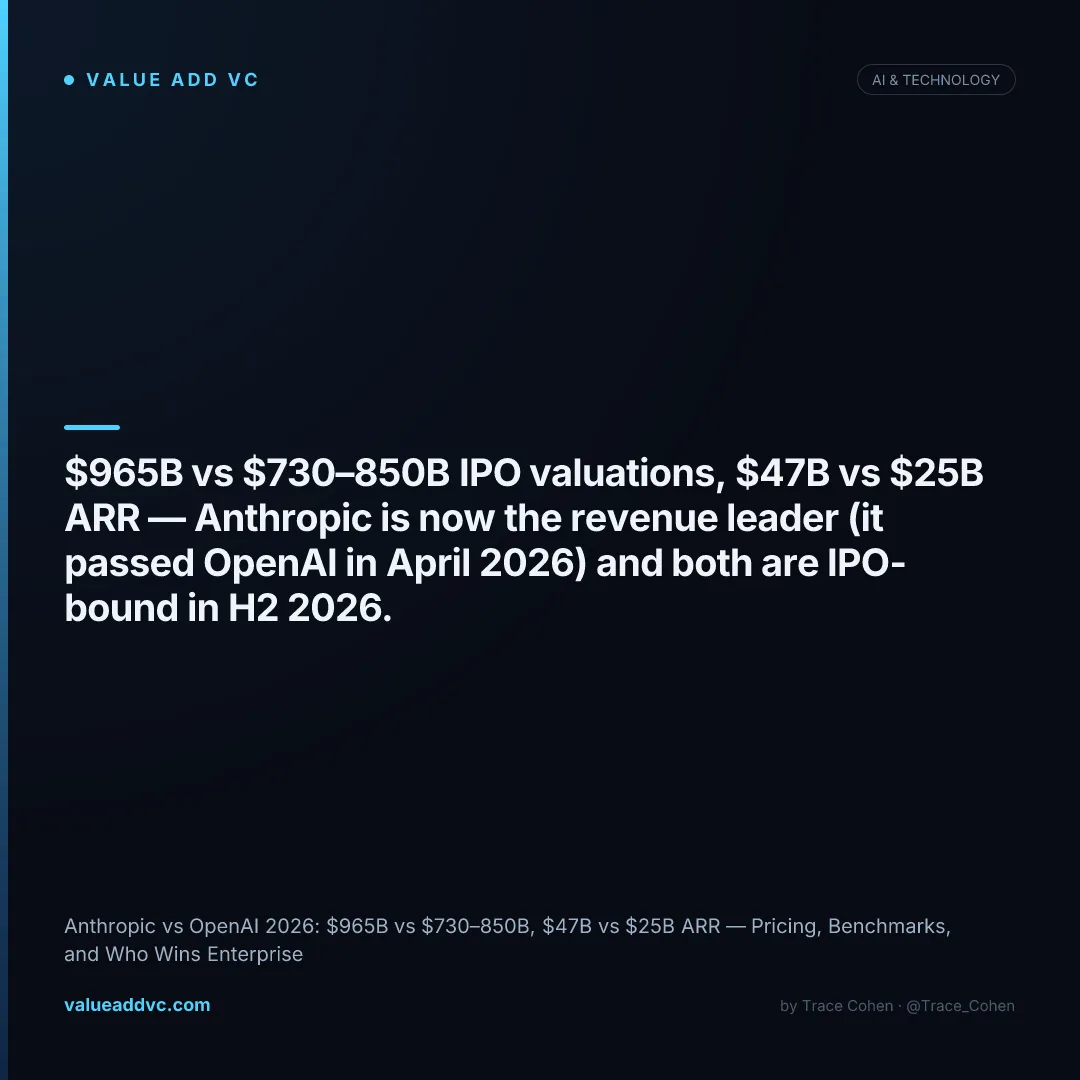
Anthropic filed for IPO on June 1, 2026 at $965B on roughly $47B in annualized revenue. OpenAI has filed confidentially, targeting $730–850B on roughly $25B annualized revenue for a September 2026 debut. Anthropic passed OpenAI in revenue in April 2026 — and yet the pricing gap on their flagship models is under 50 cents per million tokens. They are competing for very different parts of the enterprise stack.
Who actually wins which workloads, and where each company is making its real bets, is the more useful comparison.
Anthropic vs OpenAI Comparison 2026: The Side-by-Side
Anthropic vs OpenAI in 2026 comes down to four things: valuation and revenue, model performance per dollar, safety posture, and enterprise distribution. OpenAI leads on scale, consumer reach, and multi-modal breadth. Anthropic leads on code-generation quality, long-context reasoning, and a more conservative safety stance. The pricing delta is small enough that most buyers run both in production.
| Metric | Anthropic | OpenAI |
|---|---|---|
| Valuation (mid-2026) | $965B (IPO filing, June 1, 2026) | $730–850B target (Sept 2026 IPO) |
| Annualized revenue | ~$47B | ~$25B |
| Flagship model | Claude 4 Opus | GPT-5 Pro |
| API pricing (per 1M tokens, mid-tier) | $3.00 / $15.00 | $2.50 / $10.00 |
| Context window (flagship) | 200K tokens | 400K tokens |
| SWE-bench Verified (coding) | 72.7% | 65-67% |
| MMLU score | 88.7% | 91.4% |
| Enterprise customers | ~300K | ~600K |
| Largest investor | Amazon ($8B) | Microsoft ($13B) |
| Founded | 2021 | 2015 |
Pricing and benchmark figures reflect publicly disclosed numbers as of mid-2026. Track current AI company prices on Value Add VC's AI Valuations dashboard.
The Valuation and Revenue Gap
Anthropic's $965B IPO filing on roughly $47B in annualized revenue works out to about 20x revenue. OpenAI's $730–850B target on roughly $25B annualized revenue is closer to 30x. The headline shift of 2026: Anthropic passed OpenAI in revenue in April ($30B vs $25B run-rate) and now leads on both valuation and revenue, with both companies IPO-bound in the second half of the year.
The revenue mix is the bigger story. OpenAI's ARR is roughly 70% consumer — ChatGPT Plus, Team, Pro, and Enterprise seats on the consumer surface — and 30% API and direct enterprise contracts. Anthropic is the inverse: roughly 80% of revenue comes from the API and enterprise deals, and 20% from claude.ai. That means OpenAI's growth is tied to consumer subscription dynamics (churn, ARPU, freemium conversion), while Anthropic's growth is tied to developer adoption and enterprise sales cycles.
Both companies grew roughly 3-5x year over year. Both are burning real money on training — OpenAI's 2025 cash burn was reportedly above $7B; Anthropic's was over $3B. Microsoft's $13B investment and Amazon's $8B in Anthropic are not just equity — most of those dollars are compute commitments that flow right back to Azure and AWS.
Model Performance: Where Each Company Actually Wins
Benchmark leadership rotates quarterly, so the only useful question is: which company is currently winning which workload type? Here's the honest scoreboard as of mid-2026.
Anthropic wins
- ✓ Code generation — 72.7% SWE-bench Verified vs GPT-5's 65-67%
- ✓ Long-form writing and editing — preferred 60-65% of the time in blind tests
- ✓ Agentic tool use over many steps — Claude Sonnet 4 holds context across 50+ tool calls
- ✓ Safety-critical workflows — fewer hallucinations in legal, medical, and regulated domains
- ✓ Computer-use API for desktop agents (released 2024, matured in 2026)
OpenAI wins
- ✓ Multi-modal — best-in-class image, audio, and video input/output
- ✓ Reasoning at the frontier — OpenAI's flagship GPT (reasoning now built in) leads AIME and ARC-AGI
- ✓ Math and science benchmarks — 91.4% MMLU, leads GPQA Diamond
- ✓ Cost at the low end — GPT-5 mini at $0.25/$2.00 is the cheapest credible model
- ✓ Voice and real-time API — Realtime is meaningfully ahead of anything Anthropic ships
The single highest-signal split: Claude is the default for production coding tools (Cursor, Windsurf, GitHub Copilot's premium tier all route hard tasks to Claude), and GPT is the default for anything multi-modal or voice. If your workload doesn't cleanly sit on one side of that split, the right answer is to use both.
API Pricing: The Anthropic vs OpenAI Pricing Comparison That Actually Matters
Per-token pricing is close enough that for most workloads it isn't the deciding factor. Both companies cut prices roughly twice a year, and inference costs have dropped about 95% across the industry since 2023. Here's where they sit today.
| Tier | Anthropic (input / output per 1M tokens) | OpenAI (input / output per 1M tokens) |
|---|---|---|
| Flagship | Opus 4 — $15.00 / $75.00 | GPT-5 Pro — $15.00 / $120.00 |
| Mid-tier | Sonnet 4 — $3.00 / $15.00 | GPT-5 — $1.25 / $10.00 |
| Cheap & fast | Haiku 3.5 — $0.80 / $4.00 | GPT-5 mini — $0.25 / $2.00 |
| Ultra-cheap | Haiku 3 — $0.25 / $1.25 | GPT-5 nano — $0.05 / $0.40 |
| Reasoning model | n/a (in Sonnet) | o4 — $3.00 / $12.00 |
| Voice / Realtime | n/a | GPT-Realtime — $5.00 / $20.00 |
OpenAI is materially cheaper at the bottom — GPT-5 nano at $0.05/$0.40 is 80% less than Claude Haiku 3 on input and about 68% less on output — and that matters if you're running classification, routing, or summarization at scale. At the top, Claude Opus 4 and GPT-5 Pro tie on input at $15, but Opus is about 38% cheaper on output ($75 vs $120), which matters if you're doing agentic work where the model burns tokens. In the middle tier, GPT-5 at $1.25/$10.00 undercuts Claude Sonnet 4's $3.00/$15.00. Updated October 2026: OpenAI prices corrected to the rates on OpenAI's API pricing page.
Safety: Anthropic vs OpenAI in 2026 on the Question That Started Anthropic
Anthropic exists because Dario Amodei, Daniela Amodei, and other ex-OpenAI safety researchers thought OpenAI wasn't taking safety seriously enough. Five years later, that fork has produced two distinct postures.
Anthropic trains its models using Constitutional AI — an explicit written set of principles the model is fine-tuned against, which we unpack in detail separately. The result: Claude refuses more prompts in safety-critical categories (bioweapons, self-harm, election interference) and produces more transparent refusals when it does. Anthropic also publishes the most aggressive interpretability research in the industry, including circuit-level analyses of what features its models actually compute internally.
OpenAI ships safety through RLHF and a Preparedness Framework that gates capability releases on internal evals. In practice, OpenAI models are more flexible — they'll engage with edge-case requests Claude would refuse — and the company is more willing to ship consumer-facing products (voice, image generation, agents) that introduce new safety surface area. OpenAI's for-profit conversion in late 2025 also weakened some of the original nonprofit governance constraints that had distinguished it from Anthropic.
For enterprises in regulated industries — healthcare, financial services, legal, defense — Anthropic's posture is a real procurement advantage. JPMorgan, Pfizer, and several major US law firms run Claude as their default specifically because of the safety story.
Enterprise Distribution: Where the Real Anthropic vs OpenAI Comparison Lives
OpenAI has roughly 600K business customers and 3M+ paid seats. Microsoft sells GPT-4 and GPT-5 as part of every Azure, Copilot, and Dynamics SKU, which gives OpenAI distribution into 95%+ of the Fortune 500 by default. Approximately 92% of Fortune 500 companies have at least one OpenAI deployment somewhere in the org.
Anthropic has roughly 300K business customers — half OpenAI's count — but average contract values are reportedly 2-3x larger. Distribution comes from three places: AWS Bedrock (where Claude is the default frontier option), Google Cloud Vertex AI, and Anthropic's direct API. Cursor and Windsurf alone push 500M+ Claude API calls per day, which is the single largest concentration of agentic-workload usage anywhere.
If you're a buyer, the procurement math is: OpenAI is easier to add because Microsoft already has your enterprise agreement; Anthropic typically requires a separate contract through AWS or direct. That friction is real, but the model differentiation is real too. Most large enterprises end up running both.
Anthropic vs OpenAI: Which One Should You Pick?
Pick Anthropic (Claude) if
- → You're building a coding agent or shipping code generation
- → Your workload is long-context (legal, research, long documents)
- → You operate in a regulated industry and safety is a procurement requirement
- → You're building agentic workflows with many sequential tool calls
- → You prefer the cleaner, more conservative refusal behavior
Pick OpenAI (GPT) if
- → You need image, voice, or video input/output
- → You're running high-volume, cheap classification or routing
- → You want the lowest-friction enterprise procurement via Azure
- → You're building consumer-facing AI products that need broad capability coverage
- → You need the deepest reasoning (OpenAI's flagship GPT, with reasoning built in) for math, science, or research
The Anthropic vs OpenAI comparison in 2026 isn't a winner-take-all market.
It's a duopoly where one company won breadth and the other won depth — and the right enterprise answer is almost always both.
Track AI company valuations, revenue, and market share on the AI Valuations dashboard at Value Add VC. Originally published in the Trace Cohen newsletter.
Latest from the Pulse
Get VC data most people never see
— free to subscribe
Trace's notes on venture, AI and startups, a few times a week. Join 5,000+ subscribers. No spam.
No spam, unsubscribe anytime. Sent via Substack · Privacy · or subscribe on Substack ↗