Updated Oct 1, 2026
Mercor's last confirmed, priced valuation is still $10 billion (Series C, October 2025, per Mercor's own announcement). The $20 billion figure, reported by Bloomberg in July 2026 (relayed by TechCrunch), remains an in-talks number; we found no report of that round closing as of today. Added a valuation-history table with lead investors as the primary sources state them, linked the $500 million raise size to the Forbes report it comes from, widened the take-rate estimate to the 30-40% range The Next Web reports, labeled the $20B figure as reported or unclosed everywhere it appears in this post, and linked out to Mercor's Pulse company page for the live funding record.
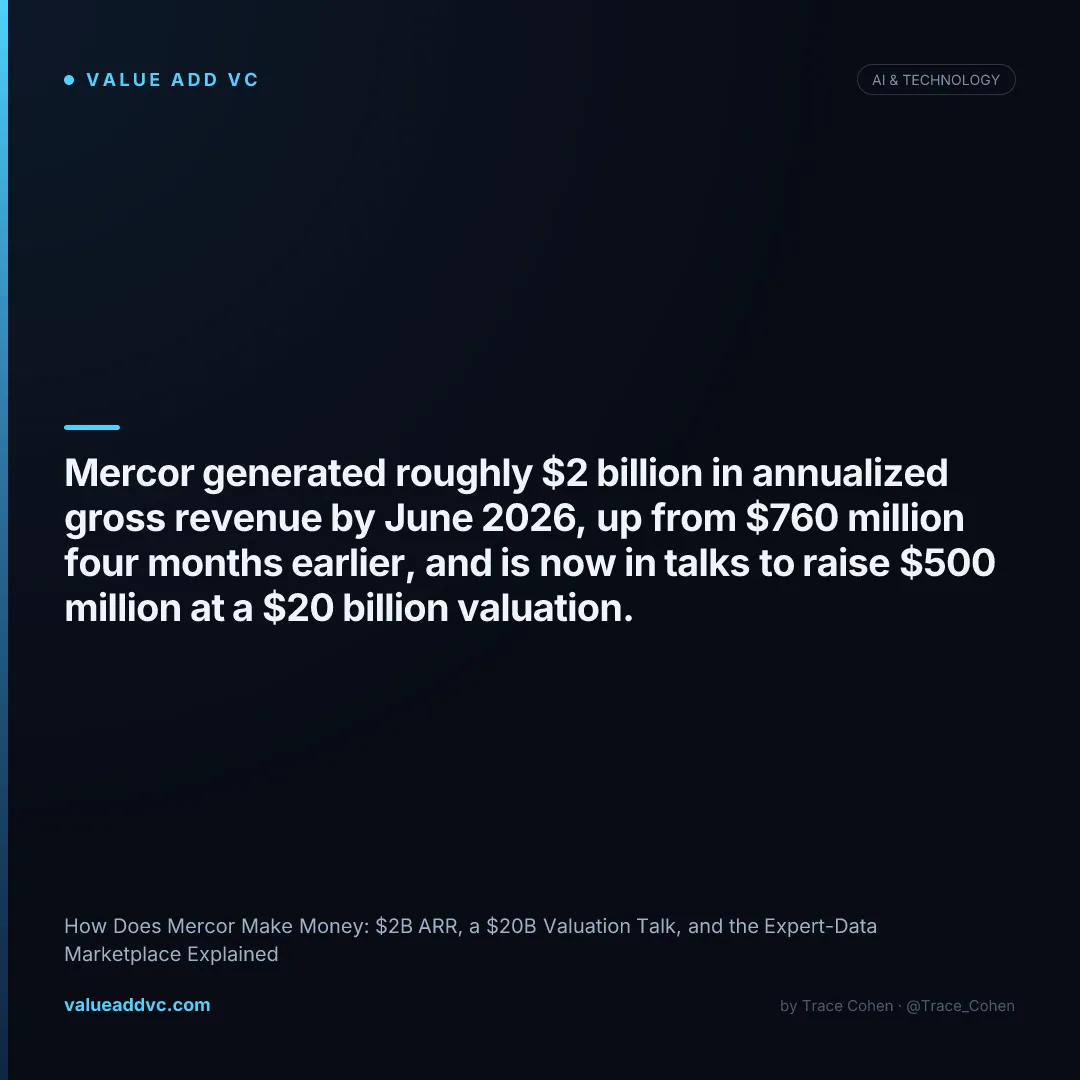
Mercor generated roughly $2 billion in annualized gross revenue by June 2026, up 100% in just four months, and is reportedly in talks for a $20 billion valuation — though we found no report of that round closing as of October 1, 2026. What the ARR headline hides is that the $2B is gross payment volume flowing through a marketplace — most of it goes straight to the contractors.
Mercor doesn't build AI models — it builds the labor market that trains them. Founded by three 22-year-old college dropouts, two from Georgetown and one from Harvard, Mercor connects frontier AI labs with vetted domain experts — doctors, lawyers, engineers, PhDs — who get paid to generate the reasoning traces, evaluations, and rubrics that make large language models better at specialized tasks. That marketplace mechanic is why Mercor went from $1 million to $2 billion in annualized run-rate revenue in roughly 24 months, one of the fastest growth trajectories ever recorded by a venture-backed company, and why, by July 2026, it was reportedly in talks at a $20 billion price tag, less than nine months after its last priced round valued it at half that.
Mercor Valuation History
| Date | Round | Amount | Valuation | Lead(s) | Source |
|---|---|---|---|---|---|
| Jul 2026 (in talks, unclosed) | Growth round (reported) | $500M (reported by Forbes) | $20B (reported by Bloomberg) | General Catalyst in talks to lead; Nvidia in talks to invest (The Information, Aug 2026) | Bloomberg via TechCrunch; Forbes; The Information via TechStartups |
| Oct 27, 2025 | Series C | $350M | $10B | Felicis Ventures (with Benchmark, General Catalyst, Robinhood Ventures participating) | Mercor; TechCrunch |
| Feb 20, 2025 | Series B | $100M | $2B | Felicis Ventures | TechCrunch |
| Sep 19, 2024 | Series A | $30M | $250M | Benchmark | PR Newswire |
The $20 billion figure was reported by Bloomberg on July 9, 2026 (relayed by TechCrunch) as early-stage talks; Forbes reported the same day that Mercor was in talks to raise $500 million, citing a source familiar with the fundraising. In August, The Information reported General Catalyst was in talks to lead and Nvidia in talks to invest. We found no report of the round closing as of October 1, 2026, so $10 billion (Oct 2025 Series C) remains Mercor's last confirmed, priced valuation.
Figures from Bloomberg via TechCrunch (July 2026 funding talks), Mercor's Series C announcement (October 2025), The Next Web citing The Information (contractor payout share), and Sacra's Mercor revenue analysis.
How Does Mercor Make Money?
Mercor makes money by taking a cut of the gross payment volume that flows through its marketplace between AI labs and the expert contractors they hire. A lab like OpenAI or Google DeepMind pays Mercor an hourly billing rate for a specific type of expert — a licensed physician to evaluate a medical-reasoning model, a patent attorney to grade legal-analysis outputs, a software engineer to write and rank code solutions. Mercor keeps the spread between what the lab pays and what the contractor actually receives; contractors take home an estimated 60% to 70% of everything billed, per The Next Web, leaving Mercor roughly 30% to 40%.
That's a fundamentally different model from a traditional staffing agency or a crowdsourced labeling platform. Mercor's own AI-driven vetting and interview system screens candidates for domain expertise before they ever touch a project, which is what lets it charge a premium rate — contractors reportedly earn around $95 an hour — and still scale to $1.5 million in daily contractor payouts without a large internal recruiting team. If you're tracking how the broader private AI market is being priced, see our AI valuations dashboard.
Where the $2 Billion Actually Goes
The headline $2 billion figure is gross payment volume, not revenue Mercor keeps. Of every dollar an AI lab pays into the platform, an estimated 60% to 70% flows straight through to the contractor who did the work, leaving Mercor with roughly 30% to 40% as its actual take. That distinction matters enormously for anyone comparing Mercor's "$2B ARR" headline to a traditional SaaS company's revenue line — a $2 billion gross-volume marketplace business and a $2 billion net-revenue software business are not remotely the same size on a P&L.
Even on the conservative 30% end of that range, Mercor's net take would be roughly $600 million on an annualized basis — still an extraordinary number for a company that was doing $75 million in gross volume in February 2025, but a very different figure from the one dominating headlines. Mercor's 30,000+ contractor network is the actual cost structure being marked up, not a fixed asset the company owns outright, which is the same structural tension every AI-labor marketplace — Scale AI, Surge AI, Handshake AI — is navigating right now.
Mercor's Valuation: $250M to $10B, $20B in Talks
Mercor's funding trajectory is as steep as its revenue curve. The company raised a $30 million Series A at a $250 million valuation roughly two years ago, and in February 2025 a $100 million Series B valued it at $2 billion. In October 2025, Mercor closed a $350 million Series C at a $10 billion valuation, led by Felicis with participation from Benchmark, General Catalyst, and Robinhood Ventures. As of July 2026, the company is reportedly in talks to raise at a $20 billion valuation, according to Bloomberg, and Forbes reported the raise at $500 million, citing a source familiar with the fundraising — which, if it closes, would double the Series C valuation set less than nine months before the talks were reported, and be an 80x jump from the Series A in two years. As of October 1, 2026, we found no report of that round closing, so $10 billion remains Mercor's last confirmed, priced valuation.
If that round closes at the reported terms, the reported $500 million plus Mercor's $30 million Series A, $100 million Series B, and $350 million Series C would bring its disclosed funding to roughly $980 million. As of mid-August 2026, Nvidia was reportedly in talks to join the round, and existing investor General Catalyst has been in talks to lead it, according to The Information — notable given Mercor reportedly earned tens of millions of dollars from Nvidia in the most recent quarter supplying expert data for its Nemotron open-source models. The timing stands out: the talks come roughly three months after Meta paused its contracts with Mercor indefinitely following a breach Mercor traced to a hack of the open-source LiteLLM tool. In July, Mercor also announced it is acquiring Deeptune, which builds simulated software environments where AI agents practice real work — underscoring how much trust — not just throughput — determines who wins frontier-lab contracts in this market.
Mercor vs Scale AI vs Surge AI: How the Expert-Data Market Split
The AI expert-data market fractured in 2025 after Meta bought a 49% stake in Scale AI for $14 billion in June, which destroyed Scale's neutrality overnight — frontier labs don't want their most sensitive asset, the data shaping their unreleased models, flowing through a vendor half-owned by a direct competitor. Google, OpenAI, and xAI all cut or reduced ties with Scale within weeks. That work split between two winners: bootstrapped rival Surge AI inherited much of the frontier human-feedback business, while Mercor became the default marketplace for vetted expert reasoning data.
| Metric | Mercor | Scale AI | Surge AI |
|---|---|---|---|
| Latest valuation (priced or reported) | $20B (in talks, unclosed); $10B last priced | $29B (post-Meta stake) | ~$25B (reportedly raising, Jul 2026, per The Next Web) |
| Trailing/run-rate revenue | $2.0B gross (June 2026) | $870M (2024) | $1.4B run rate (late 2025) |
| Business model | Marketplace, est. 30-40% take rate | Managed full-stack labeling | Managed, bootstrapped |
| Ownership structure | Independent, VC-backed | 49% owned by Meta | Independent, bootstrapped |
| Headcount (approx.) | Hundreds + 30,000+ contractors | Thousands | ~110 employees |
| Founded | 2023 | 2016 | 2020 |
| Key customer relationships | OpenAI, Google DeepMind, (Meta paused, Apr 2026) | Meta (owner), reduced OpenAI/Google/xAI ties | Frontier-lab human feedback work |
Figures blended from TechCrunch, The Next Web, techfundingnews.com, and Sacra's competitive analysis of the expert-data labeling market, 2026. Scale AI's $870 million is its 2024 revenue as Scale told Forbes in May 2026; Scale put its 2025 revenue at just shy of $1 billion. Other private-company revenue and headcount figures are estimates and may not be independently audited.
Mercor vs Surge AI vs Scale AI: Valuation and Revenue, 2026
TechCrunch, The Next Web, and industry reporting, 2026; Scale AI revenue is its 2024 figure, as Scale told Forbes (May 2026)
The Risk in Mercor's Business Model
Mercor's growth is a direct bet on frontier labs continuing to spend aggressively on post-training and reinforcement learning from human feedback, which is exactly the part of AI development budgets most exposed if capital markets cool on foundation-model spending. Because Mercor's revenue is gross payment volume flowing through a marketplace rather than recurring software revenue, it can theoretically scale down almost as fast as it scaled up if a major lab pulls a contract — which is precisely what happened with Meta earlier in 2026, when it paused its Mercor contracts indefinitely after a data breach Mercor traced to a hack of the open-source LiteLLM tool.
Concentration risk compounds that exposure: with OpenAI, Google DeepMind, and a shrinking list of other frontier labs as its primary customer base, Mercor's fortunes are tied to a handful of accounts rather than a broad enterprise base. That's the same structural risk that hit Scale AI when its neutrality broke — see our full Scale AI valuation breakdown for how that $29 billion mark now compares to the $20 billion Mercor is reportedly in talks at — and it's the reason investors weighing a reported $20 billion valuation are betting less on any single customer relationship and more on Mercor's position as the trusted, lab-agnostic layer connecting expert labor to frontier AI training pipelines. Track how the broader AI infrastructure spending picture is evolving on our Big Tech Earnings Tracker.
Why the AI Expert-Data Market Got So Big So Fast
Mercor's growth curve only makes sense in the context of how post-training economics changed inside frontier labs over the past two years. Pretraining on scraped web text hit diminishing returns around 2024, pushing labs toward reinforcement learning from human feedback, chain-of-thought supervision, and domain-specific evaluation as the new frontier for model improvement. That shift turned "expert labor" — a doctor grading a diagnosis, a lawyer scoring a contract analysis, a software engineer ranking two competing code solutions — into one of the most valuable and scarce inputs in AI development, worth far more per hour than the low-cost crowdsourced annotation that dominated the labeling market a few years earlier.
That repricing of expert time is what let Mercor pay contractors roughly $95 an hour rather than the few dollars an hour typical of older data-labeling platforms, and it's what makes the market big enough to support three separate multi-billion-dollar players — Mercor, Scale AI, and Surge AI — instead of consolidating around a single winner. It also explains why founders barely out of college could build a $10 billion company in about two years (it was founded in 2023 and valued at $10 billion in October 2025): the constraint was never capital or technology, it was trust and vetting speed, and Mercor's AI-driven interview pipeline solved for exactly that bottleneck faster than legacy staffing infrastructure could. That speed is also what made Mercor's three cofounders, who became billionaires at 22, the youngest self-made billionaires ever to make Forbes' billionaires list, younger than Mark Zuckerberg was when he debuted on it at 23.
Bottom line: Mercor makes money by keeping an estimated 30-40% of the gross payment volume it routes between frontier AI labs and 30,000+ vetted expert contractors, a marketplace mechanic that took the company from $1 million to $2 billion in annualized run-rate revenue in about 24 months. That growth is why investors are reportedly in talks to value the company at $20 billion, which, if the round closes, would double the $10 billion Series C valuation set less than nine months before the talks were reported — but the same marketplace structure that made the ramp possible is what makes Mercor's revenue more fragile than a traditional SaaS company's, tied tightly to a small number of frontier-lab relationships that can shift, as Meta's pause already showed, almost overnight.
Latest from the Pulse
Get VC data most people never see
— free to subscribe
Trace's notes on venture, AI and startups, a few times a week. Join 5,000+ subscribers. No spam.
No spam, unsubscribe anytime. Sent via Substack · Privacy · or subscribe on Substack ↗