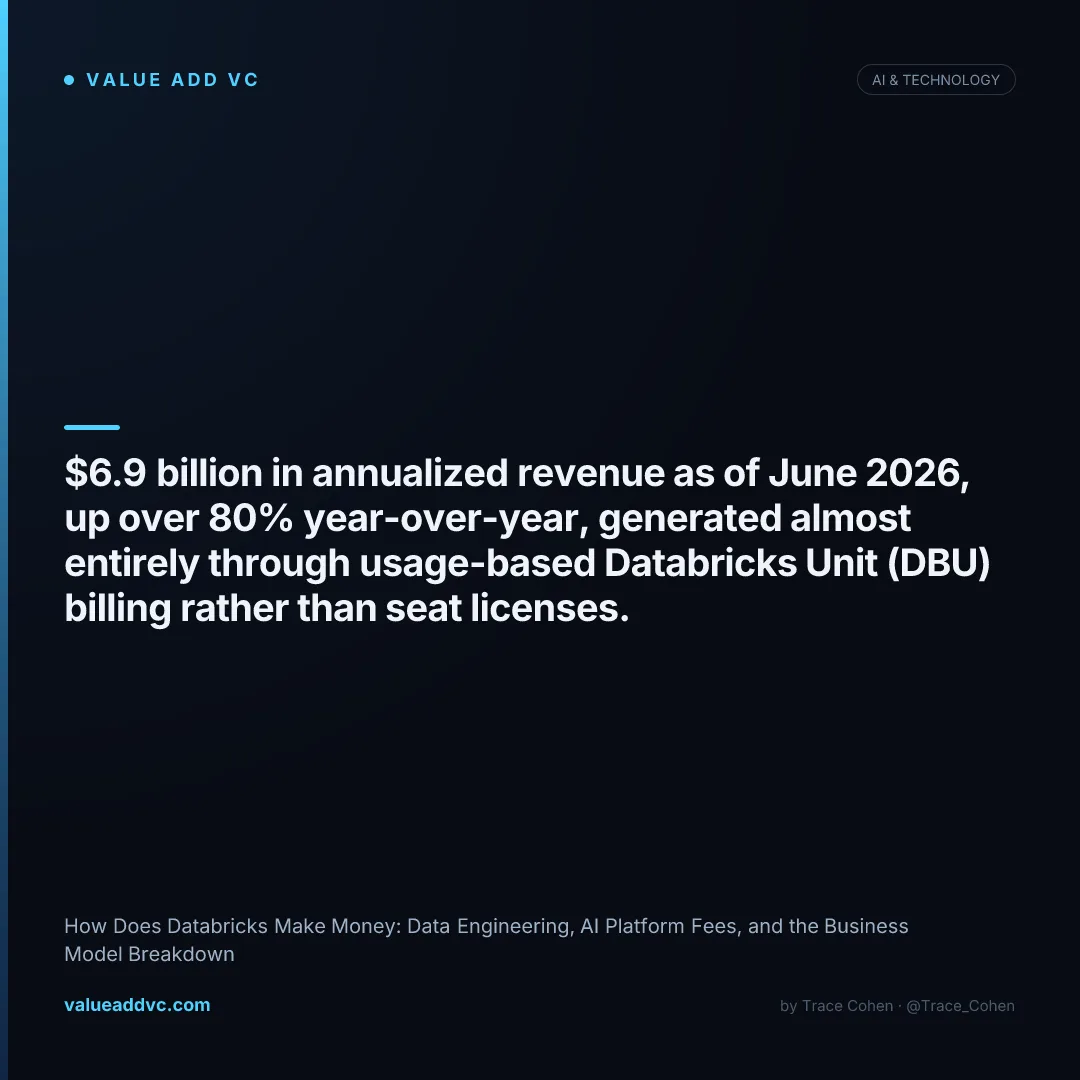
$6.9 billion in annualized revenue as of June 2026, up more than 80% year-over-year, and almost none of it comes from a per-seat license. A consumption model growing 80% a year is worth taking apart piece by piece.
Databricks doesn't sell software subscriptions the way Salesforce or Workday do. It sells compute, metered by the second, through a unit called a DBU (Databricks Unit) that scales directly with how much data a customer processes and how many AI models they run. That mechanism is the entire reason the company can post 80%+ growth on a $6.9 billion base while its closest public comparable, Snowflake, grows in the low 30s — and it's the same mechanism now under a microscope as Databricks races toward a reported $188 billion valuation.
Figures from Databricks press releases and newsroom disclosures, CNBC (June 2025 and June 2026), Bloomberg and TechCrunch (July 2026 funding coverage), and Sacra's 2026 Databricks revenue analysis.
How Does Databricks Make Money?
Databricks makes money by charging customers for compute consumption through Databricks Units, a normalized usage metric billed per second across its data engineering, SQL analytics, and AI/ML products. Customers pay a DBU rate on top of their own separate cloud infrastructure bill from AWS, Azure, or GCP, so the total cost of running Databricks scales directly with how much data a customer moves and how many models they train or serve — not with how many employees have a login.
That consumption model is why Databricks' revenue can compound so quickly once a customer is live: usage tends to grow with a customer's own data volume and AI ambitions, without a sales team having to negotiate a new seat count every renewal. It's also why the company's headline valuation and revenue numbers move together so tightly — investors are effectively underwriting the growth rate of enterprise data and AI workloads, not software adoption curves.
The DBU Pricing Mechanism, Explained
Every workload on Databricks — a nightly ETL job, an analyst running a SQL query, a model serving live predictions — consumes DBUs at a rate set by the type of compute involved. AI Model Serving is the cheapest per unit at around $0.07/DBU, reflecting Databricks' push to make hosted inference competitive on price. Jobs Compute, used for scheduled data pipelines, runs about $0.15/DBU. All-Purpose Compute, the interactive notebooks data scientists use day to day, costs roughly $0.40/DBU. Serverless SQL on AWS tops out near $0.70/DBU, the premium customers pay for instant-start, fully managed data-warehouse queries.
Critically, the DBU charge is layered on top of the customer's own cloud infrastructure spend — all-in cost typically runs 50% to 100% higher than the DBU line item alone once the underlying AWS, Azure, or GCP compute is added in. Databricks' default pricing tier is now Premium (Standard has been retired), which bundles Unity Catalog governance, role-based access control, SQL Warehouses, and the full Mosaic AI suite into one consumption pool rather than separate add-on products.
Where Databricks' Revenue Actually Comes From
Databricks doesn't break out exact product-line revenue, but its AI products — Mosaic AI training, provisioned-throughput model serving, and pay-per-token Foundation Model APIs — reached a $1.7 billion annual run rate as of mid-June 2026, up from $1.4 billion in February. Against $6.9 billion in total annualized revenue, that puts AI-specific products at roughly a quarter of the business, with the remaining three-quarters split across the older core: Jobs Compute for ETL and data engineering, Databricks SQL for analytics and BI, and Unity Catalog for governance, which is bundled into Premium but still drives DBU consumption through metastore queries.
Two acquisitions have reshaped that mix. Databricks bought MosaicML for $1.3 billion in June 2023 (per Databricks' announcement), seeding the training and serving infrastructure that became Mosaic AI and the open-source DBRX model. It bought Neon for roughly $1 billion in May 2025, and shipped the resulting product, Lakebase — a serverless Postgres database built for AI agents — just one month later in June 2025. Lakebase has reportedly generated roughly twice the revenue of Databricks SQL did at the same eight-month post-launch stage, an early signal of how fast AI-agent infrastructure is becoming its own revenue line rather than a feature of the core platform. If you're tracking how AI-native infrastructure spend is reshaping enterprise budgets more broadly, see our AI valuations dashboard.
Databricks vs Snowflake: How the Two Consumption Models Compare
Snowflake is the closest public comparable, and the comparison is instructive precisely because both companies reject per-seat pricing in favor of usage-based credits. The difference is growth rate and mix: Databricks is compounding faster off a larger, more AI-diversified base, while Snowflake remains more concentrated in SQL and data-warehouse workloads.
| Metric | Databricks | Snowflake |
|---|---|---|
| Latest annualized revenue | $6.9B (June 2026) | $4.68B (FY2026, ended Jan 2026) |
| Revenue growth rate | 80%+ YoY | 29% YoY |
| Pricing mechanism | DBUs (Databricks Units) | Credits |
| Net revenue retention | >140% | 125% |
| Latest quarter product revenue | N/A (private) | $1.33B, Q1 FY2027 (+34% YoY) |
| Remaining performance obligations | Not disclosed | $9.77B (+42% YoY) |
| Customers >$1M TTM product revenue | Not disclosed | 733 |
| Gross margin trend | Compressed from ~80% to mid-70s% | Historically ~75-78% |
Figures blended from Databricks and Snowflake company disclosures and earnings reports, CNBC and SaaS News/MLQ News (2026), and Sacra's Databricks revenue analysis. Databricks is private and does not report quarterly product revenue, RPO, or customer-count metrics the way Snowflake does as a public company.
Databricks vs Snowflake: Growth and Retention, 2026
Company disclosures, CNBC, and SaaS News/MLQ News, 2026
Gross Margin, Funding, and the $188B Valuation
Databricks' gross margin has compressed from roughly 80% in mid-2024 to the mid-70s% range in 2026, a direct consequence of how expensive AI infrastructure is relative to traditional data-engineering compute — GPU capacity for model training and serving costs meaningfully more per unit than the CPU compute that ran the company's original ETL and SQL workloads. That margin trade-off is the same one every infrastructure company selling AI compute is making right now: AI revenue grows faster, but it's less profitable per dollar than the legacy business it's layered on top of.
On the funding side, Databricks has raised roughly $20.2 billion across 14 rounds from 114 investors to date, including a16z, Insight Partners, Thrive Capital, DST Global, GIC, and WCM Investment Management across its Series J and K rounds. Its $5 billion Series L closed in February 2026 at a $134 billion valuation, including $2 billion in debt financing. Five months later, a term sheet signed mid-July 2026 valued the company at $188 billion, led by roughly $3 billion from Coatue — a 40% jump in five months, with proceeds earmarked for Unity AI Gateway, the Genie AI-agent product, and Lakebase. For the full breakdown of that round's terms, see our post on the Databricks $188B valuation and Coatue's $3B round. That term sheet ultimately landed at $190 billion once the full $5 billion round closed in August 2026, capping off a funding history covered in full in our Databricks company profile.
What Databricks' Business Model Means for Investors
For LPs and crossover investors evaluating exposure to Databricks ahead of an eventual IPO, the consumption model is the single most important variable to underwrite. It means revenue is directly tied to the volume of enterprise data and AI workloads run on the platform, which is a tailwind right now but also means a slowdown in enterprise AI spending would hit Databricks' top line faster than it would hit a seat-based SaaS vendor with sticky annual contracts. The 140%+ net revenue retention figure is the number that matters most here — it means existing customers are expanding their usage fast enough to offset any churn, which is the core assumption behind the $188 billion price tag.
For operators building on top of Databricks, the practical takeaway is that DBU costs compound with data growth and AI adoption in ways that are easy to underestimate at the pilot stage — the same pricing ladder that makes AI model serving cheap per unit also makes Serverless SQL and All-Purpose Compute expensive enough to justify real FinOps discipline once usage scales. Track how the broader AI infrastructure spending picture is evolving on our Big Tech Earnings Tracker.
Bottom line: Databricks makes money by metering compute through DBUs rather than selling seats, and that mechanism is now generating $6.9 billion in annualized revenue, up 80%+ year-over-year, with AI products alone at a $1.7 billion run rate. The business is growing nearly three times faster than Snowflake, its closest consumption-based comparable, which is exactly why investors just marked the company up 40% to $188 billion in five months. The open question isn't whether the model works — it's whether gross margins can hold in the mid-70s% range as AI compute costs keep climbing faster than the DBU rate card does.
Latest from the Pulse
Get VC data most people never see
— free to subscribe
Trace's notes on venture, AI and startups, a few times a week. Join 5,000+ subscribers. No spam.
No spam, unsubscribe anytime. Sent via Substack · Privacy · or subscribe on Substack ↗