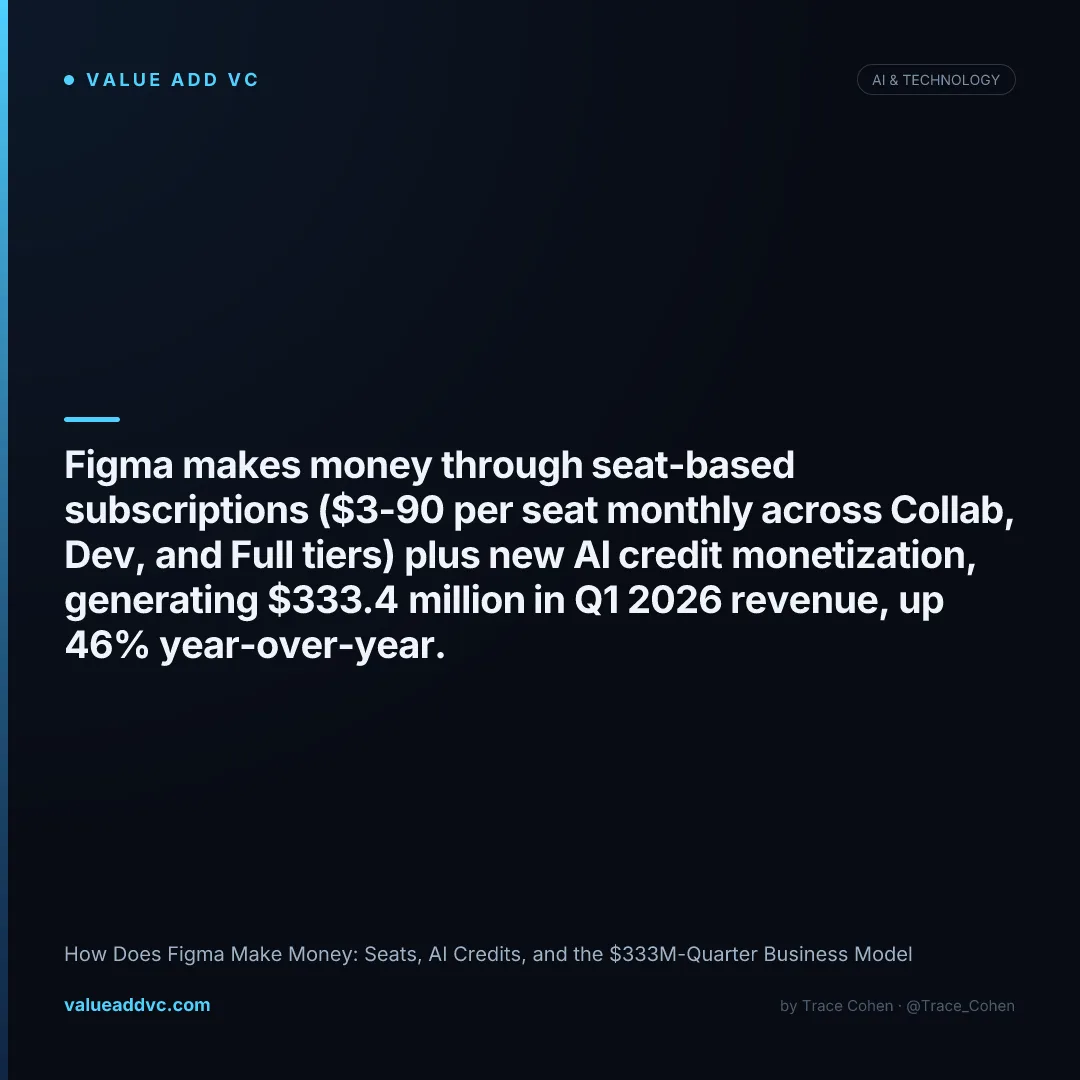
Figma made $333.4 million in revenue in Q1 2026, up 46% year-over-year, through seat-based subscriptions and a fast-growing new AI credit monetization stream. The paradox is that Figma's revenue is accelerating even as its stock trades 84% below the high it hit the week it went public.
Figma (NYSE: FIG) IPO'd on July 31, 2025 at $33/share, spiked to $142.92 the next day, and has since traded down to as low as $16.60 before settling around $24 — a market cap of roughly $12.65 billion. Meanwhile the underlying business has done the opposite of what the stock chart suggests: revenue growth accelerated from 40% to 46% year-over-year between Q4 2025 and Q1 2026. Here's exactly how the money actually gets made.
Figures blended from Figma's Q1 2026 earnings release (Businesswire, SEC 8-K), StockAnalysis.com, and Yahoo Finance reporting, May-July 2026.
How Does Figma Make Money? The Core Business Model
Figma makes money primarily by selling per-user monthly or annual seats layered across five role-based tiers: a free Viewer seat for comment-only access, Collab seats ($3-5) for lightweight collaborators, Content seats for marketers, Dev seats ($12-35) built for engineers who need code inspection tools, and Full seats ($16-90) that unlock the entire design suite. This role-based split, introduced in March 2025, lets Figma charge design-heavy users far more than the developers, marketers, and stakeholders who only touch a project occasionally — without losing those lighter users to a cheaper competitor entirely.
On top of seats, Figma has layered in a genuinely new second revenue engine in 2026: usage-based AI credit monetization tied to its AI design and prototyping tools. That pricing shift "kicked in just weeks before" the end of Q1 2026 according to management, and was cited directly as a driver behind revenue growth accelerating rather than decelerating — an unusual pattern for a SaaS company at Figma's scale and one worth watching as a template for how design and productivity tools monetize AI features going forward.
Figma's Seat-Based Pricing Explained
The seat tiers exist because Figma's actual user base splits sharply by need: developers now make up roughly 30% of monthly active users, but most of them only need to inspect specs and export code, not build full designs — hence a dedicated, cheaper Dev seat instead of forcing every technical user onto the full-price tier. That segmentation is also why 76% of Figma's customers now use two or more of its products (Design, FigJam, Dev Mode, Slides, Sites, and newer tools like Buzz and Make), up from 64% a year earlier — the bundle strategy mirrors Microsoft 365's approach of making the full suite the default choice for teams once they're inside the ecosystem.
That bundling shows up directly in retention: net dollar retention hit 139% in Q1 2026, its highest mark in over two years, meaning existing customers are spending nearly 40% more on average than they were a year earlier — largely through seat expansion and cross-product adoption rather than new logo acquisition. Paid customers grew 54% year-over-year to roughly 690,000, so Figma is growing both the number of accounts and the average revenue per account at the same time, a combination most SaaS companies lose one half of as they scale.
Figma Seat Pricing by Tier
The table below breaks down Figma's role-based seat pricing as of 2026, alongside who each tier is actually designed for — a similar role-based logic to how Notion turns free users into paid seats.
| Seat type | Monthly price range | Who it's for | Access level |
|---|---|---|---|
| Viewer | Free | Stakeholders, reviewers | Comment-only |
| Collab | $3-5 | Light collaborators | FigJam, basic editing |
| Content | ~$10 | Marketers, content teams | Buzz, Slides, Sites |
| Dev | $12-35 | Engineers (~30% of MAU) | Dev Mode, code inspection |
| Full | $16-90 | Designers | Complete design suite |
Figures are 2026 estimates blended from Figma's help center pricing documentation, third-party pricing trackers (SaaSCRMReview, UseCarly), and public reporting on Figma's March 2025 role-based seat restructuring.
From the Adobe Deal Collapse to a $12.65B Public Company
Figma's path to a public business model breakdown worth writing about started with a deal that never closed. Adobe agreed to acquire Figma for $20 billion in September 2022, only to abandon the deal in December 2023 after UK and EU regulators signaled they'd block it on competition grounds — Adobe paid Figma a $1 billion termination fee instead. That collapse forced Figma to build toward an independent future rather than an acquisition exit, and the company used the eighteen months between the killed deal and its July 2025 IPO to accelerate AI product development, launch Figma Slides and Figma Sites, and push toward the S-1 that eventually showed $749 million in FY24 revenue.
That history matters for the business model because it explains the urgency behind Figma's AI push: a company that was two years away from being folded into Adobe's Creative Cloud instead had to prove it could out-execute both Adobe and a wave of AI-native prototyping startups on its own. The seat-plus-AI-credit hybrid pricing model launched in 2025-2026 is a direct product of that pressure — Figma needed a monetization path for AI features that didn't require the balance sheet of a company the size of Adobe, which is exactly why it built AI credits on top of an already-profitable seat business instead of subsidizing a separate AI product line.
Why Figma Stock Has Fallen 84% Since Its IPO High
Figma's stock trajectory looks nothing like its revenue trajectory. FIG priced its IPO at $33/share on July 31, 2025, spiked to an all-time high of $142.92 the very next day in classic first-day-pop fashion, then ground down to an all-time low of $16.60 by April 30, 2026 — an 84% collapse from peak to trough in nine months. It has since recovered modestly to around $24, giving the company a roughly $12.65 billion market cap.
That gap between a decelerating stock price and an accelerating revenue line is the core tension in the Figma story right now: the market priced in hypergrowth-forever at the IPO pop, then repriced hard on competitive concerns — AI-native design and prototyping tools, plus Canva's continued push upmarket into product design — even as Figma's actual Q1 2026 numbers beat expectations on both revenue and EPS. That competitive pressure traces back to Canva's own freemium-to-enterprise business model, which now funds the R&D behind its move into Figma's core product-design territory. For more on how public and late-stage private tech valuations are diverging in 2026, see our Tech IPO dashboard and our breakdown of how investors are pricing AI-exposed software companies in 2026.
What Figma's Model Means for SaaS and AI-Native Competitors
Figma's willingness to add a usage-based AI credit layer on top of its existing seat model — rather than replacing seats entirely — is a useful signal for how legacy SaaS companies are choosing to monetize AI features in 2026. Instead of a separate "AI tier" that risks cannibalizing seat revenue, Figma bolted AI monetization onto an already-expanding seat base, and management directly credited that combination with the jump from 40% to 46% revenue growth. That's a meaningfully different playbook than pure AI-native challengers, who typically launch usage-based or credit-based pricing from day one because they have no legacy seat business to protect.
For founders and investors tracking the broader AI monetization pattern, Figma's 88-91% gross margins and 139% net dollar retention are the numbers that matter most — they show AI features can be layered onto an existing high-margin subscription business without diluting unit economics, which isn't guaranteed given how compute-intensive many AI features are. Track how peer AI-native and AI-augmented software companies are being valued on our AI Valuations dashboard.
It's also a useful reference point for early-stage founders building design, prototyping, or creative tooling: Figma's 690,000 paid customers and 46% revenue growth eight quarters after a nearly-closed $20 billion acquisition show that a public, standalone outcome is still very much on the table for category-defining product companies, even after a near-miss exit. The lesson isn't that every startup should turn down an acquisition — it's that Figma's seat-based pricing, built years before AI monetization existed as an option, gave it a durable enough revenue base to survive an eighteen-month gap between a collapsed deal and an IPO, then layer new monetization on top without needing to redesign the whole business.
Bottom line: Figma makes money through role-based seat subscriptions ranging from free to $90/month, layered with a new AI credit monetization stream that helped push Q1 2026 revenue to $333.4 million, up 46% year-over-year, with 139% net dollar retention and $1.42-1.43 billion guided for the full year. The business is accelerating even as the stock sits 84% below its August 2025 high — a reminder that IPO-week pricing and underlying fundamentals can diverge sharply, and that the fundamentals here currently look stronger than the chart suggests.
Latest from the Pulse
Get VC data most people never see
— free to subscribe
Trace's notes on venture, AI and startups, a few times a week. Join 5,000+ subscribers. No spam.
No spam, unsubscribe anytime. Sent via Substack · Privacy · or subscribe on Substack ↗