$2.5 billion is Canva's annualized revenue as of mid-2026 — generated almost entirely from converting a fraction of its 200 million free users into paying subscribers. Canva doesn't charge per design or per download. It runs a textbook freemium subscription model where the free tier is genuinely useful, the paid tiers unlock premium templates, brand controls, and AI-powered features, and the conversion math works because the free user base is enormous.
Founded in Sydney in 2013, Canva started as a drag-and-drop alternative to Photoshop for people who aren't designers. Thirteen years later, it's the second-largest design software company in the world by revenue, behind only Adobe, and one of the few SaaS businesses at this scale that's consistently profitable. Here's how the money actually works.
Figures compiled from Forbes, The Information, and Bloomberg reporting on Canva's revenue, user base, and valuation, as of mid-2026.
How does Canva make money
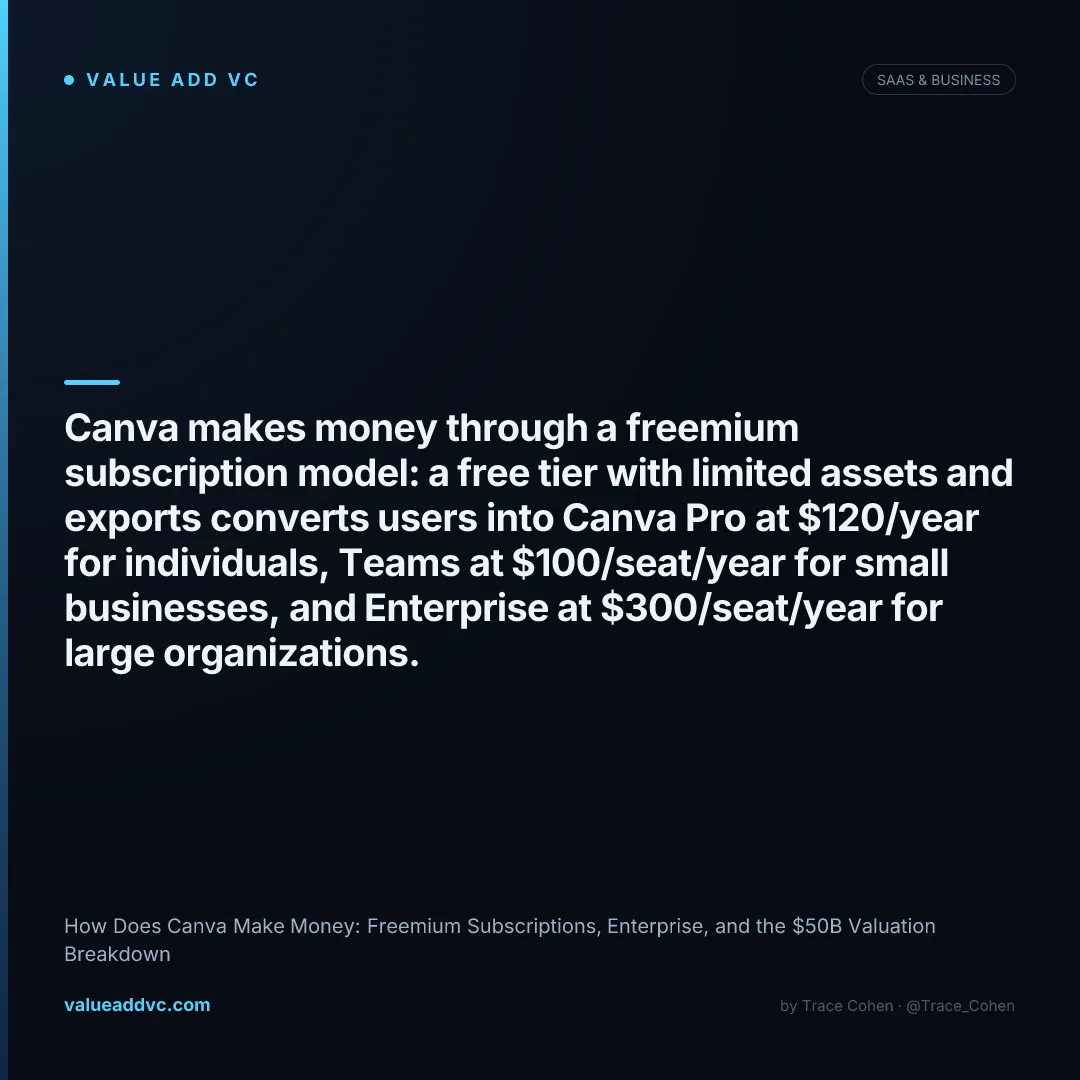
Canva makes money through three subscription tiers and two ancillary revenue lines. The core engine is Canva Pro at $120 per year ($12.99/month), which gives individual users access to 100+ million premium stock photos and videos, Brand Kit for consistent branding, background removal, Magic Resize to adapt designs across formats, and 1TB of cloud storage. Pro is the highest-volume paid tier and accounts for roughly 45% of total revenue.
Canva for Teams costs $100 per seat per year (minimum 3 seats) and adds real-time collaboration, shared brand templates, team folders, and approval workflows — features that matter when a marketing department of 15 people needs to stay on-brand without a design review bottleneck. Teams accounts represent roughly 30% of revenue and are the fastest-growing tier because they expand seat counts within existing accounts without new sales conversations.
Canva Enterprise at $300 per seat per year layers on SSO, advanced admin controls, custom brand templates locked by admins, audit logs, and dedicated support — the procurement-friendly features that let Canva land deals with companies like Salesforce, FedEx, and Marriott. Enterprise represents about 15% of revenue but carries the highest per-seat economics. The remaining 10% comes from Canva Print (physical printing and shipping of business cards, brochures, and posters) and marketplace commissions from third-party template and asset creators who sell through Canva's built-in marketplace.
The freemium conversion engine
Canva's free tier isn't a crippled trial — it includes thousands of templates, basic photo editing, real-time collaboration, and exports to PNG, JPG, and PDF. That generosity is deliberate: a free user who builds their workflow around Canva for three months is dramatically more likely to upgrade than someone who hits a paywall on day one. The company has said publicly that roughly 5% of its 200 million monthly active users convert to paid plans, which means about 10 million paying subscribers generating an average of $250 per subscriber per year across all tiers.
The AI features launched in 2023 — Magic Design (auto-layout generation), Magic Write (copywriting), Magic Eraser (object removal), and text-to-image generation — have become the primary upgrade lever. These features are limited or metered on the free tier and unlimited on Pro, creating a natural friction point that pushes power users toward paid plans. Canva's 2024 acquisition of Affinity (the Photoshop/Illustrator alternative) also expanded the product surface into professional design, giving the company a credible upsell path for the small percentage of users who outgrow template-based workflows.
Canva's valuation: $50 billion and the IPO question
Canva was valued at approximately $50 billion in a 2024 secondary share sale, up from $40 billion in a 2023 valuation cut (down from a $26 billion peak in the 2021 funding round, later marked up as revenue continued growing). The company has raised roughly $770 million in total funding from investors including Sequoia Capital, Blackbird Ventures, Felicis Ventures, T. Rowe Price, and Franklin Templeton.
At $2.5 billion in ARR, the $50 billion valuation implies a 20x revenue multiple — reasonable for a profitable, growing SaaS company but elevated compared to publicly traded peers. For comparison, Figma's $12.5 billion valuation on $700 million in ARR implies roughly 18x, and Adobe trades at about 10x revenue. The IPO question has loomed over Canva since 2023, and the company is widely expected to go public in 2026 or early 2027. See our tech IPO tracker for the latest pipeline.
| Round | Date | Amount Raised | Valuation | Lead Investors |
|---|---|---|---|---|
| Series A | 2015 | $15M | $165M | Felicis Ventures |
| Series C | 2019 | $85M | $3.2B | General Atlantic, Bond |
| Series F | Sep 2021 | $200M | $26B | T. Rowe Price, Franklin Templeton |
| Secondary sale | 2024 | N/A | ~$50B | Secondary market |
Funding data from Crunchbase, Forbes, and The Information, compiled August 2026.
Canva vs Adobe vs Figma
Canva competes in the visual design tools market, but its actual competitive position is more nuanced than a simple Adobe competitor framing. Adobe Creative Cloud dominates professional creative workflows at roughly $16 billion in annual revenue — but Adobe's users are professional designers and photographers who need Photoshop-level control. Canva's 200 million users are overwhelmingly marketers, social media managers, HR teams, and small business owners who need polished output without design expertise.
Figma at $700 million ARR competes on the product design side — UI/UX for digital products — which barely overlaps with Canva's marketing-focused use cases. The real competitive tension for Canva is downstream: Microsoft Designer (free with Microsoft 365), Google's built-in design tools, and AI-native design startups that generate layouts from text prompts. Canva's defense is its template marketplace (millions of user-contributed designs creating network effects) and its 200 million user habit — once a team standardizes on Canva's workflow, switching costs are high even if alternatives are technically comparable.
Why Canva's economics work
Two structural advantages explain Canva's unusual profitability at scale. First, the product is largely self-serve: most users discover Canva through search, word of mouth, or education partnerships (Canva for Education is free for K-12), try the free tier, and upgrade to Pro without ever talking to a salesperson. That keeps customer acquisition costs far below the SaaS industry average. Second, the template marketplace creates a supply-side flywheel — third-party creators publish templates to reach Canva's 200 million users, which makes the product more useful, which attracts more users, which attracts more creators. Canva doesn't need to produce all the content itself.
The AI investment is the current strategic bet. By embedding generative features (Magic Design, Magic Write, text-to-image) directly into the design workflow, Canva is positioning AI as the upgrade path from free to paid rather than building a separate AI product. That integration approach is cheaper and stickier than launching a standalone AI tool — and it's the same playbook that Notion used to drive its AI-powered upsell. For more on how SaaS companies are valued at different ARR ranges, see our SaaS valuations dashboard.
Bottom line: Canva makes money by converting a fraction of its 200 million free users into Pro ($120/year), Teams ($100/seat/year), and Enterprise ($300/seat/year) subscribers, supplemented by Canva Print and marketplace commissions. At $2.5 billion in ARR and roughly $50 billion in implied valuation, it's the second-largest design software company by revenue behind Adobe — and the most likely major tech IPO candidate for late 2026 or early 2027. The AI-powered upgrade path from free to paid is now the company's primary growth lever.
Latest from the Pulse
Get VC data most people never see
— free to subscribe
Trace's notes on venture, AI and startups, a few times a week. Join 5,000+ subscribers. No spam.