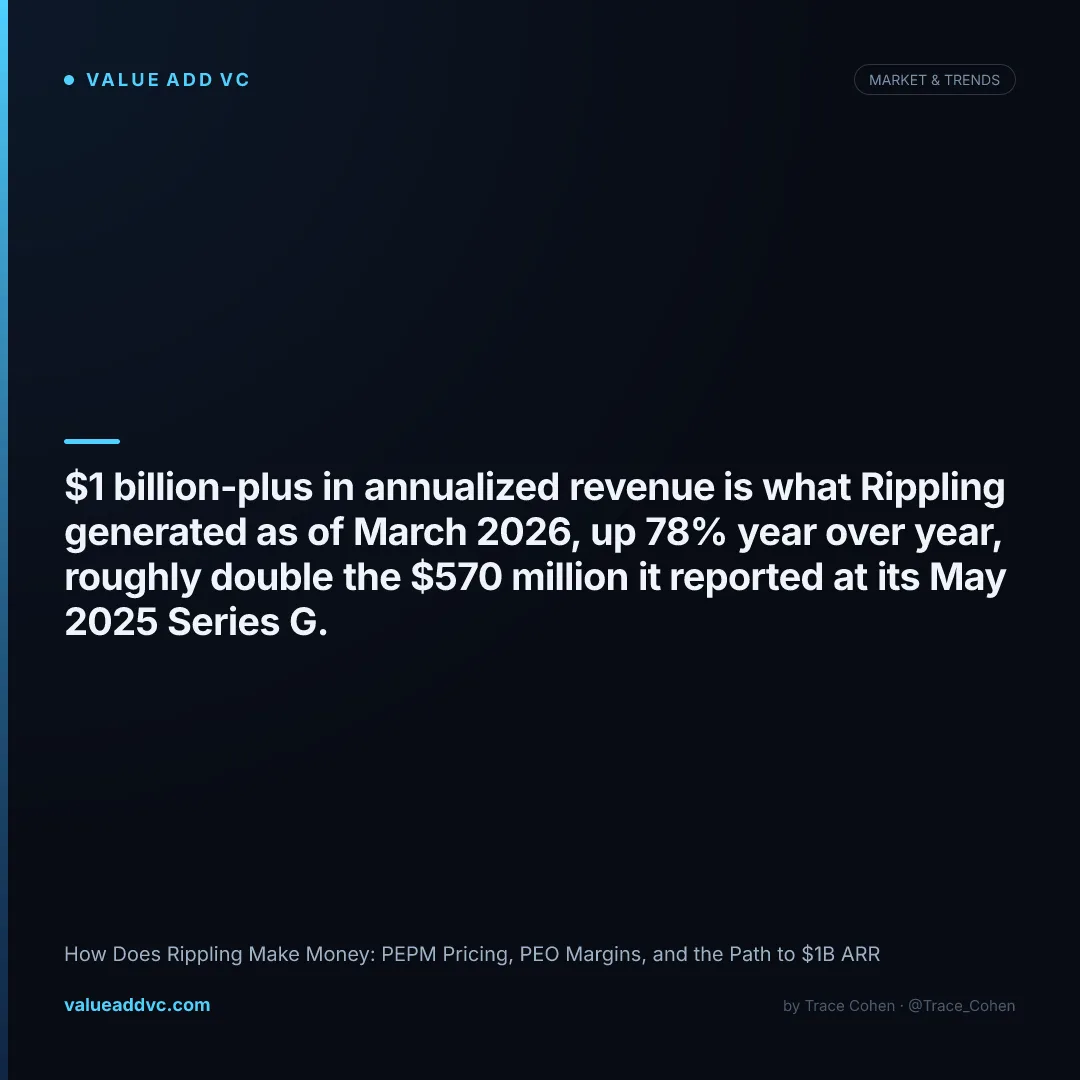
Rippling's annualized revenue crossed $1 billion in March 2026, up 78% year over year, and the San Francisco-based company is valued at $16.8 billion after a $450 million Series G that closed in May 2025. It earns that money by stacking a base platform fee plus a per-employee-per-month (PEPM) charge across more than ten HR, IT, finance, and PEO modules — a pricing structure built to expand revenue per customer long after onboarding.
Founded in 2016 by Parker Conrad and Prasanna Sankar, Rippling calls itself a "compound startup" — Conrad's own term for building many deeply integrated products on one employee-data layer rather than one standalone tool. That framing is also the clearest way to understand how the company actually bills customers: not one price, but a growing stack of them.
ARR and growth rate: Sacra company estimates, cross-referenced against CEO Parker Conrad's public disclosures, as of March 2026. Valuation: CNBC, May 9, 2025. Customer count: Apex Fintech Solutions press release, August 19, 2026. Product milestones: Rippling's company blog.
How does Rippling make money?
Rippling makes money by charging a base platform fee of roughly $35 per month, plus a per-employee-per-month rate for every module a customer turns on: payroll, benefits, IT device management, spend management, and PEO or EOR services. Each module is priced on its own, so the bill scales with how many product lines a customer buys.
That modular structure is deliberate. Rather than compete on one feature, Rippling's pitch is that every new hire or new office triggers a reason to add another module, because the employee record — name, pay, benefits elections, device assignments — already lives in Rippling's database. Payroll alone runs about $8 per employee per month billed annually (or $10 billed monthly), and IT device management runs roughly $8 per device per month, according to figures Rippling publishes on its pricing pages. A 100-person company running HR plus payroll typically lands around $4,000 or more a month before any additional modules.
The PEO and EOR layer: where the real margin sits
Rippling's highest-margin product line isn't software at all — it's the PEO (professional employer organization) business, where Rippling becomes the legal co-employer of a customer's workforce for payroll-tax and benefits-administration purposes. That lets Rippling bundle workers' compensation insurance, group health benefits, and compliance filings into a single PEPM charge rather than selling a dashboard. For global hiring without a local entity, Rippling's Employer of Record product runs roughly $499 to $599 per employee per month, on top of the $35 base platform fee, per its own pricing pages — a narrower footprint than rival Deel, which charges a flat $599 EOR rate across more than 160 countries with no separate base fee.
The tradeoff: a PEO carries co-employment liability that a pure payroll-software vendor doesn't. If a customer's workers' comp claims run hot or a benefits plan is mismanaged, Rippling is on the hook alongside the client — a structural risk a company like Gusto's base payroll tier doesn't take on at the same level, even though Gusto also sells its own PEO add-on.
The funding history behind the pricing experiments
Rippling has raised money at a fast-rising series of valuations while its ARR grew in parallel. It was valued at $1.35 billion in an August 2020 round that raised $145 million, according to TechCrunch, then $11.25 billion at a 2022 Series E that raised $500 million. By March 2023 the company had disclosed more than $100 million in ARR; that grew to over $350 million by the time of its April 2024 Series F, a $200 million round led by Coatue Management with Founders Fund, Dragoneer, and Greenoaks Capital participating that valued the company at $13.5 billion, per SiliconANGLE.
The May 2025 Series G pushed the valuation to $16.8 billion on a $450 million raise with no single lead investor, joined by Elad Gil, Sands Capital, GIC, Goldman Sachs Alternatives, and Baillie Gifford, according to CNBC, which also reported that TechCrunch confirmed Y Combinator uses Rippling's platform as a customer. Conrad told CNBC the company would need to be profitable before it would consider going public, and that it has no specific IPO plans.
Notably, that round priced while Rippling was already suing a rival over corporate espionage: Bloomberg reported on April 4, 2025 that Rippling was in early talks for the $16 billion valuation while the Deel case was already underway — investors priced the round without waiting for the lawsuit's outcome.
Rippling AI and the growth spike behind the 78% number
The jump to 78% year-over-year growth didn't happen on its own. Conrad said on X in April 2026 that Rippling AI — an agent layer that works across the company's HR, IT, and finance modules rather than inside just one of them — was "the most successful launch we've ever done," and that growth had accelerated every quarter for three straight quarters following the release. He did not disclose what portion of ARR comes from Rippling AI specifically, and no source cited in this post breaks that figure out separately from the rest of the platform.
That pattern — an AI feature layered across an existing multi-product base rather than sold as its own line item — mirrors what Notion did when it bundled AI into its Business tier instead of charging separately for it. In Rippling's case, the AI layer doesn't replace the PEPM pricing described above; it rides on top of modules customers are already paying for, which is one reason the company hasn't broken out AI as a separate revenue line.
Rippling vs Deel vs Gusto: three compound-startup business models
Rippling, Deel, and Gusto all sell overlapping payroll, benefits, and HR software, but each anchors its model on a different starting point. Deel was built EOR-and-contractor-first, aimed at companies hiring internationally without a local entity; Rippling was built HR-and-IT-first for US-headquartered companies that later added global payroll and EOR; Gusto has stayed narrower, focused on small-business payroll and benefits without Rippling's IT or spend-management layer.
| Metric | Rippling | Deel | Gusto |
|---|---|---|---|
| Latest ARR / revenue | $1.0B+ (Mar 2026) | $1.5B+ (H1 2026) | $1.0B (trailing, May 2026) |
| YoY growth rate | 78% | 63% (as of Feb 2026, $1.4B mark) | Not disclosed in figures cited here |
| Latest valuation | $16.8B (May 2025) | $17.3B (Oct 2025) | $9.3B (Jun 2025 tender) |
| Latest round | $450M Series G | $300M Series E | $200M employee tender |
| Founded | 2016 | 2019 | 2011 |
| Core pricing model | Base fee + PEPM per module | Flat $599 PEPM EOR, no base fee | Per-employee payroll + PEO add-on |
| Reported customers | 30,000+ businesses | 37,000+ businesses | 500,000+ small businesses |
| Profitability status | Not profitable; CEO says it needs to be before an IPO | Profitable for three straight years as of Sept 2025 | Cash-flow positive for several years |
Rippling: Sacra estimates, CNBC. Deel: Deel's own Series E announcement and Sacra estimates. Gusto: TechCrunch, May 7, 2026. All figures as self-reported or estimated by the sources linked; none of the three companies is public, so none of this is audited.
The Deel lawsuit: a cost, not a revenue-model problem
Rippling sued Deel in March 2026, alleging Deel paid a Rippling employee in its Dublin office, Keith O'Brien, to act as a corporate spy and pass along pricing proposals, sales-pipeline data, and personnel information. Rippling says it caught O'Brien through a honeypot operation: a fake Slack channel named "#d-defectors" that baited him into searching for information Deel would find embarrassing. Deel has denied wrongdoing.
The case has run for over a year with multiple twists: TechCrunch reported in January 2026 that O'Brien had agreed to cooperate with Rippling after initially contesting the allegations, and Irish courts separately ruled in March 2026 that some Deel executives could be removed as defendants from a related espionage case in that jurisdiction. On September 26, 2026, Bloomberg reported that a federal judge in the Northern District of California rejected Deel's bid to strike testimony from that same central witness, declined to reopen an earlier ruling that let Rippling's claims proceed, and ordered Deel's most serious counterclaims against Rippling into arbitration.
PitchBook's analysis of the case notes several ways it could still resolve, from settlement to a jury trial. None of that changes either company's underlying pricing or margin structure — but litigation of this scale consumes legal spend and executive attention that would otherwise go toward product or sales, an opportunity cost that doesn't show up in either company's headline ARR number. Founders comparing the two platforms purely on price and country coverage can see our side-by-side breakdown in Deel vs Rippling 2026.
What the valuation multiple actually implies
Dividing each company's latest valuation by its latest ARR gives a rough revenue multiple (Value Add VC calculation, not disclosed by any of the three companies): Rippling's $16.8 billion valuation against $1.0 billion-plus in ARR works out to roughly 16-17x; Deel's $17.3 billion against $1.5 billion-plus in ARR comes to roughly 11-12x; and Gusto's $9.3 billion against $1 billion in trailing revenue is about 9.3x. On that math, Rippling is currently priced richer per dollar of revenue than either of its two closest compound-startup peers — a premium investors are paying for its 78% growth rate and its ten-plus-module expansion engine, not for current profitability, since Rippling has none of the three years of profits Deel has disclosed.
What the headline misses
A $1 billion ARR milestone growing 78% year over year reads as an unambiguous win, but a few things complicate that picture. First, Rippling is not profitable: Conrad told CNBC the company needs to reach profitability before it would even consider an IPO, which means the 78% growth rate is being bought at some cost that hasn't been disclosed publicly. Second, the PEPM-per-module model that drives Rippling's expansion revenue also means its reported ARR blends very different margin profiles — a $35 base platform fee is close to pure software margin, while the PEO business carries real co-employment and benefits-liability risk that doesn't show up in a single topline number. Third, Rippling's own EOR footprint of roughly 32 directly-owned countries (with a broader claimed reach into the 80s through third-party partners) is narrower than Deel's 160+-country network, so a chunk of Rippling's revenue growth is necessarily concentrated in markets where it already has infrastructure, not the long tail of geographies where Deel is stronger.
Bottom line: Rippling makes money from a base platform fee plus per-employee-per-month pricing stacked across more than ten HR, IT, finance, and PEO modules, with the PEO and EOR layer carrying the richest margin and the most liability. ARR crossed $1 billion in March 2026, up 78% year over year, on a $16.8 billion valuation set in May 2025 — ahead of Gusto's $1 billion and behind Deel's $1.5 billion-plus, in a three-way compound-startup race where none of the companies is yet public.
Compare more payroll and HR platforms on our Deel vs Rippling tool page, or track more private-company valuations on the SaaS Valuations tracker at Value Add VC. Originally published in the Trace Cohen newsletter.
Latest from the Pulse
Get VC data most people never see
— free to subscribe
Trace's notes on venture, AI and startups, a few times a week. Join 5,000+ subscribers. No spam.