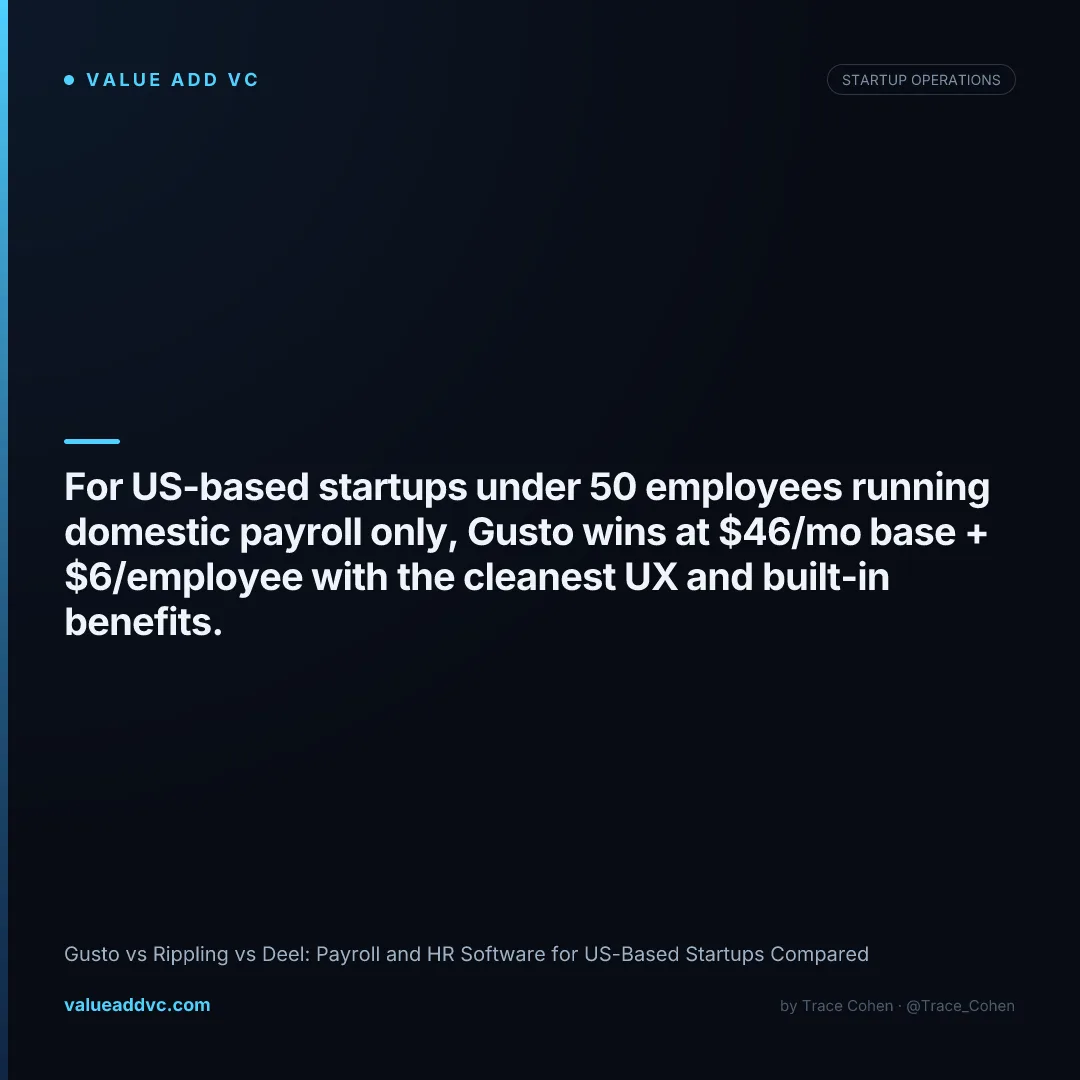
Choosing between Gusto, Rippling, and Deel for payroll comes down to three variables: team size, where you're hiring, and how much operational complexity you're willing to pay to manage in one platform.
This decision gets made wrong constantly. Founders use Gusto past the point where it stops scaling. Or they jump to Rippling at 8 employees and pay for modules they'll never use. Or they use two separate tools when Deel would have consolidated everything. The right answer changes by stage — here's how to think through it. Payroll is only half the back-office stack — see our Ramp vs Brex vs Airbase breakdown for the corporate card and spend management side.
The Quick Answer: Gusto vs Rippling Payroll by Stage
Pre-Seed / Seed (1–15 employees, US only)
Cheapest, cleanest UX, handles all 50 states automatically. No excess complexity.
Series A (15–75 employees, US + maybe international)
Unified HR + IT + payroll. Device management, HRIS, analytics all in one. Migration from Gusto is common here.
Any stage with international hiring
EOR in 150+ countries, contractor payments in 120+ currencies, no local entity required.
Series B+ (distributed global team)
Rippling if you want one platform for everything. Deel if international headcount dominates.
Gusto: Best Payroll Software for Small US Startups
Gusto has served 300,000+ businesses and processed hundreds of millions in payroll tax filings since 2011. It won the early-stage market by being the first payroll tool that was genuinely easy for non-HR founders to use. The UX is cleaner than ADP or Paychex by a wide margin, and it's one of the few platforms that makes multi-state payroll feel non-intimidating.
Simple Plan
$40/mo + $6/employee
Plus Plan
$80/mo + $12/employee
Premium Plan
Custom pricing
Contractor Only
$6/contractor/mo
Where Gusto wins: Built-in benefits administration (health insurance, 401k through Guideline, HSA, FSA), automatic federal and state tax filings, W-2 and 1099 generation, R&D tax credit identification, and a genuinely good employee self-service portal. For a founder running payroll for the first time, Gusto removes almost all of the friction.
Where Gusto falls short: No IT device management. Limited analytics. No equity management. No consolidated platform for international hiring. Most Series A+ companies outgrow Gusto because it stops being "enough platform" even though it's still perfectly good software.
Rippling: The Unified HR + IT + Finance Platform
Rippling was valued at $13.5B in its 2024 funding round and has built what is probably the most ambitious HR software product ever attempted: a single platform that handles payroll, benefits, HRIS, IT device management, spend management, and global compliance — all from one employee record. Founder Parker Conrad previously built Zenefits, so he's been chasing this unified platform vision for over a decade.
Platform Fee
$35/mo base
Per Employee (Payroll)
+$8/employee/mo
Additional Modules
Priced separately
Global Payroll
50+ countries
Where Rippling wins: The "one employee record" architecture means when you hire someone, Rippling provisions their laptop, adds them to Slack, sets up their email, enrolls them in benefits, and runs their payroll — all from a single workflow. For Series A+ companies managing distributed teams, this saves 5–10 hours per hire. Rippling also has the best analytics of the three, and its automation engine (trigger-based workflows) is genuinely powerful.
Where Rippling falls short: It's expensive when you start adding modules. A fully featured Rippling deployment — payroll, HRIS, IT, spend management — can easily reach $25–$40/employee/month for a 50-person team. The modular pricing makes it hard to estimate true costs without a sales call. Customer support is also slower than Gusto's for small accounts.
Deel: Built for International Hiring and Global Payroll
Deel was founded in 2019 and reached a $12B valuation faster than almost any HR tech company in history. The core product is simple: let you hire anyone, anywhere, without setting up a local legal entity. It does this through its Employer of Record (EOR) service and contractor management platform. 35,000+ companies across 150+ countries use Deel, per Deel's own pricing page, which lists the $599/month EOR fee cited above.
Contractor Management
$49/contractor/mo
EOR (Full-Time Employee)
$599/employee/mo
Global Payroll (Own Entity)
$29/employee/mo
US Payroll
$19/employee/mo
Where Deel wins: If you want to hire a full-time engineer in Portugal, a sales rep in Brazil, or a designer in Nigeria without incorporating locally, Deel's EOR service handles the employment contract, local compliance, payroll, benefits, and taxes — for a flat $599/month. That's significantly cheaper than the legal and administrative cost of setting up a foreign subsidiary.
Where Deel falls short: For US-only teams, Deel is neither the cheapest nor the simplest option. Gusto has better benefits integration and lower per-employee costs for domestic-only payroll. Deel's US payroll product ($19/employee/month) is competitive on price but lacks Gusto's polish and benefits depth. Also, Deel has faced criticism over its aggressive pricing for EOR compared to competitors like Remote and Oyster.
Head-to-Head: Gusto vs Rippling vs Deel on Key Dimensions
| Feature | Gusto | Rippling | Deel |
|---|---|---|---|
| Base price (20 employees) | ~$160/mo | ~$195/mo (payroll only) | ~$380/mo |
| US payroll + tax filings | ✓ All 50 states | ✓ All 50 states | ✓ Basic |
| Benefits administration | ✓ Best-in-class | ✓ Strong | ✗ Limited |
| International EOR | ✗ | ✓ 50+ countries | ✓ 150+ countries |
| Contractor payments | ✓ US only | ✓ Global | ✓ 120+ currencies |
| IT device management | ✗ | ✓ Full MDM | ✗ |
| Workflow automation | Basic | Advanced | Moderate |
| Best for stage | Seed–Series A | Series A–C | Any (international) |
How to Choose: A Framework by Company Situation
Choose Gusto if...
- ✓ Under 50 employees, all US-based
- ✓ First-time payroll setup, want simplicity
- ✓ Need strong benefits (health, 401k) built in
- ✓ Budget is a constraint at early stage
- ✓ No plans to hire internationally this year
Choose Rippling if...
- ✓ 50+ employees or fast-scaling headcount
- ✓ Need IT + HR + payroll in one platform
- ✓ Distributed team across multiple states/countries
- ✓ Want advanced automation and analytics
- ✓ Engineering team needs device management
Choose Deel if...
- ✓ Hiring contractors internationally right now
- ✓ Need EOR to employ in countries without entity
- ✓ Majority of team is outside the US
- ✓ Want one tool to handle all global payroll
- ✓ Remote-first with no plans to centralize
The Migration Question: When to Switch
Most startups start on Gusto and migrate to Rippling at Series A when they hit 3–4 of these triggers: 30+ employees, multiple states, first international hire, stock option administration complexity, or a VP of People who wants real HRIS analytics. The migration itself takes 2–4 weeks and is well-documented — Rippling offers a dedicated migration team for Gusto accounts.
Some companies run Gusto for US employees and Deel for international contractors simultaneously — this is a legitimate approach before you have the headcount to justify Rippling's full suite. The downside is two separate systems and manual reconciliation, but the cost savings before Series A are real.
Track startup hiring trends and headcount benchmarks on the Hiring Dashboard at Value Add VC.
Gusto vs Rippling vs Deel: Full Comparison Table 2026
| Feature | Gusto | Rippling | Deel |
|---|---|---|---|
| Starting price | $46/mo + $6/person | $8/person/mo (Unity) + modules | $49/mo (US payroll) or $599/mo (EOR) |
| US payroll | ✓ Core strength | ✓ Full-service | ✓ Available (newer) |
| International payroll | Limited (contractor only) | ✓ 50+ countries | ✓ 150+ countries (flagship) |
| Employer of Record (EOR) | ✗ No EOR | ✓ Via Rippling PEO | ✓ Best-in-class EOR |
| Benefits administration | ✓ Strong (medical, 401k, FSA) | ✓ Full suite + brokers | Limited for US; country-varies intl |
| Device management (MDM) | ✗ No | ✓ Built-in (key differentiator) | ✗ No |
| HRIS / org chart | Basic | ✓ Full HRIS platform | ✓ Deel HR (free tier) |
| Time tracking | ✓ Basic | ✓ Advanced + scheduling | ✓ Basic |
| Onboarding automation | ✓ Good for US hires | ✓ Full workflow automation | ✓ Specialized for global hires |
| Contractor payments | ✓ US contractors | ✓ Global contractors | ✓ Global (core product) |
| Customer support | Phone + email (US hours) | Email + chat | 24/7 chat + dedicated CSM at scale |
| Best for | US-only startups, SMBs | Fast-growing startups wanting one platform | Global-first teams or heavy contractor use |
Pricing as of May 2026. Rippling's modular pricing means real costs depend heavily on which modules you add. Always get a custom quote for teams over 25 people.
For a broader look at how Multiplier, Oyster HR, and Papaya Global stack up against these three on price and country coverage, see our full ranking of payroll and EOR providers for startups.
The wrong payroll platform is a 12-month distraction.
Start on Gusto. Migrate to Rippling at Series A. Add Deel the day you hire internationally.
Latest from the Pulse
Get VC data most people never see
— free to subscribe
Trace's notes on venture, AI and startups, a few times a week. Join 5,000+ subscribers. No spam.