
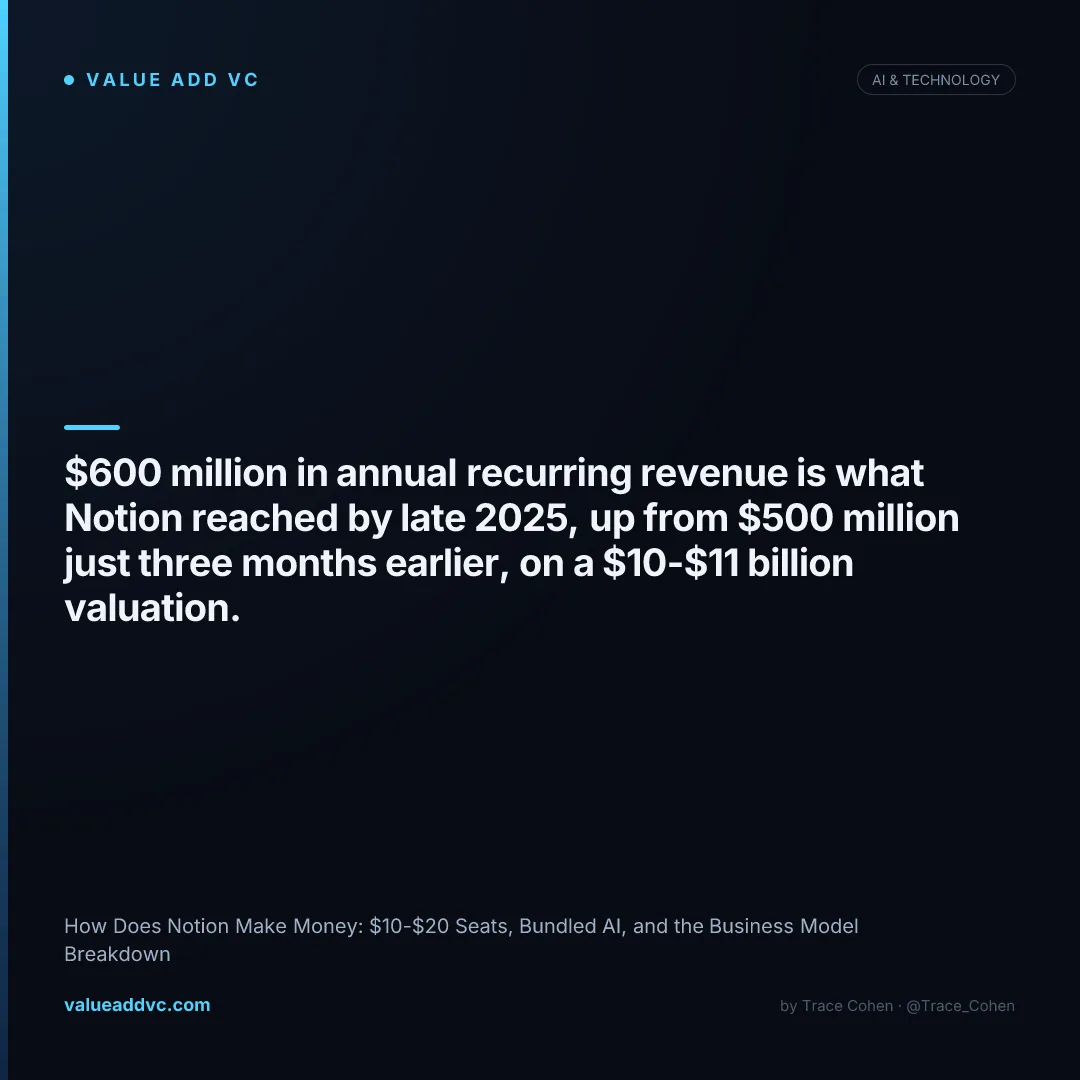
Updated October 1, 2026: ARR now uses Sacra's $865M estimate for July 2026 (this post previously carried $600M), and the valuation multiple was recalculated. Pricing was re-checked against Notion's pricing page and user figures against Notion's homepage on October 1, 2026. Figures we could not tie to a source were removed: the 2021 and 2023 ARR points, the paying-customer count and conversion rate, the Enterprise list price, and the country and Fortune 500 counts, which are replaced with Notion's own published numbers. The AI-enabled share of ARR is now dated to the end of 2025, and competitor comparisons and growth explanations are attributed to Sacra.
Sacra estimates Notion reached $865 million in annual recurring revenue in July 2026, up 82% year over year, and Notion was valued at $11 billion after a $270 million employee tender offer closed in January 2026. Per Sacra, its revenue is still driven primarily by seat subscriptions: since May 2025 the core AI features have been included in the $20 Business tier and above rather than sold as an add-on, and since May 2026 agent usage has been billed separately through Notion credits.
Notion was founded in 2013, released its product in 2016, and announced its own AI writing feature two weeks before ChatGPT launched in November 2022, according to CNBC. Notion disclosed that at the end of 2025, more than 50% of its ARR came from AI-enabled customers, a share that more than doubled over the prior year, as reported by Sacra. This post breaks down how the free-to-paid funnel and the AI bundling work, and what the public numbers do and don't show about how much revenue each drives.
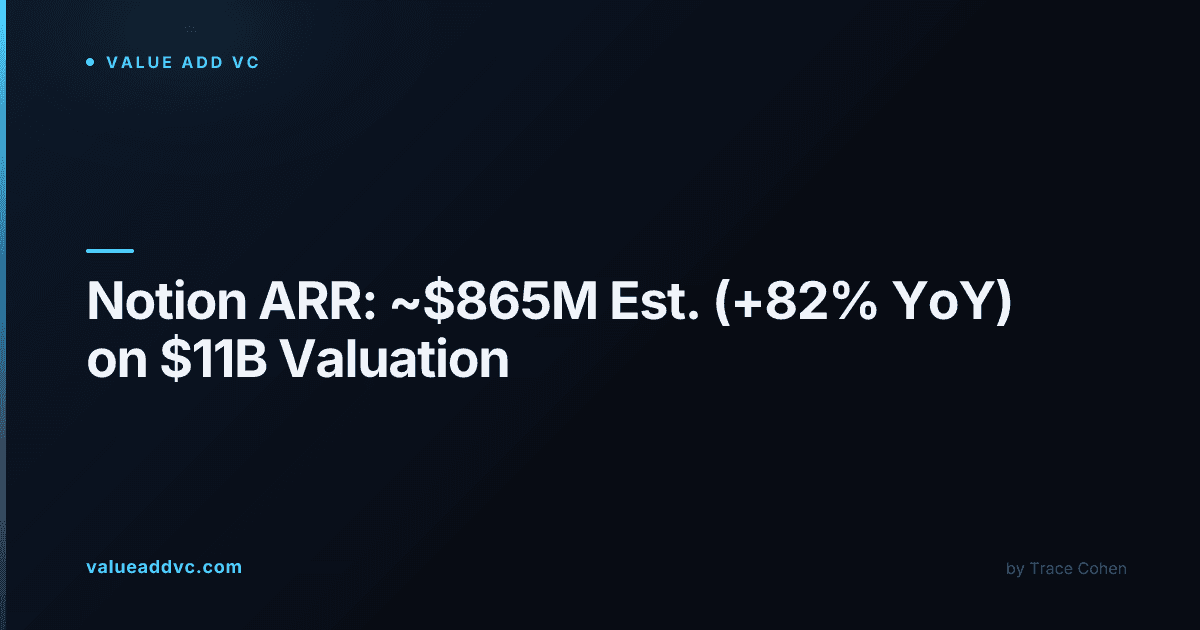
ARR: Sacra research note, August 10, 2026. Valuation and AI-enabled share of ARR: Sacra's Notion profile; the AI-enabled share is a Notion disclosure. Users: notion.com, checked October 1, 2026. Notion is private, and the $865M figure is Sacra's estimate, not a company disclosure.
How does Notion make money?
Notion sells per-seat subscriptions in four tiers. On its pricing page (checked October 1, 2026), Free costs $0, Plus is $10 and Business is $20 per member per month, and Enterprise is custom-priced; those are annual-billing prices ($12 and $24 per member per month billed monthly). Business is the lowest tier that includes Notion Agent, AI Meeting Notes and Enterprise Search, along with SAML SSO and private teamspaces; Free and Plus get a limited trial of Notion AI. Custom Agents are billed on top of seats: free to try, then $10 per 1,000 monthly Notion credits.
Sacra describes this as a freemium model designed for viral adoption by individuals that converts teams to paid plans as usage grows: the Free plan is unlimited for one person but limits blocks once two or more members share a workspace. Akshay Kothari, Notion's co-founder and operating chief, told CNBC in September 2025 that about 90% of the business comes from "multiplayer usage," meaning teams. Sacra counts Notion credits, which went live in May 2026, as Notion's first non-seat revenue line.
Notion's pricing tiers: the free-to-paid funnel
Notion runs four plans. The table below reflects Notion's pricing page as of October 1, 2026. At listed prices, Business costs $10 more per member per month than Plus, and it is the lowest tier with Notion AI included rather than offered as a trial.
| Plan | Price | What it includes | AI access |
|---|---|---|---|
| Free | $0 | Unlimited pages and blocks for one person, limited blocks for 2+ members, 7-day page history, 10 guests | Limited trial |
| Plus | $10/member/mo | Unlimited collaborative blocks, 30-day page history, unlimited guests | Limited trial |
| Business | $20/member/mo | SAML SSO, private teamspaces, 90-day page history | Included: Notion Agent, AI Meeting Notes, Enterprise Search |
| Enterprise | Custom pricing | Unlimited page history, audit log, SCIM user provisioning, customer success manager | Included, with zero data retention at LLM providers |
Source: Notion pricing page, checked October 1, 2026. Custom Agents on Business and Enterprise require Notion credits: free to try, then $10 per 1,000 monthly credits. Sacra reports that from August 2026, the AI bundled into Business plans carries a usage allowance rather than being fully unlimited.
Why Notion bundled AI into Business instead of selling it separately
In October 2024, Notion's pricing page (archived) sold Notion AI as an add-on for the whole workspace at $8 per member per month billed annually ($10 billed monthly), next to a Business plan at $15 per seat per month. In May 2025, Notion bundled Notion AI (Enterprise Search, Research Mode and AI Meeting Notes) into its Business and Enterprise plans only, according to Sacra. Notion's current pricing page lists Business at $20 and shows no standalone AI add-on.
Kothari explained the timing to CNBC in September 2025: in 2024, 10% to 20% of Notion customers paid for AI add-ons; that rose to 30% or 40% early in 2025 and then crossed 50%, at which point Notion started including AI in its Business and Enterprise plans without charging extra. Sacra says the change required organizations that wanted AI to upgrade entire teams, which increased contract values and shifted the mix toward higher tiers.
Put the two pricing pages side by side and the Business seat went from $15 per seat per month, with AI sold separately, in October 2024 to $20 per member per month with Notion AI included in October 2026. Notion disclosed that at the end of 2025 more than 50% of its ARR came from AI-enabled customers, a share that more than doubled over the prior year (Sacra). That figure measures customer mix; it does not say how much revenue AI itself produces. For a different packaging choice, see our breakdown of how Figma prices seats and AI credits.
How Notion's free tier feeds paid seats
Notion's homepage says it has 100 million users in over 50 countries (checked October 1, 2026), and Notion told CNBC in September 2025 that it had over 100 million users. Much of that base came early: Forbes reported in October 2021 that Notion had more than 20 million users, up from one million in 2019, with 80% of users based outside the U.S. None of the sources cited here gives a paying-customer count, so we don't estimate a free-to-paid conversion rate. Consumer apps run their own version of this funnel; see how Discord makes money from Nitro. Fellow workplace collaboration tool Miro ran the same team-to-enterprise expansion playbook to roughly $600 million in ARR before agreeing to be acquired by Bending Spoons for a $1.355 billion enterprise value.
On enterprise reach, Notion says 62% of Fortune 100 companies and over 50% of Y Combinator companies use it (checked October 1, 2026). Kothari's figure that about 90% of the business comes from teams (CNBC, September 2025) lines up with where the pricing page puts the limits: the Free plan's block cap applies once a workspace has two or more members. For context on how private software companies are priced, see our SaaS valuations tracker.
How Notion's revenue grew to an estimated $865M
Notion was founded in 2013 and released its product in 2016 (CNBC). A $50 million raise in April 2020 valued it at $2 billion (Sacra), and in October 2021 it raised $275 million in a round led by Coatue Management and Sequoia, with Base10 Partners participating, at a $10 billion valuation, according to Forbes. Forbes noted that Notion did not share revenue numbers at the time, so this post does not chart revenue before 2025.
In September 2025, Notion told CNBC it had passed $500 million in annualized revenue. Kothari said annual revenue growth had accelerated every month since Notion's May 2025 launch of AI meeting-summary and enterprise-search products, though he declined to give growth rates. Sacra estimates ARR reached $610 million at the end of 2025 and $865 million in July 2026, up 82% year over year, per its August 2026 research note; Sacra's company profile lists Notion's 2025 growth rate at 52.5% year over year.
Sacra attributes the acceleration to three factors: the May 2025 bundling of Notion AI into Business and Enterprise, which forced whole-team upgrades and lifted average revenue per user; Notion 3.0 (September 2025) and Custom Agents, which Sacra says created hard gates at the Business tier because downgrading pauses existing agents; and Notion credits at $10 per 1,000, a consumption revenue line that went live in May 2026. That is Sacra's analysis. Notion's own disclosure shows AI-enabled customers passing half of ARR by the end of 2025, which is consistent with Sacra's read but does not measure how much of the growth AI caused.
How Notion's business model compares to Confluence and Coda
According to Sacra, Atlassian bundles its Rovo AI agent product into all paid Confluence plans at no extra cost, and Confluence Standard costs $6.05 per user versus $20 for Notion Business. Coda charges per "Doc Maker" rather than per user and has merged with Grammarly; Sacra says the combined company's growth rate remains well below Notion's. Sacra also notes that Microsoft sells Copilot as a $30 per user per month add-on to Microsoft 365, and Google bundles Gemini into Workspace Business Standard at $14 per user per month (prices as listed in Sacra's Notion profile, accessed October 1, 2026). For a seat-based model in engineering tools, see our Linear breakdown.
We compare the products in more depth in our Notion vs Confluence vs Coda breakdown. On Sacra's figures, a team that wants AI pays $20 per seat for Notion Business against $6.05 for Confluence Standard with Rovo included, and Sacra lists that pricing gap, plus Notion's variable credit charges, among the risks to Notion's model.
What Notion's model means for SaaS and AI investors
Notion's revenue is still mostly seats. Sacra describes it as driven primarily by seat-based subscriptions, and Kothari told CNBC that about 90% of the business comes from teams. AI changes which seat a team buys and, through credits, adds usage-based revenue on top. Sacra flags the risk in that new line: Notion resells model inference through credits at a markup to buyers who can reach the same models directly, while Anthropic and OpenAI are at once its model suppliers and its competitors.
For diligence on any SaaS company with an "AI-driven" growth story, Notion shows what evidence to ask for: a dated pricing change (the May 2025 bundling), a disclosed customer-mix metric (more than 50% of ARR from AI-enabled customers at the end of 2025), and run-rate figures before and after. Even with all three, the public data shows timing and correlation. Attributing growth to AI still requires the company's own cohort or upgrade data, which Notion has not published in any source cited here.
On valuation, Sacra cites an 18x multiple for the $11 billion January 2026 tender. Dividing $11 billion by Sacra's $865 million July 2026 estimate gives about 12.7x (Value Add VC calculation). Sacra's comparison set in the same note: Monday.com at 3.2x TTM revenue (June 2026), Asana at 2.7x TTM revenue (April 2026), and Glean at 45x its June 2025 ARR at its Series F. Airtable, which Sacra describes as having been Notion's closest architectural competitor, agreed in August 2026 to be acquired by Bending Spoons at a $1.285 billion enterprise value on about $480 million of ARR. For more private-market multiples, see our AI valuations dashboard.
Bottom line: Notion makes money from per-seat subscriptions ($10 Plus and $20 Business per member per month at listed prices, plus custom Enterprise), with Notion AI included from Business up since May 2025 and Custom Agents billed through Notion credits since May 2026 (Notion; Sacra). Sacra estimates ARR at $865 million in July 2026, up 82% year over year, against the $11 billion valuation set at the January 2026 tender, about 12.7x by our calculation. Notion says more than half of its end-2025 ARR came from AI-enabled customers; how much of the growth AI caused has not been broken out in any source cited here.
Latest from the Pulse
Get VC data most people never see
— free to subscribe
Trace's notes on venture, AI and startups, a few times a week. Join 5,000+ subscribers. No spam.
No spam, unsubscribe anytime. Sent via Substack · Privacy · or subscribe on Substack ↗