Some links in this post may earn us a commission — this never affects our comparisons or rankings. See our editorial standards.
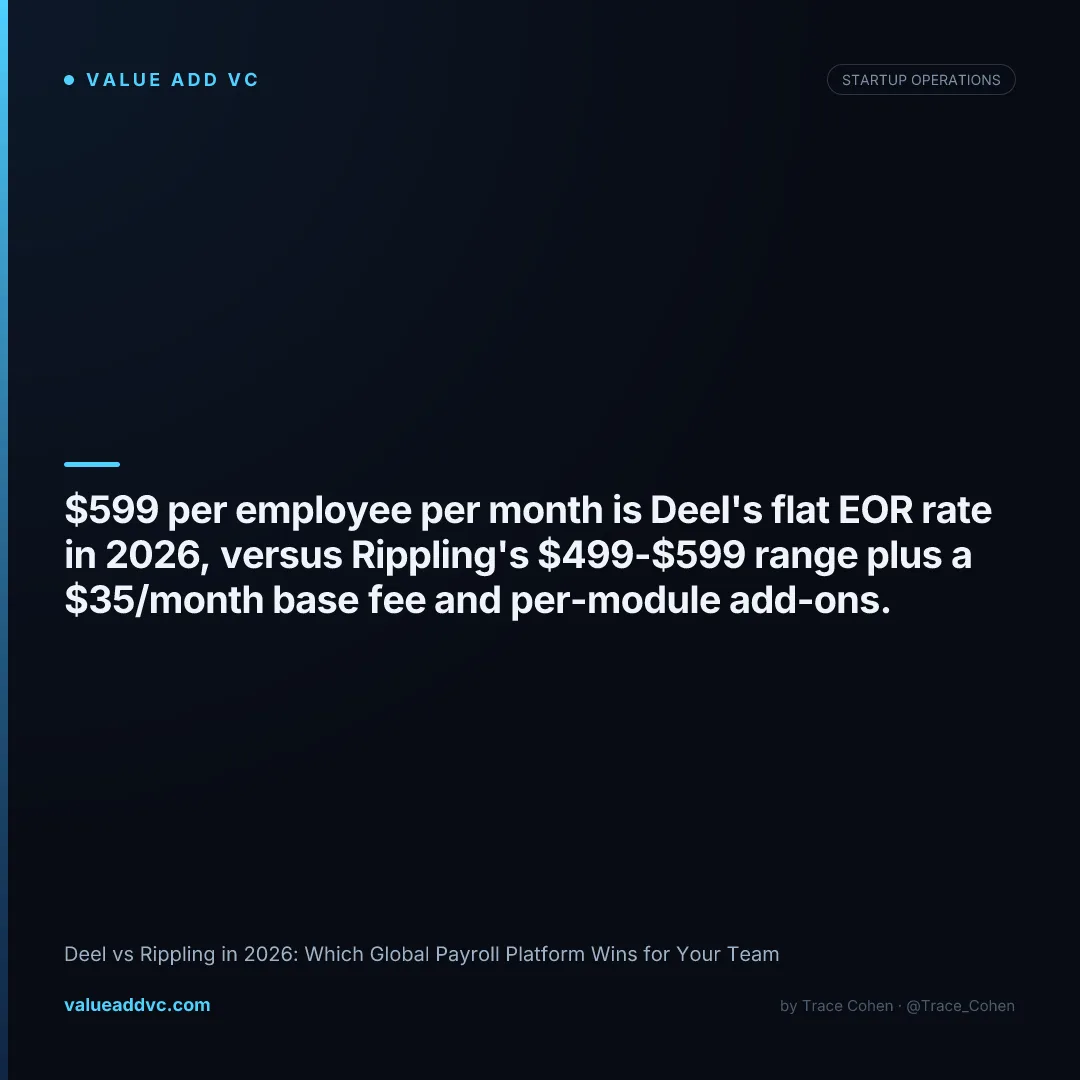
Deel charges a flat $599 per employee per month for Employer of Record services in 2026. Rippling's EOR runs $499 to $599 per employee, but that sits on top of a $35/month platform fee and per-module pricing that pushes the real total higher for most teams. The two platforms aren't really substitutes — Deel is built EOR-and-contractor-first across 160+ countries, while Rippling is built HR-and-IT-first with global payroll layered on top — and which one wins depends entirely on what you're actually buying it to do.
Sources: Deel.com pricing pages, Rippling.com pricing pages, Sacra company revenue estimates, 2026.
Deel vs Rippling: Full Pricing and Feature Comparison
Deel and Rippling both sell Employer of Record and global payroll, but their pricing structures aren't built the same way. Deel quotes one flat number per product; Rippling stacks a base platform fee on top of per-module, per-employee charges, so the sticker price on Rippling's low end can understate what a real deployment costs.
| Category | Deel | Rippling |
|---|---|---|
| EOR price (per employee/month) | $599 flat | $499-$599 + $35/mo base fee |
| Global payroll add-on | ~$29/employee/month | ~$29/employee/month |
| Core HRIS | Included free with EOR/contractor plans | $8/employee/month + $35/mo base |
| Contractor management | ~$49/contractor/month | Custom quote, no published rate |
| EOR country coverage | 160+ countries (mostly partner entities) | 32 owned-entity countries; 80-85 total incl. partners |
| IT / device management | Deel IT: $99/mo base + $19/item, 130+ countries | ~$8/device/month, unified cross-OS MDM |
| Native integrations | 110+ | 650+ |
| G2 rating | 4.7/5 (6,602 reviews) | 4.8/5 (12,881 reviews) |
| 2026 ARR | ~$1.4B (Feb 2026) | ~$1.0B (Mar 2026) |
| Latest valuation | $17.3B (Oct 2025 Series E) | $16.8B (May 2025 Series G) |
| Customers | 37,000+ businesses | 20,000+ (as of May 2025) |
Figures blended from Deel's global payroll page, Rippling's pricing page, G2's Rippling vs Deel comparison, and Sacra's 2026 revenue estimates. Neither company publishes enterprise or volume pricing; contractor and IT add-on rates are self-serve list prices and can be negotiated down at scale.
Deel vs Rippling: EOR Price Per Employee, Per Month
Deel.com and Rippling.com pricing pages, 2026.
Deel's EOR price is a flat, published rate; Rippling's range excludes its $35/month base fee and module add-ons, so the two numbers aren't fully apples-to-apples.
Why Deel's Country Coverage Number Is Misleading Both Ways
Deel markets EOR coverage in 160+ countries, built mostly through local partner entities rather than Deel's own legal subsidiaries — a structure that lets it launch new markets fast but adds an intermediary layer between Deel and the employee's actual compliance chain. Rippling's headline number is fuzzier: its EOR is directly available in roughly 32 countries where Rippling itself holds the entity, and its broader claim of 80-85 countries blends that direct coverage with third-party partner markets, the same partner-entity model Deel uses at a much larger scale. Neither company's marketing page makes the direct-vs-partner distinction obvious, so a buyer comparing "countries covered" side by side is comparing two different things unless they dig into each company's entity list.
For a startup hiring its first employee outside the US, this matters more than the raw number suggests. A country where Deel or Rippling owns the entity directly generally means faster onboarding and a shorter chain of compliance responsibility; a partner-covered country adds a step. If your target country isn't in either platform's owned-entity list, ask for the entity structure in writing before signing — both companies will tell you if asked, but neither leads with it.
IT and Device Management: Where Rippling Actually Pulls Ahead
Rippling's IT product is the one area where the platform has a structural head start over Deel. Rippling built its IT suite on top of the same employee record used for payroll and HR from the start, so device provisioning, mobile device management (MDM), identity and access management, and endpoint protection are unified in one workflow at roughly $8 per device per month — and the platform now claims 650+ native integrations spanning HRIS, payroll, identity, finance, and productivity tools, according to Rippling's own integrations page. Deel IT is newer and narrower by comparison: a $99/month base fee plus $19 per equipment item, covering device provisioning and lifecycle management across 130+ countries, with mobile device management, identity and access management, and endpoint protection added to the product only in the past year.
If IT device management for a distributed workforce is a real requirement — not just a nice-to-have — Rippling's product is more mature today. Deel's IT offering closes the gap on paper but has less of a track record.
Revenue, Valuation, and Company Momentum in 2026
Deel reached approximately $1.4 billion in annualized revenue by February 2026, up 63% year-over-year, according to Sacra's company data, and raised a $300 million Series E in October 2025 co-led by Ribbit Capital, Andreessen Horowitz, and Coatue Management at a $17.3 billion valuation. Rippling hit roughly $1.0 billion in annualized revenue by March 2026, up from about $850 million at the end of 2025 — 78% year-over-year growth, per Sacra's Rippling estimates — and last raised $450 million in a May 2025 Series G at a $16.8 billion valuation, per CNBC's reporting.
Neither company has filed to go public. Rippling CEO Parker Conrad has said an IPO isn't a near-term priority, and market analysts generally place a possible Rippling listing in the 2027-2028 window rather than 2026 or 2027. Deel has not signaled IPO timing publicly either. This likely means both companies are prioritizing private growth capital and product expansion over a near-term public listing, which matters for buyers weighing platform stability — a private company under investor pressure to grow ARR can shift pricing or product priorities faster than a public one bound by quarterly disclosure.
What the Headline Numbers Miss
Every price in the comparison table above is a self-serve list rate, not what an actual enterprise customer pays. Rippling in particular has been reported to charge implementation fees up to $15,000 for EOR rollouts on top of its per-employee rate, and neither company publishes what negotiated volume pricing looks like once a customer has 50 or more international hires — the number both companies will actually quote a growing team can differ meaningfully from the sticker price. Rippling's modular pricing also means the same "per employee per month" figure can mean very different total costs depending on how many add-on products (IT, finance, benefits) a customer layers on top of core HR and payroll. A buyer should get a real quote for their specific headcount and country mix before treating either company's published rate as the number that will show up on an invoice.
Which One Should You Actually Pick?
Pick Deel if international EOR hiring across a wide spread of countries is your primary need — its 160+ country reach and flat, predictable $599/employee rate make budgeting simpler, and its contractor pricing is fully published rather than quote-only. Pick Rippling if you're a US-headquartered company that needs IT device management and a unified HR-payroll-finance stack, and your international hiring is concentrated in a smaller set of countries — Rippling's 650+ integrations and mature IT product are the stronger fit once device provisioning matters as much as payroll. A distributed team under 15 people hiring in five or more countries typically leans Deel; a Series A or later US company issuing company laptops and managing SaaS access alongside payroll typically leans Rippling. Teams that genuinely need both — broad EOR reach and deep IT management — should run quotes from both, since no published rate card captures what either company charges once volume pricing and module bundling enter the conversation.
For a three-way view that adds Gusto into the mix for US-only teams, see our Gusto vs Rippling vs Deel comparison, or check how Deel stacks up against another EOR-first competitor in our Deel vs Remote breakdown. You can also run a deeper side-by-side on our Deel vs Rippling comparison tool, or browse the wider category on our Best EOR Platforms page.
The bottom line:
Deel wins on EOR breadth and flat pricing; Rippling wins on IT, integrations, and G2 ratings — the right pick depends on whether you're buying global hiring or a unified HR-IT stack.
Compare more payroll and HR tooling on our Best EOR Platforms page, and explore more startup operations coverage at Value Add VC. Originally published in the Trace Cohen newsletter.
Latest from the Pulse
Get VC data most people never see
— free to subscribe
Trace's notes on venture, AI and startups, a few times a week. Join 5,000+ subscribers. No spam.