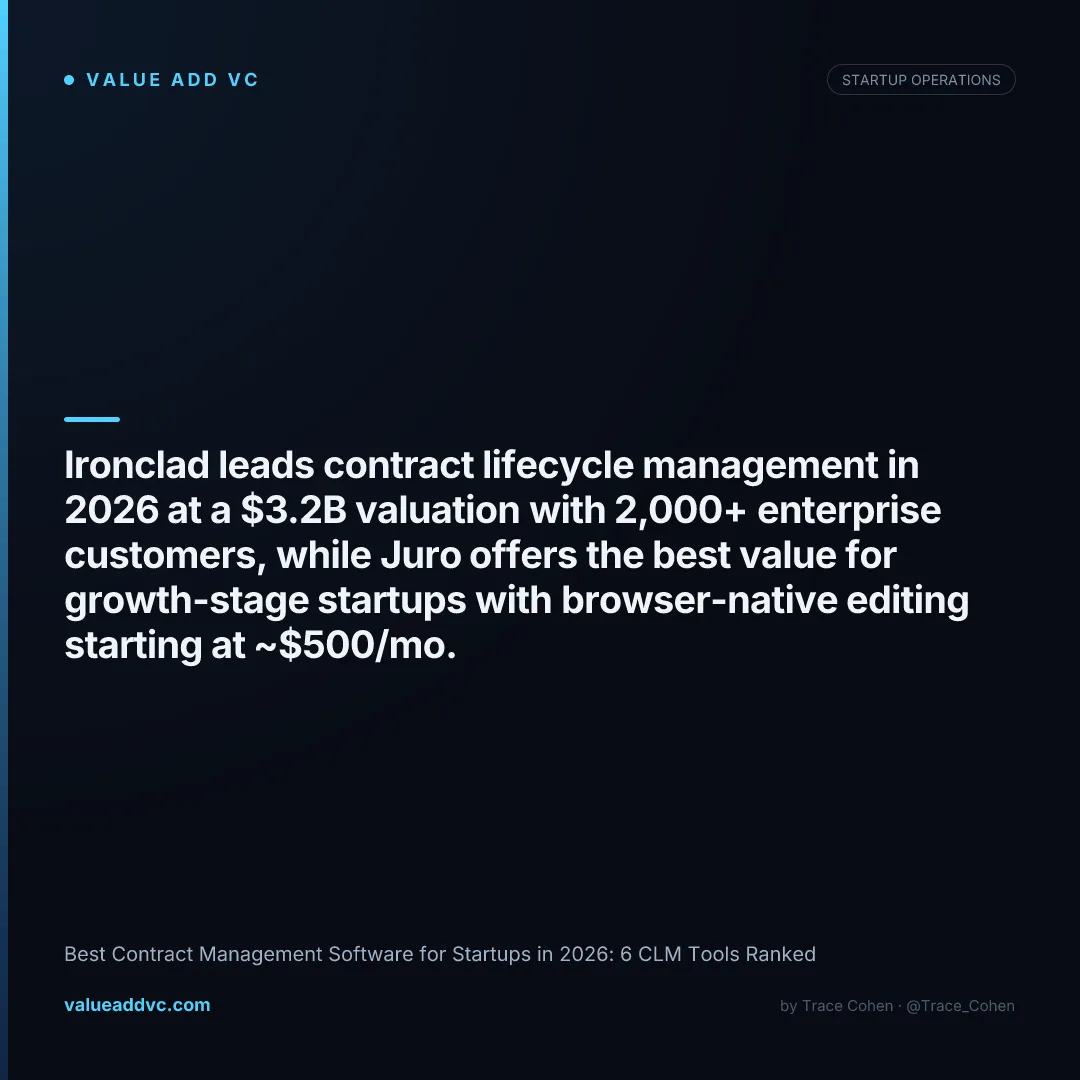
Companies lose an average of 9.2% of annual revenue to poor contract management according to World Commerce & Contracting, and the six CLM platforms ranked below have raised a combined $790M+ to fix it. Every single one now ships AI-powered features — but the tool that fits a 20-person seed-stage startup is fundamentally different from what works at a 500-person Series D company with a five-person legal team.
The contract chaos follows a predictable pattern. A startup runs on DocuSign and Google Drive until Series B, then one missed renewal auto-commits them to a six-figure vendor contract nobody tracked, and suddenly CLM becomes a P0 project. The tools below are ranked by how well they solve that problem at each stage, not by who raised the most money. For the e-signature layer specifically, see our separate ranking of e-signature tools.
What is the best contract management software for startups in 2026?
Ironclad is the best contract management platform for growth-stage and enterprise companies with dedicated legal teams and high contract volume in 2026. Juro is the best fit for sales and HR teams that need to self-serve contracts without legal bottlenecks. LinkSquares leads contract analytics for companies sitting on large existing portfolios they need to analyze for risk and obligations, and SpotDraft is the most startup-friendly modern CLM with built-in e-signatures and affordable pricing.
The market splits into two tiers: enterprise CLM platforms (Ironclad, LinkSquares, Agiloft, ContractPodAi) that assume you have in-house legal counsel, and growth-stage tools (Juro, SpotDraft) that assume legal is one person wearing three hats. Buying from the wrong tier is the most common and most expensive mistake. For the broader legal and finance tech stack, see our AI finance tools ranking.
The 6 best contract management tools, ranked
Total funding raised: which CLM tools have the deepest backing
Contract management software is sticky by design — migrating away means re-templating every contract type and retraining every team. Funding matters here because a vendor that runs out of runway leaves you with a migration project nobody budgeted for. Ironclad's $330M+ dwarfs the rest of the category, reflecting enterprise CLM's winner-take-most dynamics at the top end.
CLM tools compared: core strengths, pricing, and fit
| Platform | Core strength | Starting price | Total funding | Best for |
|---|---|---|---|---|
| Ironclad | AI Assist drafting + workflow automation | Custom | $330M+ | High-volume enterprise legal |
| Juro | Browser-native editor + self-serve contracts | ~$500/mo | ~$35M | Sales/HR team self-serve |
| LinkSquares | AI contract analytics + risk extraction | Custom | ~$160M | Portfolio analysis + compliance |
| Agiloft | No-code workflow builder + AI clause library | Custom | ~$120M | Complex custom workflows |
| ContractPodAi | AI-native + Microsoft ecosystem integration | Custom | ~$115M | Microsoft-stack companies |
| SpotDraft | Templates + approvals + built-in e-sign | Custom | ~$30M | Early-stage startup CLM |
Pricing as of August 2026 from vendor sites and direct outreach. Custom-quoted platforms scale with contract volume and user count — contact vendors directly for accurate budgeting.
How We Ranked These
The ranking weighs three factors: product-market fit per company stage (whether the tool is built for the right size buyer), AI capability depth (contract review, drafting assistance, obligation extraction, analytics), and financial backing as a proxy for vendor longevity in a category where switching costs are extremely high. Funding figures come from Crunchbase, PitchBook, and primary funding announcements. No vendor paid for placement — see our editorial standards.
The AI contract review landscape in 2026
All six platforms on this list now ship AI features, but the implementations vary significantly. Ironclad's AI Assist focuses on drafting and review acceleration — suggesting clause language, flagging non-standard terms, and scoring risk. LinkSquares leads in post-signature AI, extracting structured data from thousands of existing contracts to surface obligations and renewal risks that manual review would miss.
ContractPodAi takes the most AI-native approach, building intelligence into every layer of the platform rather than adding it as a feature. Agiloft pairs AI with no-code configurability, letting teams train the system on their specific clause libraries. Juro and SpotDraft offer AI-assisted drafting that helps business teams create contracts without legal involvement for routine agreement types.
The practical limit across all platforms: AI handles standard contract types (NDAs, MSAs, SOWs, employment agreements) well, but novel deal structures and jurisdiction-specific nuances still require human legal judgment. The value isn't replacing lawyers — it's eliminating the 80% of routine review work that was never a good use of a $400/hour attorney's time.
How to choose CLM by stage
Pre-seed to Series A with under 100 active contracts: stick with DocuSign or PandaDoc plus a shared Google Drive folder — any CLM at this stage is overhead you don't need. Series A-B with a first legal hire and 100-500 contracts: SpotDraft or Juro — both get you organized with modern AI features without enterprise pricing. Series B-D with a growing legal team and complex workflows: Ironclad or LinkSquares, depending on whether your priority is workflow automation or portfolio analytics. Series C+ or enterprise with multi-department needs and Microsoft infrastructure: Agiloft for maximum configurability, ContractPodAi if you're deep in the Microsoft ecosystem.
For project management alongside your legal ops stack, see our ranking of project management tools. For the finance team's AI toolkit, see our AI finance tools comparison.
The Bottom Line
All six CLM tools now ship AI — the differentiator is which company stage and workflow complexity each one is built for, not whether it has an AI checkbox.
Ironclad for enterprise legal workflow. Juro for commercial team self-serve. SpotDraft for early-stage startups that want modern CLM without enterprise pricing.
Track how legal tech and SaaS valuations are evolving on the SaaS Valuations Dashboard at Value Add VC.
Latest from the Pulse
Get VC data most people never see
— free to subscribe
Trace's notes on venture, AI and startups, a few times a week. Join 5,000+ subscribers. No spam.