
Beehiiv wins for monetization at scale in 2026 — 0% take rate plus an ad network paying $15-$30 CPMs. Ghost wins for ownership and customization at $9-$199/month flat. Substack still wins for cold-start discovery, even at a 10% cut.
That's the short answer. The longer answer depends entirely on where your subscribers come from — and how much of your revenue Substack's recommendation network is actually driving versus charging for. The 10% line gets very expensive once you're past 5,000 paid subscribers.
Substack vs Ghost vs Beehiiv in 2026: The Bottom Line
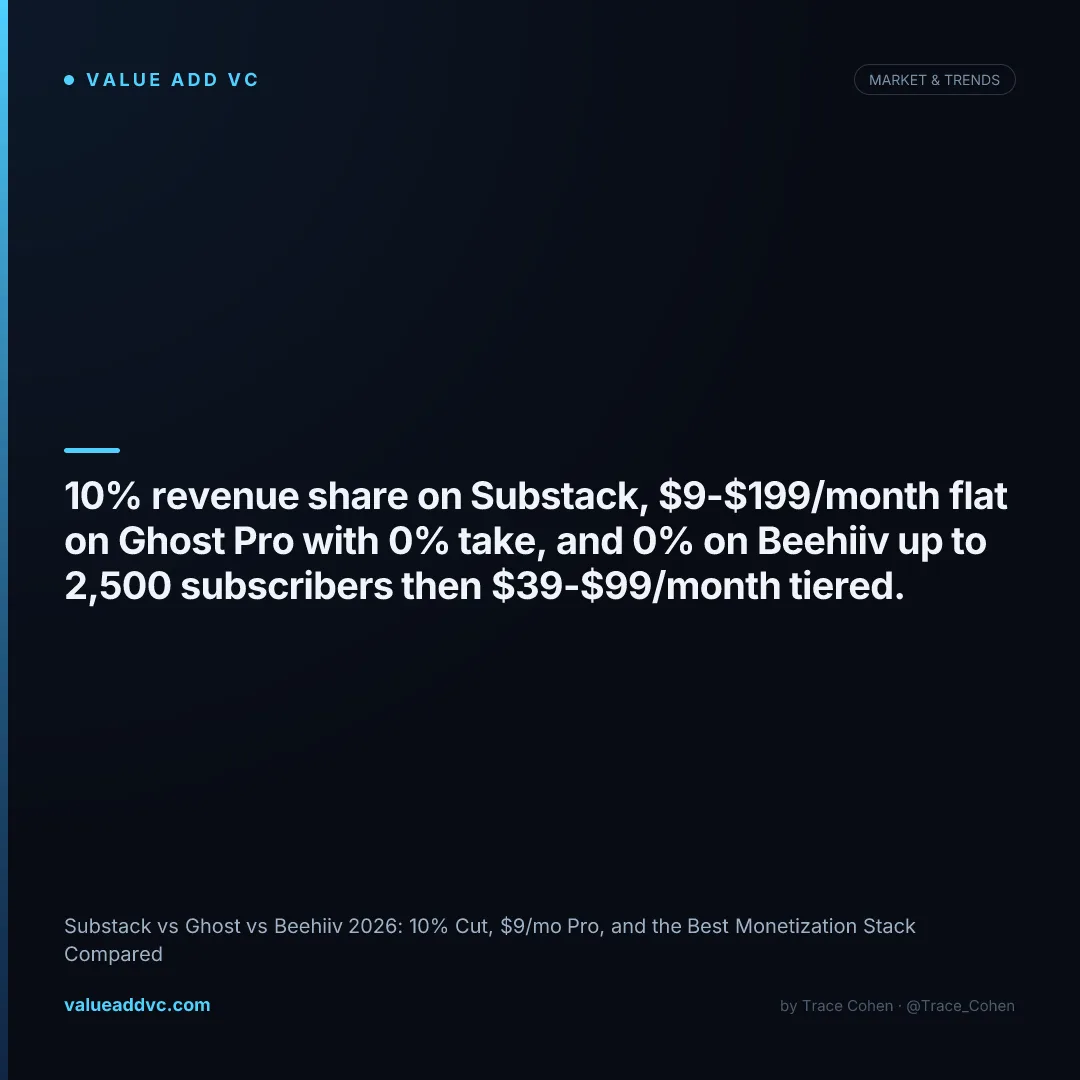
Substack takes 10% of paid subscription revenue plus Stripe processing — roughly $1,200 per year off a 100-paid-subscriber newsletter at $10/month. Ghost Pro charges $9-$199 per month flat with 0% revenue share. Beehiiv is free up to 2,500 subscribers, scales to $99/month at 100,000 subscribers, takes 0% of subscriptions, and adds an ad network paying $15-$30 CPMs that competitors don't match.
In 2024, Substack hit 35M+ active subscribers across its network and 5M+ paid. Beehiiv crossed 25M total subscribers across its platform in 2025 after founding by three ex-Morning Brew operators in 2021. Ghost passed 100M page views per month across hosted publications and remains the only one of the three that you can self-host for free under an MIT license — the open-source repo has 47K+ GitHub stars.
Side-by-Side: Substack vs Ghost vs Beehiiv Comparison Table
| Attribute | Substack | Ghost Pro | Beehiiv |
|---|---|---|---|
| Platform fee | 10% of paid sub revenue | $9-$199/mo flat | $0-$99+/mo tiered |
| Free tier | Unlimited free readers | None (paid hosting only) | Free up to 2,500 subs |
| Payment processing | Stripe 2.9% + $0.30 | Stripe 2.9% + $0.30 | Stripe 2.9% + $0.30 |
| Ad network | None | None (DIY) | Beehiiv Ad Network, $15-$30 CPM |
| Cross-promo / boosts | Recommendations (free) | None | Boosts marketplace, $1-$5 per sub |
| Referral program | Manual | Manual / 3rd-party | Built-in milestones |
| Custom domain | $50 one-time | Included | Included |
| Native mobile app | Yes (Substack app) | No | Yes (in-app reader) |
| API access | Limited (read only) | Full Admin + Content API | API on Max tier |
| Self-host option | No | Yes (MIT license, free) | No |
| Podcast hosting | Included | Add-on | Included |
Real Cost Math: What Each Platform Takes at 1K, 10K, and 100K Subscribers
Pricing pages obscure what each platform actually costs. Here's the math on a newsletter charging $10/month with 10% of free readers converting to paid — the average for newsletters with real reader trust.
1,000 total subs (100 paid)
Gross ARR: $12,000
Substack: $1,200/yr cut + ~$390 Stripe = $1,590
Ghost Pro Starter: $108/yr + ~$390 Stripe = $498
Beehiiv Launch: $0/yr + ~$390 Stripe = $390
10,000 total subs (1,000 paid)
Gross ARR: $120,000
Substack: $12,000/yr cut + ~$3,900 Stripe = $15,900
Ghost Pro Business: $2,388/yr + ~$3,900 Stripe = $6,288
Beehiiv Scale: $468/yr + ~$3,900 Stripe = $4,368
100,000 total subs (10,000 paid)
Gross ARR: $1,200,000
Substack: $120,000/yr cut + ~$39K Stripe = $159K
Ghost Pro Enterprise: ~$6,000/yr + ~$39K Stripe = $45K
Beehiiv Max: $1,188/yr + ~$39K Stripe = $40K
At 100K total subscribers, Substack costs $114K more per year than Beehiiv. That's the entire compensation for two full-time editors. The question is whether Substack's recommendation network drives more than $114K in incremental revenue — which for top political and culture writers it absolutely does, and for almost everyone else it absolutely does not.
Substack vs Ghost vs Beehiiv on Ad Revenue, Boosts, and Referrals
The subscription fee is only one revenue line. The bigger gap between these platforms in 2026 is everything else — ad networks, paid subscriber acquisition exchanges, and built-in referral programs that pay for themselves once you cross 5,000 active readers.
Beehiiv Ad Network is the only native programmatic ad system among the three. It places newsletter sponsorships at $15-$30 CPMs depending on niche (B2B finance lands $40-$60), settles weekly via Stripe, and Beehiiv keeps 0% of the ad revenue — writers get 100%. A 50K-subscriber business newsletter with 45% open rates can clear $5K-$15K per month from Beehiiv ads alone, no sales work required.
Beehiiv Boosts is a paid acquisition marketplace where one newsletter pays $1-$5 per converted subscriber from another newsletter's audience. It works as a two-sided market — recommending newsletters earn cash, growing newsletters acquire subscribers at predictable CAC. Substack's recommendation network is the closest analogue but pays nothing to recommenders (it's reciprocal free exposure).
Substack Recommendations is genuinely valuable — top writers like Heather Cox Richardson, Bari Weiss, and Matt Taibbi report 30%+ of new subscriber growth from recommendations. That's the entire reason the 10% fee makes sense for them. If recommendations drive 30% of your growth, you'd need to spend more than 10% on paid acquisition to replace it.
Ghost has none of this. No ad network, no boost marketplace, no recommendation system. Ghost is unbundled software — you keep 100% of every dollar but you also build every distribution channel yourself. For most writers below 50K subs, that's a worse trade than it sounds.
Substack vs Ghost vs Beehiiv on Discovery and Network Effects
Substack's network is its real moat — and the only honest justification for the 10% fee. The Substack app has 4M+ daily active readers as of 2026, and the discover feed routinely sends 100-500 daily signups to mid-tier writers without any active marketing. New writers launching cold on Substack often hit 1,000 subscribers in 30 days from the recommendation system alone.
Beehiiv's network is smaller but more transactional — Boosts gives you predictable CAC at $1-$5 per subscriber, which makes it usable as an acquisition channel rather than a hope-and-pray feature. For B2B newsletters where each subscriber is worth $20-$100 in lifetime value, paying $3 per sub via Boosts has obvious ROI that Substack's reciprocal recommendation system can't match for cold launches.
Ghost has zero network effects. Every subscriber comes from your own SEO, social, paid ads, or word of mouth. This is fine — even ideal — if you have an audience already (a podcast, a Twitter following, an existing email list). If you're starting cold, Ghost is the slowest of the three to scale to 1,000 readers.
Switching Between Substack, Ghost, and Beehiiv: Migration Reality
All three platforms support imports and exports of subscriber lists in CSV. Both Beehiiv and Ghost offer free white-glove migration from Substack, including paid subscriber Stripe handoff and full post archives with 301 redirects. A typical Substack-to-Beehiiv migration takes 1-3 weeks end-to-end. Casey Newton's Platformer left Substack for Ghost in late 2022. Charlie Warzel and Anne Helen Petersen moved their joint paid newsletters off Substack the same year. In 2024 and 2025, Polygon co-founder Chris Plante, Ed Zitron, and Lenny Rachitsky all moved to or expanded on Beehiiv.
The friction in migration is mainly three things: DNS cutover for your custom domain, notifying free readers (you typically lose 5-15% of free readers in the transition who don't re-confirm their subscription), and losing your spot in Substack's recommendation feed. Paid subscribers transfer cleanly because Stripe owns the customer relationship — the subscriber sees no payment disruption.
Who Should Pick Which: The Decision Framework
Pick Substack if
- ✓ You write political, cultural, or general-interest content
- ✓ You have no existing audience and need cold-start distribution
- ✓ You expect under 5,000 paid subscribers
- ✓ You want zero technical setup
Pick Ghost if
- ✓ You need full design and brand control
- ✓ You want to own your stack via self-hosting
- ✓ You already have an audience to migrate
- ✓ You sell courses, memberships, or non-newsletter products
Pick Beehiiv if
- ✓ You expect to monetize via ads, not subscriptions
- ✓ You want predictable paid-acquisition via Boosts
- ✓ You're building a B2B or financial newsletter
- ✓ You want the lowest take rate at scale
For new writers in 2026, the default is Beehiiv.
The 0% take, ad network, and Boosts marketplace make Beehiiv the right choice for any newsletter operator whose growth doesn't depend on Substack's recommendation engine — which is almost everyone.
For more on creator-economy infrastructure and SaaS pricing models, read about why content is still the highest-ROI marketing channel or browse the rest of Value Add VC. Originally published in the Trace Cohen newsletter.
Latest from the Pulse
Get VC data most people never see
— free to subscribe
Trace's notes on venture, AI and startups, a few times a week. Join 5,000+ subscribers. No spam.
No spam, unsubscribe anytime. Sent via Substack · Privacy · or subscribe on Substack ↗