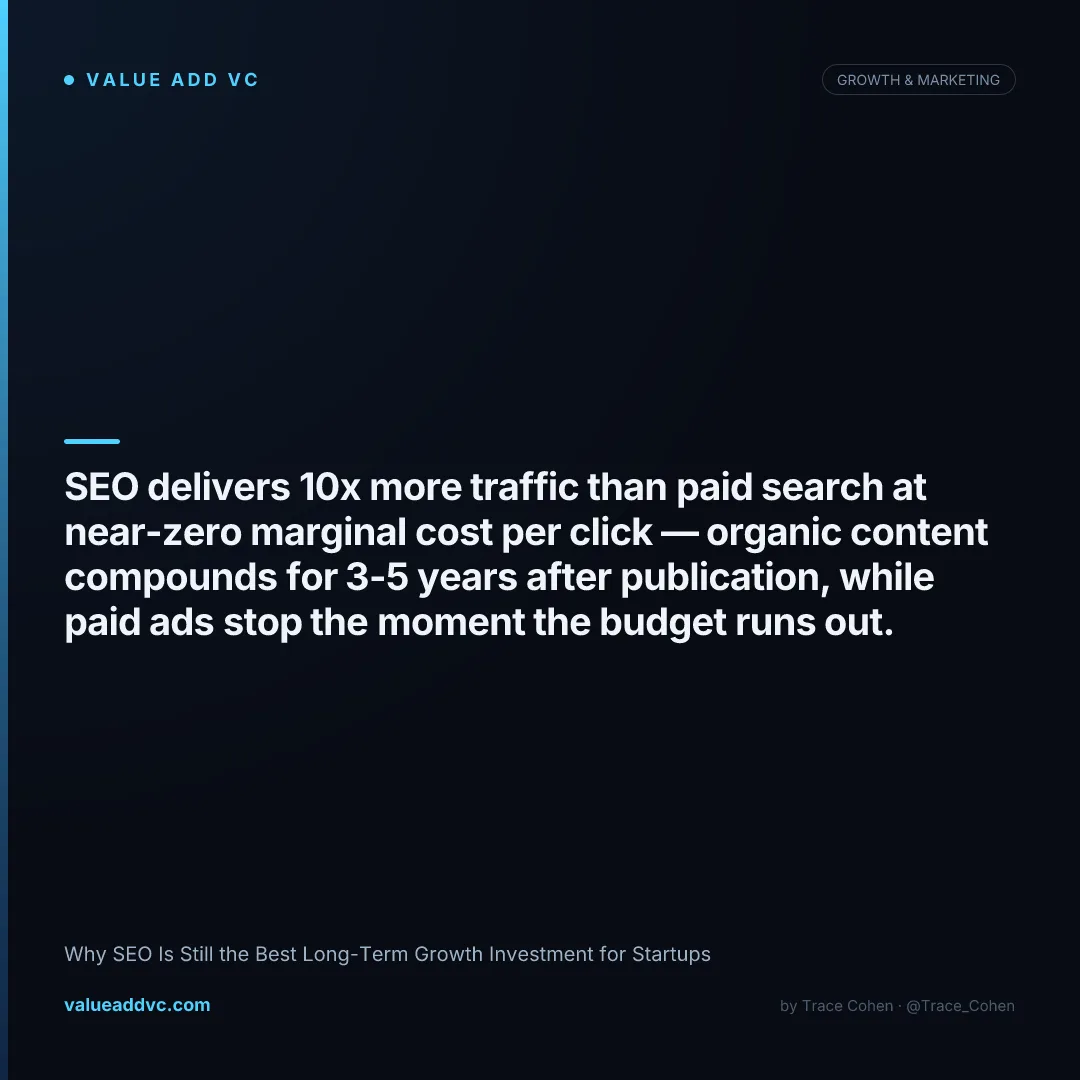
Google processes 8.5 billion searches every single day. Organic search drives 53% of all website traffic — more than paid ads, social media, email, and direct navigation combined.
And yet founders keep asking whether SEO is dead. It isn't. The channel is transforming, but the underlying logic is stronger than ever: the internet runs on search, and startups that build authority in their category own the most durable, compounding distribution channel available.
The Numbers That Silence the SEO Skeptics
The data on SEO vs. paid is not close. It's not even a legitimate debate once you model out a 3-year horizon.
53%
of all website traffic comes from organic search
Source: BrightEdge
3x
more leads generated by content vs. outbound at 62% lower cost
Source: DemandMetric
27.6%
click-through rate for position #1 vs. 9.5% for position #2
Source: Ahrefs
12.2x
better ROI from SEO than digital advertising over 3 years
Source: Semrush
The average organic click costs $0. The average Google paid click costs $2–15 depending on category. A B2B SaaS startup generating 50,000 monthly organic visitors would need to spend $100,000–$750,000 per month in Google Ads to replicate that traffic — every single month, forever.
The Compounding Math Nobody Teaches Founders
Paid advertising is a treadmill. SEO is a flywheel. The moment you stop funding paid, traffic stops. The moment you stop publishing SEO content, existing pages keep ranking, often for years.
HubSpot's blog generates over 4.5 million monthly organic visitors. Zapier built a programmatic SEO strategy with 100,000+ landing pages that now drives 3 million monthly visits. Ahrefs grows almost entirely on content. None of these companies built their audiences through paid social — they built topical authority through relentless, search-optimized publishing, and the returns compound every quarter.
Content is indexed, rankings are low. Traffic is minimal. Most founders give up here.
Pages begin ranking on pages 2–3. Traffic grows 20-40% month-over-month from a small base.
Top pages hit page 1. Backlinks accumulate organically. CAC drops as inbound volume increases.
Existing content compounds. New content ranks faster due to domain authority. Marginal cost per visitor approaches zero.
Why AI Search Changes the Game — But Doesn't End It
The most common objection I hear from founders in 2026: "ChatGPT and AI Overviews are going to kill search traffic." The data doesn't support this — yet.
Google's AI Overviews cite authoritative web content. ChatGPT, Perplexity, and Claude all draw from indexed pages to generate answers. Ranking in AI-generated responses requires the same fundamentals as ranking in traditional search: high-authority domains, expert-level depth, and strong topical coverage. The game hasn't changed — the presentation layer has.
The new objective is becoming the source AI cites — not just the page that ranks. That means more data journalism, more original research, and more definitive takes on narrow topics. Answer Engine Optimization is built on the same foundation as SEO. The startups building that authority today will be cited by every AI assistant in the category tomorrow.
What Actually Works in 2026: The Startup SEO Playbook
Generic content marketing advice doesn't work. Here is what does for B2B startups with limited resources:
- 01Start with bottom-funnel queries. "Best [category] tool for [use case]" and "[Product A] vs [Product B]" pages convert at 3-5x the rate of top-funnel content. Zapier's "best apps for X" pages drive more revenue per visit than any awareness content.
- 02Publish original data and research. First-party research generates 3x more backlinks than opinion content. One study with real numbers — even from a small sample — earns links for years. Ahrefs, Semrush, and Backlinko built massive authority this way.
- 03Build topical clusters, not isolated posts. Google ranks domain expertise, not individual pages. A single long-tail post rarely compounds. Ten interlinked posts on a narrow topic signal authority and drive the whole cluster up together.
- 04Don't ignore technical SEO. Core Web Vitals, crawlability, structured data, and internal linking are table stakes. A slow site with perfect content still ranks below a fast site with decent content. Every 100ms improvement in page load increases conversion by 1%.
- 05Optimize for conversion, not just ranking. Traffic that doesn't convert is just vanity. Strong CTAs embedded in high-intent content — free tools, calculators, template downloads — convert organic visitors into pipeline at 2-4x the rate of generic newsletter CTAs.
The Honest Tradeoff: SEO Requires Patience
SEO is not a growth hack. It doesn't work in 30 days. If you need customers next month, paid ads or outbound will outperform SEO in the short term. This is the real tradeoff.
But if you are building a company that will exist in 3 years — and you should be — then every week you delay starting your SEO investment is compounding interest you are leaving on the table. The startups that started publishing in 2021 are now sitting on organic traffic engines worth millions in equivalent paid spend. The ones that waited until 2024 are 18 months behind.
The question is not whether SEO works. It does. The question is whether you are willing to play a long game in an ecosystem that rewards patience with compound returns.
Paid ads are renting traffic. SEO is buying it.
The startups that started publishing in 2021 are now generating millions in equivalent paid traffic — at zero marginal cost per click. Start today, not next quarter.
Latest from the Pulse
Get VC data most people never see
— 100% free
Weekly benchmarks, valuations, and fund data. Join 5,000+ investors. No spam.