
Google CPCs have risen 122% since 2019. Facebook CPMs are up 89% in three years. And yet the CMO of every Series B company I know is still pumping 60% of their budget into paid ads and wondering why CAC keeps climbing.
Content marketing has an image problem. It feels slow, qualitative, and hard to attribute. Paid ads feel fast, measurable, and controllable. That perception gap is exactly why content is still the best arbitrage in B2B marketing — and why the founders who figure it out early build durable businesses.
The Compounding Math Nobody Does
Here is the comparison most growth teams never actually run. Say you spend $10,000 on Google Ads this month. You get some clicks, some leads, some revenue. Month ends. You stop paying. Traffic goes to zero. The $10,000 is gone.
Now spend that same $10,000 on three deeply-researched, well-optimized long-form articles targeting high-intent keywords. Month one: minimal traffic. Month six: meaningful organic traction. Month 24: each article is driving 300-500 visits per month autonomously, generating leads at effectively zero marginal cost.
Paid Ads: Month 1 ROI
Immediate
Clicks, impressions, some leads — all stop when budget stops
Content: Month 1 ROI
Minimal
Indexing, early crawls — almost no visible return yet
Paid Ads: Month 24 ROI
Same as Month 1
No compounding. Every lead costs the same or more.
Content: Month 24 ROI
3-10x Month 1
Organic rankings compound. Cost-per-lead keeps falling.
The Numbers Are Not Ambiguous
I have seen these stats cited so many times that people start to tune them out. But they remain true and they remain underacted on:
- →
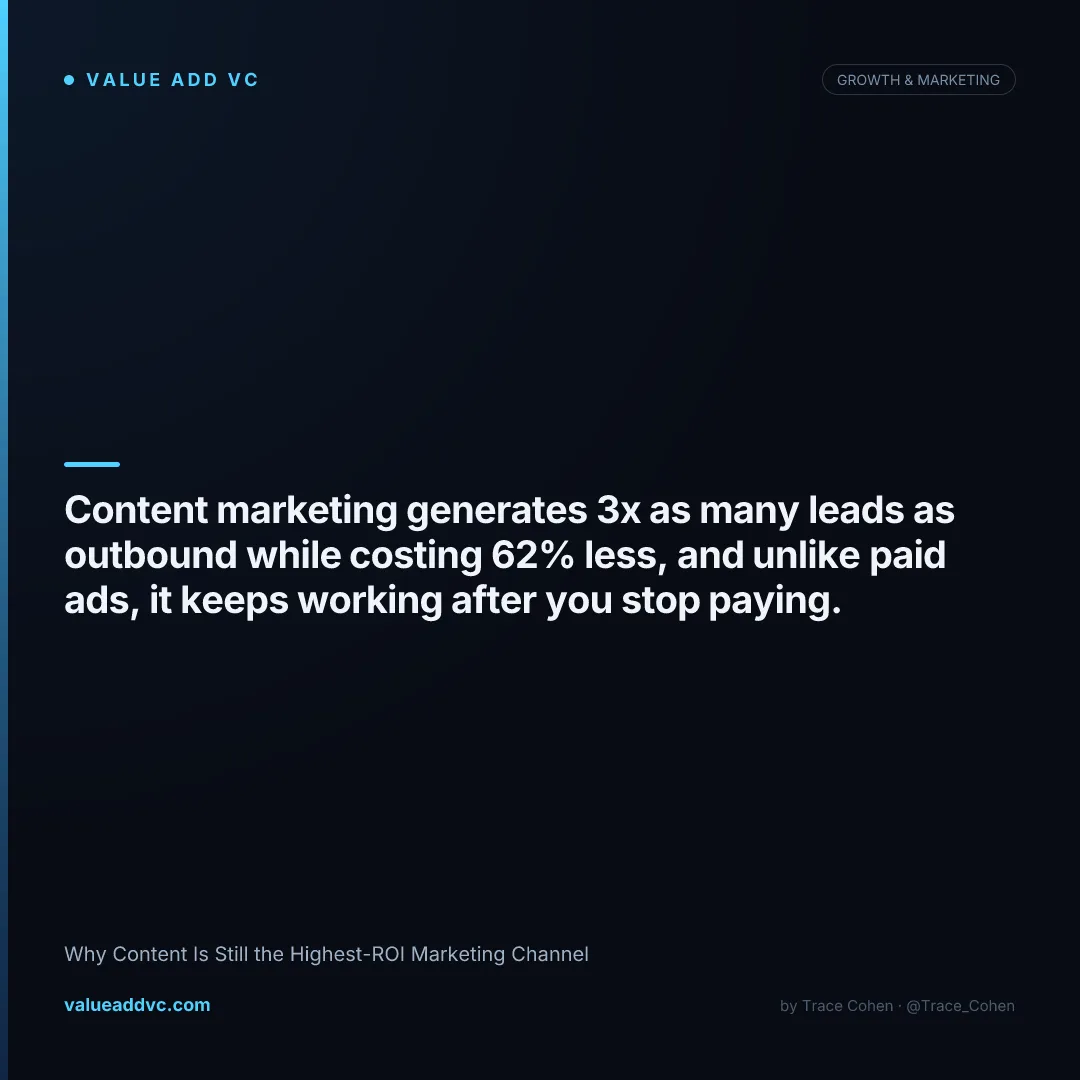
Content marketing costs 62% less than traditional outbound and generates 3x as many leads (Content Marketing Institute, 2025)
- →
Companies that blog consistently generate 67% more leads per month than companies that don't (HubSpot)
- →
SEO-driven traffic converts at 14.6% — cold outbound email converts at 1.7%
- →
B2B buyers consume an average of 4.3 pieces of content before engaging a sales rep (Gartner, 2025)
- →
70-80% of users ignore paid search results entirely and focus on organic listings
- →
Organic search drives 1,000%+ more traffic than organic social media across B2B categories
- →
The average cost-per-lead from content marketing is $92 vs. $225 for paid search in B2B SaaS
What Actually Works in 2026
AI has flooded the internet with mediocre content. That is actually good news for anyone willing to go deeper. Here is what separates high-performing content from noise in 2026:
Proprietary data and angles
Original research, unique datasets, or contrarian takes that AI cannot synthesize from existing web pages
High-intent keyword clusters
Target 3-5 word phrases with clear commercial or investigational intent — not vanity traffic, actual buyers
Depth over breadth
One 2,500-word post that actually answers the question outperforms ten 400-word posts that don't
Internal linking architecture
Content ecosystems where posts reinforce each other drive 40-60% more organic reach than isolated pieces
Distribution loops baked in
Write for an audience first, then optimize for search — not the reverse. The best content is shared before it ranks.
Founder voice and specificity
Generic advice from a faceless brand gets ignored. A 3x founder sharing what actually happened in their portfolio gets bookmarked.
Why Most Companies Still Fail at Content
Having advised 65+ startups, I see the same failure modes repeat:
They quit at month three
Content ROI is back-weighted. The team sees no results in the first 90 days and reallocates the budget to paid ads, which show immediate (but non-compounding) results.
They produce volume over quality
Pumping out 30 mediocre posts per month is worse than publishing 4 exceptional ones. Google actively demotes thin content now, and AI has made volume meaningless.
They write for search engines, not readers
Keyword-stuffed content ranks briefly and then drops. The best-performing content earns backlinks naturally because actual humans find it useful.
No one owns it
Content marketing is a team sport — strategy, writing, SEO, distribution, analytics. When it gets assigned to the one person who 'likes writing,' it dies.
The best startup marketing decision you can make right now:
Commit 12 months to content. Build the asset that keeps working after you stop paying for it. Every other channel is a cost. Content is an investment.
Latest from the Pulse
Get VC data most people never see
— free to subscribe
Trace's notes on venture, AI and startups, a few times a week. Join 5,000+ subscribers. No spam.
No spam, unsubscribe anytime. Sent via Substack · Privacy · or subscribe on Substack ↗