
Building in public works. Buffer grew to $20M ARR partly by sharing revenue numbers, churn rates, and culture openly. But for every success story, there are dozens of founders who handed competitors their entire retention playbook — and watched it get replicated in 90 days.
The Build-in-Public Thesis Has Real Data Behind It
The numbers are compelling. Ghost, the open-source publishing platform, crossed $5M ARR with zero paid marketing — driven almost entirely by founder-led content about how they built the product. Levels.health built a 100,000-person waitlist before it launched a single product feature, using weekly founder updates as its primary acquisition channel. NFX's research on 200 early-stage startups found that companies with consistent founder-led content see 3–5x higher organic reach than those relying on traditional marketing alone.
The mechanism is real: you build trust, you build an audience, and that audience becomes customers, referrers, and sometimes investors. Founders who build in public also tend to close funding rounds faster — investors have been watching their thinking for months before the first meeting, which compresses the trust-building phase dramatically.
The Line Between Transparency and Intelligence
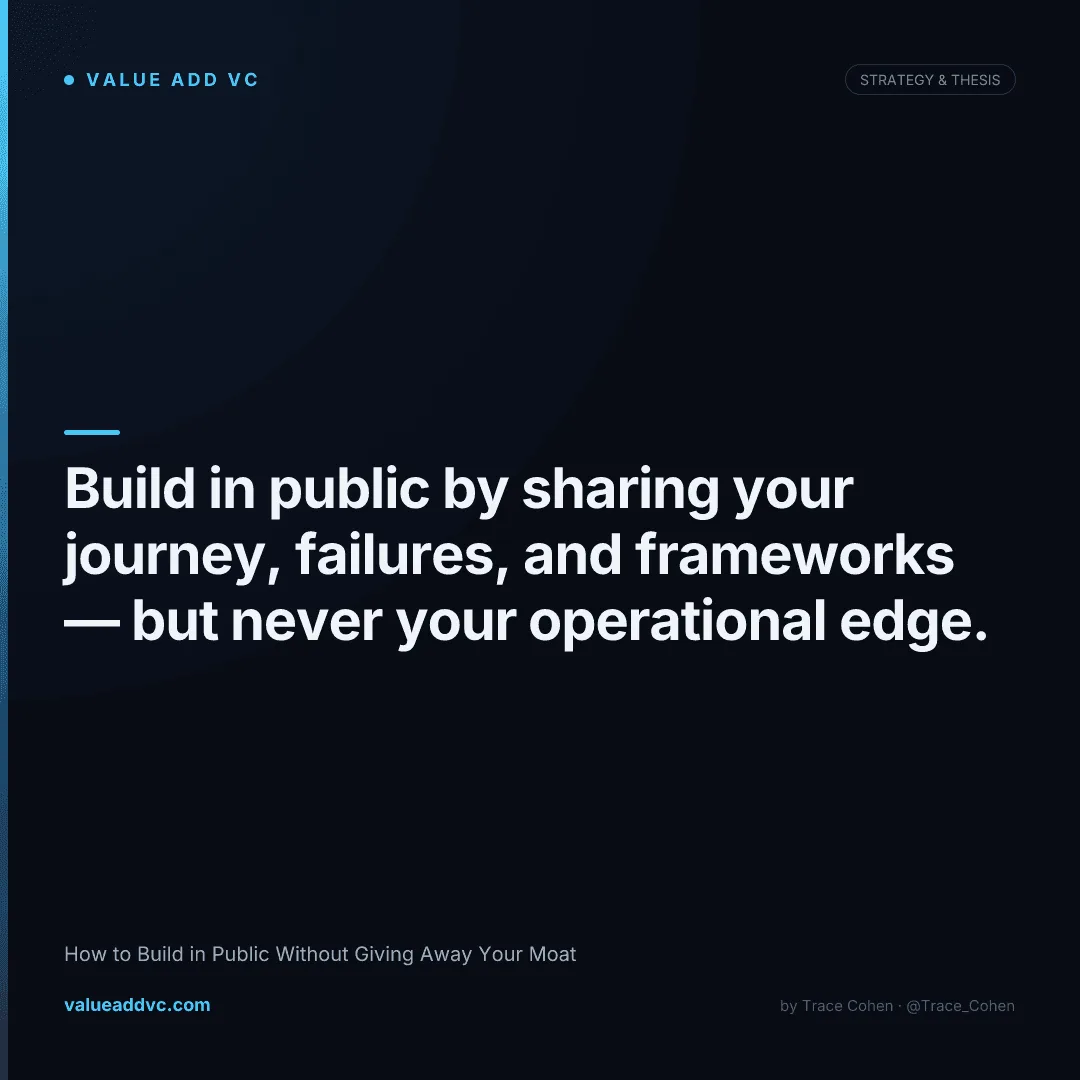
Here is where most founders get it wrong: they think building in public means sharing everything. It does not. There is a meaningful difference between sharing your journey — the failures, the frameworks, the lessons — and sharing your operational edge.
When Stripe built in public during its early years, the team shared their developer philosophy, their culture, their approach to hiring world-class engineers. They did not publish their fraud detection model weights or their bank partnership negotiation strategy. When Notion's early team shared community documents and product thinking publicly, they built a cult following. They did not expose their enterprise pricing tiers, their retention curve by customer segment, or their sales conversion funnel by industry vertical.
Your customer acquisition cost, LTV by segment, cohort retention curves, pipeline conversion rates, and technical architecture decisions are not inspiration content. They are your moat. Sharing them publicly is the strategic equivalent of leaving your playbook in a competitor's office.
What You Should Never Publish
- •Unit economics in enough detail that a competitor can reverse-engineer your pricing model or margin structure
- •Churn data by customer segment or cohort — this tells competitors exactly where your product is weakest
- •Your top five customer names or logos before those customers have given explicit public permission
- •Active fundraising terms, cap table structure, or investor names while a round is in progress
- •Specific product roadmap timelines that reveal features you have not yet shipped — you are advertising capability gaps
- •Partnership or distribution deals before they are fully signed, announced, and operational
- •Technical architecture decisions that represent genuine IP, proprietary data pipelines, or your core switching cost
The Framework That Actually Works
The founders who do this well share the "why" and the "what" — but never the "how." They share results without sharing the recipe. They share the lessons of failure without sharing the specific operational details that could be cloned.
Sahil Lavingia at Gumroad shares annual revenue figures publicly — but his LTV by creator category, CAC by acquisition channel, and churn by cohort are not on the internet anywhere. Lenny Rachitsky built one of the most influential product communities by writing about frameworks and patterns across companies — not by exposing any single company's actual growth mechanics. Both are building massive audiences while protecting the actual edge that makes their businesses defensible.
Use this filter before posting anything: if your three most dangerous competitors read this today, would they learn something operationally actionable? If the answer is yes, keep it private. If it only reinforces their belief that you are executing at a high level, publish it freely. The goal is to make the market believe you are winning — not to teach the market how you win.
Build your story publicly. Build your edge privately. The best founders are transparent about the journey and ruthless about protecting the mechanism.
Stay current with VC and startup trends at Value Add VC. Originally published in the Trace Cohen newsletter.
Latest from the Pulse
Get VC data most people never see
— free to subscribe
Trace's notes on venture, AI and startups, a few times a week. Join 5,000+ subscribers. No spam.
No spam, unsubscribe anytime. Sent via Substack · Privacy · or subscribe on Substack ↗