
Every few decades, a new computing paradigm reshapes the entire technology landscape. Mainframes gave way to PCs, PCs to the web, the web to mobile, and mobile to cloud. Each shift created trillions of dollars in new value and destroyed incumbents who failed to adapt. In 2026, we are in the early innings of the next great platform shift: AI agents. The question every founder and investor should be asking is not whether agents will matter, but who captures the value.
What AI Agents Actually Are (Beyond the Hype)
Let us start by cutting through the noise. The term "AI agent" has been stretched to meaninglessness by marketing departments and pitch decks. Everything from a chatbot with a system prompt to a fully autonomous software system gets called an agent. That linguistic sloppiness makes it hard to have a serious conversation about the economics of this category.
A useful definition: an AI agent is a software system that can take a goal, break it into sub-tasks, execute those tasks autonomously using tools and APIs, handle errors and edge cases, and deliver a completed outcome with minimal human intervention. The key distinction from traditional AI applications is autonomy and tool use. A chatbot answers questions. An agent completes work.
This distinction matters enormously for economics. When AI moves from answering questions to completing tasks, it shifts from being a productivity enhancer to being a labor substitute. That changes the total addressable market from "software licenses" to "wages," which is a dramatically larger number. Global knowledge worker compensation runs into the tens of trillions of dollars annually. Even capturing a small percentage of that value represents a market opportunity that dwarfs traditional SaaS.
The maturation of agents over the past 18 months has been remarkable. In early 2025, most agent systems were demos that fell apart at the edges. By mid-2026, we are seeing production-grade agents that can reliably complete multi-step workflows in domains like customer support, code development, financial analysis, legal research, and sales outreach. The reliability improvements come from better models, better tooling, and hard-won engineering around error handling, state management, and human-in-the-loop patterns.
The Agent Stack
Like every platform shift, the agent economy has a layered stack. Understanding the stack is essential to understanding where value will accrue. The AI landscape is evolving rapidly, but the stack is crystallizing into three distinct layers.
Infrastructure layer: This includes the foundational compute, models, and training infrastructure that agents run on. Think GPU clouds, foundation model providers (OpenAI, Anthropic, Google, Meta), and the data infrastructure that feeds them. This is the picks-and-shovels layer of the agent economy.
Middleware / orchestration layer: This is the tooling that makes it possible to build, deploy, and manage agents. Agent frameworks (LangChain, CrewAI, AutoGen), tool and API integration platforms, memory and state management systems, evaluation and monitoring tools, and the connective tissue between models and applications. This is where the developer experience is shaped.
Application layer: This is where agents meet end users and solve specific problems. Customer support agents, coding assistants, sales development agents, research agents, financial planning agents. This is where the rubber meets the road in terms of delivering value to customers and generating revenue.
Who Wins: Infrastructure Layer
The infrastructure layer is where the most money is being spent and where the biggest companies are competing. The question is whether this is a good place for startups.
The foundation model providers are the obvious winners at this layer. Every agent interaction generates API calls to a language model, and the model providers capture value on every call. The AI valuations we track show that the market agrees: the most valuable AI companies are the model providers. OpenAI, Anthropic, and Google DeepMind sit at the top of the value chain.
But the infrastructure layer is also brutally competitive and capital-intensive. Training frontier models costs hundreds of millions of dollars. Serving them at scale requires massive GPU fleets. The barriers to entry are enormous, and the competitive dynamics favor scale. For most startups, competing at the foundation model layer is not viable.
There are, however, interesting infrastructure niches where startups can win. Specialized compute optimization for inference workloads — exemplified by companies like Baseten, which handles autoscaled model serving at scale with sub-second latency — model routing and cost optimization tools, fine-tuning infrastructure for domain-specific models, and edge deployment systems for running agents on-device. These niches do not require billion-dollar capital expenditures but can be highly valuable as the agent economy scales. Current AI spending trends show infrastructure spend growing faster than any other category.
Who Wins: Middleware Layer
The middleware layer is where the most interesting startup dynamics are playing out. This is the layer that determines how easy it is to build agents, how reliable they are in production, and how efficiently they use underlying infrastructure.
Agent frameworks have proliferated over the past two years, and we are seeing the beginning of consolidation. The early winners are the frameworks that struck the right balance between flexibility and opinionation. Developers want guardrails and best practices baked in, but they also need the ability to customize for specific use cases. The frameworks that are too rigid lose to the ones that are too flexible, which in turn lose to the ones that get the abstraction level right.
Tool integration is another critical middleware category. Agents are only as useful as the tools they can access, and the ecosystem of agent-compatible APIs, data connectors, and action endpoints is still maturing. Companies building universal tool layers, authentication frameworks for agent-to-API interactions, and standardized action protocols are creating essential infrastructure for the agent economy.
Evaluation and monitoring is the unsexy but essential middleware category that will define whether agents graduate from demos to production systems. How do you test an agent that behaves non-deterministically? How do you monitor agent performance in production? How do you catch and correct errors before they cascade? These are hard problems that require purpose-built tooling, and the companies solving them are building critical picks-and-shovels businesses.
The risk at the middleware layer is that foundation model providers vertically integrate and absorb the most valuable middleware functions into their platforms. OpenAI and Anthropic are both building tooling that competes with middleware startups. This is the classic platform risk question: how do you build a business on top of a platform without getting subsumed by it?
Who Wins: Application Layer
The application layer is where the most value will ultimately be created and captured, but it is also where the competition is fiercest and the moat questions are most acute. If you have been following the conversation about moats, this is where it gets real.
The big question at the application layer is whether horizontal agents or vertical agents will win. Horizontal agents try to be general-purpose. They promise to handle any task across any domain. Think of them as the AI equivalent of a general contractor. Vertical agents specialize in a specific domain, workflow, or industry. They are the specialists.
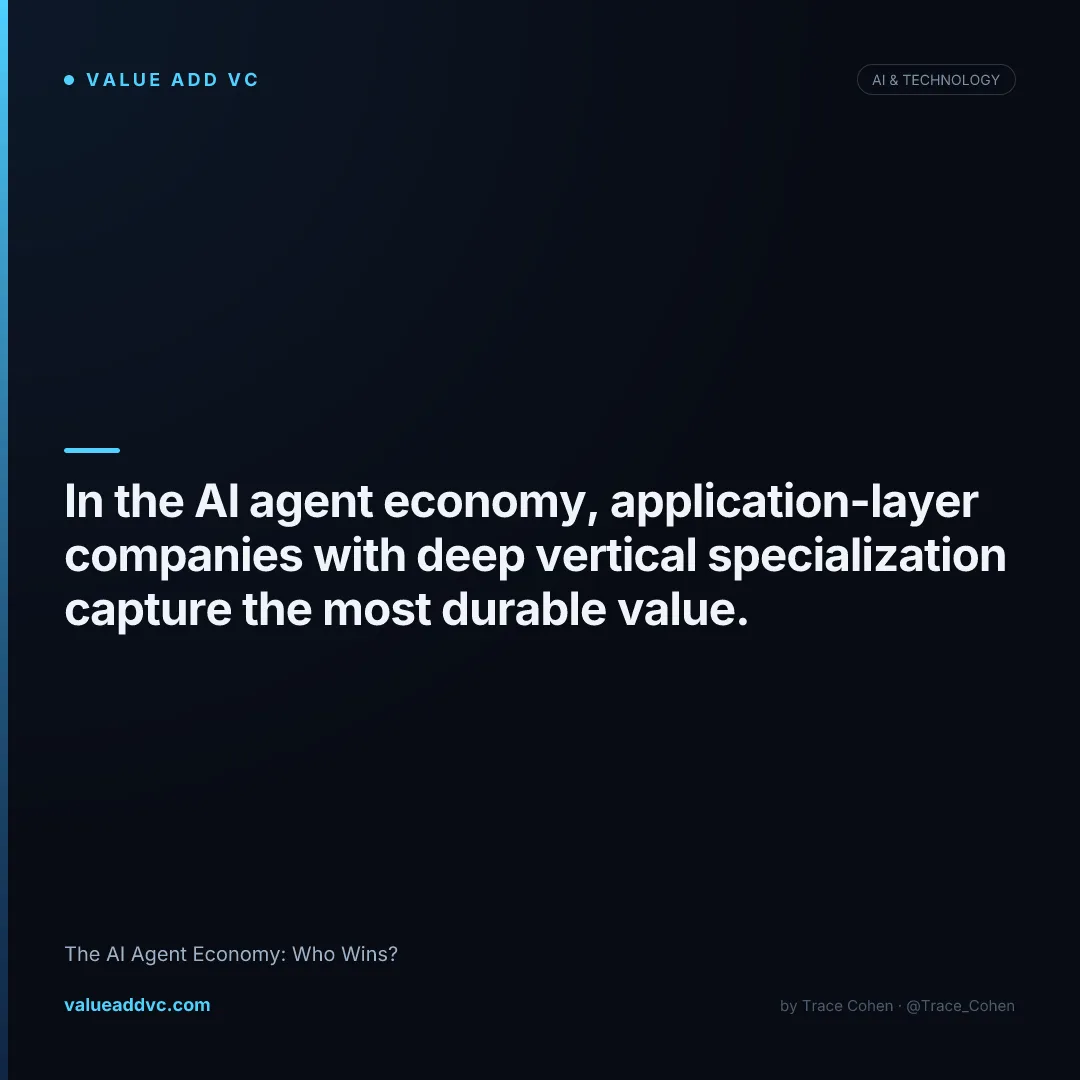
The strong case is that vertical agents will capture more durable value. Here is why: domain expertise is the moat. A general-purpose agent can attempt to do legal research, but a legal-specific agent with access to case law databases, trained on legal reasoning patterns, and integrated into legal workflow tools will be dramatically better at it. The same logic applies to healthcare, financial services, construction, logistics, and every other specialized domain.
The winners at the application layer will be companies that deeply understand a specific workflow, integrate tightly with the tools and data sources in that domain, and deliver measurable outcomes that customers can tie to ROI. They will not compete on general intelligence. They will compete on domain-specific reliability, accuracy, and integration depth.
The Economics of Agents
Understanding agent economics is critical for both founders and investors. The unit economics of agent businesses are fundamentally different from traditional SaaS, and getting this wrong leads to bad business models.
Cost per task: Every time an agent completes a task, it incurs compute costs (model inference), tool costs (API calls to external services), and overhead costs (monitoring, error handling, state management). For a typical agent workflow that requires 10-20 LLM calls, several tool invocations, and some error recovery, the raw compute cost might be $0.05-$0.50 per task completion. That needs to be compared against the value of the task to the customer, which for knowledge work tasks might be $5-$500.
Margin structure: The best agent businesses will have gross margins of 70-85%, comparable to SaaS. The key is pricing on value delivered rather than compute consumed. If your agent saves a customer $100 per task in labor costs and your cost to execute is $0.50, charging $10-$20 per task gives you excellent margins and delivers obvious ROI to the customer. Companies that price on compute cost rather than value delivered will find themselves in a race to the bottom.
Revenue model innovation: Agents enable new revenue models that were not possible with traditional SaaS. Instead of charging per seat per month, you can charge per task completed, per outcome achieved, or per dollar saved. This outcome-based pricing aligns vendor and customer incentives in a way that seat-based SaaS never could. It also means revenue scales with usage rather than headcount, which can be either a feature or a bug depending on your customer base.
Implications for SaaS
The agent economy has profound implications for the existing SaaS landscape. The question of whether SaaS is dead has been debated extensively, and agents bring that question into sharper focus.
Traditional SaaS products are tools that make humans more productive. Agents are systems that replace human labor entirely for certain tasks. When an agent can do in 30 seconds what a human using a SaaS tool does in 30 minutes, the SaaS tool becomes less valuable. The SaaS company's customer is not buying software; they are buying the outcome that the software enables. If an agent can deliver the same outcome more cheaply and more quickly, the SaaS tool is at risk.
This does not mean all SaaS is dead. SaaS products that serve as systems of record, that manage complex multi-stakeholder workflows, or that require deep integration with other systems will remain valuable. But SaaS products that are primarily productivity tools, reporting layers, or simple automation tools are vulnerable to agent-based alternatives. The real vs. overhyped AI startup analysis becomes essential for separating signal from noise.
Smart SaaS companies are adapting by embedding agent capabilities into their existing products, turning their data advantages and workflow integration into defensible positions in the agent economy. The ones that will struggle are those that treat agents as a feature to bolt on rather than a fundamental architectural shift that requires rethinking their entire value proposition.
What Founders Should Build
If you are a founder considering building in the agent economy, here is a framework for where to focus.
Pick a vertical, go deep. The highest-value agent companies will be domain-specific. Choose an industry or workflow you understand deeply, where you have unfair access to domain expertise, data, and distribution. The generalists will compete with the foundation model providers. The specialists will build defensible businesses.
Own the workflow, not just the model call. Agents that are thin wrappers around an LLM API call are not defensible. Build deep integration with the tools, data sources, and systems that your target users rely on. The moat is in the integration depth and workflow understanding, not in the model itself.
Price on outcomes. Charge based on the value you deliver, not the compute you consume. This requires understanding your customer's economics well enough to quantify the value of each task your agent completes. Outcome-based pricing is harder to implement but creates far superior unit economics and customer alignment.
Invest in reliability engineering. The difference between a demo and a product is reliability. Customers will tolerate a chatbot that gets it wrong 20% of the time. They will not tolerate an agent that autonomously takes actions and gets it wrong 20% of the time. The companies that solve the reliability problem in their domain will win.
Build feedback loops. The best agent companies will get better over time because they capture data from every interaction and use it to improve performance. This creates a flywheel effect: more users generate more data, which improves the agent, which attracts more users. This flywheel is the ultimate moat in the agent economy.
What Investors Should Fund
The agent economy presents a nuanced investment landscape. Here is what appears to separate the winners from the noise.
Fund teams with deep domain expertise in their target vertical. The best agent companies will be built by people who have spent years in the industry they are automating. A team of machine learning PhDs building a generic agent framework is less compelling than a team of former legal professionals building an agent that automates contract review.
Look for companies with proprietary data advantages. Agents that can access unique data sources, proprietary training data, or exclusive tool integrations have structural advantages that are hard to replicate. Data is the moat that matters most in the agent economy.
Favor companies with clear unit economics and outcome-based pricing models. The agent companies that will scale are the ones where the economics work at the per-task level, where customer ROI is measurable, and where the pricing model creates natural expansion within accounts.
Be cautious about companies competing directly with foundation model providers. The infrastructure and horizontal agent layers are increasingly being absorbed by the big model companies. The most defensible positions are at the application layer, where domain expertise and workflow integration create natural barriers to entry.
The Bottom Line
The AI agent economy is the most significant platform shift since mobile. It will create enormous new companies and destroy some existing ones. The value distribution across the stack will not be even. Infrastructure providers will capture significant revenue but face brutal competition. Middleware players will build essential tooling but face platform risk. Application layer companies, particularly those with deep vertical expertise, have the best risk-reward profile for venture-scale outcomes.
For founders, the message is clear: go deep, not wide. Build for a specific domain, own the workflow, price on outcomes, and invest relentlessly in reliability. For investors, the message is equally clear: the winners will look more like domain-expert teams than AI research labs, and the moats will be built from data, integration depth, and workflow understanding rather than model architecture.
We are still early. The agent economy is where mobile was in 2009 or cloud was in 2007. The biggest agent companies have not been built yet. The founders who will build them are probably reading this right now, deciding which vertical to attack. Choose wisely, build deeply, and move quickly. The platform shift waits for no one.
Latest from the Pulse
Get VC data most people never see
— free to subscribe
Trace's notes on venture, AI and startups, a few times a week. Join 5,000+ subscribers. No spam.
No spam, unsubscribe anytime. Sent via Substack · Privacy · or subscribe on Substack ↗