
The AI Funding Explosion
We are in the middle of the largest venture capital concentration event in history. Artificial intelligence, in its various forms, now accounts for an estimated 40-45% of all venture capital deployed in the United States. In 2025 alone, AI startups raised over $150 billion globally. The top five foundational model companies have collectively raised more than $50 billion in private capital. These are numbers that would have seemed absurd even three years ago.
The scale of investment is matched by the scale of ambition. AI is being applied to virtually every industry, every workflow, and every category of software. The pitch deck that does not mention AI in 2026 is the exception, not the rule. Every SaaS company has become an "AI company." Every marketplace has added "AI-powered matching." Every fintech has "AI-driven underwriting." The label has become so ubiquitous that it has started to lose meaning.
And that is precisely the problem. When everything is an AI company, nothing is. The gap between companies that are genuinely leveraging AI to create transformative products and companies that have bolted a ChatGPT API call onto an existing workflow is enormous. The signal-to-noise ratio has never been worse, and the stakes for getting the distinction right have never been higher. Track the full landscape on our AI Landscape Dashboard.
What Is Genuinely Transformative
Let me be clear about something: the AI revolution is real. This is not a dot-com bubble where the underlying technology was overpromised. The capabilities of modern AI systems are genuinely extraordinary and improving at a pace that continues to surprise even the people building them. The question is not whether AI is transformative. The question is which specific applications, business models, and companies will capture durable value. Here is where the real signal is.
Vertical AI Applications
The most compelling AI companies are building deep vertical solutions that combine foundational model capabilities with domain-specific data, workflows, and distribution. These are companies that do not just use AI as a feature. They use AI to fundamentally reimagine how an entire industry operates.
Consider healthcare. Companies that combine large language models with clinical datasets, electronic health record integrations, and regulatory expertise are building products that can do things that were literally impossible two years ago: automatically generating clinical notes from doctor-patient conversations, reading medical images with specialist- level accuracy, predicting patient deterioration before it happens. These are not incremental improvements. They are step-function changes in capability that unlock massive value.
The same pattern applies in legal (contract analysis at scale), financial services (real-time risk assessment), logistics (dynamic route optimization), and manufacturing (predictive maintenance and quality control). In each case, the winning companies have three things: deep domain expertise, proprietary data or data advantages, and tight integration into existing workflows. They are not asking users to change how they work. They are making existing work dramatically more efficient, accurate, and scalable.
AI Infrastructure
Every gold rush needs picks and shovels. The AI infrastructure layer is where some of the most defensible businesses are being built. This includes companies building model evaluation and testing frameworks, fine-tuning and training infrastructure, vector databases and retrieval systems, AI observability and monitoring, data labeling and curation platforms, and compute orchestration layers.
What makes infrastructure companies compelling is that they benefit from AI adoption regardless of which specific applications win. If every company is going to deploy AI, every company needs the tooling to do it reliably, efficiently, and at scale. The best infrastructure companies are becoming embedded in their customers' workflows in ways that create real switching costs. Our AI Spending Dashboard tracks how enterprise AI budgets are being allocated across these categories.
AI Agents and Autonomous Systems
The next wave of AI is moving from copilots to agents: systems that do not just assist humans but act autonomously to complete complex, multi-step tasks. This shift represents potentially the largest expansion of AI's economic impact. Instead of AI helping a salesperson write an email, an AI agent can prospect, personalize outreach, schedule meetings, and follow up, handling an entire workflow end-to-end.
AI agents are still early. Reliability remains a real challenge, and the gap between demo and production is wide. But the trajectory is clear, and the companies that solve the reliability problem in specific high-value domains will be enormously valuable. Particularly worth watching are agent systems in software development (autonomous coding, testing, and deployment), customer support (full resolution without human escalation), financial operations (autonomous bookkeeping, reconciliation, and reporting), and sales development (end-to-end prospecting and qualification). The companies that nail agent reliability in one vertical will have a template to expand into others.
What Is Overhyped
For every genuinely transformative AI company, there are dozens riding the hype cycle with products that are unlikely to build durable businesses. Here are the most common patterns.
Thin Wrappers Around Foundation Models
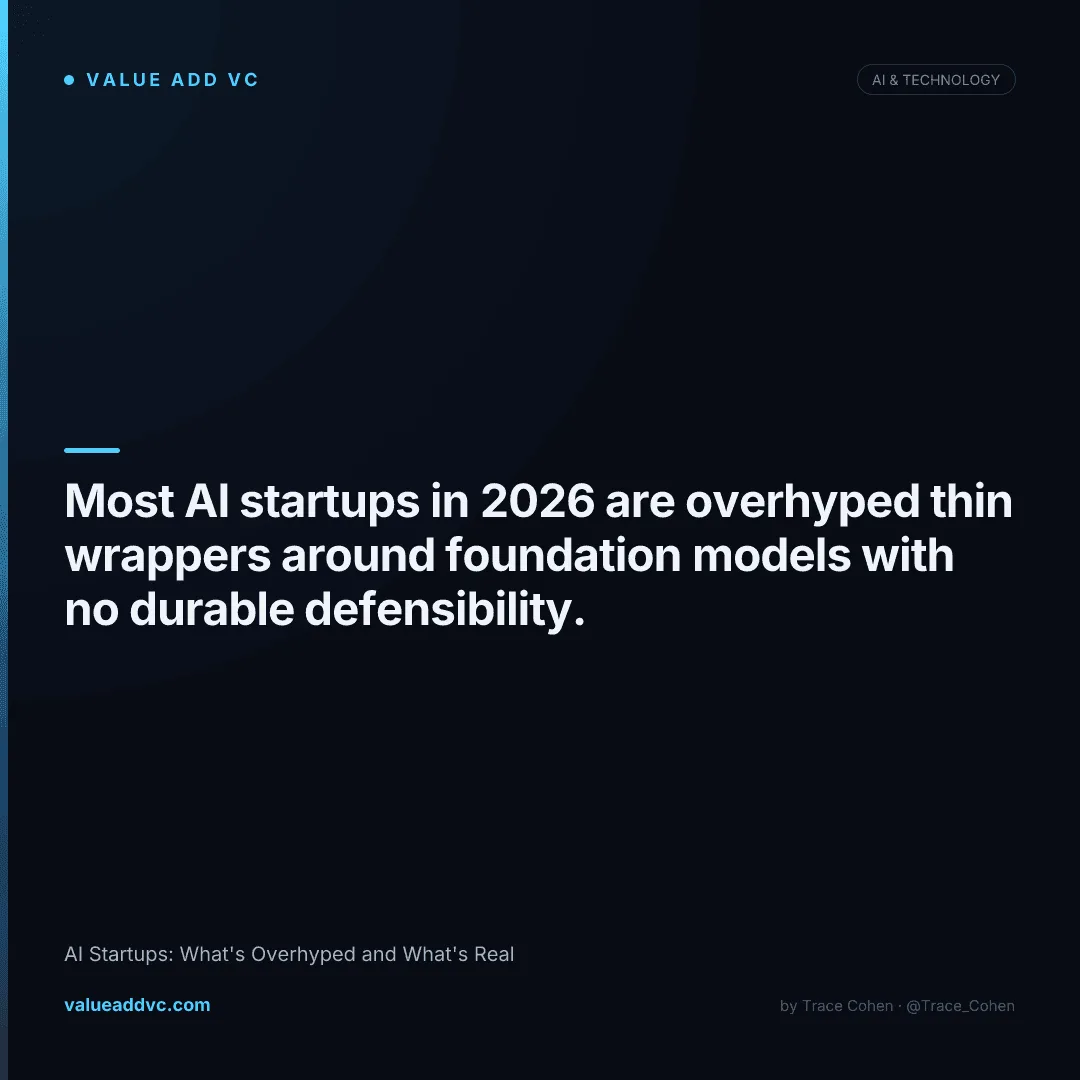
The most common pattern in the AI startup landscape is a company that has built a user interface on top of the OpenAI or Anthropic API, added minimal customization, and is calling itself an AI company. These wrapper companies have a fundamental problem: their core value proposition can be replicated in a weekend. When the foundational model companies improve their own interfaces, ship new features, or lower prices, the wrapper's value proposition evaporates.
This does not mean every company that uses third-party models is a wrapper. The distinction is in the depth of the product. A company that uses GPT-4 as one component within a deeply integrated, workflow-specific product with proprietary data and custom logic is not a wrapper. A company whose entire product is "ChatGPT but for lawyers" with nothing more than a system prompt and a nice UI is a wrapper. The former can build a durable business. The latter cannot.
Undifferentiated Chatbots and Assistants
We have seen hundreds of "AI assistant" companies across every conceivable category: AI writing assistants, AI meeting assistants, AI email assistants, AI scheduling assistants, AI research assistants. The problem is that most of these products offer nearly identical functionality. When 90% of the same output is available from a direct conversation with Claude or ChatGPT, why pay $20/month for a specialized wrapper?
The assistant companies that will survive are those that have built deep integrations into specific workflows, accumulated proprietary data that improves their output quality, and created user experiences that are genuinely better than the general-purpose alternative. But most have not. Most are competing on marketing and UI polish while relying on the same underlying models and delivering the same underlying quality.
AI Companies Without a Business Model
A surprising number of well-funded AI companies have yet to demonstrate a viable business model. Some are burning enormous amounts of capital on compute costs while charging users pennies. Others have impressive user counts but negligible revenue because users will not pay for something they can get for free from the foundational model providers. The willingness to pay, or lack thereof, is the single most revealing signal about whether an AI product is genuinely valuable or merely interesting. If users consistently choose the free ChatGPT over your paid product, that is not a pricing problem. That is a value problem.
Defensibility: The Critical Question
Defensibility is the central challenge for AI startups and the question that separates serious investors from momentum chasers. If the foundational models are commoditizing and API access is universal, what prevents any company from building what you have built?
The honest answer is that defensibility in AI is harder to build than in traditional software. In the SaaS era, you could build defensibility through network effects, switching costs, and feature accumulation over years. In the AI era, a new entrant with the same model access can replicate your core functionality quickly. So where does defensibility come from?
Sources of Defensibility in AI
- Proprietary Data: The most durable moat. Companies that generate or aggregate unique datasets through their product usage create a flywheel: more users create more data, which improves the model, which attracts more users. This is hard to replicate because the data itself is the barrier.
- Deep Workflow Integration: When your product becomes embedded in a customer's daily workflow, connected to their systems of record, integrated with their existing tools, the switching cost becomes significant regardless of the underlying model. Integration depth beats model sophistication.
- Domain Expertise and Regulatory Moats: In regulated industries like healthcare, finance, and government, the compliance and certification requirements create barriers that pure-play AI companies cannot easily cross. Understanding the regulatory landscape is as important as the technology itself.
- Speed of Iteration: In a rapidly evolving landscape, the ability to ship faster, incorporate new model capabilities sooner, and iterate on user feedback more quickly is a real advantage. Companies with strong engineering culture and tight product loops compound this advantage over time.
- Distribution: The best product does not always win. The product with the best distribution often does. Companies that have cracked go-to-market in their specific vertical, whether through partnerships, content, community, or direct sales, have an advantage that is hard to replicate even if the technology is commoditized.
The AI Valuations Dashboard reveals an interesting pattern: the AI companies commanding the highest valuations are not necessarily the ones with the most advanced technology. They are the ones with the clearest moats, the deepest customer relationships, and the strongest evidence that their product creates value users cannot easily replicate elsewhere. Technology is table stakes. Defensibility is what justifies the premium.
Where the Next Wave Is Heading
After three years of the generative AI wave, the market appears to be entering the second phase of this technology shift. The first phase was about foundational capabilities: proving that large language models, image generators, and multimodal systems could do extraordinary things. The second phase is about operationalization: turning those capabilities into reliable, scalable, profitable businesses.
From Demos to Production
The biggest shift happening right now is the move from impressive demos to production-grade systems. The gap between a demo that works 80% of the time and a production system that works 99.5% of the time is enormous in both engineering effort and business value. The companies that close this gap in specific verticals will dominate. This is where the real money will be made, not in building slightly better chatbots but in building systems that enterprises can trust to run critical workloads autonomously.
The Rise of AI-Native Business Models
Traditional SaaS pricing, per-seat, per-month, does not work well for AI products. If your AI agent can do the work of five people, charging per seat misaligns incentives. We are seeing the emergence of outcome-based and consumption-based pricing models that better reflect the value AI delivers. Companies that figure out pricing and business model innovation alongside product innovation will have a significant advantage. The question of whether traditional SaaS is dead is not hypothetical anymore. It is playing out in real time.
Multimodal and Physical AI
The next frontier extends beyond text and images into multimodal understanding and physical world interaction. AI systems that can see, hear, understand context, and take actions in physical environments represent a massive expansion of the addressable market. Robotics, autonomous vehicles, drone systems, and industrial automation are all being accelerated by the same foundational model advances that powered the chatbot wave. These categories require more capital, more time, and more domain expertise, but the long-term value creation potential dwarfs what we have seen in pure software applications.
How Smart Investors Are Navigating This
The best AI investors are not chasing every hot deal or paying any price for AI exposure. They are being surgical. They are asking hard questions about defensibility, business model durability, and unit economics. They are distinguishing between companies that are AI-native, where AI is the core of the product and creates a genuine competitive advantage, and companies that are AI-adjacent, where AI is a feature that could be replicated by any competitor.
The most important question any investor can ask an AI startup is: "What happens to your business when the foundational models get 10x better and 10x cheaper?" For wrapper companies, the answer is existential: better, cheaper models make their value proposition weaker. For deeply integrated vertical companies, the answer is transformative: better, cheaper models make their product more valuable because they can deliver more with less. That distinction is everything.
As covered in the analysis of the state of VC funding in 2026, the capital environment for AI companies is historically favorable. But favorable capital conditions do not guarantee favorable outcomes. The companies that will define the next decade of technology are being built right now. They just are not always the ones with the loudest marketing, the highest valuations, or the most Twitter followers. They are the ones quietly solving hard problems, building deep moats, and creating genuine value for their customers. Separating signal from noise has never been harder, and never been more important.
Explore AI Tools and Data
Track the AI startup landscape with our free dashboards:
- AI Valuations Dashboard — Compare AI startup valuations across stages and sectors.
- AI Landscape Map — Explore the full AI startup ecosystem by category.
- AI Spending Tracker — See how enterprise AI budgets are growing and shifting.
- Is SaaS Dead? — Analyze whether AI is replacing traditional SaaS models.
Latest from the Pulse
Get VC data most people never see
— free to subscribe
Trace's notes on venture, AI and startups, a few times a week. Join 5,000+ subscribers. No spam.
No spam, unsubscribe anytime. Sent via Substack · Privacy · or subscribe on Substack ↗