The Big Picture: 2025-2026 Market Overview
The venture capital market in 2026 looks fundamentally different from where it was three years ago. After the ZIRP-fueled frenzy of 2021 that saw nearly $350 billion deployed globally into startups, the correction that followed was swift and painful. 2022 and 2023 brought a reckoning: deal volumes dropped by more than 40%, valuations compressed across every stage, and the IPO window slammed shut. But by mid-2025, something shifted. The market did not return to 2021 levels, nor should anyone expect it to, but a new equilibrium emerged. One that is more disciplined, more thesis-driven, and heavily concentrated in a single sector.
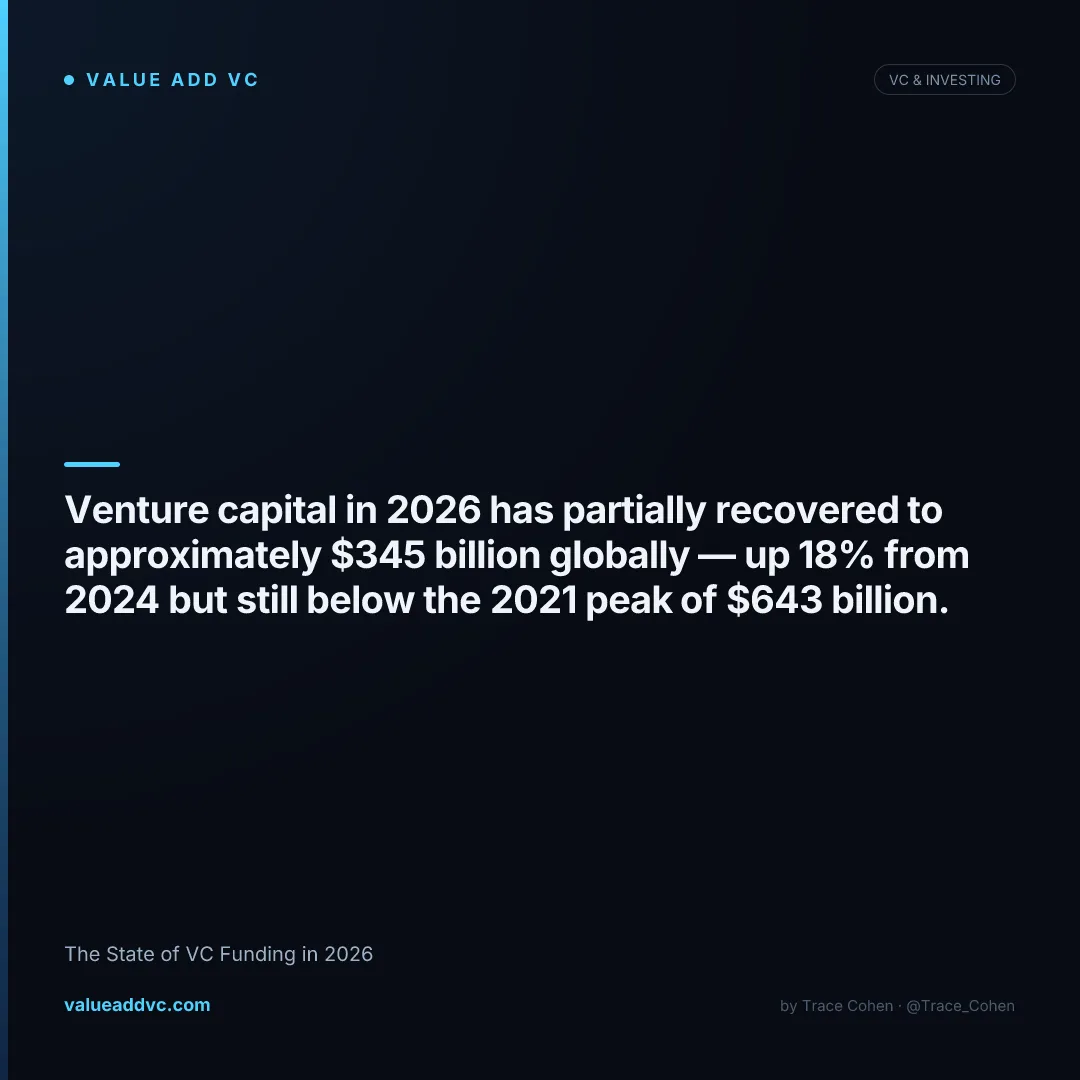
Global VC deployment in 2025 came in at approximately $285 billion, a meaningful recovery from the $240 billion low point in 2023 but still well below the 2021 peak. The first quarter of 2026 suggests we are tracking toward $300 billion for the full year. That number, however, masks an extraordinary concentration. Roughly 40% of all venture dollars deployed in Q1 2026 went into AI-related companies. Strip out AI, and the rest of the venture market is still operating at 2019 levels. This bifurcation is the single most important thing to understand about the current funding environment.
Having tracked these numbers closely through our 2025 Funding Dashboard, the story is clear: capital is available but concentrated. If you are building in AI, you are operating in a seller's market. If you are building in almost any other category, you are fighting for a shrinking pool of non-AI dollars. Understanding this dynamic is essential for any founder planning a raise in 2026.
Funding by Stage: Where the Dollars Are Going
The stage-by-stage breakdown reveals important nuances that the top-line numbers miss. Each stage of the venture funding stack is telling a different story in 2026, and founders need to understand where they sit within it.
Pre-Seed and Seed
The earliest stages have been the most resilient throughout the downturn. Pre-seed round sizes have settled into a range of $500K to $2M, with seed rounds averaging $3M to $5M for top-tier companies. Deal volume at seed is actually up 15% year-over-year, driven by the explosion of new micro-funds and solo GPs who focus exclusively on early-stage. The barriers to starting a company have never been lower, particularly for AI-native teams that can ship an MVP in weeks rather than months. As a result, there are simply more fundable companies at the earliest stage. If you want a deeper breakdown of how these stages differ, see our guide on Pre-Seed vs Seed vs Series A.
Series A
Series A remains the hardest round to close in 2026. The so-called Series A crunch that started in late 2022 never fully resolved. With seed deal volumes increasing while Series A investors maintain higher bars, the mathematical reality is brutal: roughly 70-75% of funded seed companies will not raise a Series A. The median Series A in 2026 is $12M at a $50-60M pre-money valuation, but these numbers are heavily skewed by AI companies commanding $80-100M+ pre-money. For non-AI startups, a Series A at $35-45M pre-money with $8-10M raised is more typical. Investors at this stage want to see $1-2M ARR or clear evidence of product-market fit with strong retention metrics. Narratives alone no longer suffice.
Series B and Beyond
Late-stage venture has seen the most dramatic recovery, but it is almost entirely AI-driven. The mega-rounds are back: we saw multiple $500M+ rounds in 2025 and early 2026, nearly all for AI infrastructure and foundation model companies. Outside of AI, late-stage rounds are happening but at much more modest valuations than the 2021 vintage. Growth equity investors are demanding clear paths to profitability, real unit economics, and often break-even timelines within 18-24 months. The days of raising $100M at a $2B valuation on $10M of ARR with no path to profitability are gone for non-AI companies. They are very much still happening in AI, which tells you everything about where investor conviction sits.
2026 Funding Snapshot by Stage
- Pre-Seed: $500K-$2M rounds, valuations $5-12M, volume up 20% YoY
- Seed: $3-5M rounds, valuations $12-25M, volume up 15% YoY
- Series A: $8-15M rounds, valuations $40-80M, volume flat YoY
- Series B: $25-60M rounds, valuations $150-400M, heavily AI-skewed
- Growth: $100M+ rounds almost exclusively AI infrastructure
Track real-time funding data on our 2025 Funding Dashboard.
The AI Dominance: A Market Within a Market
It is impossible to discuss the state of VC funding in 2026 without confronting the overwhelming gravitational pull of artificial intelligence. AI is not just a hot sector within venture capital. It has become a parallel market that operates under entirely different rules than the rest of the ecosystem.
In 2025, AI startups raised approximately $110 billion globally, representing roughly 38% of all venture capital deployed. Through Q1 2026, that share has climbed to over 40%. The concentration is even more extreme at the top: the ten largest venture rounds of 2025 were all AI companies. Foundation model companies like OpenAI, Anthropic, and their competitors have raised billions individually, but the AI funding wave extends far beyond the model layer. Vertical AI applications, AI infrastructure (compute, data pipelines, evaluation tools), and AI-enabled services companies are all attracting significant capital.
Check our AI Valuations tracker to see how AI company valuations compare to their non-AI peers at every stage. The premium is real and significant: AI companies at Series A are commanding 2-3x the valuations of comparable non-AI SaaS companies. Whether this premium is justified depends on whether you believe AI represents a true platform shift (like mobile or cloud) or a hype cycle that will correct. My view, having watched this space closely for years, is that it is both. The platform shift is real, but the valuation premiums on undifferentiated AI applications will compress sharply as the market matures.
Geographic Shifts: Beyond Silicon Valley
The geographic distribution of venture capital continues to evolve, though the narrative of Silicon Valley's decline has been greatly exaggerated. The Bay Area still captures roughly 35% of all US venture funding, and that share has actually increased in 2025-2026 as AI companies, many of which are headquartered in San Francisco, raise enormous rounds. If anything, AI has re-concentrated capital in the Bay Area after several years of post-COVID geographic dispersion.
That said, several secondary markets have matured into legitimate venture ecosystems with their own self-sustaining cycles of talent, capital, and exits. New York remains the clear number two, with particular strength in fintech, media, e-commerce, and enterprise software. Miami has emerged as a genuine tech hub, no longer just a pandemic-era curiosity but a city with a growing base of founders, operators, and investors. Austin continues to benefit from corporate relocations and a deep engineering talent pool. Los Angeles has quietly become a powerhouse in consumer technology, gaming, and aerospace.
Internationally, the biggest story is India. Indian startups raised over $15 billion in 2025, making it the third-largest venture market globally behind the US and China. Southeast Asia, the Middle East, and Latin America are also seeing increased venture activity, though from lower bases. The European market remains strong but fragmented, with London, Paris, Berlin, and Stockholm each supporting robust local ecosystems that still struggle to produce the kind of mega-outcomes that US and Chinese markets generate.
Valuations Then and Now: The 2021 Reset
The 2021 vintage of venture-backed companies represents the most expensive cohort in history, and the consequences of those valuations are still reverberating through the market. Many companies that raised at peak 2021 valuations have been unable to grow into those numbers. The result has been a wave of down rounds, flat rounds, and structured rounds that have reshaped how investors and founders think about pricing.
Across the board, 2026 valuations are roughly 30-50% below their 2021 peaks for non-AI companies. A Series B that might have been priced at $500M in 2021 is now closing at $200-300M with similar metrics. The exception, again, is AI, where valuations have exceeded 2021 levels for the strongest companies. Our 2025 Unicorns tracker shows that while new unicorns are still being minted, the pace has slowed considerably from the 2021 peak of over 500 new unicorns globally.
For founders raising now, the valuation reset is actually healthy. Companies that raise at reasonable valuations have more room to grow into their price, face less pressure to hit unrealistic growth targets, and are better positioned for future rounds. The 2021 lesson was painful but clear: inflated valuations are a liability, not an asset. A $20M round at a $60M valuation is often a better outcome than a $20M round at a $150M valuation if the higher price comes with unrealistic expectations and aggressive liquidation preferences.
LP Sentiment: Who Is Writing the Checks Behind the Checks
Understanding LP sentiment is critical because it determines how much capital VCs have to deploy. LPs are the investors behind the investors, and their appetite for venture capital as an asset class directly influences the health of the entire ecosystem.
Through 2025 and into 2026, LP sentiment toward venture capital has been mixed. On one hand, the lack of distributions (DPI) from the 2020-2022 vintage funds has frustrated many institutional LPs. Funds that were marked up aggressively during the bull market have seen those paper gains evaporate, and the IPO drought of 2022-2024 meant that LPs received very little cash back. This created what the industry calls the denominator effect: when public markets dropped in 2022, LP portfolios shrank, but their venture allocations (which are marked to model, not market) stayed flat, making them over-allocated to venture on paper.
On the other hand, the AI narrative has been compelling enough to keep many LPs engaged. Funds with strong AI exposure have seen genuine markups supported by real revenue growth, and the partial reopening of the IPO market in 2025 has started to generate distributions. The net result is a flight to quality among LPs: top-quartile fund managers are oversubscribed and closing new funds quickly, while emerging and bottom-quartile managers are struggling to raise. The bifurcation in the LP market mirrors the bifurcation in the startup market: capital is available, but it is concentrating at the top.
Seed vs Late-Stage: Two Different Markets
One of the most important structural features of the 2026 venture market is that seed and late-stage are operating as effectively separate ecosystems with different supply-demand dynamics, different investor bases, and different return expectations.
At seed, the market is highly competitive for investors. The explosion of micro-funds, angel syndicates, and rolling funds has created more competition for early-stage deals than at any point in history. There are now an estimated 3,000+ active seed-stage funds globally, up from roughly 1,200 a decade ago. This abundance of seed capital means that strong founding teams can raise seed rounds quickly, often in 2-4 weeks, with favorable terms. The challenge comes later: all of these seed-funded companies will eventually need to raise a Series A from a much smaller pool of investors.
At late-stage, the dynamics have inverted. After the 2021 era of tourist capital from hedge funds, mutual funds, and sovereign wealth funds, many of those non-traditional investors have pulled back. The remaining late-stage investors are more disciplined, more focused on fundamentals, and less willing to pay premium valuations on forward revenue multiples. Late-stage rounds are taking longer to close, involving more due diligence, and increasingly include structured terms like liquidation preferences greater than 1x, anti-dilution ratchets, and minimum IPO price provisions. For founders, this means the late-stage market is a buyer's market in a way it has not been since 2018.
Seed vs Late-Stage at a Glance
- Seed investors globally: 3,000+ active funds (up 150% in 10 years)
- Series A conversion rate: ~25-30% of funded seeds
- Late-stage non-traditional participation: Down 60% from 2021 peak
- Median time to close Series B+: 8-14 weeks (up from 4-6 weeks in 2021)
- Structured late-stage terms: Present in 40%+ of growth rounds
What This All Means for Founders Raising in 2026
If you are raising capital in 2026, here is the practical takeaway from everything above. The market is open, but it rewards preparation, specificity, and fundamentals in a way that the 2021 market did not. Here is what I would do differently based on what the data is telling us.
1. Understand Your Category's Funding Environment
If you are building an AI company, you are operating in an abundant capital environment. Lean into it. Move fast. Multiple investors will want in, and you have leverage on terms and valuation. If you are building outside of AI, recognize that you are competing for a smaller pool of capital. Your pitch needs to be sharper, your metrics need to be stronger, and your ask needs to be more reasonable. This is not a judgment on the quality of your company; it is a reflection of where capital is flowing.
2. Plan for the Series A Gap
With seed deal volumes increasing and Series A conversion rates hovering around 25-30%, you need to raise enough seed capital to give yourself 24-30 months of runway, not 18. Build in a buffer. The worst position to be in is running low on cash without the metrics to clear the Series A bar. If you need guidance on managing your burn, read our breakdown on navigating between funding stages.
3. Focus on Revenue and Retention, Not Vanity Metrics
The 2026 investor is allergic to vanity metrics. User counts without revenue, GMV without take rate, and ARR without net revenue retention will not get you funded. Investors want to see evidence that customers love your product enough to pay for it and keep paying for it. If you are pre-revenue, show intense engagement metrics and a clear monetization plan. If you are post-revenue, show efficient growth with strong unit economics.
4. Be Strategic About Valuation
Resist the temptation to optimize for the highest possible valuation. A reasonable valuation that gives you room to grow into your next round is far more valuable than a stretched valuation that sets you up for a down round in 18 months. Talk to founders who raised at peak 2021 valuations and ask them how their subsequent fundraises went. The stories are instructive.
5. Build Relationships Before You Need Them
In a more disciplined market, warm introductions and pre-existing relationships matter more than ever. Start meeting investors 6-12 months before you plan to raise. Share updates. Build familiarity. When you eventually go out to raise, you want investors who already understand your business and trajectory, not investors who are seeing your pitch deck for the first time.
Looking Ahead: The Rest of 2026
The venture capital market in 2026 is healthier than it was in 2023, more rational than it was in 2021, and more concentrated than it has ever been. AI will continue to dominate the funding headlines. The IPO window is cautiously reopening, which will help unlock distributions and improve LP sentiment. Seed-stage investing will remain competitive and accessible. Late-stage will remain selective and disciplined.
For founders, the message is straightforward: this is a fundable market if you are building something real, have the metrics to prove it, and target investors whose thesis aligns with what you are building. The spray-and-pray approach to fundraising that worked in frothy markets will not work here. But a thoughtful, prepared, well-targeted fundraise absolutely will.
The best companies get funded in every market environment. Make sure you are building one of them.
Explore the Data
Dive deeper into the funding landscape with our free tools:
- 2025 Funding Dashboard โ Real-time funding data by stage, sector, and geography.
- AI Valuations Tracker โ How AI company valuations compare to non-AI peers.
- 2025 Unicorn Tracker โ Every new billion-dollar company, tracked in real time.
- 2025 IPO Dashboard โ Track the IPO pipeline and post-listing performance.