Back to Blog
BLOGApril 2026Β·10 min read

Pre-Seed vs Seed vs Series A: What's the Difference?

What each stage actually means, how much to raise, what investors expect, and when you're ready.

TC
Trace Cohen
3x founder, 65+ investments, building Value Add VC

The Funding Landscape in 2026

If you're a founder raising money right now, the rules have shifted. The zero-interest-rate era of 2020-2021 β€” where pre-revenue companies raised $10M seed rounds on vibes β€” is long gone. We're in a market that rewards clarity, capital efficiency, and real traction. Valuations have come back to earth, due diligence cycles are longer, and investors at every stage are asking harder questions about unit economics and path to profitability.

But the good news? Money is still flowing. According to our 2025 funding tracker, venture activity has stabilized after two years of correction. Seed and pre-seed remain the most active stages by deal count, and the best founders are still raising competitive rounds β€” they just need to show more substance, earlier.

The biggest confusion I see from first-time founders is understanding what stage they're actually at, what investors expect at that stage, and how to position themselves accordingly. Getting this wrong doesn't just cost you a check β€” it costs you months of wasted meetings with the wrong people. So let's break it all down.

Pre-Seed ($50K – $1M): Turning an Idea into a Real Thing

What It Is

Pre-seed is the earliest institutional (or quasi-institutional) fundraising stage. You're raising capital to go from concept to something tangible β€” a prototype, early user testing, first hires. Think of it as funding the β€œproof of concept” phase. You might have a landing page, a waitlist, or a rough MVP, but you probably don't have meaningful revenue yet.

Pre-seed didn't even exist as a recognized stage ten years ago. It emerged because the cost of starting a company dropped dramatically (thanks to AWS, open source, no-code tools, and now AI), and a category of investors emerged to match that reality. Today in 2026, pre-seed is a well-established stage with its own ecosystem of dedicated funds, accelerators, and angel networks.

Who Invests

  • Angel investors β€” Individual high-net-worth individuals writing $5K-$100K checks
  • Pre-seed funds β€” Dedicated micro-VCs with fund sizes of $10M-$50M (Precursor, Hustle Fund, Chapter One)
  • Accelerators β€” Y Combinator, Techstars, and vertical-specific programs
  • Friends & family β€” Often the very first dollars in, though be careful with this

What You Need

At pre-seed, investors are betting almost entirely on the team and the idea. You don't need product-market fit. You don't need revenue. But you need to demonstrate:

  • A clear, compelling problem statement β€” who has this problem and why does it hurt?
  • A credible founding team with relevant experience or unique insight
  • Some form of early validation: a waitlist, LOIs, user interviews, a prototype with early usage
  • A large addressable market (TAM) worth going after
  • A clear plan for how you'll use the capital to hit milestones that justify a seed raise

Typical Terms

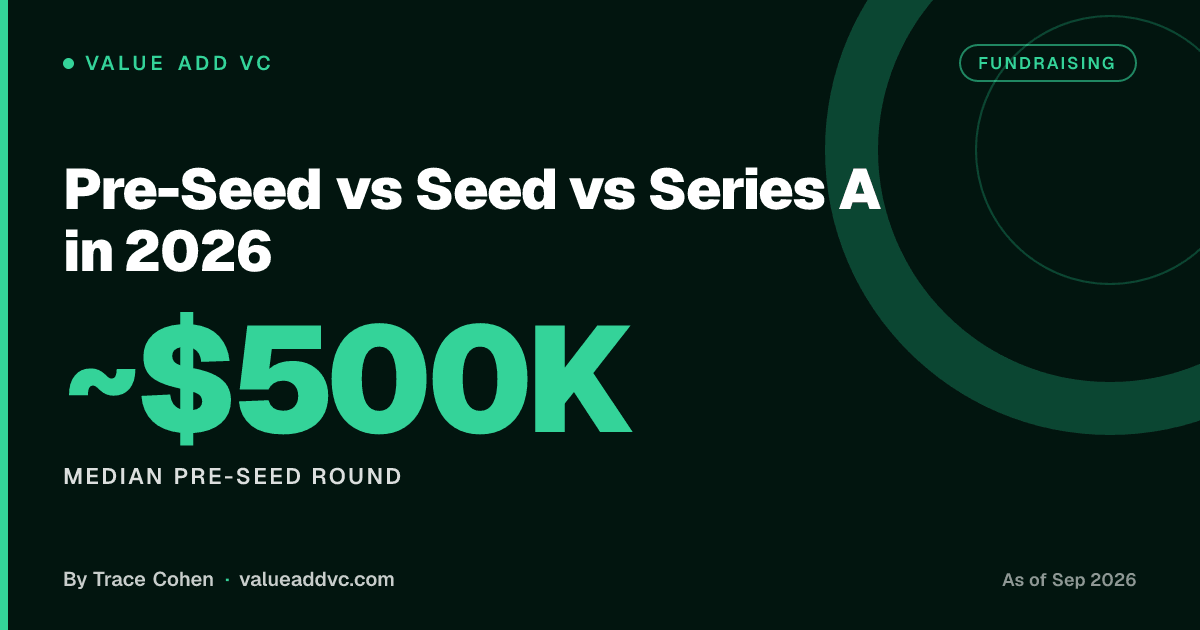
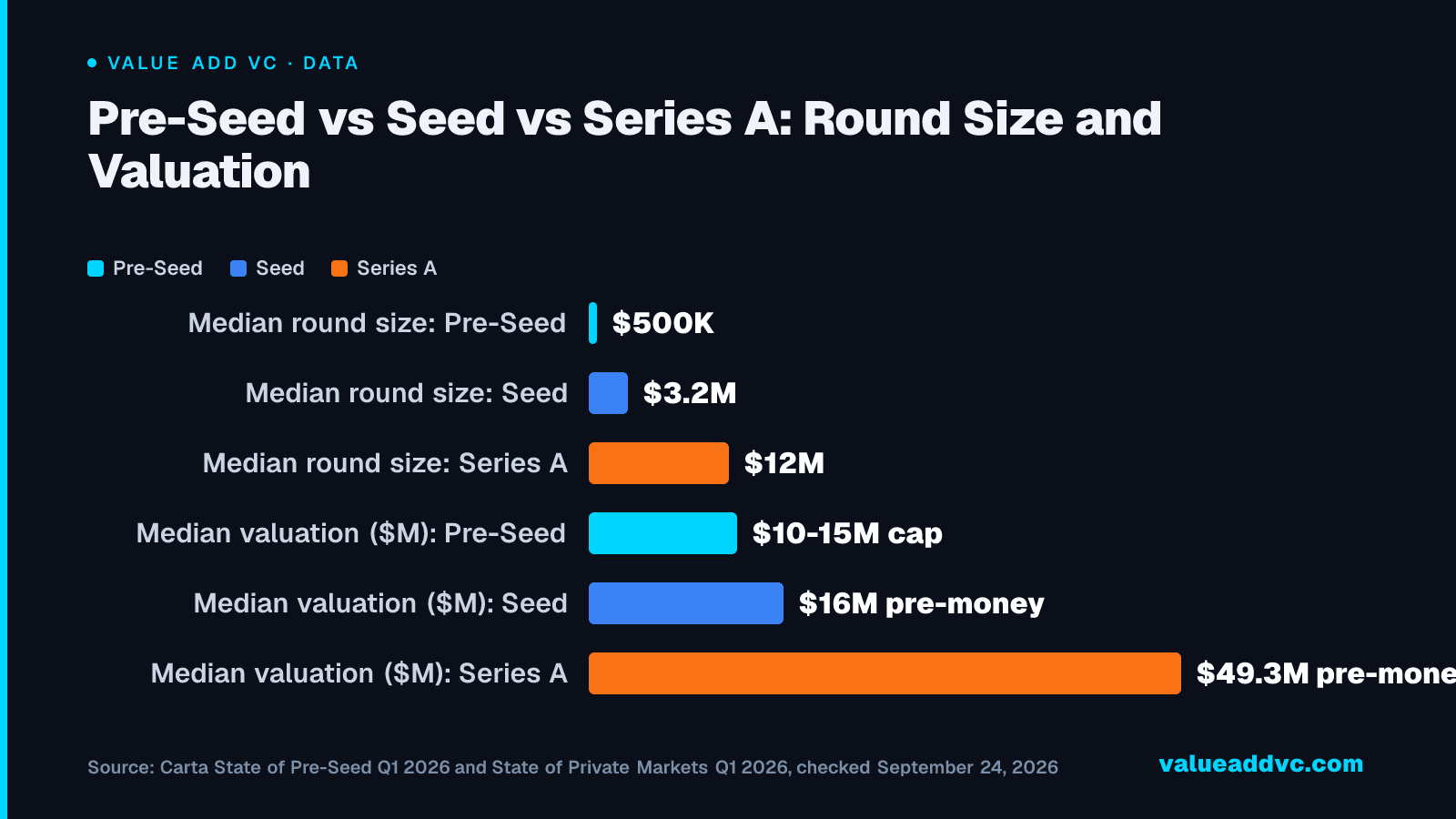
  • Amount raised: $50K – $1M (median around $500K in 2026)
  • Valuation cap: $3M – $10M on a SAFE or convertible note
  • Instrument: Almost always a SAFE note (Simple Agreement for Future Equity) or convertible note
  • Dilution: Typically 10-15%
  • Timeline to close: 2-8 weeks for the round, often rolled over 1-3 months

Seed ($1M – $5M): Proving the Model Works

What It Is

Seed is the stage where you're validating that your product solves a real problem and that people will pay for it (or engage with it deeply enough that a business model can emerge). You've moved beyond the idea phase β€” you have a product in market, early users or customers, and you're trying to find the repeatable growth levers that will unlock scale.

In 2026, the seed stage has bifurcated. There are β€œseed” rounds that look like what pre-seed was five years ago ($1M-$2M on minimal traction), and there are β€œseed+” or large seed rounds ($3M-$5M) that come with real metrics expectations. The bar has risen at both ends.

Metrics Investors Expect

For SaaS / B2B:

  • $5K-$50K MRR (or strong usage metrics if product-led growth)
  • 20-50+ paying customers or design partners
  • Evidence of retention: low churn, expanding usage
  • Clear understanding of ICP (ideal customer profile)

For Consumer / Marketplace:

  • Thousands to tens of thousands of active users
  • Strong engagement metrics (DAU/MAU > 30%)
  • Organic growth or strong viral coefficient
  • Clear path to monetization even if not monetizing yet

Typical Investors

  • Seed-stage VCs β€” Dedicated seed funds with $50M-$200M under management (First Round, Founder Collective, Lerer Hippeau)
  • Multi-stage VCs writing seed checks β€” a16z Seed, Sequoia Scout, Lightspeed Scout
  • Syndicates and angels β€” Often filling out a round led by an institutional investor
  • Corporate VCs β€” Strategic investors in relevant verticals

SAFE vs Priced Round

This is one of the most common questions at seed. Here's the honest answer: it depends on leverage.

SAFE Notes at Seed

Best when: you have momentum, multiple interested investors, and want to close quickly without negotiating a full term sheet. SAFEs are faster, cheaper (minimal legal fees), and give you flexibility to stack multiple investors.

Watch out: stacking too many SAFEs at different caps creates a messy cap table. Make sure you understand the total dilution when they convert. Read our full guide on SAFE notes.

Priced Rounds at Seed

Best when: you have a lead investor who wants a board seat, you're raising $3M+, or you want to set a clean valuation and ownership structure from day one. Priced rounds offer more clarity to everyone involved.

Watch out: legal costs ($15K-$40K), more negotiation points (liquidation preference, pro-rata rights, board composition), and a longer close timeline (4-8 weeks).

  • Amount raised: $1M – $5M (median around $3M in 2026)
  • Valuation: $8M – $25M (pre-money)
  • Instrument: SAFE, convertible note, or priced equity (Series Seed)
  • Dilution: 15-25%
  • Timeline to close: 4-12 weeks

Series A ($5M – $20M): Scaling What Works

What It Is

Series A is the inflection point. You're no longer trying to figure out if your product works β€” you've proven it. Now you need capital to scale: hiring a go-to-market team, expanding into new segments, building out infrastructure, and growing revenue aggressively. Series A is where startups go from β€œinteresting experiment” to β€œreal company.”

This is also where the investor profile changes dramatically. You're no longer talking to angels and seed funds β€” you're pitching institutional VCs who manage hundreds of millions (or billions) of dollars, have formal investment committees, and take board seats. The process is more rigorous, the diligence is deeper, and the bar is significantly higher.

Metrics Required

Revenue & Growth

  • $1M – $3M ARR (minimum; $2M+ preferred in 2026)
  • 2-3x year-over-year growth rate
  • Month-over-month growth of 10-20%
  • Clear, repeatable customer acquisition channels

Unit Economics

  • LTV:CAC ratio of 3:1 or better
  • Gross margins above 60% (SaaS: 70%+)
  • CAC payback period under 18 months
  • Net revenue retention above 100% (ideally 110%+)

Other Signals

  • Low churn: monthly logo churn under 3%, revenue churn under 1%
  • Strong NPS or qualitative customer love
  • Evidence of category leadership or defensibility
  • A team that's executing β€” not just the founders, but early hires who are performing

Lead Investor Dynamics

Series A is almost always a β€œled” round. One investor commits a large chunk (50-70% of the round), sets the terms, and takes a board seat. The lead runs diligence, negotiates the term sheet, and effectively vouches for the company to other investors who fill out the round.

Finding a lead is the hardest part of Series A. Without a lead, your round doesn't happen. VCs at this stage are typically deploying $5M-$15M per check, and they're looking for companies they believe can return 10-50x their investment. That means they need to believe in a path to $100M+ in revenue.

Typical Series A leads include Benchmark, Greylock, Index Ventures, Bessemer, Accel, General Catalyst, and similar funds. Many multi-stage firms also actively lead Series A rounds. Check our 2025 unicorns tracker to see which firms are most active.

  • Amount raised: $5M – $20M (median around $12M in 2026)
  • Valuation: $25M – $80M (pre-money)
  • Instrument: Priced equity (Series A Preferred Stock)
  • Dilution: 20-30%
  • Board: Typically 3 seats (1 founder, 1 investor, 1 independent or founder)
  • Timeline to close: 6-16 weeks from first meeting to wire

Quick Comparison Table

Pre-SeedSeedSeries A
Amount$50K – $1M$1M – $5M$5M – $20M
Valuation$3M – $10M cap$8M – $25M$25M – $80M
InstrumentSAFE / NoteSAFE / PricedPriced equity
InvestorsAngels, micro-VCs, acceleratorsSeed VCs, multi-stage scoutsInstitutional VCs, multi-stage funds
Revenue$0 – minimal$5K – $50K MRR$1M – $3M+ ARR
What You NeedTeam, idea, early validationProduct in market, early PMF signalsProven PMF, strong unit economics
Dilution10 – 15%15 – 25%20 – 30%

How to Know When You're Ready for Each Stage

You're Ready for Pre-Seed When...

You've validated the problem deeply enough that you can articulate exactly who has it, why existing solutions fail, and what your unique approach is. You have a co-founder (or a very compelling reason for being solo). You've built something β€” a prototype, a landing page with signup data, a working demo β€” that shows you can execute. And crucially, you have a clear 12-18 month plan for what you'll build and learn with the capital.

The bar is not revenue. The bar is conviction. Can you convince a smart investor that you're the right team to solve this problem, and that the problem is worth solving?

You're Ready for Seed When...

You have a product that real people or companies are using. You're seeing early signs of product-market fit: customers are sticking around, usage is growing (even if slowly), and you're starting to understand what makes your product click. You have at least a hypothesis about your go-to-market motion, even if you haven't scaled it yet.

The key question: do you have enough signal that the next dollar of investment will accelerate growth, not just extend runway while you search for PMF? If you're still figuring out what to build, you're probably still pre-seed. If you know what to build and need resources to build it faster and sell it harder, you're seed-ready.

You're Ready for Series A When...

You've found product-market fit and can prove it with data. Revenue is growing predictably. You know your unit economics and they work (or have a clear, funded path to making them work). You have a repeatable sales or growth process, and you need capital to pour fuel on it β€” more salespeople, more marketing spend, more engineering to handle scale.

The Series A question is fundamentally different from seed: it's not β€œcan this work?” but β€œhow big can this get, and how fast?” If you can't paint a credible picture of $100M+ in revenue, most Series A investors will pass β€” no matter how impressive your current metrics are. Explore our helpful tools and apps to build better data rooms and financial models for your raise.

Common Mistakes at Each Stage

Pre-Seed Mistakes

Raising too much on too high a valuation

Raising $1.5M at a $15M cap with no product creates expectations you probably can't meet. If your seed round needs to show massive progress from that high baseline, you're setting yourself up for a down round or a deadlocked company. Raise what you need for 12-18 months of runway at a valuation that gives you room to grow into.

Pitching VCs when you should be pitching angels

If you're raising $300K, don't waste months trying to get meetings with Sequoia. Target angels, pre-seed funds, and accelerators. The right investor at the right stage will move faster, add more value, and have expectations aligned with where you actually are.

Spending too long fundraising instead of building

Every month you spend in fundraising mode is a month you're not learning from customers. Set a time limit (6-8 weeks), run a tight process, and if it's not working, go back to building and come back with more traction. Fundraising should not become your full-time job at pre-seed.

Seed Mistakes

Stacking SAFEs without understanding dilution

Multiple SAFEs at different valuation caps, plus an option pool, can mean founders own far less than they think when everything converts at Series A. Model out the fully diluted cap table before every new SAFE. Use a cap table tool β€” not a napkin.

Hiring too fast before finding PMF

You raised $3M and immediately hired 10 people. Now you're burning $200K/month but still haven't nailed the product. The capital that was supposed to last 18 months will last 12 β€” and you'll be fundraising again from a position of weakness. Stay lean until you know what's working.

Ignoring the Series A bar

Your seed investors told you $1M ARR is the Series A bar. But when you get there, Series A VCs want $2M+ with strong growth and good unit economics. The bar moves. Build with the assumption that the Series A bar will be higher than what anyone tells you today, and you'll be better prepared.

Series A Mistakes

Raising before you have the metrics

If you go to market at $800K ARR growing 1.5x year-over-year, you'll burn through 30-50 VC meetings with no term sheet and demoralize your team. Wait until your numbers genuinely tell a compelling story. A few more months of growth can be the difference between a β€œno” and a competitive round.

Not building relationships with Series A investors early

Series A VCs want to track companies over time. If the first time they hear from you is when you're actively raising, you're behind. Start building relationships 6-12 months before you plan to raise. Share updates, ask for advice, get warm intros. When you're ready, the conversations will move much faster.

Optimizing for valuation over partner

At Series A, the partner who leads your round will likely sit on your board for 7-10 years. Choosing the firm that offers the highest valuation over the partner you genuinely trust and respect is a mistake that compounds over every board meeting, hiring decision, and future fundraise. Pick the partner, not the price.

The Gap Between Stages: The Series A Crunch and Bridge Rounds

Here's the uncomfortable truth most fundraising guides won't tell you: the majority of seed-funded companies never raise a Series A. The data in our 2025 funding tracker shows that roughly 70-75% of companies that raise seed rounds do not go on to raise a Series A. This is the β€œSeries A crunch” β€” and it's been a persistent feature of the venture landscape for over a decade.

The crunch exists because the seed and Series A markets operate differently. Seed investors take lots of bets, knowing most will fail. Series A investors take fewer, bigger bets and require proof. The filter between these two stages is brutal by design β€” it's where the market separates companies with real traction from those that are merely β€œstill around.”

Bridge Rounds: The In-Between

When a company is between stages β€” too much traction for another seed round but not enough for a Series A β€” bridge rounds become an option. A bridge is typically a smaller raise ($500K-$2M) from existing investors, structured as a convertible note or SAFE, designed to give the company 6-12 more months of runway to hit Series A metrics.

When Bridge Rounds Make Sense

  • You're genuinely close to Series A metrics and need 3-6 more months
  • You've identified the specific milestone that will unlock Series A and have a clear plan to hit it
  • Your existing investors believe in the trajectory and are willing to participate
  • The capital will be used for growth, not just survival

When Bridge Rounds Are a Red Flag

  • You don't have a clear path to the metrics Series A investors want
  • You're raising a bridge because you ran out of money, not because you're close to a milestone
  • Your existing investors won't participate (the strongest negative signal possible)
  • This is your second or third bridge β€” at some point, you need to either hit the milestone or consider alternative paths (profitability, acquisition, wind-down)

Alternative Paths

Not every company should β€” or can β€” follow the pre-seed to seed to Series A playbook. Some of the best outcomes come from companies that raised a seed round, found a profitable niche, and never raised again. Revenue-funded growth is underrated, especially in a market where capital efficiency is valued more than ever.

The venture path makes sense when you're building in a market where speed matters and the winner-take-most dynamics justify giving up ownership for capital. If that's not your market, there's no shame β€” and often more wealth creation β€” in building a profitable, self-funded business.

Bottom Line

The stage names matter less than understanding what each one requires. Pre-seed is about conviction, seed is about validation, and Series A is about proof. Know where you are, target the right investors, and raise the right amount at the right time.

Use our 2025 funding tracker to see real deal data at every stage, and browse our recommended tools to build your data room, model your cap table, and run a tight fundraising process.

Explore 41+ free VC tools, dashboards, and recommended startup software.