
For years, tech worshipped the moat. Defensibility meant keeping competitors out.
Proprietary data. Lock-in. High switching costs. Walled gardens.
The logic was medieval: survive by fortifying.
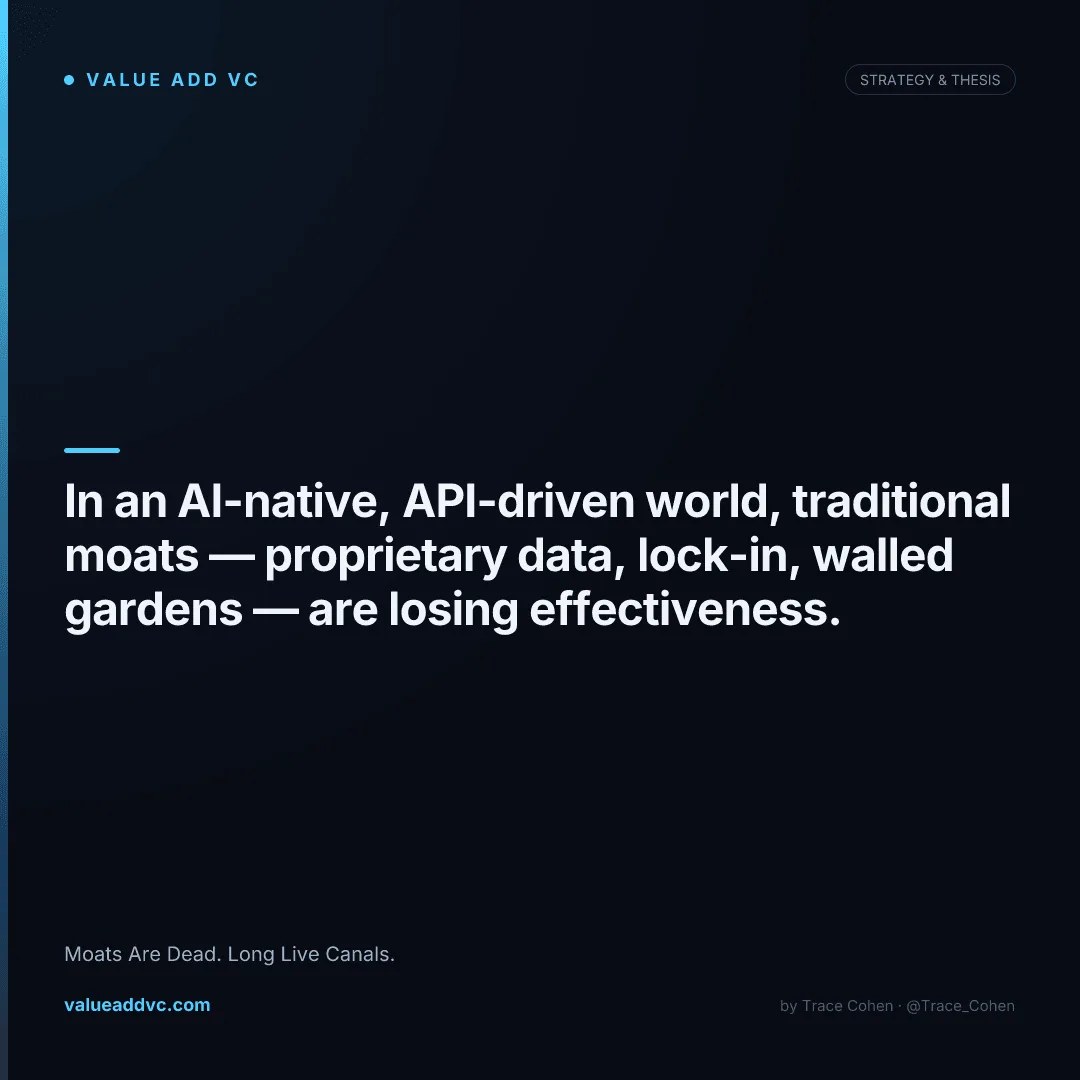
But in an AI-native, API-driven world, many moats are starting to look less like protection and more like prisons.
A moat often extracts. It traps users through friction. It holds data hostage. It makes leaving painful. It can preserve incumbency, but it doesn't always create flow.
A canal does the opposite.
A canal is engineered openness. It moves value.
Historically, moats protected castles. Canals built economies.
That distinction matters.
The best companies increasingly look less like fortresses and more like infrastructure. They don't win because no one can get in. They win because everyone wants to route through them.
A Moat Says:
- ✕Stay inside.
- ✕Defensive.
- ✕Blocks.
- ✕Scales through exclusion.
A Canal Says:
- ✓Build on top.
- ✓Generative.
- ✓Connects.
- ✓Scales through throughput.
The Modern Winners Are Canals
Think about the modern winners. Stripe wasn't built as a moat as much as a canal for internet commerce. Twilio became programmable plumbing. Amazon Web Services turned infrastructure into waterways.
The strongest platforms increasingly expose APIs, invite ecosystems, enable composability, and become routes others depend on.
That is canal thinking.
Value Accrues to Movement
In a world of agents, APIs, headless software, and interoperable models, value often accrues to whoever facilitates movement:
Not whoever walls them off.
The old question was: How do we make our moat wider?
The new question is: How do we become a canal others cannot afford to bypass?
That changes how you build.
Don't just ask whether your product has defensibility.
Ask whether it has flow.
The Flow Test
The Deeper Shift
FROM
Protecting scarcity
TO
Orchestrating movement
FROM
Owning the castle
TO
Owning the route
And routes, historically, often outlast empires.
Moats protected kingdoms.
Canals created civilizations.
This essay reflects how I evaluate startups at Value Add VC. When I look at a company's defensibility, I'm increasingly asking not “how wide is the moat?” but “how much flows through you?” The companies in our AI Landscape tracker and AI Valuations dashboard that are winning the fastest are almost all canal companies — they're infrastructure, not fortresses.
Latest from the Pulse
Get VC data most people never see
— free to subscribe
Trace's notes on venture, AI and startups, a few times a week. Join 5,000+ subscribers. No spam.
No spam, unsubscribe anytime. Sent via Substack · Privacy · or subscribe on Substack ↗