
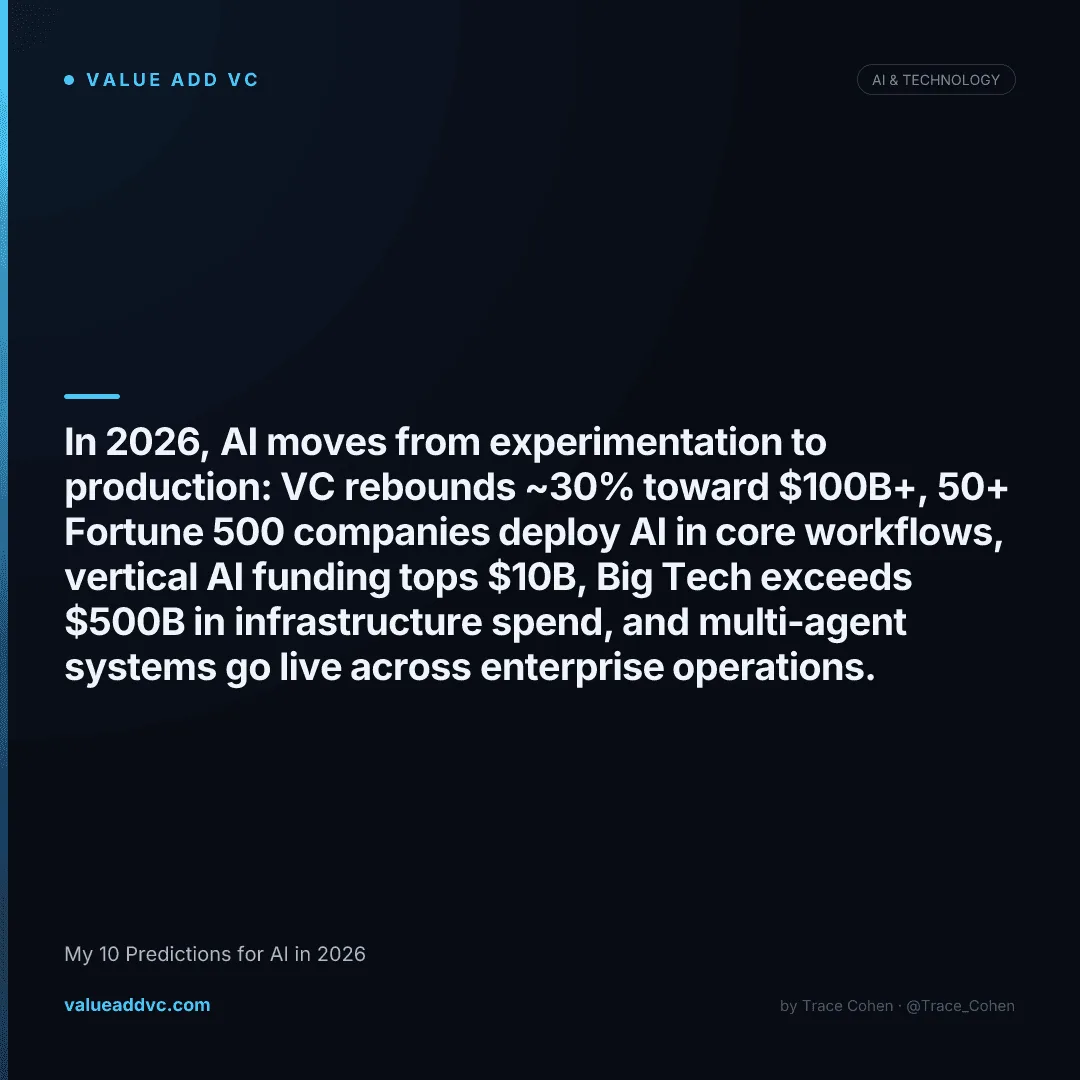
2025 ended with a bang. Here's what I expect for AI in 2026.
VC rebounds ~30%, pushing global fundraising back toward $100B+
After two uneven years, venture capital meaningfully rebounds as LPs regain confidence in AI-led outcomes. More than 50% of new venture dollars flow into AI-related companies, with capital concentrating further into fewer funds and fewer platforms. Generalist funds continue to face headwinds.
Enterprise AI moves from pilots to production at scale
By the end of 2026, 50+ Fortune 500 companies move AI beyond experimentation and into core, revenue-impacting workflows. Enterprise AI adoption reaches 85–90%, driven by clearer ROI, maturing infrastructure, and improved trust. AI budgets increasingly resemble core IT spend rather than innovation line items.
Vertical AI dominates the early stage
Annual Vertical AI funding exceeds $7–10B, as investors prioritize companies embedded in real industries rather than horizontal tools. Defense, cybersecurity, healthcare, compliance, logistics, and industrial automation absorb the majority of early-stage capital.
Big Tech exceeds $500B+ in AI infrastructure spend
Hyperscalers collectively invest over $500B annually across data centers, networking, silicon, power generation, and cooling. Demand continues to exceed supply, forcing deeper partnerships with chipmakers, utilities, and energy providers.
The AI chip ecosystem expands, not consolidates
Compute remains the system bottleneck, sustaining funding for a broad chip ecosystem. Cerebras reaches the public markets, while Groq and Lambda raise additional large rounds. Dozens of smaller startups focused on edge workloads, power efficiency, and defense use cases successfully raise capital alongside incumbents.
Edge AI becomes real at scale for the first time
Edge and IoT deployments accelerate after years of promise. Advances in specialized chips and power efficiency remove prior constraints, enabling real-time AI decision-making in defense systems, factories, logistics networks, and mobile devices.
Agent-to-agent systems move into production
AI agents evolve beyond copilots into coordinated systems executing real workflows across enterprises. Dozens of large organizations deploy multi-agent systems across procurement, compliance, security, and operations, creating new demand for orchestration platforms and identity layers.
Cybersecurity and defense AI continue to boom
Cybersecurity and defense become foundational layers of AI adoption. Annual funding in cyber and defense AI surpasses $25B, driven by both government and enterprise buyers. Companies like Anduril and Palantir scale rapidly as AI is treated as critical infrastructure tied to national sovereignty.
Tech M&A accelerates meaningfully
Following $100B+ in tech acquisitions in 2025, consolidation accelerates. Expect 2–3 mega-deals exceeding $25B each, focused on AI infrastructure, cybersecurity platforms, and verticalized enterprise software. Buying capability proves faster and more reliable than internal builds.
AI valuations remain extreme — and one breaks publicly
Elite AI teams continue to raise $100M+ rounds at multi-billion-dollar valuations. At the same time, dependency on continuous funding increases fragility. One highly visible AI company fails to raise again or execute commercially, resetting expectations without slowing overall AI adoption.
Track AI trends in real time on the AI Landscape Dashboard and AI Valuations at Value Add VC. Originally published in the Trace Cohen newsletter.
Get VC data most people never see
— free to subscribe
Trace's notes on venture, AI and startups, a few times a week. Join 5,000+ subscribers. No spam.
No spam, unsubscribe anytime. Sent via Substack · Privacy · or subscribe on Substack ↗