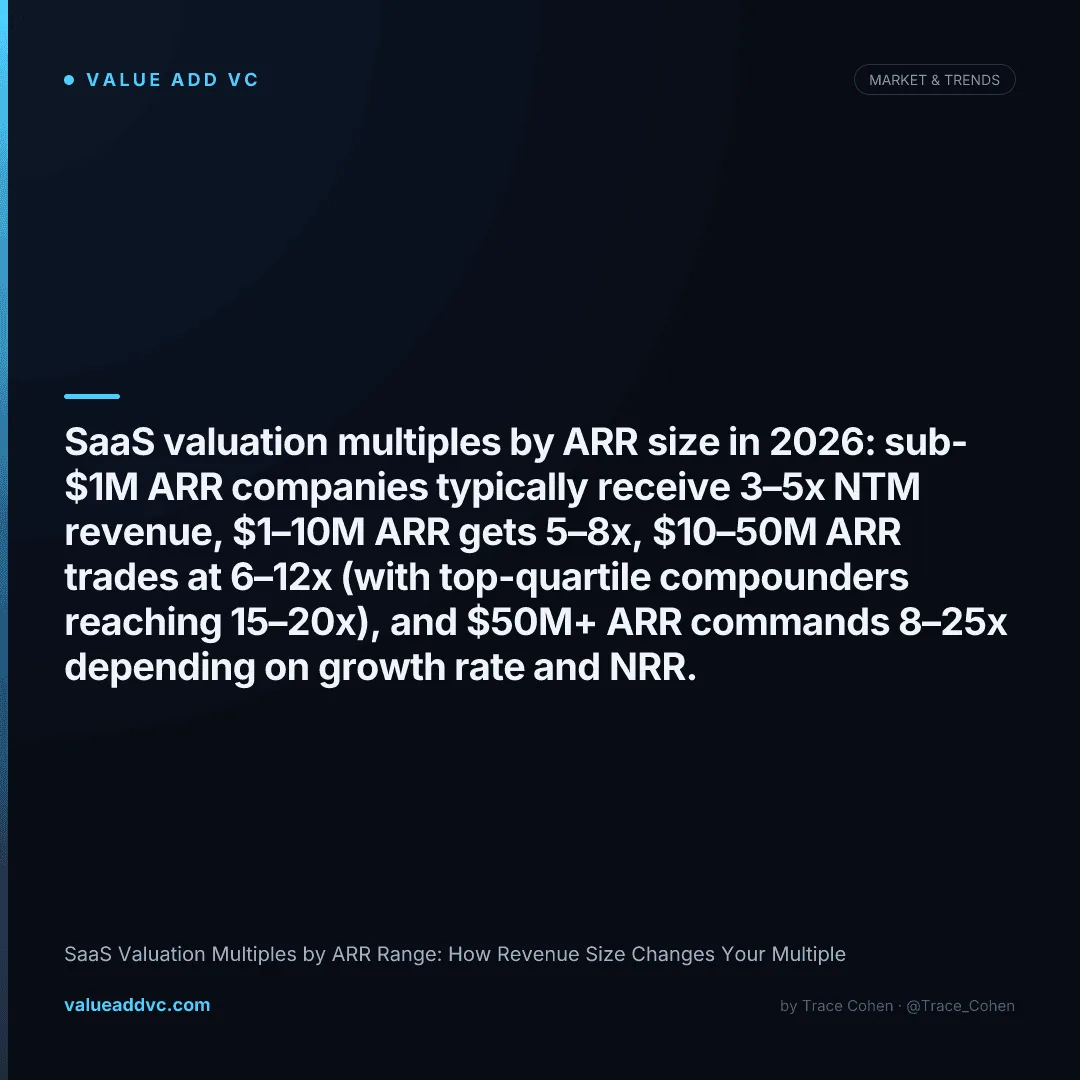
In 2026, the SaaS multiple you get is a function of two variables: how big you are and how well you grow. The market prices these differently at every ARR band.
The post-2022 correction compressed multiples across the board — what many are calling the era of valuation compression — but it did not compress them uniformly. Small companies with weak metrics got hit hardest. Large companies with strong NRR and efficient growth barely felt it. Understanding this dispersion is the most practical thing a SaaS founder or investor can know going into a fundraise or M&A process in 2026.
SaaS Valuation Multiples by ARR Range in 2026
The table below reflects private market NTM revenue multiples derived from comparable public SaaS trading ranges, adjusted for a 25–35% private liquidity discount. “Top quartile” reflects the upper end achievable for best-in-class metrics at that ARR level.
| ARR Range | Median Multiple | Top-Quartile | Typical Stage |
|---|---|---|---|
| < $500K | 2–4x | 5–8x | Seed / Pre-seed |
| $500K – $1M | 3–5x | 6–10x | Seed / Series A |
| $1M – $5M | 5–8x | 8–15x | Series A |
| $5M – $10M | 6–10x | 12–18x | Series A / B |
| $10M – $30M | 7–12x | 15–22x | Series B / C |
| $30M – $50M | 8–14x | 16–25x | Series C / Growth |
| $50M+ | 8–15x | 18–30x | Late-stage / Pre-IPO |
Source: Compiled from Carta, Battery Ventures, OpenView Partners, and public SaaS comp sets. NTM revenue multiples, private market. Q1–Q2 2026.
Track current public SaaS trading multiples in real time on the SaaS Valuations Dashboard — the data updates weekly with EV/NTM revenue and EV/ARR across 50+ public comps.
Why the ARR Band Matters More Than the Market
Most founders think of their multiple as a function of “the SaaS market.” It is not. The market sets the ceiling. Your ARR and metrics set where you land within that range.
A $2M ARR company with 150% NRR and 120% YoY growth can raise a Series A at 10–14x ARR. A $2M ARR company with 95% NRR and 50% YoY growth will struggle to get 5x from the same investors. Same market, same quarter — the multiple difference is 2–3x based on quality, not macro.
The ARR band matters because it changes who the buyers are. Below $5M ARR, you are mostly relying on VC investors who price on potential. Between $5M and $30M ARR, strategic acquirers and growth funds start to apply real DCF and comp-set analysis. Above $50M ARR, you are compared directly to public SaaS names — which is why the liquidity discount and growth premium dominate the conversation. DigitalOcean's 14.6x price-to-sales multiple in 2026 is a useful real-world anchor for what "public SaaS comp" actually means in dollar terms. The frontier AI labs stretch this table further than any SaaS company ever has; Moonshot AI's 117x ARR round is a case study in why a headline multiple alone can mislead without growth-rate and supply-constraint context.
The Metrics That Drive the Multiple Within Each Band
Scale alone does not earn a premium multiple. Within any ARR band, the following metrics create a 30–80% spread between the median company and the top-quartile company:
Net Revenue Retention (NRR)
The single most correlated metric with SaaS multiples. 120%+ NRR typically commands a 50–80% premium over 100% NRR peers at the same ARR. Companies with 130%+ NRR (think Snowflake, Datadog class) trade at 2x the multiple of the median at any given ARR size.
Revenue Growth Rate
At $10M ARR, a company growing 60%+ YoY consistently earns top-quartile treatment. Below 40% YoY growth at $10M+ ARR, you are pricing into the median-or-below bucket. The rule of thumb: every 10 percentage points of additional YoY growth adds roughly 1–1.5x to the multiple at the $5–20M ARR range.
Gross Margin
75%+ gross margin is the threshold for premium SaaS pricing. Companies below 60% gross margin (common in services-heavy or infrastructure-heavy SaaS) face a 20–35% multiple discount versus pure-software peers. Services revenue embedded in ARR is a red flag investors reprice aggressively.
Burn Multiple
Burn multiple = net burn / net new ARR. In 2026, efficient companies with burn multiples under 1.5x trade at a 30–40% premium over peers with burn multiples above 3x. Capital efficiency became a valuation input post-2022 in a way it had not been since the 2008 cycle.
Logo Concentration
If your top customer is more than 15–20% of ARR, expect a valuation haircut. Investors price this as key-customer risk: losing one logo halves the business. The discount ranges from 15–30% depending on the ARR band and how contractual the revenue is.
The $5M–$20M ARR Window Is Where Multiples Are Made
The $5M–$20M ARR range is where SaaS companies either earn a durable premium or lock themselves into a mediocre multiple. Below $5M, investors are still pricing on narrative. Above $20M, the data is what it is and the market assigns accordingly.
At $5M ARR, you have enough churn cohorts to show whether your NRR is structural or accidental. You have enough growth quarters to separate the 100% YoY growers from the 40% growers. You have enough burn history to show capital efficiency. The companies that enter this window with clean data and strong cohorts earn 10–15x multiples. The companies that enter this window with mixed signals get 6–8x.
The 2022–2025 correction collapsed the floor but left the ceiling largely intact for the best companies. OpenView’s 2025 SaaS Benchmarks report showed median NTM revenue multiples across private SaaS around 6–8x, but companies in the top-quartile growth and NRR cohort still achieved 16–22x. The gap between median and elite has widened, not narrowed, post-correction.
How to Think About Valuation at Your Specific ARR
Below $2M ARR
- →Use ARR multiple, not revenue multiple
- →NRR and growth rate matter most
- →Comparable public SaaS are only loosely relevant
- →Founder quality and market size drive 50%+ of value
$2M – $10M ARR
- →Public comps become relevant at 30–40% discount
- →NRR above 110% starts to unlock premium pricing
- →Series A investors apply NTM revenue multiples
- →Burn multiple is now a direct valuation input
$10M – $50M ARR
- →Growth rate and Rule of 40 score dominate
- →Strategic acquirers start looking at full DCF
- →Logo count and concentration matter for defensibility
- →Gross margin quality (services vs. software) is interrogated
$50M+ ARR
- →Direct comp to public SaaS peers, with ~25% liquidity discount
- →Path to profitability timeline becomes a key input
- →NTM growth rate below 30% triggers multiple compression
- →IPO readiness unlocks the top end of the range
Use the Benchmarking Dashboard to compare your metrics against the cohort at your ARR range — it pulls live data from Carta and Battery Ventures benchmarks to show where you stand on growth rate, NRR, burn multiple, and gross margin against peers.
The multiple market has not recovered to 2021. It never will.
But 15–20x NTM revenue is still available in 2026 — for the roughly 15% of SaaS companies that actually earn it.
Track live public SaaS multiple data on the SaaS Valuations Dashboard at Value Add VC. Originally published in the Trace Cohen newsletter.
Latest from the Pulse
Get VC data most people never see
— free to subscribe
Trace's notes on venture, AI and startups, a few times a week. Join 5,000+ subscribers. No spam.
No spam, unsubscribe anytime. Sent via Substack · Privacy · or subscribe on Substack ↗