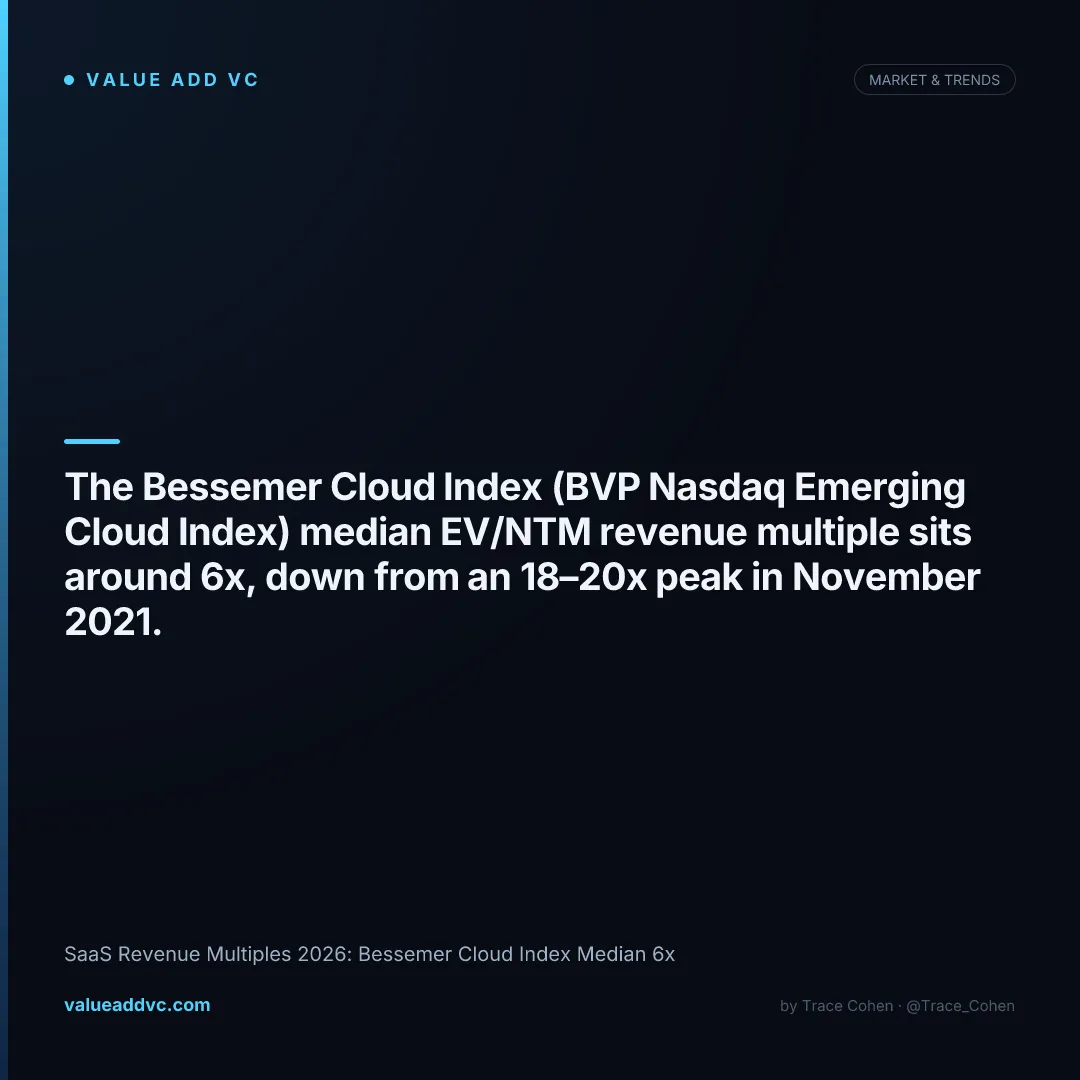
The Bessemer Cloud Index — formally the BVP Nasdaq Emerging Cloud Index — has climbed back to roughly 8x EV/NTM revenue as of late August 2026, up from a spring low near 6.3x in June, with the median-growth public SaaS company trading at 6–9x. That is not a guess — it is where the index sits after re-expanding through the summer, still down 55%+ from the 2021 peak.
But the headline number hides the story. The spread between a 3x company and an 18x company has never been wider — and it is almost entirely explained by three variables: growth rate, net revenue retention, and free cash flow margin. If you are pricing a deal, raising a round, or benchmarking your own company, the index-wide figure is the wrong number. You need the full distribution.
Current SaaS Revenue Multiples by Growth Rate
The market does not pay a single multiple for SaaS. It pays a growth-adjusted multiple. Here is what public SaaS actually trades at across growth tiers, based on the most recent available index data:
| YoY Revenue Growth | Median EV/NTM Rev | Top Quartile | Representative Names |
|---|---|---|---|
| >50% | 12–18x | 20–28x | Cloudflare, Snowflake, CrowdStrike (security/infra premium) |
| 30–50% | 9–13x | 15–20x | Datadog, high-growth cohort |
| 15–30% | 6–9x | 10–13x | ServiceNow, MongoDB, HubSpot |
| 5–15% | 3–5x | 5–7x | Salesforce, mature enterprise SaaS |
| <5% | 2–3x | 3.5–5x | Box, value / restructuring plays |
Source: BVP Cloud Index tracker (pulled Aug 29, 2026), GuruFocus EV-to-Revenue by ticker (Jun–Aug 2026 pulls). Company multiples are approximate LTM EV/Revenue and typically run above forward NTM figures.
The Three Drivers of Current SaaS Multiples
Growth rate is the biggest single factor, but it is not sufficient on its own. Today's market prices the full efficiency stack. Three variables explain most of the multiple variance across the public SaaS universe — DigitalOcean's jump from a 12.4x to 14.6x multiple in a single month shows how fast growth-rate re-ratings can move a stock even without a change in the underlying share price.
Net Revenue Retention
>115% = premium
NRR above 115% signals that the existing customer base is expanding faster than churn erodes it. Datadog's NRR has cooled to roughly 110% by mid-2026, down from the 130%+ level cited a year earlier, yet its multiple compression has been modest relative to growth — a sign the market still prices in the platform story. Below 100%, investors start pricing in secular decline regardless of new logo growth.
Rule of 40
>50 = 9–13x range
The sum of revenue growth rate and FCF margin has become the market's shorthand for sustainable SaaS economics. Companies scoring above 50 trade at a 2–3x premium to peers with similar growth but worse efficiency. This is the metric that separated the 2022 survivors from the casualties.
Gross Margin
>75% for full premium
Gross margin dictates the long-run economics of the business model. SaaS companies with gross margins below 65% — common in infrastructure-heavy or services-attached businesses — face a structural discount of 1–2x regardless of growth. Pure-play SaaS above 80% gross margin commands the highest multiples.
Public SaaS Comps: Where Specific Companies Trade
Benchmarks are only useful when you can anchor them to real companies. Here's where key public SaaS names trade on EV/NTM revenue:
Edge/security premium; among the richest multiples in public SaaS
~40x
33–36% YoY
AI/data-platform narrative keeps the multiple elevated
~21x
31% YoY
Multiple expanded even as growth decelerated from 32% a year earlier
~37x
22–23% YoY
Multiple compressed from ~14x as NRR cooled toward 110%
~11x
28–36% YoY
Enterprise workflow leader; 41% below its own 10-year median multiple
~9x
~20%+ YoY
SMB exposure creates discount vs. enterprise peers
~9–10x
19% YoY
Developer-led growth and Atlas expansion
~9x
20–24% YoY
Compressed further from ~7x as growth slowed to double digits
~4.5x
10–11% YoY
Low growth; stable FCF story
~3.4x
~6% YoY
Approximate EV/Revenue figures from GuruFocus EV-to-Revenue trackers by ticker, individual pulls dated June–August 2026; most reflect trailing (LTM) revenue and run higher than the forward NTM multiples used elsewhere in this post. Use the SaaS Valuations dashboard for live, updated multiples.
How Current SaaS Multiples Compare to the 2021 Peak
To understand where we are, you have to understand where we were. In November 2021 the BVP Nasdaq Emerging Cloud Index hit a median EV/NTM Revenue of 18x. Individual names like Snowflake and Confluent were trading at 50–100x forward revenue. The market had completely decoupled valuation from fundamentals.
The correction was fast and brutal. By mid-2022 the median had fallen to roughly 6x. By early 2023 it bottomed near 5x. The 2023–2024 AI narrative drove a partial recovery — particularly for companies with credible AI attach stories — but it was selective. By early 2025 the market had settled into a fundamentals-first regime, and the index dipped again to a 2026 low near 6.3x in June before re-expanding to roughly 8x by August 29, 2026, per trackers of Bessemer's published figures.
What changed since spring 2026: the summer re-rating was not broad-based. Cloudflare, Snowflake, and CrowdStrike all pushed past 20x EV/revenue on AI-infrastructure and security demand, while Salesforce compressed further, from roughly 7x to near 4.5x, as its growth slowed into the low double digits. One read on this: the index-level number is being pulled up by a handful of names re-rating hard, not by the median public SaaS company getting meaningfully more expensive — the same bifurcation story as 2021, just with different winners.
The structural difference from 2021: there is no longer a rising tide lifting all boats. Rate normalization has permanently raised the bar for what qualifies as a premium-multiple SaaS business. Track the live data on the SaaS Valuations dashboard.
Private SaaS Multiples vs. Public Comps
Private SaaS companies have historically traded at a 30–40% discount to public comparables, reflecting illiquidity, information asymmetry, and smaller scale. That discount held through 2025 and into 2026, though it compresses for companies with strong metrics heading into a fundraise or acquisition process — see our full breakdown of how private SaaS valuations compare to public multiples by stage for the exact ranges. This likely means: as the public re-rating this summer was concentrated in a few names rather than the median company, the private discount probably has not narrowed much yet — but H2 2026 primary transaction data to confirm that isn't available at the time of this update.
Series A ($2–5M ARR, 100%+ growth)
Series B ($5–20M ARR, 60–100% growth)
Series C ($20–50M ARR, 40–60% growth)
Growth ($50M+ ARR, 20–40% growth)
Private ranges reflect typical VC and growth equity deal comps as tracked through H1 2026; public comp column updated to the growth-tier multiples above as of late August 2026. Individual deals vary significantly based on competitive process dynamics.
What Current SaaS Multiples Mean for Founders
If you are raising in September 2026, the math is straightforward: investors anchor to public comps and apply a private discount. If your closest public comparable trades at 8x NTM revenue, expect to raise at 5–6.5x ARR unless your metrics are meaningfully superior — and expect that comp to keep moving; it was 6.3x four months earlier.
The implication for fundraising strategy is to stop optimizing for headline ARR and start optimizing for the denominator of your Rule of 40 score. A company at $10M ARR growing 80% with negative FCF might get a worse multiple than a $10M ARR company growing 50% with 20% FCF margins. The market has repriced discipline above growth. Data across nearly 1,400 private companies confirms the pattern holds well beyond the public comps used in this analysis.
For acquisition scenarios, strategic buyers are using the same public comp benchmarks. Enterprise buyers running corp dev processes in late 2026 are building DCF models anchored to 5–9x revenue for profitable SaaS and adjusting upward only for strategic fit, proprietary data, or market-defense rationale. Use our SaaS benchmarking tool to see where your metrics stand relative to public peers.
The current SaaS multiple environment rewards exactly one thing:
Proof that you can grow efficiently. Not growth alone — not efficiency alone — but both, measured together, ruthlessly.
Rule of 40 above 50 with NRR above 115% puts you in the top quartile of public SaaS multiples. Everything else is noise.
Track live public SaaS multiples on the SaaS Valuations Dashboard at Value Add VC. Originally published in the Trace Cohen newsletter.
Latest from the Pulse
Get VC data most people never see
— free to subscribe
Trace's notes on venture, AI and startups, a few times a week. Join 5,000+ subscribers. No spam.