
For more than a decade, SaaS had one of the simplest narratives in venture capital. If a company was growing revenue quickly and building predictable recurring revenue, investors assigned very high multiples. Growth was the primary signal. Then everything changed.
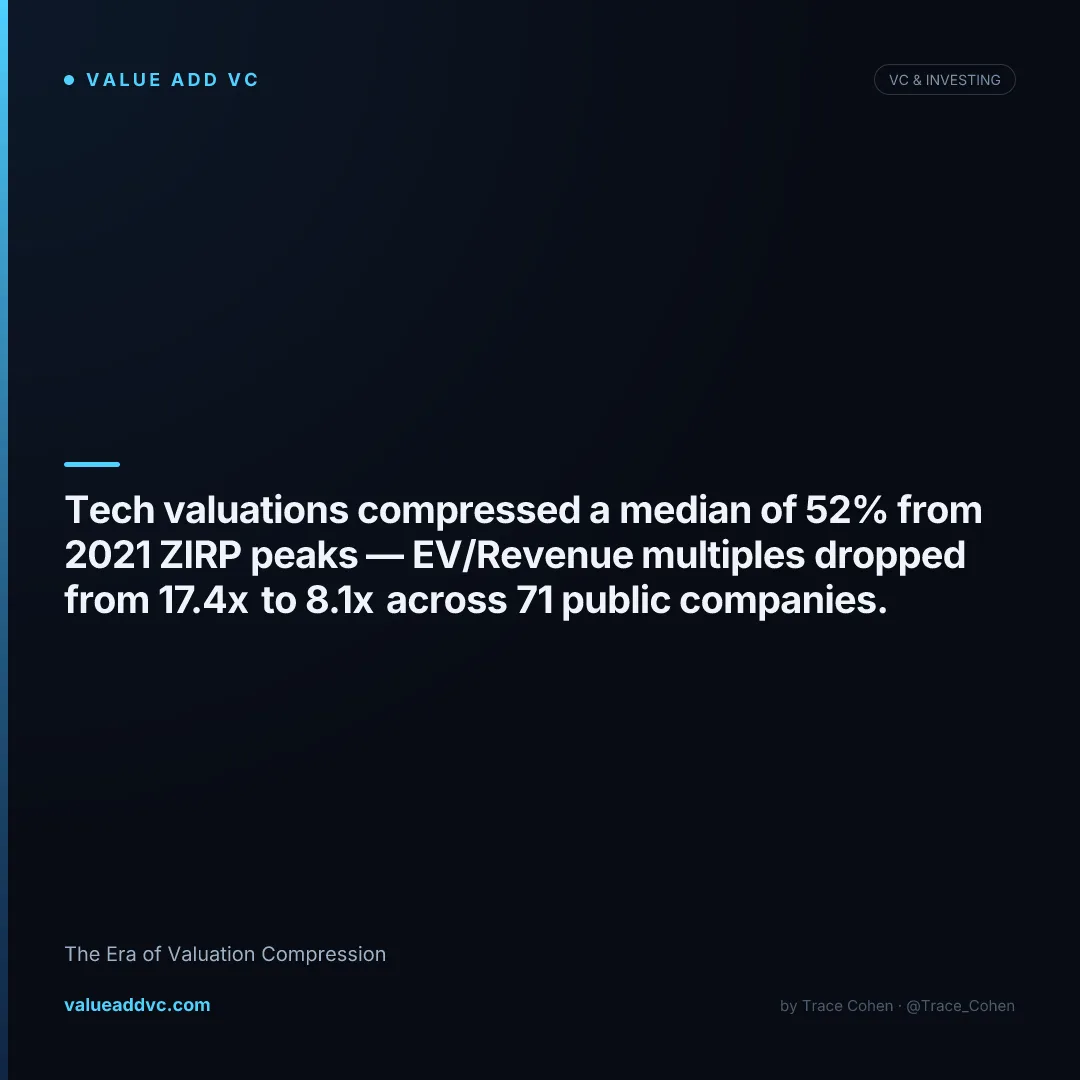
I built a dashboard tracking valuation multiples across 71 public tech companies since 2021. The data tells a clear story — and the sectors don't move together.
The Headline Numbers
8.1x
Median EV/Revenue today
Down from 17.4x at peak
52%
Median multiple compression
Since 2021
23.3%
Median revenue growth
Still healthy
41.7
Median Rule of 40 score
Above the threshold
Many public software companies are still growing at healthy rates and meeting Rule of 40 standards. What changed is not growth itself. What changed is how investors value that growth.
The Sector Rotation
The bigger story is not just compression. It is where capital moved:
Semiconductors are the clearest example — multiples tripled almost entirely due to the AI infrastructure cycle. Meanwhile, traditional SaaS saw their valuation frameworks reset. You can track these shifts in real time on the live AI Valuations tracker.
The Spread Between Winners and Losers
Best stock since 2020
+1,108%
Worst stock since 2020
-89%
Total spread: 1,197 percentage points. Public tech is no longer moving as a single category. Only four companies maintained EV/Revenue multiples above 15x every year:
All four sit directly in the AI infrastructure ecosystem.
Notable Individual Company Moves
The SaaS model itself did not break.
But the valuation environment has become much more selective. Markets are no longer pricing software companies as a single category — they're separating companies based on efficiency, profitability, and how directly they participate in the AI economy.
Explore the full interactive dashboard with 71 companies, 8 sectors, and 590 data points on the SaaS Valuations Dashboard at Value Add VC. Originally published in the Trace Cohen newsletter.
Latest from the Pulse
Get VC data most people never see
— free to subscribe
Trace's notes on venture, AI and startups, a few times a week. Join 5,000+ subscribers. No spam.
No spam, unsubscribe anytime. Sent via Substack · Privacy · or subscribe on Substack ↗