
Over the past few months, something fundamental has shifted in software.
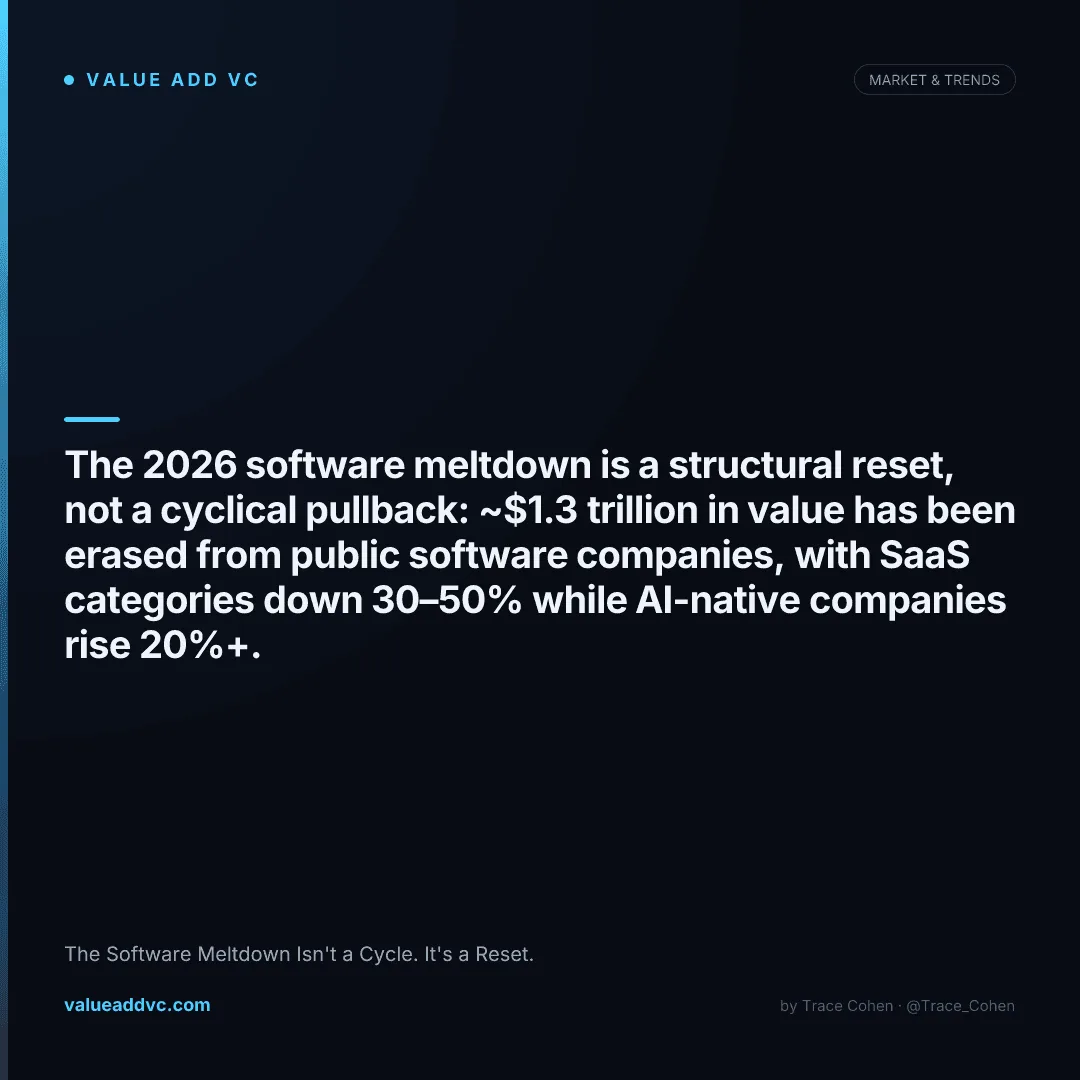
This is not just another multiple compression cycle or macro-driven pullback. It is a structural repricing of what software is worth in an AI-native world.
~$1.3T
Value erased from public software companies
30–50%
Decline across entire SaaS categories
+20%+
AI-native companies in the same window
At the same time, AI-native companies are compounding in the opposite direction, creating one of the sharpest divergences in modern tech. This is not random. It's the market repricing the role of software itself.
What Actually Broke
For the last 15 years, SaaS followed a simple formula:
It worked because software was the interface to getting work done. AI breaks that assumption.
When an agent can execute workflows directly, the value shifts away from the interface and toward the outcome. Many SaaS products were effectively:
Those layers are now compressing. Software is moving toward a much thinner stack where agents + data replace large portions of the middle layer.
The Market Is Telling You This
Public markets moved first. The divergence matters more than the absolute decline — because talent, capital, and attention follow relative performance. That creates second-order effects:
Talent Migration
Unvested equity at software companies declined materially while AI companies gained value. Software companies lose retention power. AI companies gain hiring leverage.
Capital Rotation
The narrative shifted from "SaaS is predictable and durable" to "AI may absorb large parts of SaaS functionality." Investors are reallocating, not just de-risking.
Private Market Lag
Private valuations have not fully caught up. Markups that cannot be realized. Funds sitting on paper gains with no liquidity path. Increasing pressure on secondaries.
This Is Bigger Than Valuations
The real shift is not multiples. It's where value accrues.
Historically
- Value sat in the application layer
- Distribution tied to software interfaces
- Switching costs embedded in workflows
Now
- Value moving toward models, data, and distribution
- Interfaces becoming more interchangeable
- Workflows becoming dynamic, not fixed
Software used to be the product. Now software is becoming the byproduct.
What Survives and Wins
Not all software is broken. But the bar has moved significantly higher. The companies that will persist tend to have:
Deep System Ownership
Not just UI layers — deeply embedded into infrastructure, data, or critical workflows.
Proprietary Data Advantages
Systems that improve with usage and cannot be easily replicated by a general-purpose model.
Distribution Control
Products that own the customer relationship, not just the feature set.
AI-Native Architecture
Not 'AI features' bolted on — re-architected products where AI is the core interaction model.
The software meltdown is not about fear. It is about clarity.
The market is stripping away what was never truly defensible.
Explore the full dataset on the Software Meltdown Dashboard and SaaS Valuations tracker at Value Add VC. Originally published in the Trace Cohen newsletter.
Latest from the Pulse
Get VC data most people never see
— free to subscribe
Trace's notes on venture, AI and startups, a few times a week. Join 5,000+ subscribers. No spam.
No spam, unsubscribe anytime. Sent via Substack · Privacy · or subscribe on Substack ↗