
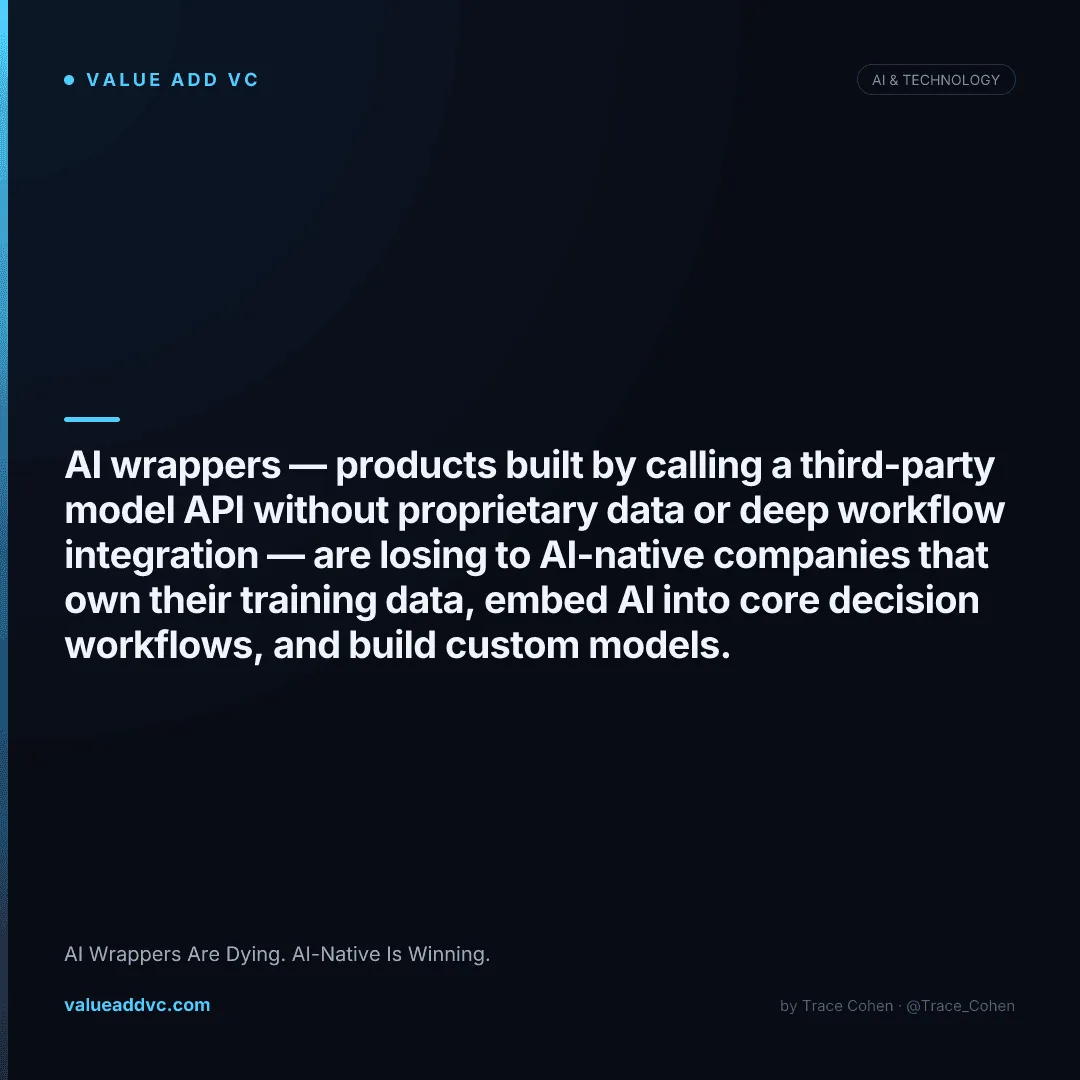
In 2022 and 2023, hundreds of “AI companies” were funded that were, in reality, API calls wrapped in a UI.
The pitch was always some variation of: “We use GPT-4 to do [X] for [industry Y].” The problem: so did 50 other companies with identical architectures, competing on design and distribution rather than technology.
Now the reckoning is here. And the winners and losers are becoming obvious.
What Is an AI Wrapper?
An AI wrapper is a product that derives its core value proposition entirely from a third-party foundation model — typically by calling an API — without building proprietary model capabilities, datasets, or infrastructure.
Simple test: if OpenAI, Anthropic, or Google built a UI for their own model in your exact category — would your product survive?
If the answer is “probably not,” you're building a wrapper.
This doesn't mean wrappers can't make money in the short term. They can. But they're businesses, not durable technology companies.
The Wrapper Trap: Why They Fail
The model gets better
Foundation models improve every 6-12 months. Many things that required a dedicated product in 2023 — summarization, code review, document extraction — are now just features inside base models. If your product is a better interface for a specific task, the task often gets absorbed.
The platform closes the gap
OpenAI launched Custom GPTs. Anthropic built Projects. Google embedded Gemini everywhere. Every major lab is building the product layer themselves. They have infinite distribution advantages.
Margin compression is structural
API costs have dropped dramatically, but inference is still your largest COGS. Unlike SaaS, where serving an additional customer costs nearly zero, AI wrappers pay per token. Gross margins are structurally constrained.
No proprietary data
The most powerful AI companies are the ones accumulating proprietary datasets through customer usage that can be used to fine-tune and improve models. Wrappers that don't collect and leverage data are renting intelligence, not building it.
What AI-Native Actually Means
AI-native means AI is the product, not a feature of the product.
An AI-native company is architected from the ground up around AI capabilities — and builds compounding advantages through data, workflow depth, and model customization that can't be replicated by calling a public API.
Proprietary data flywheel
Every customer interaction generates training signal. The product gets smarter from usage, and that intelligence is not replicable by a competitor without the same data.
Deep workflow integration
AI is not a feature — it's embedded in the decision-making and action layer of the workflow. The system doesn't just suggest — it acts.
Custom models or fine-tuning
The company is investing in domain-specific model improvements, not just calling a foundation model. Their AI is better at their specific task than any general model.
Outcome-based architecture
The product is measured and priced on outcomes (deals closed, time saved, errors caught) rather than usage or seats. This alignment shapes the entire product architecture.
The Investment Framework
When I evaluate AI companies at Value Add VC, here's the core question:
What is the proprietary data asset, and how does it compound over time?
Would this product get worse if OpenAI launched a direct competitor tomorrow?
Is AI delivering outcomes, or just outputs? (An AI that drafts emails is an output. An AI that closes deals is an outcome.)
Is the model improving from usage, or is it static relative to the underlying foundation model?
What is the gross margin trajectory — is it getting better as scale increases, or worse?
Can a Wrapper Become AI-Native?
Yes — and some of the best AI companies started as wrappers. The question is whether the team is intentionally building toward defensibility or just riding the wave.
The companies making this transition successfully are doing three things:
Collecting proprietary data
Instrumenting their product to capture training signal from every user interaction
Going deeper on workflow
Moving from surface features into the core of how decisions get made and actions get taken
Building toward evaluation loops
Creating internal systems that measure AI output quality and use that signal to improve
The companies that survive the AI shakeout aren't the ones with the best prompts.
They're the ones that own the data, the workflow, and the outcome.
See how the AI landscape is evolving on the AI Landscape Tracker and AI Valuations Dashboard at Value Add VC. Updated regularly.
Latest from the Pulse
Get VC data most people never see
— free to subscribe
Trace's notes on venture, AI and startups, a few times a week. Join 5,000+ subscribers. No spam.
No spam, unsubscribe anytime. Sent via Substack · Privacy · or subscribe on Substack ↗