
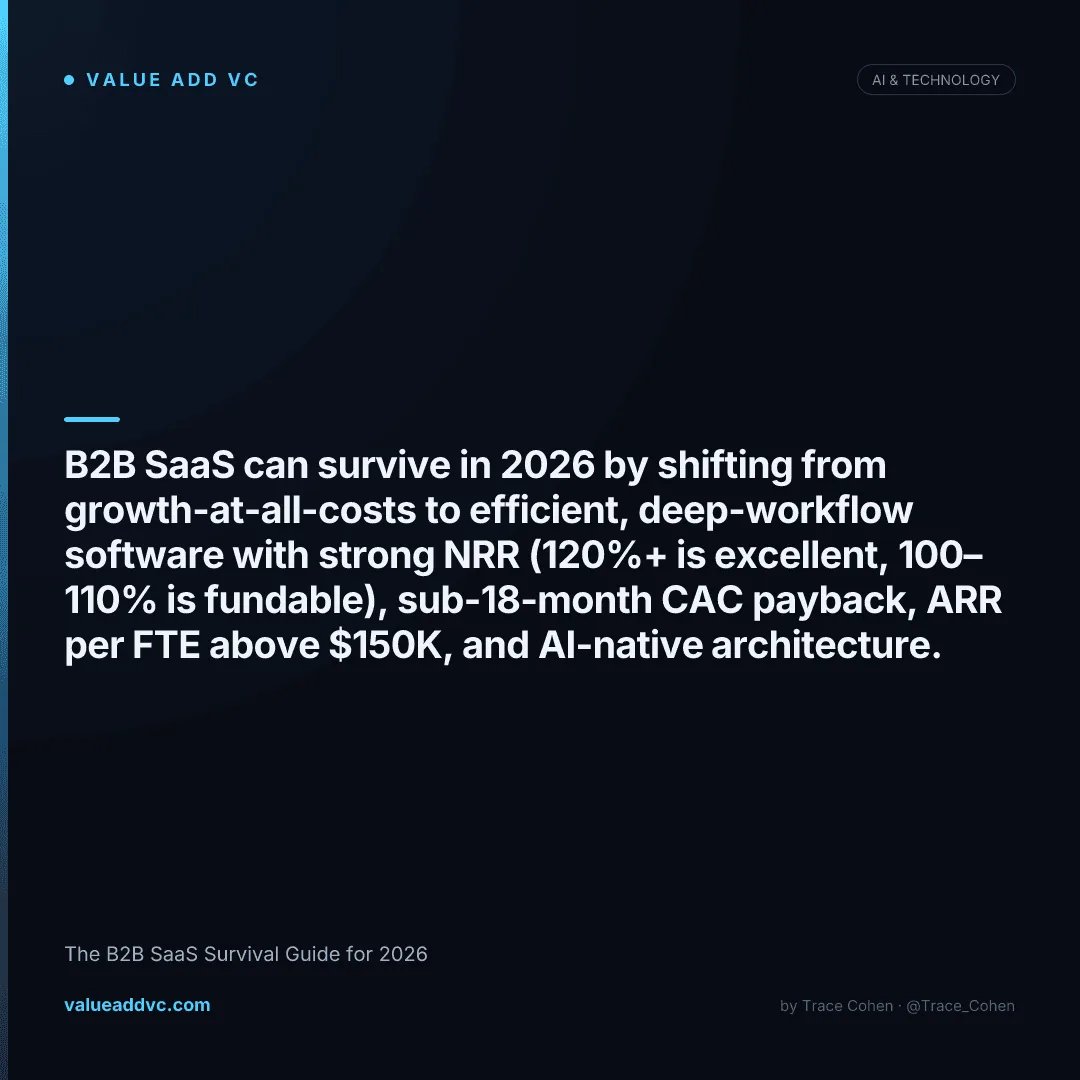
SaaS isn't dead. But the SaaS playbook that worked from 2010 to 2021 is broken.
Cheap capital, high multiples, and the assumption that “land and expand” would outpace churn forever created a generation of B2B companies that were rewarded for growth at any cost. That era is over.
Here's what's actually working in 2026 — and what you need to change if you're still running a playbook from four years ago.
What Changed
The Old SaaS Playbook (Broken)
- ✕Grow ARR at all costs, worry about margins later
- ✕Land with a low-value entry point, expand infinitely
- ✕Raise every 18 months regardless of need
- ✕Valuation = ARR multiple, full stop
- ✕AI is a feature, not a threat
The New SaaS Reality (Working)
- ✓Efficient growth — revenue per employee matters
- ✓Deep initial value or don't bother landing
- ✓Raise when you have leverage, not because the calendar says so
- ✓Valuation = quality of ARR + margin profile + growth
- ✓AI is either your core product or your biggest threat
The Metrics That Actually Matter Now
Investors and operators have recalibrated. Here's what the scorecard looks like in 2026:
This single number tells investors whether your customers are expanding or dying, per ICONIQ's 2026 SaaS benchmarks. Anything below 100% means you're burning water.
In a high-rate environment, 3-4 year payback periods are brutal. The best B2B companies are getting paid back in 12 months or less.
Revenue efficiency is the new growth rate. Companies growing 50% with 100 employees beat companies growing 80% with 500 employees.
If you're below 60%, you're either a services business or you have a structural cost problem.
Every dollar of net new ARR should not cost more than $2 in net burn. If it does, you're funding growth that can't sustain itself.
The AI Threat Is Real — and Specific
Not all SaaS categories are equally threatened by AI. Here's an honest breakdown:
If a foundation model plus a thin wrapper can do what you do, you are in trouble.
AI is replacing specific features, not the entire category. You need to stay ahead of the model.
The combination of integration depth, regulatory complexity, and multi-user workflows creates real moat.
What to Do If You're Building B2B SaaS Today
Build deep, not wide
Feature breadth is no longer defensible. Every feature you have, a model can approximate. Depth of integration, workflow, and data is what makes you sticky.
Own a workflow, not a feature
The best SaaS companies in 2026 are systems of record for specific workflows — not tools that sit adjacent to the work. If you can be removed without friction, you will be.
Price on outcomes, not seats
Usage-based and outcome-based pricing aligns you with your customer's success. Seat-based pricing in an AI world is an artifact — customers will optimize seats away.
Compound data advantages
The more proprietary data you accumulate through customer usage, the harder you are to replicate. Build data flywheels into your product architecture from day one.
The companies winning in B2B SaaS in 2026 aren't the ones who adapted to AI — they're the ones who built AI into their core thesis from the start.
Survive by going deeper, not by growing faster.
Track real-time SaaS valuation benchmarks on the SaaS Valuation Dashboard and see our full analysis at Is SaaS Dead? — both free tools at Value Add VC.
Latest from the Pulse
Get VC data most people never see
— free to subscribe
Trace's notes on venture, AI and startups, a few times a week. Join 5,000+ subscribers. No spam.
No spam, unsubscribe anytime. Sent via Substack · Privacy · or subscribe on Substack ↗