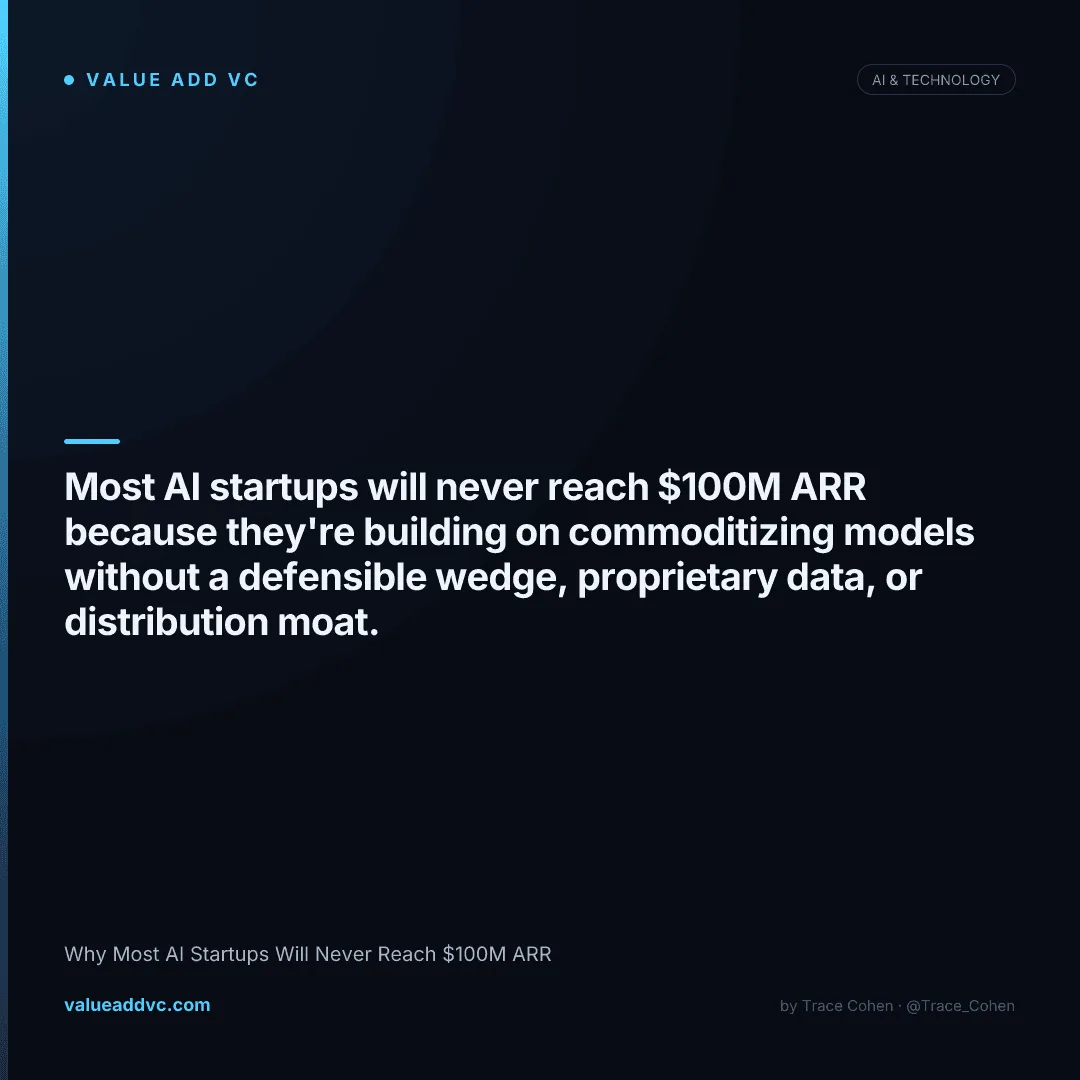
There are now more AI startups than there were total VC-backed startups five years ago. The overwhelming majority will never see $10M ARR. Almost none will see $100M.
I've made 65+ investments across seed and early stage. I've also built companies from scratch. The current AI moment has created the most activity I've ever seen — and the most confusing signal-to-noise ratio. Founders who raised $5M on a demo are now discovering that demo-to-revenue is a completely different game.
The $100M ARR Math Is Brutal
Let's start with base rates before we even get to AI-specific dynamics:
of seed-stage companies ever reach $100M ARR
Bessemer / SaaS industry benchmarks
of Series A companies eventually reach $100M ARR
a16z internal portfolio analysis
median time from founding to $100M ARR for successful SaaS companies
OpenView Partners 2024 report
in cumulative capital raised by most SaaS companies before reaching $100M ARR
PitchBook 2023–2025 data
Now layer on AI-specific headwinds. Model costs are dropping 10x every 18 months. OpenAI, Google, and Anthropic are building features directly into their platforms that would have been standalone startups 24 months ago. And the CAC to acquire a customer who will churn when a cheaper alternative launches is a death spiral.
The AI Wrapper Problem Is Worse Than People Admit
"AI wrapper" has become a pejorative — but the problem is structural, not superficial. When your entire product is a thin layer of UX on top of someone else's model, you are permanently in their pricing and capability shadow. Three dynamics kill wrapper companies:
- →
Model providers move up the stack
OpenAI launched ChatGPT Enterprise. Anthropic has Claude for Work. Salesforce has Einstein. Every major model provider is building the UX layer that your product occupies.
- →
Price compression destroys margins
GPT-4 cost $0.06 per 1K tokens in 2023. Equivalent models today cost 10–20x less. Customers expect pricing to follow. Your margin gets squeezed from both sides.
- →
Retention is structurally low
Customers who adopted you for ease of access will leave when the native integration ships. Churn in AI tools with no workflow lock-in is running 40–60% annually in early cohorts.
The Three Types of AI Companies That Will Make It
After working with dozens of AI companies across my portfolio and in deals I've passed on, the pattern is clear. Three archetypes consistently break through to durable revenue:
Proprietary Data Flywheels
Companies where usage generates training data that improves the model, which drives more usage. Harvey (legal), Rad AI (radiology), Hippocratic (healthcare) — each sits on data no competitor can buy.
Moat: Data compounds with scale
Deep Workflow Ownership
AI that doesn't just assist a workflow — it becomes the workflow. When switching costs aren't about the AI feature but about ripping out the entire operating system of a team, retention is structural.
Moat: Switching cost is the product
Distribution-First AI
Companies that acquired a captive user base before building AI, or that partner with incumbents who own the distribution channel. The AI is a wedge into an existing relationship, not a cold-start problem.
Moat: Distribution predates the product
What the $100M ARR Survivors Have in Common
Looking at AI-era companies that have crossed or are approaching $100M ARR — Cursor, Perplexity, ElevenLabs, Sierra, Harvey — the common thread is not the quality of their model. It's the answer to one question: why can't OpenAI or Salesforce ship this in 12 months? Even category peers still well under that mark trade on the same logic — Decagon was valued at $4.5B on roughly $35M in ARR in early 2026, a bet that its enterprise integrations compound into the same defensibility Sierra already has.
Cursor owns developer workflow integration that took years of UX iteration to build — not just model access
Harvey has 3+ years of legal-specific training data and enterprise compliance depth that general models can't match
Sierra's agentic customer service sits inside enterprise security perimeters with custom integrations that took 18 months
ElevenLabs built a proprietary voice cloning pipeline with a content creator community that feeds its own training data
The AI hype wave will lift many boats to $1M–$5M ARR. But $100M ARR requires something the model providers can't replicate.
Own the data. Own the workflow. Own the distribution. Everything else is rented ground.
Originally published in the Trace Cohen newsletter. Follow AI startup performance trends at Value Add VC.
Latest from the Pulse
Get VC data most people never see
— 100% free
Weekly benchmarks, valuations, and fund data. Join 5,000+ investors. No spam.