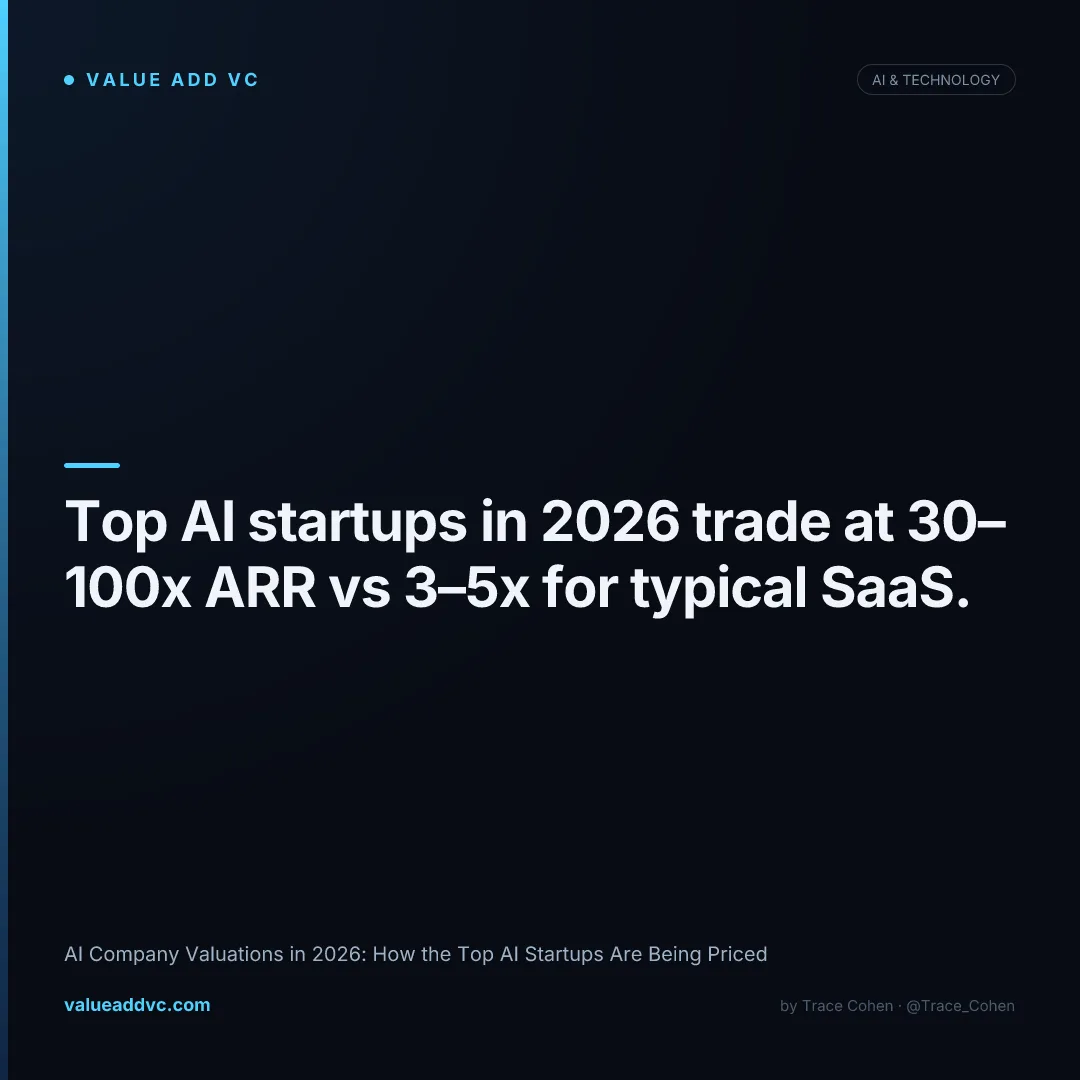
The five largest AI startups — OpenAI, Anthropic, xAI, Mistral, and Cohere — have collectively raised over $60B in private capital in the last two years at valuations that defy traditional investment math.
As of mid-2026 OpenAI is valued at roughly $852B and Anthropic at ~$965B (both have now filed S-1s), while xAI was last marked near $230B before SpaceX acquired it. These are not late-stage SaaS multiples. These are infrastructure monopoly bets. Understanding how AI company valuations work — and why they diverge so sharply from every prior SaaS comp you know — is now table stakes for anyone in venture, growth equity, or operating at a company that needs to understand this market.
AI Company Valuations: The Current Snapshot
Here is where the top AI companies sit as of early 2026, based on their most recent disclosed funding rounds and reported ARR figures:
| Company | Valuation | Est. ARR | ARR Multiple | Key Backer |
|---|---|---|---|---|
| Anthropic | ~$965B | ~$47B run rate | ~20x | Altimeter, Sequoia, Amazon |
| OpenAI | ~$852B | ~$11.6B+ | ~73x | Microsoft, NVIDIA, SoftBank |
| xAI | ~$50B | <$500M est. | 100x+ | Andreessen Horowitz, Sequoia |
| Mistral AI | ~$6B | ~$50M est. | 120x+ | Andreessen Horowitz, Lightspeed |
| Cohere | ~$5B | ~$100M est. | ~50x | Salesforce Ventures, NVIDIA |
| Perplexity AI | ~$9B | ~$100M est. | ~90x | IVP, NEA |
ARR figures are estimates based on public disclosures and reporting as of early 2026. See the full OpenAI revenue breakdown.
Why AI Valuations Are Not SaaS Multiples
Traditional SaaS valuation is straightforward: take NTM revenue, apply a growth-adjusted multiple (typically 8–15x for high-growth, 4–8x for moderate-growth), and triangulate against public comps. The Rule of 40 is your friend. Net revenue retention above 120% gets you premium multiple treatment. For a deeper breakdown of why AI trades at 10–50x while SaaS sits at 3–7x, see the full analysis in AI Startup Valuation Multiples 2026.
None of that applies cleanly to foundation model companies. Here is why:
Infrastructure monopoly dynamics
Foundation model labs are priced like AWS or Azure — not like Salesforce. The strategic importance to the entire tech stack creates a value floor that has nothing to do with current revenue.
Unprecedented revenue growth rates
OpenAI went from $1B to $3.4B ARR in 12 months. A company growing 3x year-over-year in enterprise SaaS deserves a premium; doing it at this scale is without precedent.
Strategic capital, not VC capital
Microsoft put in $13B. Amazon committed $4B to Anthropic. Google invested $2B. These are not return-seeking LP dollars — they are platform bets by companies whose survival depends on access to frontier models.
Capital intensity as a moat
Training GPT-5 or Claude 4 costs hundreds of millions of dollars. Only a handful of entities globally can fund frontier model training. That capital intensity is itself a competitive moat — and investors are pricing in the difficulty of replication.
The Application Layer Is Priced Differently
Not every AI company is an OpenAI. Once you move down from foundation model labs to AI application companies — the businesses built on top of models rather than training them — the valuation math compresses fast.
The market has started distinguishing three tiers of AI company, each with its own valuation range:
Tier 1: Foundation Model Labs
40–120x ARROpenAI, Anthropic, xAI, Mistral
Training frontier models, controlling compute access, driving the entire ecosystem. Deep strategic capital. Winner-take-most dynamics. Valued on future infrastructure potential, not current cash flows.
Tier 2: AI Infrastructure & Platforms
15–40x ARRScale AI, Cohere, Together AI, Replicate
Enabling layer between foundation models and applications. Often enterprise-focused with sticky contracts. High NRR. Valued more like traditional enterprise SaaS but with AI premium for growth rate.
Tier 3: AI Application Companies
8–20x ARRHarvey, Glean, Cursor, Jasper
Workflow-specific AI built on top of existing models. Valuation increasingly converges with SaaS multiples as the space matures. The differentiation signal is net revenue retention and whether the workflow lock-in is real.
What AI Company Valuations Signal to the Market
I've been investing in AI companies since before the ChatGPT moment changed everything. The valuations at the top of the stack are legitimately hard to analyze using any traditional framework — but they are not irrational, for several specific reasons.
First, OpenAI's revenue trajectory justifies a high forward multiple even at $157B. If their $11.6B projected 2025 revenue materializes, the current valuation implies roughly 13.5x 2025 revenue — not that different from Salesforce or ServiceNow at peak growth cycles. The premium is on the forward curve, not the current snapshot.
Second, the competitive dynamics favor concentration. The compute access required to train frontier models is controlled by three cloud providers (Microsoft Azure, AWS, Google Cloud) — all of whom have made direct equity bets in the labs they host. This is not a free market; it is a structured oligopoly with very high barriers to entry.
Third, the downside scenarios are real too. OpenAI's $5B operating loss in 2024 on $3.4B revenue means they are burning cash at a rate that would kill a normal company. The current valuation assumes either (a) the cost curves compress dramatically as inference gets cheaper, or (b) the revenue growth rate sustains long enough to justify the capital deployed. Neither is guaranteed. The AI Valuations dashboard tracks how these numbers are evolving in real time.
How Investors Actually Value AI Companies in 2025
When I look at AI companies for the portfolio, here are the factors that actually drive valuation in conversations with co-investors:
Revenue growth rate (QoQ, not just YoY)
A company going from $10M to $40M ARR in 12 months commands a fundamentally different multiple than one growing 40% annually. The AI market rewards velocity.
Net revenue retention above 130%
For enterprise AI, NRR above 130% is the signal that the product is actually embedded in workflows — not just a trial. Companies clearing this bar get 25–40% multiple premiums.
Proprietary data assets
Models trained on proprietary data (clinical records, legal documents, financial transactions) have moats that API-based wrappers cannot replicate. This is the single biggest differentiator between Tier 1 and Tier 3 valuations.
Strategic capital access
If Microsoft, Google, or Amazon have made direct investments, the implied valuation floor shifts. Strategic capital signals a relationship that has option value beyond the initial check.
Gross margin trajectory
AI companies are often GPU-cost-heavy early. Investors model the path to 60%+ gross margins as inference costs compress — companies that can demonstrate this trajectory get rewarded.
AI company valuations are not about current revenue multiples.
They are about who owns the infrastructure layer of the next technology era — and how much someone is willing to pay to be in that position before the window closes.
Track AI company valuations in real time on the AI Valuations Dashboard and the AI Landscape at Value Add VC. Originally published in the Trace Cohen newsletter.
Get VC data most people never see
— 100% free
Weekly benchmarks, valuations, and fund data. Join 5,000+ investors. No spam.