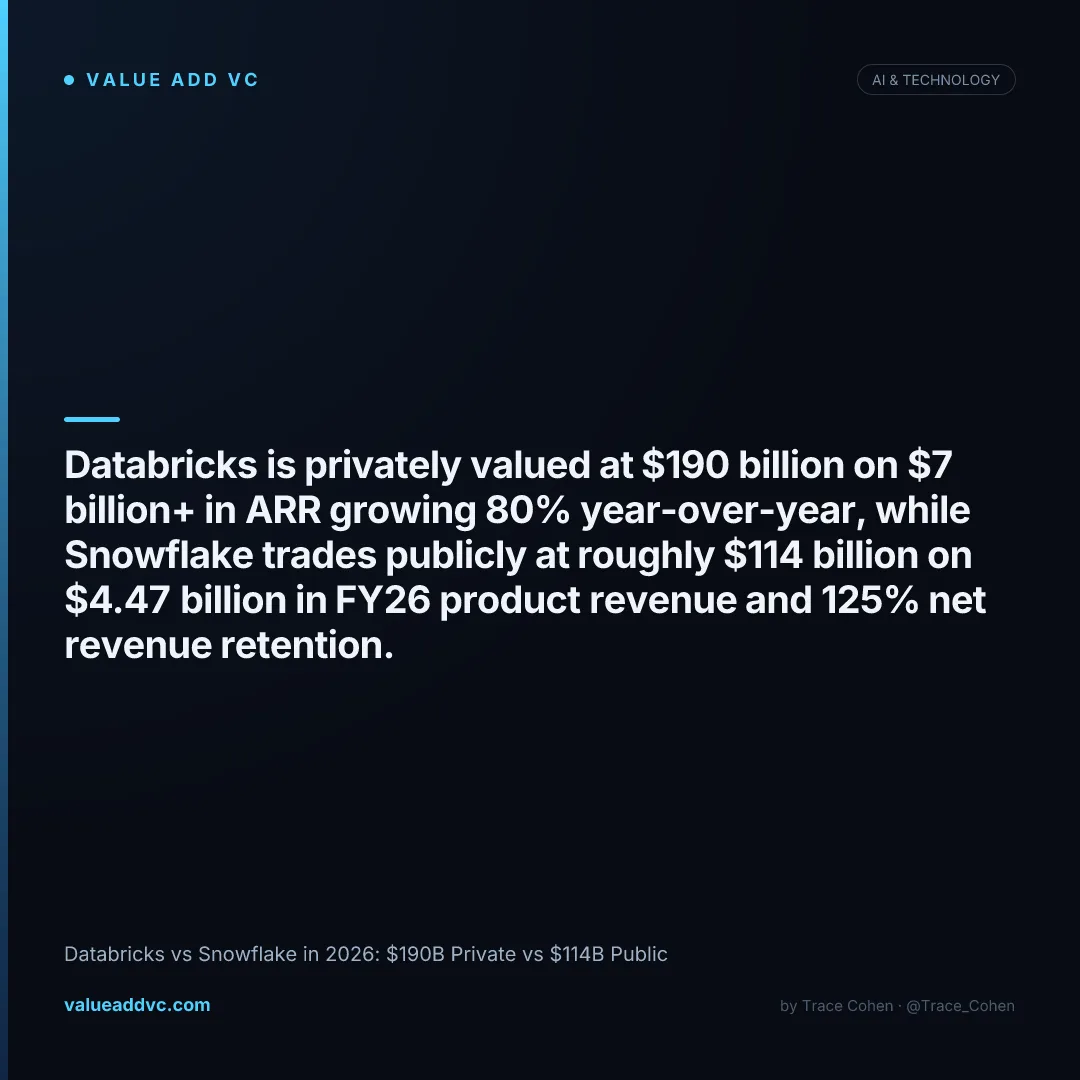
Databricks closed a $5 billion round on August 13, 2026 at a $190 billion valuation — still private, still unprofitable by most outside estimates, but growing revenue 80% year-over-year past a $7 billion run-rate. Snowflake, public since September 2020, trades at roughly a $114 billion market cap on $4.47 billion in FY26 product revenue and 125% net revenue retention. Same category, two very different bets, and picking wrong means re-platforming a data stack a year or two into using it.
Both companies started from opposite ends of the same problem. Snowflake built a fully managed, proprietary data cloud that made SQL analytics fast and simple for teams that didn't want to manage infrastructure. Databricks built an open lakehouse on top of Apache Spark that let data engineers and ML teams work directly with raw files in formats they control. In 2026, both are racing to own the AI layer on top of that foundation — Databricks with Mosaic AI and Genie, Snowflake with its Cortex AI suite — and the architectural gap between them is narrowing fast even as the financial gap between a still-private $190B company and a public $114B one stays wide.
Sources: Bloomberg, Databricks newsroom, Snowflake FY26 earnings release, stockanalysis.com, August 2026.
Databricks vs Snowflake: The Full 2026 Comparison
The numbers below come from each company's own disclosures and independent cost-benchmarking sites — Databricks doesn't file public financials since it hasn't IPO'd, so its figures rely on company press releases and reported funding-round terms rather than SEC filings.
| Category | Databricks | Snowflake |
|---|---|---|
| Company status | Private (no S-1 filed) | Public, NYSE: SNOW since Sept. 2020 |
| Valuation / market cap | $190B (Aug. 13, 2026 raise) | ~$114B (mid-Aug. 2026) |
| Revenue | $7B+ ARR, +80% YoY | $4.47B FY26 product rev., +30% YoY |
| Valuation-to-revenue multiple | ~27x ARR | ~25x FY26 product revenue |
| Core architecture | Open lakehouse, Delta Lake, open file formats | Managed proprietary cloud, separated storage/compute |
| Est. annual cost, mid-size team | ~$28,000/year | ~$36,000/year |
| Flagship AI product | Mosaic AI + Genie (AI-powered BI) | Cortex AI (LLM inference, vector search, doc AI) |
| Net revenue retention | Not publicly disclosed | 125% (FY26, no material decline) |
| Customers over $1M spend | Not publicly disclosed | 733 customers, +27% YoY |
| Total customers / Fortune 500 reach | 20,000+ customers, 60%+ of Fortune 500 | 13,300+ customers |
| IPO status | Not filed; CEO says not 2026 | Public since Sept. 16, 2020 |
Figures are August 2026 estimates blended from Databricks' newsroom, Bloomberg, Snowflake's Q4/FY26 earnings release, and stockanalysis.com. Cost-per-team estimates are third-party benchmarks (tech-insider.org, 2026) using self-serve list pricing; neither company publishes flat rate cards for enterprise deployments.
Databricks vs Snowflake: Valuation and Revenue ($B)
Bloomberg, Databricks newsroom, Snowflake FY26 earnings release, August 2026.
Databricks trades at a higher valuation on lower disclosed revenue because investors are pricing its 80% growth rate roughly 2.5x above Snowflake's 30%.
Why Databricks Is Worth More Than Snowflake Despite Less Revenue
Databricks' $190 billion price tag on $7 billion of ARR works out to roughly 27x revenue, while Snowflake's ~$114 billion market cap on $4.47 billion of FY26 product revenue is closer to 25x — similar multiples, but applied to very different growth rates. Databricks is compounding at 80% year-over-year; Snowflake, a decade into its life as a company, is growing product revenue around 30%. That growth-rate gap is the entire story behind why private investors will pay a similar multiple for a company with less absolute revenue: Databricks' own August 2026 growth disclosure came six months after a prior round that valued the company at $134 billion — a 42% valuation jump in half a year. For the full picture on how that valuation was built — funding history, product portfolio, and IPO timeline — see this Databricks company deep dive.
The round was led by Coatue Management with Blackstone, T. Rowe Price, Point72, and several other crossover investors participating — the same class of late-stage growth funds that historically waited for an S-1 before writing a check. Their willingness to price a private round at a premium to a comparable public company is itself a signal that they expect Databricks to either IPO at a higher multiple than Snowflake trades at today, or to keep compounding revenue fast enough to grow into the valuation privately.
Architecture: Open Lakehouse vs Managed Data Cloud
The real product difference has nothing to do with valuation. Databricks stores data in open formats — Delta Lake, Parquet — on cloud object storage you control, meaning you can point other tools directly at the same files without an export step. That openness is why data engineering and ML teams gravitate toward it: training a model or running a custom Spark job against raw files is native to the platform, not bolted on.
Snowflake is the opposite bet — a fully managed, proprietary data cloud with storage and compute cleanly separated, built so a SQL analyst never has to think about file formats, clusters, or partitioning. That abstraction is genuinely faster to stand up and easier to govern for a business intelligence team, which is why Snowflake's FY26 results show 733 customers now spending over $1 million a year with the platform, up 27% year-over-year, and 56 customers past $10 million in annual spend.
Cost estimates from independent benchmarking put a mid-size team's annual spend around $28,000 on Databricks versus $36,000 on Snowflake, with ETL workloads reported as up to 9x cheaper on Databricks in some published tests — but Snowflake counters with roughly 2x faster query performance on comparable analytics workloads in the same benchmarks. Neither number is the whole picture: a team running heavy nightly ETL pays the Databricks bill; a team running thousands of ad hoc dashboard queries a day pays the Snowflake bill, and the "cheaper" platform flips depending on which workload dominates.
The AI Race: Genie vs Cortex
Both companies are spending heavily to make AI a first-class feature rather than an add-on. Databricks' fresh $5 billion is earmarked specifically for Lakebase, Genie, and Unity AI Gateway — infrastructure the company is positioning as the backbone for deploying autonomous AI agents inside large enterprises, not just chatbots on top of existing dashboards. Genie lets business users query data in natural language and get back a governed SQL result, aimed squarely at closing Databricks' historical gap with Snowflake on ease of use for non-technical analysts.
Snowflake's answer is Cortex AI — a managed suite covering LLM inference, vector search, document processing, anomaly detection, and sentiment analysis, all running inside Snowflake's governed environment so data never has to leave the platform to hit an external model API. For a security- or compliance-sensitive enterprise, keeping inference inside the same governance boundary as the underlying data is a real advantage Cortex has over stitching together an external AI stack on top of Databricks' more open architecture.
What the Valuation Headlines Miss
A $190 billion private valuation is not a market price — it's the price one set of crossover investors agreed to pay for a slice of the company in a round Databricks controlled the terms of, with no public market forcing daily price discovery. Snowflake's $114 billion market cap, by contrast, is set fresh every trading day by anyone who wants to buy or sell shares. That's not a knock on Databricks' growth, which is real and well-documented, but the two numbers aren't measuring the same thing, and a "Databricks is worth more than Snowflake" headline glosses over the fact that only one of these companies has actually been tested by a public market that can also mark the price down.
Which One Should You Actually Pick?
Pick Databricks if your team is training or fine-tuning models, running heavy ETL and data engineering pipelines, or wants data stored in open formats you can move between vendors without lock-in — its lakehouse architecture and Mosaic AI stack are built model-first. Pick Snowflake if your primary workload is SQL-driven business intelligence for a broad set of business users, and you'd rather pay a premium for a fully managed platform with less infrastructure overhead and faster time-to-first-query. A five-person data team at a Series A startup building an AI product usually leans Databricks; a 200-person company standardizing BI and reporting across finance, sales, and ops usually leans Snowflake. Past Series B, many companies run both — Snowflake for governed reporting, Databricks for ML and data engineering — rather than treating the choice as exclusive.
For more on how Databricks' valuation and IPO timeline are shaping up, see our full Databricks valuation breakdown, or how the company's revenue actually gets generated in our Databricks business model explainer. You can track broader SaaS pricing trends on the SaaS Valuations dashboard at Value Add VC.
The bottom line:
Databricks wins on open architecture and AI/ML-native workloads; Snowflake wins on managed simplicity and governed analytics — the right pick depends on whether you're building models or running dashboards.
Explore more SaaS valuation and AI infrastructure coverage at Value Add VC. Originally published in the Trace Cohen newsletter.
Latest from the Pulse
Get VC data most people never see
— free to subscribe
Trace's notes on venture, AI and startups, a few times a week. Join 5,000+ subscribers. No spam.