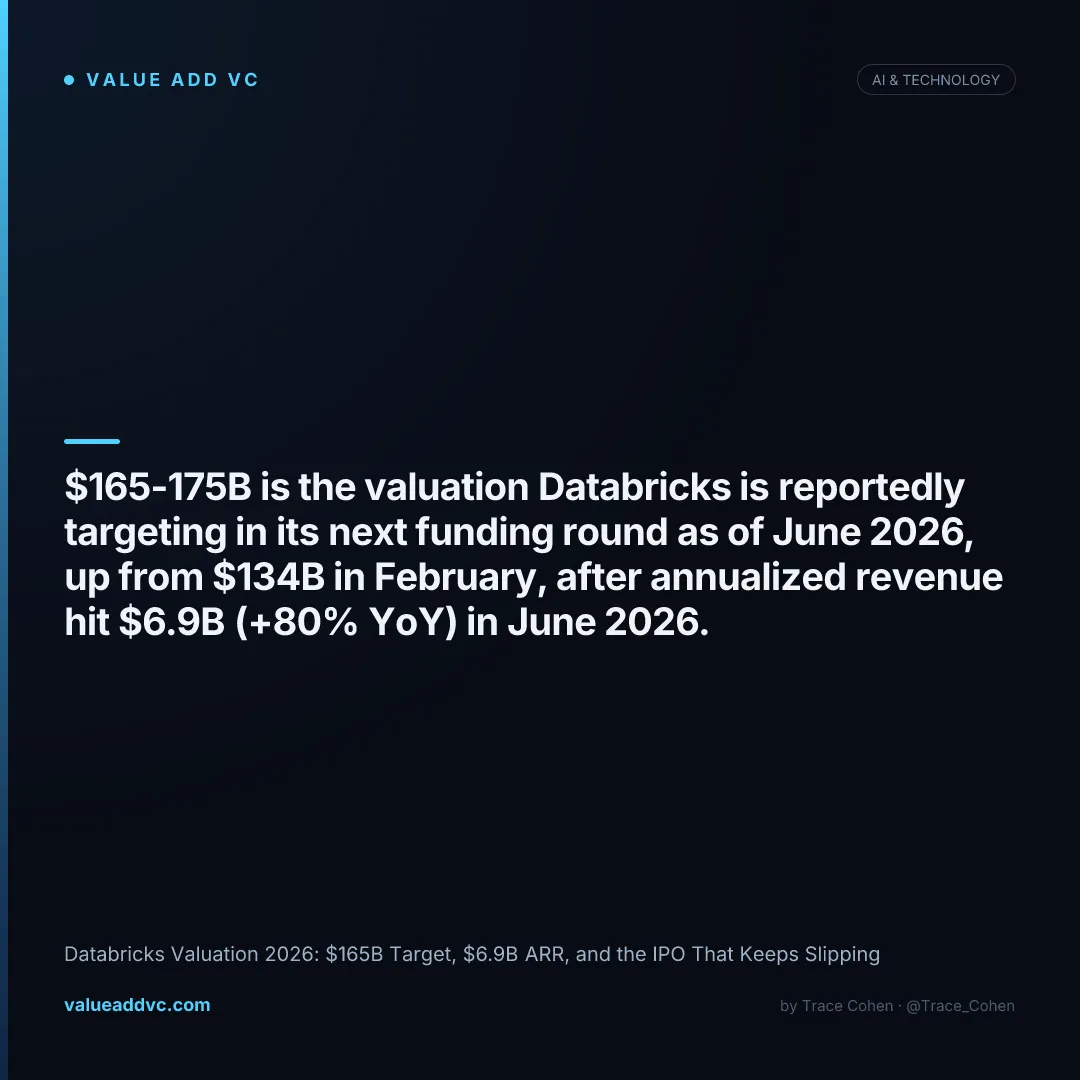
Databricks closed a $5 billion strategic round on August 13, 2026 at a $190 billion valuation — above the $165-175 billion it was reportedly targeting back in June, and up 42% from $134 billion just six months earlier — after annualized revenue crossed $7 billion, growing more than 80% year-over-year.
Databricks is now worth roughly 1.67x Snowflake's public market cap on broadly comparable revenue, has stayed free-cash-flow positive while doing it, and keeps pushing its long-rumored IPO further into the future even as every metric points toward one.
Updated September 28, 2026 with figures from Databricks' press release, Bloomberg, and CNBC coverage of the August 13, 2026 round close, Snowflake's September 2, 2026 earnings, and current secondary-market pricing.
Databricks Valuation 2026: The Complete Breakdown
Databricks' valuation in 2026 has moved in three fast steps: a $134 billion mark set in February on a $5 billion equity raise (plus $2 billion in added debt capacity), reports in June that the company was in talks for a new round targeting $165-175 billion, and then a $188 billion term sheet signed with Coatue in mid-July that ultimately closed on August 13 at a $190 billion valuation for a $5 billion strategic round. The jump tracks almost exactly with revenue acceleration — annualized revenue grew from $5.4 billion in February to $6.9 billion in June to a $7 billion-plus run rate by the August close, with year-over-year growth holding at roughly 80% even as the base nearly doubled.
For context on how private markets price AI-era software companies more broadly, see our breakdown of the 10 highest-valued private AI companies in 2026 and track live comps on the AI Valuations dashboard.
Founded in 2013 by the creators of the Apache Spark open-source project, Databricks spent its first decade positioned as infrastructure for data engineers — the pipes that move and process enterprise data before anyone builds an application on top of it. That positioning is exactly why the 2026 valuation surprises people who haven't followed the company closely: a business once thought of as unglamorous plumbing has become one of the largest AI infrastructure bets in venture history, second only to the foundation-model labs themselves in private-market size.
Databricks vs Snowflake: Comparing Valuation, Revenue, and Growth
The natural comparison for Databricks' valuation is Snowflake, the public data-cloud company it competes with head-to-head for enterprise data and AI workloads. On revenue the two are broadly comparable — Databricks' $7B+ run rate against Snowflake's $6.07B FY2027 product revenue guidance, raised when Snowflake reported Q2 fiscal 2027 earnings on September 2, 2026 (Q2 product revenue of $1.49B, up 37% year-over-year). On valuation, Databricks is worth far more: roughly $190B against Snowflake's roughly $118B public market cap as of late September 2026. That gap has held in a fairly narrow band since the summer — Snowflake's stock and its raised guidance both moved up modestly after its September earnings beat, while Databricks hasn't re-priced since its August 13 round, so the ratio between the two has stayed close to 1.6x rather than swinging sharply either way.
| Metric | Databricks | Snowflake |
|---|---|---|
| Valuation / market cap | $190B (closed Aug 13, 2026), up from $134B in Feb | ~$118B public market cap (Sep 28, 2026) |
| Annualized revenue | $7B+ (Aug 2026) | ~$6.07B FY2027 product revenue guidance (raised Sep 2, 2026) |
| YoY growth rate | 80%+ (Aug 2026) | 36% guided product growth |
| AI product revenue | $1.4B run rate (last disclosed, ~20% of ARR) | AI strategy still pivoting per reporting |
| Net dollar retention | 140%+ | ~125% (historically disclosed range) |
| Cash flow status | FCF-positive for full-year 2025 | Public, GAAP profitable on a non-GAAP basis |
| Public listing status | Private; no S-1 filed as of Aug 2026, IPO targeted late 2026 or 2027 | Public since 2020 IPO |
Figures are 2026 estimates blended from Databricks press releases, Bloomberg, CNBC, The Information, PYMNTS, and Snowflake public filings and investor materials, updated as of September 28, 2026. Databricks metrics are self-reported run-rate figures, not audited GAAP revenue.
What the Secondary Market Is Pricing Since the August Round
The clearest real-time signal on how investors expect an eventual Databricks IPO to price comes from secondary marketplaces, not press releases. Forge Global listed a Databricks share price of $268.50 as of September 27, 2026, and the Nasdaq Private Market listed $266.36 as of September 11, 2026 — both above the $253.00 per-share price set in the August 13 primary round. That gap suggests secondary buyers were marking the company modestly higher than its last official valuation heading into October, though Forge itself cautions its price is a derived estimate, not an executed market price, and neither figure should be read as confirmation of a new priced round. Databricks has not announced a new funding round since the August 13 close, and no dollar valuation above $190 billion has been confirmed by the company itself.
What's Actually Driving Databricks' 2026 Valuation Higher
Three things are pushing Databricks' valuation up faster than almost any other private software company: accelerating growth at massive scale, a real AI product line rather than a bolted-on feature, and capital discipline that lets it raise without burning through the proceeds.
Growth is re-accelerating, not decaying
80%+ YoY growth held through the August 2026 round even as the ARR base crossed $7B — unusual at that scale, where growth almost always slows
AI products are real revenue, not a narrative
$1.4B in AI product run rate (last disclosed) is now roughly 20% of the $7B+ ARR base. Lakebase alone, launched in June 2025, had already crossed a $100M run rate by the August 2026 disclosure
Data Warehousing is compounding fast
That segment alone crossed $1.5B ARR by June 2026, up from $1.0B in Q3 2025, and Databricks says it's still growing over 100% YoY as of its August disclosure
It doesn't need the cash
FCF-positive since full-year 2025 means every dollar raised goes to growth and secondary liquidity for early employees, not survival
Net dollar retention above 140% is the number that mattered most to the investors who wrote the $190B check. It means existing customers are increasing their Databricks spend by more than 40% a year on average, independent of new-logo growth — the same dynamic that let Snowflake command a premium multiple in its own early years as a public company, before its growth decelerated to the low-30s. Compare how multiples move with ARR scale on our SaaS valuation multiples by ARR range post.
The competitive backdrop matters too. Databricks is outrunning Snowflake while also fending off Google BigQuery, Microsoft Fabric, and Amazon Redshift, each backed by a hyperscaler with effectively unlimited capital and a captive cloud customer base. That Databricks keeps taking share from vendors with that kind of distribution advantage is itself a data point investors weigh heavily: it suggests the product, not the sales channel, is winning the deal.
Who Is Actually Backing the Databricks Valuation
The February 2026 round wasn't a niche syndicate — it was led by Insight Partners, Fidelity Management & Research, and J.P. Morgan Asset Management, with Andreessen Horowitz, BlackRock, Blackstone, Coatue, GIC, MGX, NEA, Ontario Teachers' Pension Plan, Robinhood Ventures, T. Rowe Price, Temasek, Thrive Capital, and Winslow Capital all participating. That roster looks more like a pre-IPO crossover book than a typical late-stage venture round, and it's exactly the kind of investor base that shows up in the final 12-18 months before a listing.
The demand side of that valuation is just as concrete. Databricks counts more than 20,000 customers, including adidas, AT&T, Bayer, Block, Mastercard, Rivian, and Unilever, and says over 60% of the Fortune 500 now run on its platform. More tellingly, over 700 of those customers each generate more than $1 million in annual revenue run-rate for Databricks — the cohort that drives the 140%+ net dollar retention and gives investors confidence the $7B+ ARR base keeps compounding without heroic new-logo growth. Total funding raised to date sits at roughly $25 billion after the August round — about $20.2 billion through February 2026 plus this $5 billion close — across 15+ rounds, making the two 2026 rounds alone worth more than a third of everything raised in the company's history.
What's Changed Since July: The $188B Term Sheet Became a $190B Close
The $165-175 billion figure this post originally tracked in June turned out to be a floor, not a ceiling. On July 16-17, 2026, Databricks signed a term sheet for a strategic round at a $188 billion valuation, led by existing investor Coatue putting in roughly $3 billion, with the company saying the round hadn't closed and additional investors would join. It did close — on August 13, 2026, at $190 billion for the full $5 billion, according to Databricks' own announcement and confirmed by Bloomberg and CNBC, with Blackstone, MGX, T. Rowe Price, and new investor Sixth Street Growth joining Coatue as the largest checks (full round breakdown here). New backers BOND, Clearlake Capital, Point72, Premji Invest, and TPG also joined, alongside repeat participants Andreessen Horowitz, Thrive Capital, Fidelity, Franklin Templeton, GIC, Insight Partners, J.P. Morgan Private Capital, NEA, Ontario Teachers' Pension Plan, Temasek, and Morgan Stanley Investment Management.
The revenue picture moved with it. Databricks disclosed a $7 billion-plus annualized run rate alongside the August close, up from $6.9 billion in June, with growth still holding above 80% year-over-year. This likely means the company is now compounding roughly $100 million of new annualized revenue every week — a pace that makes the roughly 27x revenue multiple embedded in the $190B mark look less stretched than the 39x multiple implied briefly at the $188B term-sheet stage on the lower $4.8B figure cited in some July reporting.
The round itself was oversubscribed by a wide margin. Ghodsi told reporters Databricks initially planned to raise just $1 billion, but investor demand reached roughly $15 billion — "the interest level was just insane," he said, according to TechCrunch. The company settled on $5 billion to limit dilution rather than take the larger check size on offer, a decision that itself signals confidence it won't need another round anytime soon.
Will Databricks IPO Before the Next Valuation Reset?
Databricks CEO Ali Ghodsi has said the company is in "IPO preparation mode," with a listing possible as soon as late 2026 — but he also told Bloomberg Television in June 2026 that this is "a terrible year" to go public, citing competition for investor attention from marquee listings like SpaceX. As of September 28, 2026, Databricks still has not filed an S-1, confidentially or publicly, and that combination of readiness and reluctance has defined its IPO story for three years running.
The practical effect is that Databricks keeps raising private capital instead — $5B in February 2026, $5B more closing in August — rather than testing public markets. Every private round at a higher price makes the eventual IPO a bigger, higher-stakes event, and raises the bar for what counts as a successful debut. Databricks' chief revenue officer has separately said the company is building toward a trillion-dollar valuation, which reads as another signal it is comfortable staying private for years rather than rushing a listing. Track how the broader IPO pipeline is shaping up on our Tech IPO tracker.
What the headline misses
A $190 billion mark on a $7 billion revenue base is still roughly 27x run-rate — rich by any traditional software standard, and it only holds together if 80%+ growth continues. Nearly all of Databricks' disclosed metrics (revenue, retention, AI product mix) are self-reported, not audited GAAP figures, so outside observers are underwriting the same numbers the company chooses to publish. And two multibillion-dollar private rounds inside of seven months is also a signal that early employees and seed-stage investors need liquidity that an IPO isn't yet providing — these rounds typically include a secondary component precisely because staying private this long creates its own pressure to let early holders sell.
Databricks added roughly $56 billion in valuation in six months without going public.
$190B closed, $7B+ in revenue growing 80%+ a year, and an IPO that still has no filing date as of September 28, 2026.
At some point the private markets run out of room to keep re-pricing a company this size. Until then, Databricks is proof that staying private longer is now a valuation strategy, not just a delay tactic.
Track live private-company valuations on the AI Valuations Dashboard and SaaS Valuations Dashboard at Value Add VC. Originally published in the Trace Cohen newsletter.
Latest from the Pulse
Get VC data most people never see
— 100% free
Weekly benchmarks, valuations, and fund data. Join 5,000+ investors. No spam.