
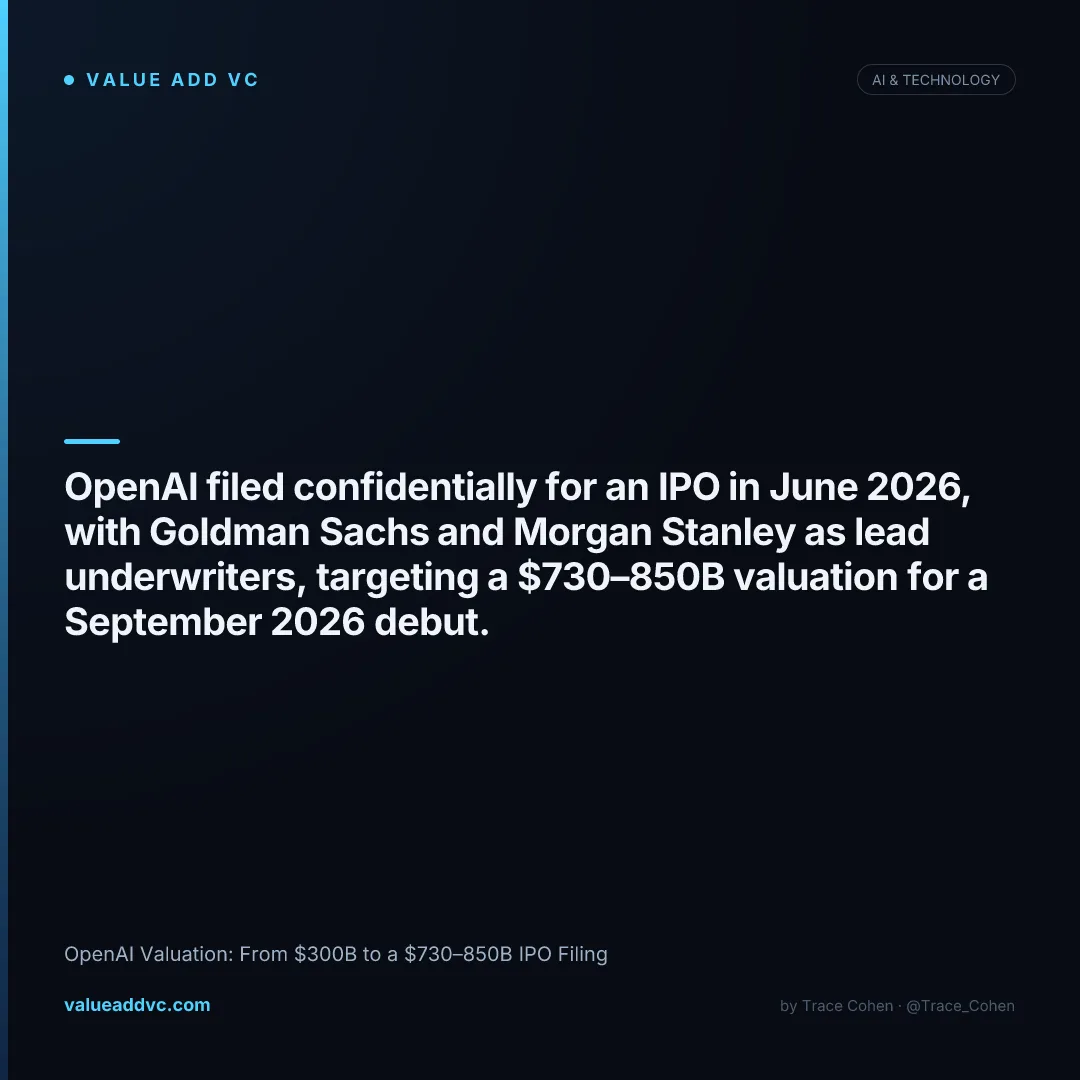
OpenAI filed confidentially for an IPO on June 8, 2026 — Goldman Sachs and Morgan Stanley leading — targeting a $730–850 billion valuation. On August 10, 2026 the company closed a $7 billion employee tender offer that reaffirmed its $852 billion price tag, while CFO Sarah Friar has since told associates OpenAI now leans toward a 2027 listing rather than the September 2026 debut once floated. The $300 billion post-money valuation from its March 2025 $40 billion round — the largest private tech funding round on record at the time — is now just a waypoint on the chart.
Annualized revenue topped $40 billion in July 2026 according to Bloomberg (up from ~$20B at the end of 2025, ~$6B in 2024, and ~$2B in 2023), and yet Anthropic's revenue run rate is still ahead at roughly $65B by the end of July 2026, on a $965B post-money valuation set by its May 2026 Series H. The rest of this post walks through how the $300B era was priced, what changed by mid-2026, and what the August 2026 tender and the 2027 IPO lean mean now.
OpenAI Valuation 2026: The 60-Second Breakdown
OpenAI was valued at $300 billion post-money when it raised $40 billion on March 31, 2025 in a primary round led by SoftBank, with Microsoft, Coatue, Altimeter, and Thrive Capital participating. That price was roughly 24x the $12.7B in revenue OpenAI expected for 2025, and nearly double the $157B post-money mark from October 2024. Six months later, in October 2025, a roughly $6.6 billion secondary share sale for employees priced the company at $500 billion. By March 2026 it had repriced far higher — to $852 billion via a $122B primary round — and filed confidentially for an IPO on June 8, 2026 targeting $730–850B. On August 10, 2026, a $7 billion employee tender offer reaffirmed the $852B price unchanged, even as the IPO timeline itself has slipped toward 2027. The breakdown below explains how that $300B mark was justified and what carried it forward.
How the $300B OpenAI Valuation Was Set
The $300B figure is a primary-round price: the post-money valuation of the $40 billion SoftBank-led financing OpenAI closed on March 31, 2025, which CNBC called the largest private tech funding round on record. It was new capital going onto the balance sheet, not employees selling existing shares. The employee liquidity came separately: a roughly $1.5 billion SoftBank tender in late 2024 priced to match the $157B round, and a secondary sale in October 2025 that OpenAI had authorized at up to $10.3 billion but that closed at about $6.6 billion, at a $500 billion valuation.
The valuation arc since 2019 tells the story better than any single number:
| Date | Valuation | Round Type | Lead Investor |
|---|---|---|---|
| Jul 2019 | Not disclosed | Microsoft strategic ($1B) | Microsoft |
| Apr 2023 | $27–29B | Tender offer (~$300M) | Sequoia/a16z/Thrive/K2 Global |
| Feb 2024 | $86B | Tender offer | Thrive Capital |
| Oct 2024 | $157B | Primary round ($6.6B raised) | Thrive Capital |
| Nov 2024 | $157B | Employee tender (~$1.5B) | SoftBank |
| Mar 2025 | $300B | Primary round ($40B raised) | SoftBank |
| Oct 2025 | $500B | Secondary share sale (~$6.6B of up to $10.3B authorized) | Thrive/SoftBank/Dragoneer/MGX/T. Rowe Price |
| Mar 2026 | $852B | Primary round ($122B raised) | SoftBank/a16z/MGX/TPG |
| Aug 10, 2026 | $852B (reaffirmed) | Employee tender ($7B, company-funded) | OpenAI (self-funded buyback) |
The AI-era curve alone, from the $27–29B tender in April 2023 to the $852B March 2026 round the August 2026 tender reaffirmed, is roughly a 29–32x increase in 35 months. The 2019 Microsoft deal did not come with a disclosed valuation, so the pre-ChatGPT starting point is left blank rather than estimated. Sources: Bloomberg (Feb 2024 tender), CNBC (Oct 2024 round), CNBC (Oct 2025 sale), TechCrunch (Aug 2026 tender).
Revenue Mix: From $13B to $40B+ ARR
When critics call OpenAI overvalued they usually focus on the multiple. But the underlying revenue mix has changed dramatically — and it's no longer just ChatGPT Plus subscriptions. The breakdown below is the last fully itemized run-rate snapshot (~$13B); the total has since roughly tripled to over $40B annualized by July 2026, per Bloomberg, with Codex and ChatGPT Work driving a growing share of the API and enterprise lines:
ChatGPT Plus consumer ($20/mo)
Estimated 23M+ paid subs
$5.5B
~42%
ChatGPT Pro ($200/mo)
Power users, researchers, devs
$1.8B
~14%
ChatGPT Team & Enterprise
4M+ paid business seats
$2.3B
~18%
API & developer platform
Growing fastest, lower margin
$2.9B
~22%
Other (Sora, agents, licensing)
Sora consumer + Operator
$0.5B
~4%
Consumer revenue (Plus + Pro + Team) is now ~74% of total — that's the highest consumer mix of any frontier AI company by a wide margin. More detail on revenue trajectory here.
OpenAI Valuation 2026 vs Anthropic, xAI, and the Frontier Peers
As of August 2026, OpenAI's revenue multiple is no longer the lowest in the cohort — Anthropic's faster revenue growth has pushed its multiple below OpenAI's even at a higher headline valuation. Compare like-for-like:
| Company | Valuation | ARR Estimate | Revenue Multiple | Lead Investor |
|---|---|---|---|---|
| OpenAI | $852B (Mar 2026 round; reaffirmed by Aug 2026 tender) | $40B+ (Jul 2026) | ~21x | SoftBank co-led with a16z, D.E. Shaw, MGX, TPG, T. Rowe Price; Aug tender was an OpenAI buyback |
| Anthropic | $965B (May 2026) | ~$65B (end-Jul 2026) | ~15x | Altimeter/Dragoneer/Greenoaks/Sequoia |
| xAI (acquired by SpaceX, Feb 2026) | $250B (merger value, Feb 2026) | Not disclosed | — | SpaceX (share-exchange merger) |
| Perplexity | $20B (Sep 2025) | ~$500M (Apr 2026) | ~40x | Not disclosed |
| Mistral AI | €11.7B / ~$13.8B (Sep 2025) | $400M+ (Feb 2026) | ~35x | ASML |
| Cohere | $7B (Sep 2025) | ~$240M (end-2025) | ~29x | Radical Ventures/Inovia |
| Cursor (Anysphere; acquired by SpaceX, Aug 2026) | $60B (acquisition, all-stock) | ~$4B (early Jun 2026) | ~15x | SpaceX (acquirer) |
Figures as of August 21, 2026; multiples are approximate, calculated as the latest disclosed valuation divided by the most recent reported annualized revenue, and because the revenue dates differ, older run rates overstate the multiple for fast growers. Sources: TechCrunch (OpenAI $122B round), TechCrunch (OpenAI Aug 2026 tender), Bloomberg (OpenAI run rate), CNBC (Anthropic run rate), CNBC (xAI merger value), TechCrunch (Perplexity $20B), The Information (Perplexity ARR), CNBC (Mistral Series C), Financial Times via PYMNTS (Mistral run rate), Cohere and CNBC (Cohere ARR), TechCrunch (Cursor deal close), Forbes (Cursor run rate). SpaceX's IPO filing reports xAI inside a combined AI segment that also includes X advertising and subscriptions, so no standalone xAI revenue figure is shown. Anthropic's Series H leads per Anthropic. ~21x is still reasonable next to public comps — Palantir at ~70x sales, CoreWeave at ~30x — but it's no longer the cheapest seat at the frontier table now that Anthropic's revenue has scaled faster. See the full peer breakdown on the AI Valuations dashboard.
What Justifies the OpenAI 2026 Valuation
The bull case rests on four specific data points, each of which justifies meaningful multiple expansion on its own:
1. Consumer scale is unprecedented
700M+ weekly active users — bigger than X (Twitter), bigger than Snapchat, approaching Instagram's 1.4B. No B2B SaaS company has ever matched this distribution.
2. Revenue growth is still doubling in months, not years
$3.7B (2024) → ~$20B run-rate (end of 2025) → $40B+ (July 2026, per Bloomberg). Most public AI companies grow 30-60% annually. OpenAI roughly doubled its run rate in about seven months, which is essentially unheard of at this scale.
3. Enterprise mix is accelerating
ChatGPT Enterprise + Team went from 1M paid seats (Q3 2024) to 4M+ (Q2 2026), with Codex and ChatGPT Work now contributing to the API/enterprise line. Net dollar retention reported above 130% on enterprise contracts.
4. Distribution moat compounds
ChatGPT.com is now the 8th most-visited site globally. Every API competitor still has to acquire users; OpenAI converts existing brand traffic at ~3% to paid.
The Bear Case Against the $852B OpenAI Valuation
The bear case is concrete and worth taking seriously — most private valuations at this scale collapse under one or two of these risks, and OpenAI has all four:
Cost of revenue
OpenAI reportedly burned $5B+ in 2024 against $3.7B revenue, and HSBC estimates a roughly $14B loss for 2026 even with revenue above $40B annualized. Compute costs are still rising faster than the gross margin on consumer subs.
Model commoditization
GPT-4 class models are now matched by Claude 4, Gemini 2.5, Llama, DeepSeek, and Grok. The differentiation is shifting from model quality to distribution and product — a much harder moat to maintain. See our analysis on why AI valuations are detached from revenue.
Microsoft entanglement
Microsoft held roughly 27% on an as-converted diluted basis after the October 2025 recapitalization and keeps Azure API exclusivity until AGI, which an independent expert panel must now verify. How that AGI clause is applied remains a key risk for public-market investors.
For-profit conversion risk
At the $300B round, SoftBank said its investment could be cut to as low as $20B if OpenAI did not restructure into a for-profit entity by the end of 2025. The October 2025 recapitalization into OpenAI Group PBC completed that step, but the unusual nonprofit-rooted governance is still something public-market investors will have to price.
Capex commitments dwarf revenue
OpenAI has committed to ~$500B in compute spending across the Stargate JV ($100B Phase 1, scaling to $500B), Oracle, CoreWeave, and Nvidia partnerships. Even against the July 2026 $40B+ run rate, that's still roughly 12x current ARR.
August 2026: The $7B Tender, and Why the IPO Now Leans 2027
OpenAI confidentially submitted its IPO prospectus to the SEC on June 8, 2026, without disclosing a listing date. Weeks later, the New York Times reported that the company was weighing two paths: list in 2026 at a lower valuation, or wait until 2027 for a shot at $1 trillion. CEO Sam Altman reportedly called any cut below $1 trillion a "nonstarter," and CFO Sarah Friar told employees at an August 19, 2026 all-hands that OpenAI "will be a public company in 2027," possibly sooner if the business keeps accelerating — a real change from the September 2026 window once discussed. On August 10, 2026, OpenAI closed a $7 billion tender offer, buying back employee and former-employee shares itself (rather than bringing in outside investors) at a price that reaffirmed the $852 billion valuation set by its March 2026 primary round, unchanged three-and-a-half months later. It followed two earlier employee liquidity rounds at rising prices: a roughly $1.5B SoftBank tender in late 2024 at the $157B round price, and a $6.6B secondary sale in October 2025 at $500B.
The sequence now looks like this:
A confidential S-1 is a step toward an IPO, not a commitment — OpenAI can still delay or withdraw it depending on market conditions. For retail investors wondering how to get exposure before then, options remain limited: the SpaceX pre-IPO playbook applies almost identically here — secondary marketplaces like Forge Global (where shares traded around $721.85 as of August 20, 2026) and EquityZen, accredited-only SPVs, and indirect exposure through Microsoft and SoftBank stock.
What the $852B OpenAI Valuation Means for VCs and Founders
Three implications matter most for anyone investing in or building AI right now:
- The frontier AI moat is now distribution, not model quality. OpenAI commands an $852B valuation because it has 700M users, not because GPT-5 is meaningfully better than Claude 4 or Gemini 2.5. Founders building AI startups should optimize for the user, not the benchmark — though the benchmark layer itself is now a real business: Arena, the crowdsourced leaderboard, raised a $200M Series B at a $3.1B valuation in October 2026 on exactly this model-commoditization trend.
- Roughly 15-21x ARR is the frontier ceiling at $500B+ scale, not the floor. Both OpenAI (~21x on $852B/$40B) and Anthropic (~15x on $965B/$65B) now sit in that band. AI startups doing $10M ARR at 100x multiples are repricing toward 30x as they grow — meaning growth has to outrun multiple compression. The same dynamic shows up well outside pure software: Genesis AI's reported $3B valuation talks price the robot-foundation-model startup at roughly 29x its year-old seed round, almost entirely on narrative rather than revenue.
- Capex commitments are the new dilution — track the numbers on the AI Spending dashboard. OpenAI committed $500B+ in compute against a $40B+ run rate as of July 2026 — still roughly 12x revenue. The capital intensity of frontier AI means even winners give up enormous equity — Microsoft held roughly 27% after the October 2025 recapitalization, and SoftBank's stake keeps growing. That dynamic doesn't exist in SaaS.
$852B reaffirmed by a $7B tender on August 10, 2026, on a ~21x multiple, is still one of the highest valuations ever set for a private company — though SpaceX's $1.25 trillion combination with xAI and Anthropic's $965B mark now sit above it, and it's no longer the cheapest multiple in frontier AI.
Both can be true. The remaining question is whether $1 trillion holds up once public markets get a vote in 2027.
Explore Related Dashboards
Interactive tools with live data on this topic
Track frontier AI valuations on the AI Valuations dashboard at Value Add VC. Originally published in the Trace Cohen newsletter.
Latest from the Pulse
Get VC data most people never see
— free to subscribe
Trace's notes on venture, AI and startups, a few times a week. Join 5,000+ subscribers. No spam.
No spam, unsubscribe anytime. Sent via Substack · Privacy · or subscribe on Substack ↗