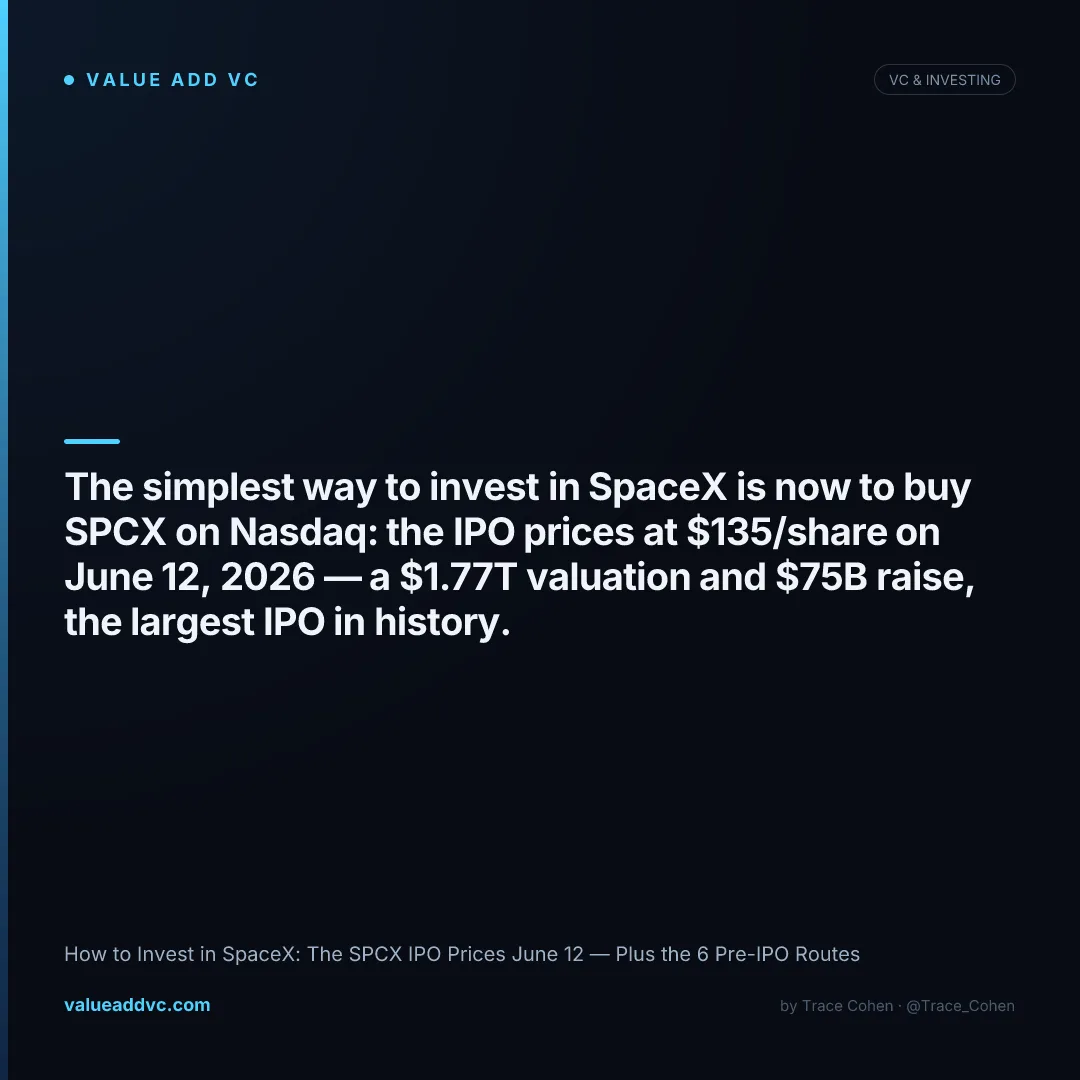
The era of SpaceX workarounds ends June 12, 2026: SPCX lists on Nasdaq at $135 per share — a $1.77 trillion valuation and $75B raise, the largest IPO in history.
Two of those paths require nothing but a brokerage account. Three require accredited-investor status and $20K–$100K minimums. The sixth — SPVs — can let you write smaller checks but layers on fees that can eat half your upside. Below is the full landscape with real numbers, not marketing copy. For a deep dive on the VC side, read how Founders Fund bet on SpaceX and the $60B+ VC return math.

How to invest in SpaceX before the IPO: the six options ranked
Six realistic options exist to buy SpaceX pre-IPO in 2026: Destiny Tech100 (DXYZ) at no minimum, ARK Venture Fund (ARKVX) at $500, EquityZen at $20K, Hiive at $25K–$100K, Forge Global at $100K, and SPVs at $25K–$50K with carry. DXYZ and ARKVX are the only paths open to non-accredited investors. Everything else requires meeting SEC Rule 501 — $200K annual income or $1M net worth excluding primary residence.
| Option | Minimum | Accredited Only? | Fees / Premium | SpaceX Exposure |
|---|---|---|---|---|
| Destiny Tech100 (DXYZ) | ~$30/share (1 share) | No | ~0.75% expense + 50–200% NAV premium | ~12% of fund NAV |
| ARK Venture Fund (ARKVX) | $500 | No | 2.75% expense, quarterly redemption at NAV | ~12% of fund NAV |
| EquityZen | $20,000 | Yes | 5% transaction fee + spread | Fund-of-fund / direct |
| Hiive | $25,000–$100,000 | Yes | 3% buyer fee + bid/ask spread | Direct shares |
| Forge Global | $100,000 | Yes | 5% buyer commission + spread | Direct shares |
| SPV / syndicate | $25,000–$50,000 | Yes | 1–2% mgmt fee + 10–20% carry | Pooled direct shares |
Option 1 — Destiny Tech100 (DXYZ): the only public ticker that owns SpaceX directly
Destiny Tech100 lists on NYSE under DXYZ and holds direct equity in roughly 24 private companies. SpaceX is the single largest position at approximately 12% of NAV as of mid-2026, followed by Stripe at ~9% and OpenAI at ~7%. Anyone with a brokerage account at Fidelity, Schwab, Robinhood, or Interactive Brokers can buy a single share for around $30 — no accreditation, no minimum, no paperwork.
The catch is the premium. DXYZ is a closed-end fund, meaning its market price floats independently of NAV. Since launch in March 2024 it has traded between 75% and 800% above its disclosed NAV. As of June 2026, the premium sits near 100% — meaning $1.00 of DXYZ buys you about $0.50 of actual underlying private equity. Apply that to the 12% SpaceX weighting and your effective entry valuation is closer to $700B, double the last primary round.
Use DXYZ when: you want symbolic exposure with no minimum and accept paying the NAV premium for liquidity and SEC-registered convenience. Skip DXYZ when: the premium is above 100% — at that point, you're paying more than the IPO is likely to deliver.
Option 2 — ARK Venture Fund (ARKVX): $500 minimum, NAV redemptions, the cleanest retail vehicle
ARKVX is a non-traded interval fund managed by Cathie Wood's ARK Invest. Anyone — accredited or not — can buy through SoFi, Titan, or directly via ARK at a $500 minimum. Unlike DXYZ, ARKVX prices at NAV daily and offers quarterly redemptions, so you don't pay a structural premium to enter.
SpaceX is also ARKVX's top position at roughly 12% of NAV as of Q1 2026, alongside OpenAI (~9%), Anthropic (~6%), Epic Games (~4%), and dozens of smaller private tech holdings. Expense ratio is 2.75%, which is high for an ETF but standard for an interval fund holding illiquid private equity.
Use ARKVX when: you want diversified private tech exposure including SpaceX at NAV without accreditation or a 6-figure check. Limitation: redemptions are capped quarterly at 5% of fund assets — if everyone redeems at once you can be gated for several quarters.
Option 3 — Forge Global, Hiive, EquityZen: how secondary marketplaces actually work for SpaceX
The three major secondary platforms all require accredited-investor status and offer direct SpaceX share purchases, but with different mechanics. Forge Global is the oldest (founded 2014) and typically requires $100K minimum per transaction with a 5% buyer commission. Hiive launched in 2021 and runs a price-discovery auction model with $25K–$100K minimums and a 3% buyer fee. EquityZen offers $20K-minimum fund-of-fund access that pools investors into single-company SPVs, charging 5% transaction fees plus carry.
In June 2026, Forge SpaceX bids cluster around $325–$345 per share. Hiive listings have shown $330–$360. EquityZen's SpaceX SPV last closed at an implied $440B valuation. All three platforms hold shares in a custody account (typically Forge Trust, Carta, or AST) and you receive a beneficial interest, not direct certificates — meaning SpaceX itself approves each transfer through its Right of First Refusal process.
Expected timeline from bid acceptance to settled position: 4–10 weeks. SpaceX rejects roughly 15–25% of transfer requests through ROFR, which means your committed capital can be tied up before being returned. Plan for that.
Option 4 — SPVs: pooled syndicates for $25K–$50K checks (with fees that matter)
Special purpose vehicles let a sponsor — typically a venture investor or wealth platform — buy a large block of SpaceX shares from an employee or early investor and then sell fractional units to LPs. Typical SPV terms in 2026: $25K–$50K minimum, 1–2% annual management fee, 10–20% carry on gains, 5–10 year hold.
Run the math. If you commit $25,000 to a SpaceX SPV at $440B valuation and SpaceX IPOs at $700B (59% upside), you make $14,750 gross. After a 2% annual fee over 3 years (~$1,500) and 20% carry on the gain (~$2,950), you net ~$10,300 — a 41% net return instead of 59% gross. Below a 30% IPO premium, fees consume the majority of upside.
Major SpaceX SPV sponsors in 2026 include Manhattan Venture Partners, Setter Capital, ApeX Money, AngelList Roll-Up Vehicles, and dozens of private wealth platforms. Always verify the underlying entry valuation, fee structure, and whether shares are common, preferred, or LP interests in a multi-layered structure — fee stacking across multiple SPVs is the most common trap.
Option 5 — Public proxies: how much SpaceX exposure each one actually gives you
If you want to invest in SpaceX before the IPO without accreditation and without the DXYZ premium, several publicly traded companies have direct or competitive exposure. These are imperfect proxies — but they're tradeable in any brokerage account today.
Direct competitor in small-launch and now medium-launch (Neutron); not SpaceX exposure but space-launch beta.
ULA joint venture partner — competes with SpaceX on national security launches; inverse correlation to SpaceX growth.
Other half of ULA; Starliner program has lost market share to SpaceX Crew Dragon. Negative exposure.
Satellite communications; partially competes with Starlink in maritime/aviation.
Direct Starlink competitor in satellite broadband; mostly negative beta to SpaceX success.
Provides Apple's iPhone satellite service. Indirect Starlink Direct-to-Cell competitor.
None of these are SpaceX. RKLB is the closest behavioral proxy because both companies pull capital from the same launch-services thesis. Most other tickers are inversely correlated — when SpaceX wins, they lose. Use proxies as theme exposure, not as a substitute for actual SpaceX equity.
Why investing in SpaceX before the IPO is harder than it looks
Three structural realities make pre-IPO SpaceX investing much less attractive than the marketing implies. First, SpaceX exercises Right of First Refusal on essentially every secondary transfer. They reject 15–25% of attempted transfers, especially to buyers without an existing relationship. Your committed capital sits in escrow for 4–10 weeks during ROFR review.
Second, lockups extend the hold further. Even if SpaceX IPOs in 2027, employees and existing shareholders face standard 180-day post-IPO lockups. Secondary buyers who bought through SPVs may face additional contractual restrictions of 270–365 days. From check write to liquidity, plan on 18–36 months minimum.
Third, you're buying at peak narrative. The last primary round priced SpaceX at $350B in late 2024. Mid-2026 secondaries trade at $400–460B — a 14–31% premium to that round. For an IPO to deliver meaningful upside, SpaceX would need to list at $550B+. That's possible — Starlink alone is plausibly worth $200–250B at scale (see the Starlink IPO timeline) — but it's no longer the asymmetric bet it was in 2020 at $46B. Track all upcoming offerings on the Tech IPO dashboard.
SpaceX revenue, Starlink, and what justifies the $400B+ secondary price
The numbers that drive SpaceX's valuation: $14.2B in 2024 revenue, growing to an estimated $19–22B in 2025. Starlink alone moved from $4.2B in 2023 to ~$9B in 2024 to a projected $12–15B in 2025, with 5.5M+ subscribers globally as of mid-2026. The Falcon 9 fleet flew 134 missions in 2024 and is on pace for 170+ in 2026 — more than every other country combined.
Headcount sits at ~13,000–14,000. Free cash flow turned positive in late 2023 and Starlink is generating cash at the segment level. Direct-to-Cell partnerships with T-Mobile, Optus, KDDI, and others have already onboarded over 350M total subscriber positions for emergency-text service, with full data rollout starting in 2026.
At $400B today on roughly $20B run-rate revenue, SpaceX trades at ~20x revenue. By comparison, RKLB trades at ~12x, LMT at ~1.8x, and BA at ~1.4x. The premium reflects Starlink's terminal value, not the launch business. If Starlink can hit $25B in revenue at 30% margins by 2028, a $700B IPO is justifiable. Below that scenario, you're betting on multiple expansion rather than fundamentals.
The fee math: what each path actually costs over 3 years
Comparing $10,000 invested in each option, assuming SpaceX IPOs in 2027 with 35% appreciation from current secondary prices to listing price, then another 20% in the first 90 days post-lockup.
| Path | Gross Return | Fees Over 3yr | Net Return on $10K |
|---|---|---|---|
| DXYZ (100% premium) | +62% | ~2% expense + premium compression risk | ~$3,000–8,000 (premium can collapse) |
| ARKVX | +62% | ~$825 (2.75% × 3yr) | ~$5,375 |
| Hiive direct shares | +62% | $300 buyer fee, no carry | ~$5,900 |
| Forge direct shares | +62% | $500 buyer fee, no carry | ~$5,700 |
| SPV (1.5% + 15% carry) | +62% | $450 mgmt + $930 carry | ~$4,820 |
Direct purchases on Hiive and Forge come out best on a fee-adjusted basis if you can meet the minimums. ARKVX is the best path under $25K. SPVs lose ~$1,000 on a $10K position to fees alone in this scenario — and that's before considering they typically require larger checks. DXYZ is wild card: if the NAV premium contracts during the IPO process (which historically happens as private holdings revalue), you can lose the entire SpaceX upside to multiple compression.
Net return on a $10,000 SpaceX position, after 3 years of fees
Source: fee terms and minimums as disclosed by DXYZ, ARK Invest, Hiive, Forge Global, and typical 2026 SPV terms; scenario assumes 62% gross appreciation.
What to do if you're not accredited
Non-accredited investors — meaning under $200K annual income or $1M net worth excluding primary residence — have two legitimate paths: ARKVX at $500 minimum and DXYZ at any share count. Skip everything else. The "SpaceX investment opportunities" promoted on Reddit, Telegram, and via cold DMs to non-accredited buyers are almost always either fraud, layered SPV structures with terrible economics, or unregistered securities that violate SEC rules and create personal legal exposure for the seller.
The accreditation rule exists for a reason: pre-IPO investments are illiquid, often opaque, and frequently mispriced. If you're not accredited, your best path is ARKVX, then waiting for the actual IPO when the float, price, and lockup are public and standardized.
The cleanest paths to invest in SpaceX before the IPO in 2026:
ARKVX at $500 for everyone, Hiive at $25K for accredited buyers, and patience for everyone else.
Track the IPO timeline and valuation movements on the SpaceX IPO Dashboard.
Explore Related Dashboards
Interactive tools with live data on this topic
Live SpaceX valuation and Starlink subscriber data live on the SpaceX IPO tracker and the Tech IPO Dashboard at Value Add VC. Originally published in the Trace Cohen newsletter.
Get VC data most people never see — free.
Weekly benchmarks, valuations, and fund data. No spam, unsubscribe anytime.